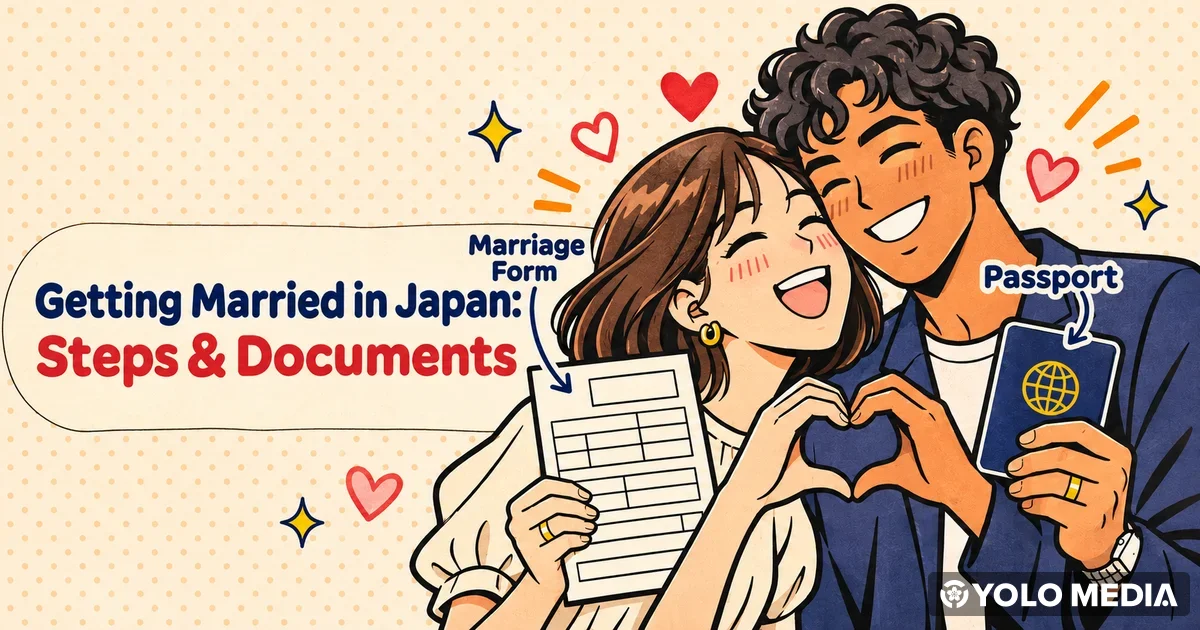
You live in Japan, and you and your partner have decided to get married. Congratulations! But right after the excitement, a lot of us stop and wonder: “So what do we actually file, and where?” Whether you are marrying a Japanese citizen, someone from your own country, or someone from a third country, marrying under Japanese procedure means submitting a marriage registration form (konin todoke) to a city, ward, town or village office. And the non-Japanese partner is asked for documents that Japanese citizens do not need.
In this guide, we walk through the process of getting married in Japan in order: choosing which country’s procedure to use, the documents you need, how to file the marriage registration, and what to do after you are married. Many of the document names are hard to understand, so we explain each one when it first appears.
This article is for informational purposes only and does not constitute legal advice. The documents you need depend on your partner’s nationality and on the office where you file. Before you start, always check with the municipal office where you plan to file and with the embassy or consulate of your home country.
How You Get Married Depends on Which Country’s Procedure You Use
The first thing to decide is whether you marry under Japanese procedure or under another country’s procedure. Japan’s Ministry of Justice distinguishes the two as a “Japanese-form marriage” and a “marriage under another country’s law.”
In a Japanese-form marriage, you submit the marriage registration to the family register (koseki) counter of a Japanese municipal office. If the office confirms that both of you meet the requirements to marry and accepts the registration (formally receives it), the marriage takes effect at that moment. This method is available for a Japanese and non-Japanese couple, and also for two non-Japanese partners marrying in Japan.
On the other hand, sometimes the marriage has already taken effect under another country’s law, for example when you completed the marriage procedure in your partner’s country. In that case, the Japanese partner must submit a copy of the marriage certificate issued by that country, with a Japanese translation, within 3 months of the date the marriage took effect. It goes to a Japanese embassy or consulate, or to the office of their registered domicile (honseki-chi, the place where their family register is kept).
Here are the three patterns in a table.
| Pattern | When the marriage takes effect | Filing with a Japanese office |
|---|---|---|
| Marrying in Japan under Japanese procedure | When the marriage registration is accepted | Submit the marriage registration (the focus of this article) |
| Married first under another country’s procedure (one partner is Japanese) | When it takes effect under that country’s law | Submit a copy of the marriage certificate and a Japanese translation within 3 months |
| Two non-Japanese partners married at their country’s embassy or consulate in Japan | When it takes effect under their country’s procedure | No filing with a Japanese office is needed |
On the third pattern, the Ministry of Justice explains that when non-Japanese nationals register their marriage at their country’s embassy or consulate in Japan, under that country’s procedure, no filing with a Japanese family register counter is needed. In the other direction, a Japanese and non-Japanese couple cannot file a marriage registration at a Japanese embassy or consulate overseas.
If you live in Japan and are getting married here, in most cases you will use the first pattern, Japanese procedure. The rest of this article focuses on it.
A wedding ceremony alone does not make you legally married. The Ministry of Justice explains that, as with a ceremony at a church in Japan or Hawaii, a ceremony by itself may not create a legally valid marriage. Think of the ceremony date and the date you submit the marriage registration as two separate things.
(Source: Ministry of Justice, "Family Register Q&A on International Marriage, Births Abroad, etc." (Japanese))
Requirements to Check Before You File the Marriage Registration
When you marry under Japanese procedure, both partners must meet the requirements to marry. This is where international marriage gets a little complicated.
For the Japanese partner, the office checks the requirements under Japanese law. Osaka City lists these three requirements for marriage:
- Being 18 or older
- Not being in a bigamous marriage (marrying again while already married)
- Not being close relatives (such as parent and child, siblings, or an aunt or uncle)
For the non-Japanese partner, the office checks whether they meet the requirements for marriage set by the law of their home country (such as having reached the legal age to marry and being single). The office confirms this before accepting the marriage registration.
If you are remarrying after a divorce, there is something else worth knowing. Japanese law used to have a rule that only women could not remarry for a set period after a divorce (the remarriage prohibition period). It was abolished by an amendment to the Civil Code that took effect on April 1, 2024.
However, this is about Japanese law. Whether your home country’s law has a similar rule depends on the country. Check your own country’s rules with its embassy or consulate.
(Source: Osaka City, "Marriage Registration" (Japanese) / Ministry of Justice, "Family Register Q&A on International Marriage, Births Abroad, etc." (Japanese) / Ministry of Justice, "On the Act Partially Amending the Civil Code, etc." (Japanese))
Documents You Need for an International Marriage
The Japanese partner and the non-Japanese partner need different documents. The list also changes depending on the office and your partner’s nationality, so here we have gathered commonly requested documents based on the guidance of Yokohama and Nagoya. The birth certificate and written statement come from Yokohama City’s guidance.
| Document | Who prepares it | What it is |
|---|---|---|
| Marriage registration form (konin todoke) | Both partners | Available at the municipal office counter. Requires signatures from two adult witnesses (age 18 or older) |
| ID | The person filing | My Number Card, driver’s license, passport, etc. |
| Certificate of legal capacity to marry (kon’in yoken gubi shomeisho) | Non-Japanese partner | A document from your country’s embassy or similar authority certifying that you can marry under your home country’s law |
| Proof of nationality or passport | Non-Japanese partner | Something that shows your nationality |
| Japanese translation | Non-Japanese partner | Needed for documents written in other languages. Write the translator’s name |
| Birth certificate, written statement, etc. | Non-Japanese partner (depends on country) | May be requested depending on the country and the office |
On the Japanese side, until recently it was common to attach a family register transcript (koseki tohon, a copy of the family register) to the marriage registration. Kita Ward in Osaka City says that from March 1, 2024, the Japanese partner’s family register transcript is no longer needed when filing the marriage registration. However, the form still requires the correct registered domicile and the name of the head of the family register (the first person listed in it), so if you are not sure, check first with something like a certificate of residence (juminhyo) that shows the registered domicile.
(Source: Yokohama City, "Marriage Registration" (Japanese) / Nagoya City, "Procedure for marrying a non-Japanese national" (Japanese) / Osaka City Kita Ward, "For Those Marrying a U.S. Citizen" (Japanese) / e-Gov, "Civil Code" (Japanese))
What Is a Certificate of Legal Capacity to Marry?
This is the document that sets an international marriage apart from a marriage between two Japanese citizens. The certificate of legal capacity to marry (often called a certificate of no impediment) is a document in which an authorized official of the non-Japanese partner’s home country, such as its ambassador, minister or consul, certifies that the person meets the requirements for that marriage under their home country’s law.
Kita Ward in Osaka City’s guidance for U.S. citizens writes this document as “certificate of legal capacity to marry (certificate of single status).”
Where and how you get it depends on your country. Nagoya City also advises asking each country’s embassy or consulate about this certificate. Start by looking for a “marriage” page on your embassy’s website, or give them a call.
(Source: Ministry of Justice, "Family Register Q&A on International Marriage, Births Abroad, etc." (Japanese) / Osaka City Kita Ward, "For Those Marrying a U.S. Citizen" (Japanese) / Nagoya City, "Procedure for marrying a non-Japanese national" (Japanese))
If Your Country Does Not Issue This Certificate
Some countries do not have a system for issuing this certificate. In that case, the Ministry of Justice explains that you submit alternative documents.
- A sworn statement signed by your country’s consul in Japan, after you swear in front of the consul that you have reached the legal age to marry and that there is no legal obstacle (a Japanese translation is required). This may be accepted in place of the certificate
- If you cannot submit that either, a copy of your home country’s law (with its source and a Japanese translation), plus identity documents issued by your country’s public authorities, such as your passport, nationality certificate or birth certificate (each with a Japanese translation)
Country rules can change, too. For example, Kita Ward in Osaka City says that from September 1, 2025, the U.S. Embassy in Tokyo and U.S. consulates stopped notarizing (formally certifying a document at the embassy) the certificate of legal capacity to marry (certificate of single status) for U.S. citizens. The same page lists examples of required documents such as a certificate of legal capacity to marry issued by authorities in the United States and a sworn affidavit authenticated by a notary public in a U.S. state (a document swearing that you are single and have no legal obstacle to marriage). It also asks you to get an apostille (a system where a government certifies that a document is genuine) for the affidavit whenever possible.
If you rely only on experiences posted online a few years ago, you will miss changes like this. Always check the latest guidance from your embassy and the municipal office.
(Source: Ministry of Justice, "Family Register Q&A on International Marriage, Births Abroad, etc." (Japanese) / Osaka City Kita Ward, "For Those Marrying a U.S. Citizen" (Japanese))
Rules for Japanese Translations
When you submit documents in other languages, you must attach a Japanese translation to every one of them and write who translated it. The Ministry of Justice explains that the translator can be you.
Kita Ward in Osaka City says there is no set format for the translation, but each translation must show the translation date, the translator’s name and the translator’s address, and you should not write directly on the original. A Japanese translation of the passport copy is also listed as necessary.
Even if your partner, who is good at Japanese, does the translation, the name you write as translator is the person who actually translated it. Some offices have detailed format rules, so it helps to ask at the counter whether they have a sample before you write.
(Source: Ministry of Justice, "Family Register Q&A on International Marriage, Births Abroad, etc." (Japanese) / Osaka City Kita Ward, "For Those Marrying a U.S. Citizen" (Japanese))
How to File the Marriage Registration in 5 Steps
Once your documents are ready, it is finally time for the marriage registration. Here is the process in five steps.
Step 1: Ask Your Embassy or Consulate Which Documents You Need
The first thing to do is confirm the non-Japanese partner’s documents. Ask your embassy or consulate how to get the certificate of legal capacity to marry, whether you need an appointment, and how long it takes. In some countries, preparation can take time, so if you already have a wedding date in mind, get started early.
Step 2: Choose the Office and Get the Marriage Registration Form
You can file the marriage registration at the municipal office of either partner’s registered domicile, or of the place where either partner is located (shozaichi, where you are now, usually where you live). Non-Japanese nationals do not have a Japanese family register, so you will file at the office of the Japanese partner’s registered domicile, or of the place where either of you is located.
You can get the marriage registration form at the municipal office counter. Some municipalities also let you download it from their website. Osaka City says that if you download it, you must print it on plain white A3 paper, and it does not accept forms such as two A4 sheets taped together.
(Source: Ministry of Justice, "Marriage Registration" (Japanese) / Yokohama City, "Marriage Registration" (Japanese) / Osaka City, "Marriage Registration" (Japanese))
Step 3: Fill In the Form and Get Two Witnesses to Sign
The marriage registration requires signatures from two adult witnesses. A seal (hanko) is optional. Nagoya City explains that a witness can be anyone other than the two of you, as long as they are an adult who knows about the marriage. Friends and family both work.
If you have not been in Japan long, you might get stuck here wondering who to ask. The condition is “an adult who knows about the marriage,” so you can also ask a coworker. Each witness must sign the form personally, so talk to them early.
(Source: Ministry of Justice, "Marriage Registration" (Japanese) / Nagoya City, "How to fill in the witness section of the marriage registration" (Japanese))
Step 4: If Possible, Have the Counter Check Your Documents in Advance
For an international marriage, the office checks documents from another country. Kita Ward in Osaka City’s guidance for U.S. citizens says that checks can take time and the registration may not be accepted on the same day, so it recommends coming to the ward office for a preliminary review once your documents are ready or once you have filled in the form.
Especially if you want to file on a special date, having the counter look at your papers once beforehand makes it easier to avoid finding out on the day that a document is missing.
(Source: Osaka City Kita Ward, "For Those Marrying a U.S. Citizen" (Japanese))
Step 5: Submit the Marriage Registration
There is no deadline for submitting the marriage registration. Yokohama City says that the date you file becomes the date the marriage takes effect.
Some municipalities let you file even when the office is closed. Nagoya City, for example, says you can file 24 hours a day, 365 days a year, but forms submitted outside opening hours are held at the security office, and the contents are checked during the next opening hours before the registration is formally accepted. If anything is missing, you may have to come back another day.
In Yokohama and Nagoya, a marriage registration filed at night or on a holiday is first “held.” Yokohama City says it is checked on or after the next business day and, if there are no problems, accepted retroactively as of the day you filed. If something is wrong with the form, it may not be accepted as of the day you filed, or you may have to come back to the office. Nagoya City asks you to write a phone number where you can be reached during weekday daytime hours.
After the marriage registration is accepted, if you need a document proving the marriage, the office can issue a “certificate of acceptance” (juri shomeisho, proof that the registration was accepted). Yokohama City says that for registrations filed at night or on holidays, when certificates such as the certificate of acceptance can be issued depends on the type of certificate and on where your address and registered domicile are. If you need one urgently, check with the office where you will file.
(Source: Yokohama City, "Marriage Registration" (Japanese) / Nagoya City, "Procedure for marrying a non-Japanese national" (Japanese))
What to Do After You Get Married
Your work is not quite done once the marriage registration is accepted. With an international marriage, there are a few more procedures afterward. Not all of them apply to everyone, so pick the ones that are relevant to you.
Reporting the Marriage to Your Home Country
If you married under Japanese procedure, some countries require you to report the marriage to them as well. Kita Ward in Osaka City advises U.S. citizens to file a report with the United States once a Japanese-form marriage has taken effect. The procedure differs by country, so ask your embassy or consulate.
(Source: Osaka City Kita Ward, "For Those Marrying a U.S. Citizen" (Japanese))
If Your Name Changes, Update Your Residence Card (Within 14 Days)
If the non-Japanese partner’s name changes through their home country’s procedure, they must file a notification to change the information on their Residence Card (Zairyu Card). The deadline is within 14 days of the change. You file at the regional immigration services office that covers the area where you live, and there is no fee.
For a name change due to marriage, the Immigration Services Agency lists a passport showing the new name and a marriage certificate (or, if you married a Japanese citizen, a family register transcript) as the documents to submit. It also says that if you have not updated your passport first, the new card may not be issued on the same day.
(Source: Immigration Services Agency, "Notification of Changes to Residence Card Entries Other Than Place of Residence" (Japanese))
The Japanese Partner’s Surname and Family Register
When a Japanese citizen marries a non-Japanese national, the Japanese partner’s surname does not change automatically. If they want to take the non-Japanese spouse’s surname, they can do so simply by filing a surname change notification at the municipal office within 6 months of the marriage. After 6 months, permission from the family court is required.
Also, no Japanese family register is created for the non-Japanese partner, but the Japanese spouse’s family register records the fact of the marriage along with the non-Japanese partner’s name, date of birth and nationality.
(Source: Ministry of Justice, "Family Register Q&A on International Marriage, Births Abroad, etc." (Japanese))
Address, Insurance and Other Procedures
The marriage registration is a family register procedure, not a change of address. If you move to live together after getting married, you need to file a change of address for your certificate of residence separately from the marriage registration. Osaka City notes that address changes cannot be accepted at the night and holiday counter, so do them during opening hours.
If you’re looking for a place to live together, try YOLO HOME, YOLO JAPAN’s real estate site. You can search rental apartments in multiple languages, and it supports you through confusing rental contracts in Japanese and 11 other languages.
We explain how to get a certificate of residence in detail in How to Get a Juminhyo in Japan.
 Living in Japan
How to Get a Juminhyo in Japan: Certificate of Residence
Need a juminhyo in Japan? Compare the four ways to get one, what each costs, whether your residence status appears, and …
Read related article
In addition, Teine Ward in Sapporo City lists procedures like these that may be needed when you marry, depending on your situation:
- If your surname changes and you have a My Number Card, updating the information on the card
- If you are in National Health Insurance (NHI) and the head of household or your name changes, or if you become a dependent (someone supported by a family member’s income) on another health insurance plan
- If you become a Category 3 insured person in the National Pension (Kokumin Nenkin) system, a procedure through your spouse’s employer
For the My Number Card, see also How to Get a My Number Card. The names of procedures and counters vary by municipality, so the quickest way is to ask at the counter when you file the marriage registration: “Are there any other procedures I need to do?”
 Visa & Legal
How to Get a My Number Card in Japan: Apply, Pick Up, Renew
Applying for a My Number Card in Japan? See the four ways to apply, photo rules, PIN setup, pickup steps, and the expira…
Read related article
(Source: Osaka City, "Marriage Registration" (Japanese) / Sapporo City Teine Ward, "When You Get Married" (Japanese))
Visa (Status of Residence) Procedures
A non-Japanese national who marries a Japanese citizen can apply to change to the “Spouse or Child of Japanese National” status of residence (commonly called a spouse visa). The Immigration Services Agency advises applying promptly if you are no longer doing the activities of your current status and your personal status has already changed, for example through marriage. It also says that if you are not doing the activities of your current status, your status of residence may be revoked.
For this application, you are asked for documents such as the Japanese spouse’s family register transcript (showing the marriage), a marriage certificate issued by an authority in your home country, and photos showing your relationship. If the marriage is not yet recorded in the family register, you also submit the certificate of acceptance for the marriage registration.
The immigration document list includes a marriage certificate issued by an authority in your home country. How you get that certificate after marrying in Japan first differs by country, so checking with your embassy early will make preparation easier. We cover the screening and how to fill in the documents in detail in our Japan Spouse Visa Guide. For a real story of someone working on a spouse visa, read Can You Work Full-Time on a Spouse Visa? A Driver’s Story.
 Stories
Can You Work Full-Time on a Spouse Visa? A Driver’s Story
Japan's Spouse Visa has no work limits, so no extra permission is needed. A 30-year-old with N3 Japanese was hired full-…
Read related article
(Source: Immigration Services Agency, "Status of Residence: Spouse or Child of Japanese National" (Japanese))
When Two Non-Japanese Partners Marry in Japan
Some couples are two non-Japanese partners, such as two people working in Japan or two international students. They can also marry under Japanese procedure. Each partner prepares documents showing they meet their own country’s requirements, such as the certificate of legal capacity to marry, and they submit the marriage registration to a municipal office.
Because neither partner has a Japanese family register, the accepted marriage registration is kept at the office for 50 years.
Also, if your country’s embassy or consulate in Japan accepts marriages under your country’s procedure, you can marry there. In that case, no filing with a Japanese office is needed. Ask your embassy whether it accepts them, and ask both your embassy and the office where you plan to file (the family register counter) what happens if the two of you have different nationalities.
Visas depend on your partner’s status of residence. According to the Immigration Services Agency, a spouse supported by someone living in Japan on one of the statuses set by immigration, such as Engineer/Specialist in Humanities/International Services (Gijinkoku), Skilled Labor, Specified Skilled Worker (ii) or Student, falls under “Dependent.” Specified Skilled Worker (i) is not on this list. Also, the spouse of a permanent resident or special permanent resident falls under “Spouse or Child of Permanent Resident.”
We summarize the conditions for the Dependent visa in our Japan Family/Dependent Visa Guide.
(Source: Ministry of Justice, "Family Register Q&A on International Marriage, Births Abroad, etc." (Japanese) / Immigration Services Agency, "Status of Residence: Dependent" (Japanese) / Immigration Services Agency, "Status of Residence: Spouse or Child of Permanent Resident" (Japanese))
Common Mistakes When Getting Married in Japan
Based on everything above, here are five places where people tend to stumble.
- Starting too late on the certificate of legal capacity to marry: In some countries, preparation takes time. Ask your embassy before you set your wedding date
- No translator’s name on the Japanese translation: Each translation must say who translated it. Also avoid writing directly on the original
- Printing the form at home in the wrong size: Some municipalities, like Osaka City, only accept forms printed on plain white A3 paper
- Marrying abroad first but not reporting it to Japan: A Japanese citizen who married under another country’s procedure must submit a copy of the marriage certificate within 3 months
- Leaving your Residence Card unchanged after your name changes: You must file within 14 days of the change. If you miss that, you need to submit an extra document explaining why
(Source: Ministry of Justice, "Family Register Q&A on International Marriage, Births Abroad, etc." (Japanese) / Osaka City, "Marriage Registration" (Japanese) / Immigration Services Agency, "Notification of Changes to Residence Card Entries Other Than Place of Residence" (Japanese))
FAQ
Q: Does it cost anything to file the marriage registration?
A: The Ministry of Justice’s procedure guide lists the fee for the marriage registration as “none.” Whether there is a fee for getting the certificate of legal capacity to marry, and how much, depends on your country, so check with your embassy.
Q: Can a non-Japanese friend be our witness?
A: Nagoya City explains that a witness can be anyone other than the two people marrying, as long as they are an adult who knows about the marriage. It does not mention any nationality condition. If you want to ask a non-Japanese friend, check with the office where you will file just to be safe.
Q: After marrying, does the non-Japanese partner have to switch to a spouse visa right away?
A: The Immigration Services Agency asks you to apply promptly when you are no longer doing the activities of your current status (such as work or study) and your personal status has already changed, for example through marriage. What to do with your current status depends on your situation, so consult a regional immigration services office or the Immigration Services Agency’s Information Center (0570-013904).
(Source: Ministry of Justice, "Marriage Registration" (Japanese) / Nagoya City, "How to fill in the witness section of the marriage registration" (Japanese) / Immigration Services Agency, "Status of Residence: Spouse or Child of Japanese National" (Japanese))
Key Takeaways
Getting married in Japan comes down to a single sheet of paper, the marriage registration, once your documents are in order. What takes time is gathering the non-Japanese partner’s documents.
- ✅ If you marry under Japanese procedure, you submit a marriage registration to a municipal office. Once it is accepted, the day you filed becomes the legal date of your marriage
- ✅ The non-Japanese partner needs a certificate of legal capacity to marry (or alternative documents) and Japanese translations. How you get it depends on your country, so ask your embassy or consulate first
- ✅ After the marriage, remember to report it to your home country, update the name on your Residence Card (within 14 days), and take care of address, insurance and visa procedures
Alongside your celebration plans, start by contacting your embassy. For dating and meeting people in Japan, see Dating in Japan: 5 Ways to Meet People, and for procedures when a child is born later on, see our Giving Birth in Japan guide and how to apply for Child Benefit.
 Culture & Society
Dating in Japan: 5 Ways to Meet People & the Confession Culture Gap
Want to date in Japan but not sure where to start? Compare five ways to meet people, from dating apps to machi-con, plus…
Read related article
 Family & Life
Giving Birth in Japan: A Complete Guide on Procedures, Costs, and the 500,000 Yen Subsidy (2026)
Complete guide for international residents giving birth in Japan. Covers cost estimates, claiming the Lump-Sum Birth Gra…
Read related article
 Family & Life
Child Benefit (Jido Teate) in Japan: No Income Limit & Expanded Coverage! How to Avoid the “15-Day Rule” Trap (2026 Guide)
【2026 Update】Income limits gone, coverage now to high school age, ¥30,000 for the 3rd child. Master Japan's strict 15-Da…
Read related article