
Introduction
You moved to Japan after getting married, but you’re still not confident in your Japanese. Have you ever felt “a full-time job is probably out of reach” and hesitated to apply?
This article tells the story of a 30-year-old German national, living in Japan on a Spouse Visa (official status: Spouse or Child of Japanese National). He was hired as a full-time route delivery driver at a logistics company in Gunma Prefecture (reference: YOLO WORK case study).
Here’s the short answer first: on a Spouse Visa, you don’t need permission to engage in activities outside your status of residence (the permission other statuses need to work beyond what they allow), so you can work full-time from the start. How much Japanese you need, though, depends on each employer, so check the job listing. In this case, two things made a big difference: the hiring manager could speak German, and he was already living near the workplace.
Let’s walk through how he was hired.
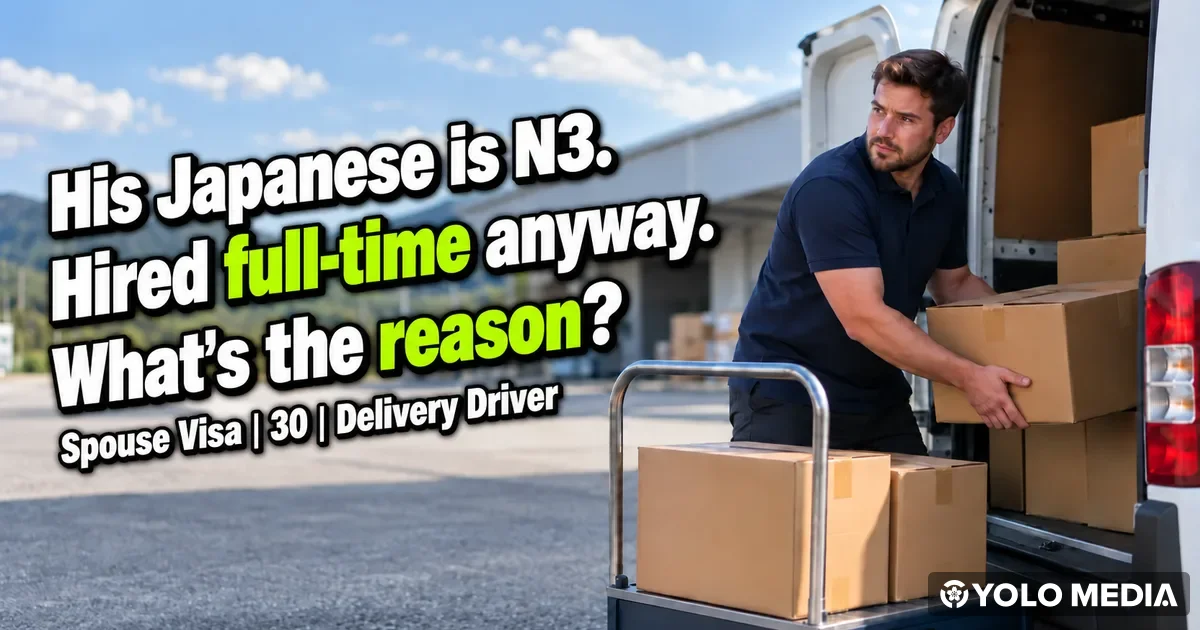
This article is for informational purposes only and is not legal advice. Visa rules can change, so check the Immigration Services Agency of Japan’s official website for the latest information before you start working. The photo in this article is for illustration only. It is not a photo of the person who was hired.
Who Was Hired
| Item | Details |
|---|---|
| Nationality | Germany |
| Age / Gender | 30 / Male |
| Visa status | Spouse or Child of Japanese National (Spouse Visa) |
| Japanese level | N3 |
| Driver’s license | Holds a standard license, with driving experience |
| Location | Gunma Prefecture |
The biggest reason he was hired was that the hiring manager could speak German. On top of that, the company expected him to stay long-term, since he held a stable status of residence (the Spouse Visa) and was already living near the workplace (reference: YOLO WORK case study).
The Job He Was Hired For
| Item | Details |
|---|---|
| Industry | Logistics |
| Job type | Route delivery driver |
| Employment type | Full-time (permanent employee) |
| Location | Gunma Prefecture |
| Required Japanese level | N3 or above |
The company delivers goods on set routes in a regional area. The listing required Japanese at N3 or above, which he met. Because the hiring manager could speak German, the interview was held in a mix of German and Japanese (reference: YOLO WORK case study).
Why He Was Chosen
This company operates in a mountainous area of Gunma, where route delivery drivers have been in short supply and hiring has been difficult. The company believed that someone with a stable status of residence like the Spouse Visa, who already lived nearby and wanted to stay in the area, would work there long-term.
The hiring manager explained his salary, shifts, and future career path in detail in German. As a result, his worries about language were greatly reduced, and they quickly agreed on the working conditions (reference: YOLO WORK case study).
Two things made the difference in this hiring: the hiring manager explained everything in German, and the company believed he would stay long-term because he already lived in the area.
3 Things You Can Do Today
Here are three things you can do starting today if you’re in a similar situation.
1. Tell employers why you want to work long-term. A Spouse Visa has no limits on the type or hours of work. If you want to keep working in the area where you live, explain why (for example, you live there with your family) in your application or interview.
2. Check the listing for language support, and ask when something is unclear. See whether the listing mentions support in languages other than Japanese, such as English. If you don’t understand a condition during the interview, ask about it right there.
3. If writing feels difficult, introduce yourself on video instead. When you’re not confident in your Japanese, showing your personality through your expression and tone can communicate more than text alone.
(YOLO JAPAN’s Screening Video lets you show your personality and motivation in ways text alone can’t.)
If you’re navigating a similar situation on a family-related visa, there’s another story worth reading.
(Also read: Can You Work Part-Time on a Dependent Visa? Hired With Almost No Japanese)
 Stories
Can You Work Part-Time on a Dependent Visa? Hired With Almost No Japanese
A 29-year-old from Indonesia on a Dependent Visa, with only greeting-level Japanese, was hired at a Kyoto craft shop. Wh…
Read related article
Working on a Spouse Visa: The Rules
Finally, let’s cover the most important rule. The Spouse Visa (status of “Spouse or Child of Japanese National”) is for people married to a Japanese citizen. Unlike a Dependent Visa, which is for family members being supported by someone else’s visa, it comes with no restrictions on the type or hours of work.
This means you don’t need permission to engage in activities outside your status of residence, and you can work full-time as a permanent employee from the start. There’s no 28-hour weekly cap.
“Spouse Visa” and “Dependent Visa” are easy to mix up. The Spouse Visa is for people married to a Japanese citizen and has no limits on the type or hours of work. The Dependent Visa is for family members of someone in Japan on a work visa, student visa, or certain other statuses. To work, they need permission to engage in activities outside their status, and they can generally work up to 28 hours a week (under the comprehensive permission). Check the name of your status of residence on your residence card first. (Reference: Immigration Services Agency of Japan, "Permission to Engage in Activity Other Than That Permitted for Dependent Status" (Japanese))
For the Spouse Visa’s application requirements and required documents, see the full guide below.
For the documents you need when starting a full-time job, see this guide.
(Also read: Full-Time Job Documents in Japan)
 Work & Career
Full-Time Job Documents in Japan: A Guide for New Graduates, Job Changers, and Overseas Hires
A practical breakdown of the documents you need before starting a full-time job in Japan, organized by three paths: new …
Read related article
Frequently Asked Questions
Q: Can I work full-time on a Spouse Visa (Japanese spouse)?
A: Yes. The Spouse Visa has no limits on the type or hours of work, so you don’t need permission to engage in activities outside your status, and you can work full-time from the start.
Q: Can I apply for full-time jobs if my Japanese is only at N3?
A: Yes, you can. The Japanese level you need is set by each listing, so check the requirements first. In this example, the listing required N3 or above, and he had N3. The hiring manager explained the conditions in German, which greatly reduced his worries about language (reference: YOLO WORK case study).
Q: What’s the difference between a Spouse Visa and a Dependent Visa?
A: A Spouse Visa is for people married to a Japanese citizen and has no limits on the type or hours of work. A Dependent Visa is for family members of someone in Japan on a work visa, student visa, or certain other statuses. To work, they need permission to engage in activities outside their status, and they can generally work up to 28 hours a week (under the comprehensive permission). Check the name of your status of residence on your residence card.
Summary: You Don’t Need Perfect Japanese to Work
- ✅ Tell employers why you want to work long-term. A Spouse Visa has no limits on the type or hours of work, so you can work full-time from the start
- ✅ Check for language support, and ask when something is unclear. Confirming the conditions yourself can reduce your worries before you apply
- ✅ Introduce yourself on video. It shows your personality in ways text alone can’t
Being unsure about your Japanese doesn’t mean you have to stop applying. Start by checking what your status of residence allows, then try applying for a job that interests you.
YOLO JAPAN also shares useful information about job hunting and life in Japan on LINE. If you’d like to receive it, add YOLO JAPAN as a LINE friend.


