Last Updated: April 24, 2026
Reading Time: 25 min read
Disclaimer: This article is for general informational purposes only and does not constitute medical advice. In an emergency, always consult a medical facility and follow professional guidance.
Introduction
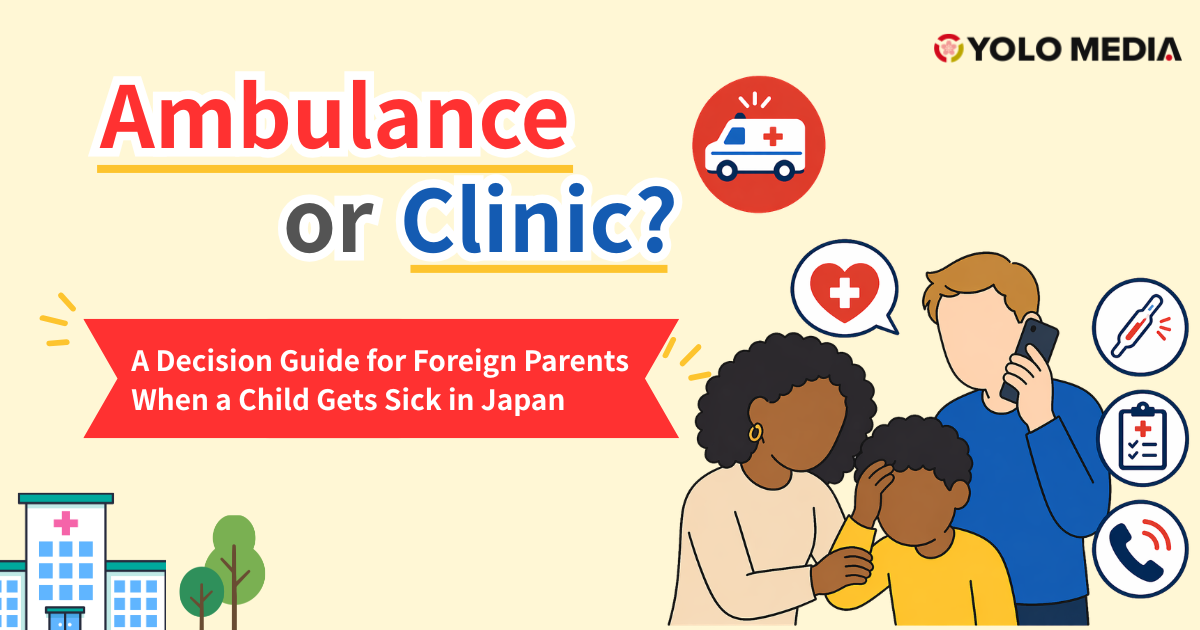
It’s 2 AM. Your child, who was sleeping soundly, suddenly starts crying uncontrollably. When you touch them, they feel alarmingly hot. Or perhaps they were playing at the park and fell so hard that the bleeding won’t stop. In these moments, especially in Japan where a language barrier can feel like a wall, it’s completely natural to feel a surge of panic.
For many of us international parents, while Japan’s medical system is world-class and highly reliable, it isn’t always clear where the “emergency entrance” actually is. I still remember the first time my child spiked a high fever late at night. I sat there with my phone in one hand and my child in the other, heart racing, wondering: “Should I call 119? Or should I just wait until morning?”
But please, take a breath. Japan’s pediatric emergency system is incredibly supportive once you know the secret codes—and in most municipalities, financial subsidies ensure that these emergencies won’t break the bank. In this guide, we’ll walk through everything from deciding when to call an ambulance to exactly what to say to the doctor. By the end of this article, you’ll have the “magic numbers” saved in your phone, and that midnight anxiety will be a lot lighter.

TL;DR
- 119: Call immediately for life-threatening emergencies. You can ask for an English interpreter.
- #8000: The go-to hotline when you’re unsure if you should go to the hospital.
- #7119: A general emergency consult line to help decide if you need an ambulance.
- Medical Subsidy Certificate: Always bring this to keep your ER bill near zero.
- AMDA International Medical Information Center: Best for finding multilingual hospital referrals.
Save These Numbers NOW: 5 Essential Emergency Contacts
Searching for numbers during a crisis is nearly impossible. Save these in your phone right now, and post a physical note where your partner or babysitter can easily see it.
| Number | Name | Purpose | Notes |
|---|---|---|---|
| 119 | Ambulance & Fire | Life-threatening emergencies | 24/7, Free |
| #8000 | Pediatric Hotline | Deciding whether to see a doctor | Hours vary by region |
| #7119 | Emergency Center | Deciding whether to call an ambulance | Not available in all areas |
| 03-5285-8088 | AMDA Center | Multilingual medical guidance | Business hours/some holidays |
| Family Doctor | Local Pediatrician | Regular health checks and minor illness | Keep their card handy |
(Reference: MHLW "Pediatric Emergency Telephone Consultation (#8000)" / Fire and Disaster Management Agency "#7119 Emergency Consultation")
Your Midnight Ally: “#8000” Pediatric Emergency Hotline
#8000 is a service that many parents in Japan carry like a protective charm. When you dial it, you are connected to a regional consultation desk where pediatricians or nurses provide professional advice on how to handle your child’s sudden symptoms.
Why You Should Call #8000 First
Emergency rooms in Japan’s large hospitals prioritize severe, life-threatening cases. If you visit for a minor issue, you might wait for 4-5 hours and risk exposing your child to other illnesses in the waiting room.
By letting a pro help you decide “Should we go now, or can it wait until tomorrow morning?”, you don’t have to carry the weight of that decision alone in the dark of night.
A Real-Life Example
A fellow expat mom once called #8000 when her 8-month-old spiked a fever. The nurse walked her through a checklist:
- Can your baby drink fluids (breast milk, formula, water)?
- Is their chest “sinking in” or making any wheezing sounds when they breathe?
- When was their last wet diaper?
- Does the baby make eye contact when you talk to them?
Thanks to these questions, the nurse concluded: “It’s safe to use a fever reducer and visit your local clinic first thing in the morning.” That single call saved her from a stressful nighttime hospital run.
(Reference: MHLW "#8000 Data Analysis Report (2022)" / Tokyo Bureau of Social Welfare "Child Health & Emergency")
【Decision Matrix】 When to Call 119 vs. When to Wait
While we often worry about “bothering” the ambulance service for something minor, children’s conditions can change rapidly. Use the following guide to act without hesitation.
Red Signal: Call 119 Immediately!
| Symptom Area | Dangerous Signs (Don’t hesitate, call 119) |
|---|---|
| Consciousness | No response to your voice, eyes not focusing, face is pale or purple |
| Breathing | Breathing has stopped, severe wheezing/rasping, breathing with shoulders |
| Seizures | Lasting more than 5 minutes, unconscious after it stops, part of body doesn’t move |
| Accidents | Heavy bleeding, head hit hard followed by confusion, swallowing chemicals/detergents |
Yellow Signal: Head to the ER (By Car/Taxi)
- Babies under 3 months with a fever of 38°C or higher
- Severe vomiting and no urine for over half a day (signs of strong dehydration)
- Refusing all fluids, dry lips or mouth
- Intense abdominal or ear pain that makes them cry inconsolably
Green Signal: Monitor at Home Until Morning
- Child over 3 months with a fever but still energetic and drinking fluids
- Mild cough or runny nose; child is in good spirits and sleeping well
- Temporary vomiting followed by calm behavior and intake of fluids
Remember the number “#7119“. This is a general emergency line for all ages (not just children) to ask “Should we call an ambulance or go to the clinic ourself?” It’s a great backup if #8000 is busy.
(Reference: Fire and Disaster Management Agency "Ambulance User Guide" / Japan Pediatric Society "ONLINE-QQ")
The 119 Call Script: Bilingual Step-by-Step Guide
In an emergency, it’s easy to freeze up. Keep this script handy to ensure you get help as quickly as possible.
1. Tell them what you need
- Dispatcher: “Kaji desu ka, Kyukyu desu ka?” (Fire or Ambulance?)
- You: “Kyukyu desu” (Ambulance, please)
2. Give your location
- You: “Basho wa [Address] desu” (The location is [Address])
Pro Tip: Include building and room numbers clearly.
3. Describe the situation
- You: “Kodomo ga [Symptom] desu” (My child has [Symptom])
– Fever: Fever (Netsu)
– Seizure: Seizure (Keiren)
– Injury: Injury (Kega)
4. Give the child’s age
- You: “[Age]-sai desu” ([Age] years old)
If you are struggling, say: “English speaker, please?” Many major fire departments now use a three-way translation system. Don’t hang up; they will bring an interpreter on the line.
(Reference: FDMA "How 119 Calls Work" / FDMA "Ambulance Use Guide for Foreigners")
Finding English-Speaking Medical Help
While most hospitals in Japan operate primarily in Japanese, many facilities in urban areas are well-equipped to handle international residents.
Medical Information Net (Navii)
This is an official national hospital search site provided by the MHLW. You can search for hospitals that are open “right now” and filter by “English-speaking” and “Pediatrics.” It was recently updated for better usability.
(Reference: MHLW "Medical Information Net (Navii)")
AMDA International Medical Information Center (03-5285-8088)
If you need to find a pediatrician who can treat your child in English immediately, this is your best resource. They provide multilingual guidance and can even help coordinate interpreters in some cases to prevent medical errors.
(Reference: AMDA International Medical Information Center Official Site)
Major International Hospitals in Tokyo (24/7 ER)
- St. Luke’s International Hospital (Chuo-ku): Known for its extensive English support. Always call before arriving to describe the situation.
- Tokyo Metropolitan Hiroo Hospital (Shibuya-ku): Has an international clinic and handles many nationalities. Their pediatric ER is highly regarded.
The “Money” Talk: Children’s Medical Subsidy System
Knowing about this system can save you a significant amount of money and stress.
Children’s Medical Subsidy (Kodomo Iryō-hi Josei)
If you have registered your residency in Japan, your child is eligible for this subsidy regardless of their nationality. In many municipalities, this reduces medical costs for children to zero, or a nominal fee of ¥200–¥500 per visit through junior high or even high school.
While an ER visit late at night usually involves high surcharges, this subsidy often covers those costs, making the actual out-of-pocket payment minimal.
Essential Checklist for the Hospital
- Health Insurance Card: (Kokumin Kenko Hoken or Shakai Hoken)
- Medical Subsidy Certificate: The card/paper issued by your city/ward office. Without this, you will pay 30% out of pocket.
- *Maternal and Child Health Handbook (Boshi Techo)*: Contains growth records, allergies, and vaccination history.
- *Medicine Notebook (Okusuri Techo)*: Crucial if your child is currently taking any medication.
- My Number Card: Increasingly accepted as a replacement for health insurance cards.
The Subsidy Certificate is usually only valid within your home prefecture. If you visit a hospital in a different prefecture (e.g., using a Tokyo card in Kanagawa), you must pay the 30% upfront and then apply for a refund at your city hall later.
(Reference: Children and Families Agency "Survey on Children’s Medical Expense Subsidies (2023)")
Navigating the “Cultural Gap” in Japanese Pediatric Care
One of the first things international parents notice is that Japanese pediatricians often have a different approach to common symptoms like fever.
Is Fever Always the Enemy?
In many Western countries, the standard is to lower a fever as quickly as possible (using Tylenol, etc.). In contrast, many Japanese pediatricians believe that “fever is proof that the body is fighting the virus. Forcing it down might actually slow down the recovery.”
Typically, you’ll be advised to use fever reducers ONLY if the fever is over 38.5°C AND your child is “listless,” “has no appetite,” or “cannot sleep.” If they are 39°C but happy and playing, many doctors will say to let it run its course.
The Truth About Cooling Sheets
You’ll see “Cooling Sheets” (like Hie-pita) on every pharmacy shelf in Japan. While they feel nice and are great for refreshing a fussy child, they do not actually lower the brain’s temperature.
If you need to lower a fever, doctors recommend placing ice packs (wrapped in towels) on areas with large blood vessels: the armpits, the groin, and the sides of the neck.
Common Japanese Fever Reducers
- Acetaminophen (Anhiba, Calonal): The most common pediatric fever reducer in Japan. It’s considered very safe and gentle.
- Ibuprofen: Sometimes used for children over 6 months, but doctors may avoid it if they suspect influenza or chickenpox due to specific risk factors. Always confirm with your doctor.
(Reference: Japan Pediatric Society "Fever Management Guide")
Don’t Panic: How to Build Your Emergency “Grab-and-Go” Kit
To ensure you can get out the door in 5 minutes, keep one dedicated bag ready near the entrance.
- Emergency Contact “Aid Card”: A single sheet listing your child’s allergies, current meds, birth date, medical history, and your address (written in both Japanese and English).
- Cash (Small Bills and Coins): For taxis or hospital vending machines. Emergency systems might not always accept credit cards or digital payments.
- Spare Phone Charger/Power Bank: ER wait times can range from 3 to 5 hours. You cannot afford to have a dead phone when you need to research or communicate.
- Extra Diapers & Clothes: Bring more than you think you need. Children often vomit or have accidents during a long ER wait.
- Plastic Bags: At least 3-5 bags in case your child gets sick in the taxi or waiting room.
- Oral Rehydration Solution (OS-1, etc.): Essential for dehydration. Liquid or jelly types are both useful.
- One Favorite Toy: Anything that provides comfort in a scary, sterile environment.
FAQ
Q: Who can ride in the ambulance?
A: Generally, only one parent or guardian is allowed to ride in the ambulance with the child. If you have other children, try to have a backup plan (a neighbor or babysitter) so you can focus on the one in need.
Q: Is the ambulance really free?
A: Yes, in Japan, the ambulance transport itself is free. However, you will be billed for the hospital consultation, tests, and medication. Using an ambulance as a “taxi” for non-emergencies is strictly prohibited.
Q: What if I don’t speak a word of Japanese?
A: Call 119 and say “English please.” Stay on the line. Use Google Translate to type out symptoms and show it to the receptionist. Most medical staff are used to non-Japanese residents and will do their best to help.
Key Takeaways
- ✅ Save “119” and “#8000” in your contacts right now and post your address on the fridge.
- ✅ Keep your Children’s Medical Subsidy Certificate and health insurance card in a set near the door.
- ✅ When in doubt, call #8000. A professional’s voice saying “it can wait until morning” is the best cure for midnight panic.
- ✅ Prepare your “Emergency Bag.” Having everything ready allows you to focus entirely on your child’s well-being.
- ✅ Remember: Japan’s pediatric care is world-class. If you stay calm and follow these steps, the doctors and nurses will doEverything in their power to help your family.
You’ve got this. Stay calm, take a breath, and don’t hesitate to ask for the help you and your child deserve.
![Father’s Day Gift Budget in Japan: The Right Gift for Your Partner’s Dad [2026]](https://media.yolo-japan.com/wp-content/uploads/2026/06/fathers-day-japan-2026-en-768x432.webp)