Last Updated: May 1, 2026
Reading Time: 28 min read
Introduction
“Are we eligible for Child Benefit (Jido Teate) even though we aren’t Japanese?” Have you ever felt that flash of doubt?
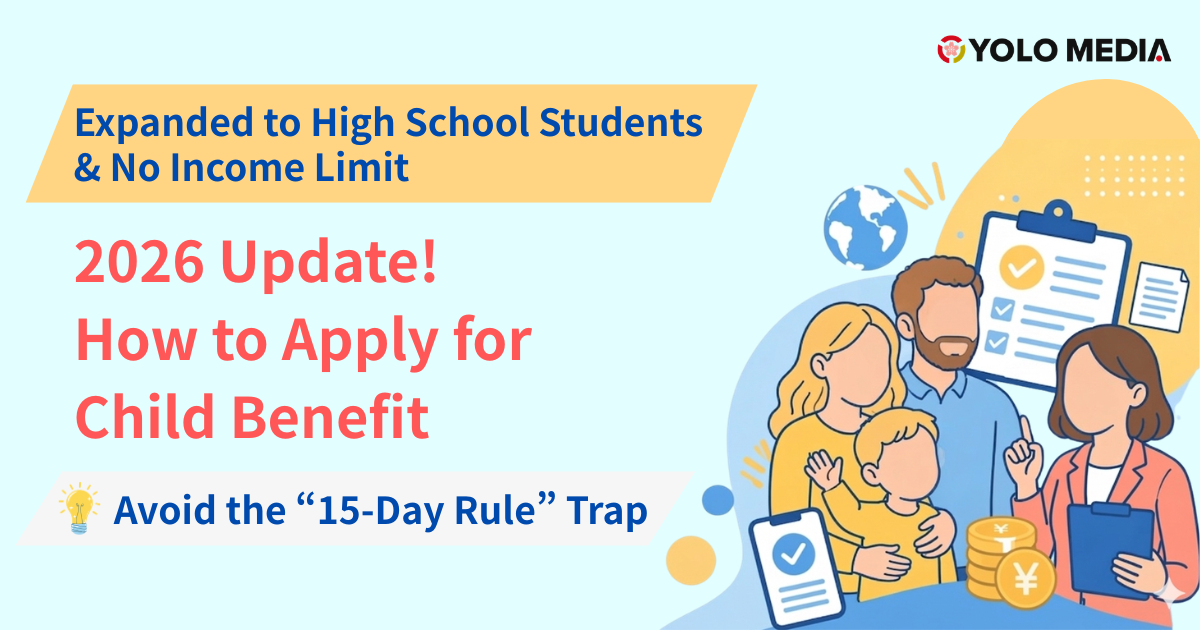
The bottom line: *if you have a registered address (jumin-hyo) in Japan, almost every international parent is eligible.* The October 2024 reform completely abolished the income limit, and coverage now extends to high school age (until the end of the fiscal year a child turns 18).
That said, pitfalls remain. Apply just one day late and you can lose a full month’s payment under the famous “15-Day Rule.” On top of that, the new “Child Care Support Fund” deduction started in April 2026, so you now need to understand both the money you receive and the money taken from your salary.
This guide walks international families through the 2026 system and the application know-how needed to claim what is genuinely your right.


TL;DR (What You’ll Learn)
- The income limit is fully abolished. Every household receives the full amount, regardless of annual income.
- Coverage extends to high school age (end of the fiscal year the child turns 18).
- The 3rd child gets ¥30,000/month. University-age siblings (19–22) don’t receive payments themselves but count toward the headcount that lets your younger child qualify as the “3rd child.”
- Apply within 15 days of birth or move-in. One day late costs you an entire month.
- Residence Card renewals, moving cities, and temporary returns home are common reasons benefits get stopped or have to be re-applied for.
- The new “Child Care Support Fund” started in April 2026. Treat it together with Child Benefit when planning your household budget.
Disclaimer: This article is for informational purposes only and does not constitute legal or tax advice. Always verify current rules and amounts with your local municipality and the Children and Families Agency. Information is current as of April 30, 2026.
What is Child Benefit? A Right for Every International Family
“Child Benefit” (Jido Teate) is a national subsidy paid to support families raising children in Japan and to back the healthy growth of the next generation.
When you first hear about this system, it’s natural to wonder, “Am I really eligible if I’m not Japanese?” A surprising number of international families assume they’re excluded because they aren’t Permanent Residents and end up applying late. In reality, eligibility is decided not by nationality but by whether you have a Japanese resident registration. Two simple conditions are all that matter:
- The child: Lives in Japan and has a residence registration. Children living overseas are generally not eligible (with limited exceptions for short-term study abroad, covered later).
- The parent (recipient): Has a residence registration in Japan and is actively raising the child.
Eligible vs. Ineligible Statuses of Residence
A common question is, “Does my visa qualify?” The general answer: any mid-to-long-term status of residence (a stay of more than 3 months that allows resident registration) is fine.
| Status of Residence | Eligible? | Notes |
|---|---|---|
| Permanent Resident / Special Permanent Resident | ✅ | No expiry concern |
| Spouse of Japanese National / Spouse of Permanent Resident | ✅ | Active child-rearing required |
| Long-Term Resident (Teijusha) | ✅ | |
| Work-based statuses (Engineer/Specialist in Humanities/International Services, Specified Skilled Worker, Intra-company Transferee, etc.) | ✅ | Residence Card must be valid |
| Dependent (Kazoku Taizai) | ✅ | |
| Student (Ryugaku) | ✅ | Resident registration + active child-rearing required. Part-time work hours may be checked |
| Short-Term Stay (Tourist) | ❌ | Cannot register as a resident |
| Expired status / status of 3 months or less | ❌ |
For families working hard to raise kids in Japan, Child Benefit is a meaningful right that supports daily life. There’s no need to hesitate or assume you don’t qualify.
The Child Benefit system contributes to the stability of family life and supports the healthy development of children who will lead the next generation, by providing allowances to those raising them. (Source: Children and Families Agency)
A Major Reform After 23 Years: What Changed in October 2024
Starting October 2024, the Children and Families Agency rolled out the biggest expansion of Child Benefit in 23 years. Critics of the old system had argued that it was unfair to cut benefits from higher-earning households, and the 2024 reform fully addressed that.
Here’s a side-by-side comparison of the main changes:
| Item | Before the Reform | After the Reform (2026) |
|---|---|---|
| Income limit | Yes (reduced or stopped above thresholds) | None (full payment for everyone) |
| Target age | Up to junior high | Up to high school age (end of fiscal year child turns 18) |
| 3rd child amount | ¥15,000/month | ¥30,000/month |
| Payment frequency | 3 times/year (every 4 months) | 6 times/year (every 2 months, in even-numbered months) |
(Source: Government Online "Child Benefit Significantly Expanded from October 2024")
The biggest practical win is the age extension. High school brings a real jump in tuition and living costs, so receiving support all the way through age 18 makes long-term education planning much more realistic.
[Key points of the October 2024 expansion] Income limits will be abolished, the payment period will be extended to high school age, and the amount for the 3rd and subsequent children will be doubled to ¥30,000 per month. (Source: Children and Families Agency)
How Much You’ll Get: Age × Birth Order Reference Table
The first thing parents want to know is, “What does this mean for our family?” The monthly amount depends on the child’s age and birth order, so here’s a clean reference table.
| Age of child | 1st & 2nd child | 3rd child onward |
|---|---|---|
| 0 to under 3 years | ¥15,000/month | ¥30,000/month |
| 3 years to high school age (until end of fiscal year child turns 18) | ¥10,000/month | ¥30,000/month |
For example, a household with two kids (ages 5 and 10) receives ¥20,000/month, while a household with three kids (ages 2, 8, and 15) receives ¥50,000/month. Payments arrive 6 times a year (every even-numbered month), with two months’ worth deposited together.
Payments start the month after your application is approved — they are not automatically backdated to the birth or move-in month. That’s why the “15-Day Rule” covered later is non-negotiable.
Securing the ¥30,000 for Your 3rd Child: How the Counting Rule Works
If your reaction is “We have three kids, so it’s ¥30,000 every month, right?”, there’s an important nuance to the counting rule worth knowing.
The 2024 reform doubled the 3rd-child payment to ¥30,000/month. Just as important: older siblings aged 19 to 22 (typically university-age) can be counted toward the sibling headcount, as long as the parents are providing meaningful financial support.
Here’s what’s easy to misread: the university-age child themselves does not receive any payment. They only count toward the headcount that determines whether a younger sibling qualifies as the “3rd child.” For example, in a family with a university-age eldest, a high-school-age second child, and an elementary-school-age third child, the eldest receives nothing. But by counting the eldest as “child #1,” the youngest is treated as the 3rd child, and their monthly payment jumps from ¥10,000 to ¥30,000.
Don’t Forget the “Care & Living Expense Confirmation Form”
The most common slip-up is assuming, “Our oldest moved out, so they’re no longer counted.” If your youngest gets bumped from “3rd child” down to “2nd child,” that’s a ¥20,000/month reduction (¥30,000 → ¥10,000).
If you’re paying tuition or sending regular financial support, the city office will recognize this as *“care and living-expense responsibility” (kango sōtō / seikeihi futan) even if your child lives separately. The counting period runs until the end of the fiscal year the older child turns 22. Make sure to include them on the application and submit the “Confirmation Form for Care and Living-Expense Responsibility” (Kango Sōtō / Seikeihi Futan ni tsuite no Kakuninsho*).
(On the 3rd-child addition) When the parent provides financial support, the child is counted as part of the calculation until the end of the fiscal year in which they turn 22. (Source: Children and Families Agency)
The Application Step-by-Step (and the 15-Day Rule)
If you “haven’t applied yet” or are “expecting a baby soon,” here’s the action plan. We get how easy it is to push paperwork to next week, but this is the one piece you should not delay.
Step 1: Gather the Required Documents
Before heading to the city or ward office, prepare the following:
- Applicant’s health insurance card
- Bankbook or cash card for the deposit account (must be in the applicant’s name)
- Residence Cards (for both the applicant and spouse)
- My Number identifier (My Number Card or notification card)
- Child’s birth certificate (with a Japanese translation if born overseas)
- Confirmation Form for Care and Living-Expense Responsibility (only if you have university-age siblings to count)
Step 2: Apply Within 15 Days
Apply within 15 days, counting from the day after your child is born or the day you moved into Japan. This is the famous “15-Day Rule” (or “15-Day Special Provision”). When you qualify, payments are backdated to the previous month.
Why one day late really does cost you a month
If you arrive at the city office a few days late because of a move or a job start, you lose an entire month of benefit. Personal reasons like “I was busy with a visa renewal” generally aren’t accepted as exceptions. The cleanest play is to walk straight from the birth-registration counter to the Children’s Affairs counter on the same day.
Step 3: Wait for the First Payment
Once your application is approved, payment eligibility starts the following month. The first deposit usually lands in an even-numbered month, 2–3 months after you apply. Keep the “Notification of Approval” the city office sends you — it’s needed for follow-up procedures down the line.
- Local municipality websites and Children’s Affairs / Childcare Support windows
- Related: Giving Birth in Japan: Procedures, Costs & the ¥500,000 Subsidy (2026)
Pitfalls International Parents Often Miss: Visa, Moving, Travel
Japan’s administrative quirks can be especially confusing for international residents. If you assumed “I applied once, so I’m set forever,” double-check that none of these apply to you.
1. The Annual Status Report (Genkyō Todoke) in June
Since 2022, most Japanese households no longer have to submit this form. International recipients, however, often still receive it because the city office uses it to reconfirm your status of residence. When an envelope arrives around June, open it. If you skip the submission, your benefit payments stop.
2. The Re-Application Trap When You Move
Moving to a different municipality means filing a “discontinuation notice” at your old city office and submitting a brand-new application at your new one. Filing only the move-in notice (tennyu todoke) is one of the most common mistakes. The 15-Day Rule applies again at your new address, so visit the Child Benefit counter the same day you file your move-in notice.
3. Residence Card Renewals and Expirations
Whenever you renew your period of stay, bring the new Residence Card to the Child Benefit counter. If the system flags your status as expired even temporarily, you risk losing eligibility.
4. Changing Status of Residence (e.g., Dependent → Engineer/Specialist in Humanities)
Switching visa categories requires reporting the new Residence Card to the city office. The same applies if your spouse’s or your child’s status changes.
Special Cases: Children Overseas and Returning Home for Birth
This is where international families have questions that mainstream Japanese sites barely cover. Worth a careful read.
When the Child Stays in the Home Country
As a rule, children living abroad are not covered by Child Benefit — no Japanese resident registration means no benefit. There are edge cases (for example, when a parent with a Japanese resident registration is continuously sending support to a child who remains overseas due to specific circumstances), and these are decided case-by-case by the local municipality. Don’t self-judge — talk to your city office.
Temporarily Studying Abroad
If your child keeps a Japanese resident registration while studying abroad (typically up to about 3 years), benefits continue. You’ll be asked to submit a “study-abroad declaration” and a school enrollment certificate from the destination, with a Japanese translation.
Returning Home to Give Birth
If you return to your home country to give birth, the 15-Day Rule clock starts the day the baby enters Japan and gets registered as a resident. Birth registration itself can be filed at a Japanese embassy/consulate abroad or at a Japanese city office, but the Child Benefit application can only be made after Japanese resident registration is in place. Plan the return-and-registration timeline backward from your due date to avoid surprises.
Long Trips Home (Several Weeks to Several Months)
Even a “temporary” trip home can wipe out your eligibility if you cancel your Japanese resident registration. Don’t preemptively file a move-out notice (tenshutsu todoke) just to be safe — talk to the Child Benefit desk before you leave. If you permanently leave Japan, eligibility ends on the day you depart, and you must complete the discharge procedure. Continuing to receive payments without reporting your departure leads to serious trouble down the line.
Pairing Child Benefit With the New 2026 “Child Care Support Fund”
To finance the Child Benefit expansion, the Child Care Support Fund (Kodomo Kosodate Shienkin) deduction started in April 2026. It’s added to your health insurance premium and pulled directly from your salary.
If you’re wondering “How much will be taken from my salary?” or “Could this affect my Permanent Residency application?”, you’re not alone. Once you can see both the money you receive and the money deducted, your household budgeting gets much more grounded. We’ve broken down the numbers and the PR-application implications in a dedicated guide.
Related article: The Child Care Support Fund: Salary Deductions Start in 2026 — Calculation Methods and Real-World Impact
Also Check: Support for Single-Parent Families and Children with Disabilities
If you’re raising a child on your own, or caring for a child with disabilities, there are additional support systems beyond Child Benefit worth tapping into.
- *Child Rearing Allowance (Jido Fuyo Teate)*: For single parents. Can be received in addition to standard Child Benefit.
- *Special Child Rearing Allowance (Tokubetsu Jido Fuyo Teate)*: For families raising children with physical or mental disabilities.
Eligibility and paperwork are a bit more involved, so the welfare counter (fukushi madoguchi) at your local municipality is the best place to start. More wards and cities now offer multilingual support and tablet-based interpretation. If you’re also working through preschool/daycare decisions, our Hoikuen vs. Yochien guide is a useful companion read.
- Children and Families Agency "Support for Single-Parent Households"
- Ministry of Health, Labour and Welfare "Special Child Rearing Allowance"
FAQ
Q: In a dual-income household, who applies — the higher earner or either parent?
A: The applicant should be the parent who supports the household to a greater degree (effectively, the higher earner). This rule survived the income-limit abolition. If you can’t tell whose income is higher, bring both withholding tax slips (gensen choshu hyo) to the city office.
Q: My Japanese is limited. Can I fill out the form in English?
A: The form itself is in Japanese, but most offices have multilingual sample forms, and many counters now use tablet-based translation services. It’s perfectly fine to walk in and say “I need help with child benefit.” Tokyo, Osaka, and Aichi prefectures tend to offer the most language coverage.
Q: I’m on a Student visa — am I eligible?
A: Yes, the “Student” status of residence can qualify, provided you have a Japanese resident registration and are actively raising an eligible child. The office may ask for proof that you’re sustaining your livelihood (for example, part-time work within the 28-hour weekly limit), so call ahead to confirm.
Q: My My Number hasn’t arrived yet. Can I still apply?
A: My Number is required for the application, so most offices ask you to wait until the notification arrives. The wait from resident registration to My Number notification is typically 2–4 weeks. If the 15-Day Rule deadline is at risk, ask at the resident-registration desk whether expedited issuance is available, and explain the situation to the Child Benefit desk — many offices can accommodate documented delays.
Q: When are deposits made? Is it monthly?
A: Payments arrive in even-numbered months (February, April, June, August, October, December), with two months’ worth deposited together. Specific deposit dates vary by municipality (the 10th or 15th is common). After a move or new application, expect the first payment to come 2–3 months later.
Q: What if I’m a public servant?
A: Public servants receive Child Benefit through their employer (the agency or office), not the local municipality. The application desk is the HR/payroll department at your workplace, which is why some applicants are told “you’re not eligible here” at city hall.
- Children and Families Agency Child Benefit Q&A
- Local municipality websites and Children’s Affairs / Childcare Support windows
Final Recap: The Points That Matter Most
- ✅ International parents qualify when the conditions are met. Resident registration + a mid-to-long-term status of residence is the key — don’t assume you’re excluded.
- ✅ The 15-Day Rule is everything. Acting within two weeks of birth or move-in is the difference between the full benefit and losing a month outright.
- ✅ University-age siblings count for the headcount. To unlock the ¥30,000 3rd-child rate, declare older student siblings (even those living away) and submit the Care & Living-Expense Confirmation Form.
- ✅ Respond to city-office mail and visa renewals immediately. Forgotten Status Reports and lapsed Residence Cards are the top causes of paused payments.
- ✅ Read Child Benefit and the Support Fund together. Knowing both the inflow and the deduction makes your household budgeting realistic, not theoretical.
- ✅ The next step is a city-office visit. On your next day off, bring your Residence Card and bankbook and start the conversation.
![Father’s Day Gift Budget in Japan: The Right Gift for Your Partner’s Dad [2026]](https://media.yolo-japan.com/wp-content/uploads/2026/06/fathers-day-japan-2026-en-768x432.webp)