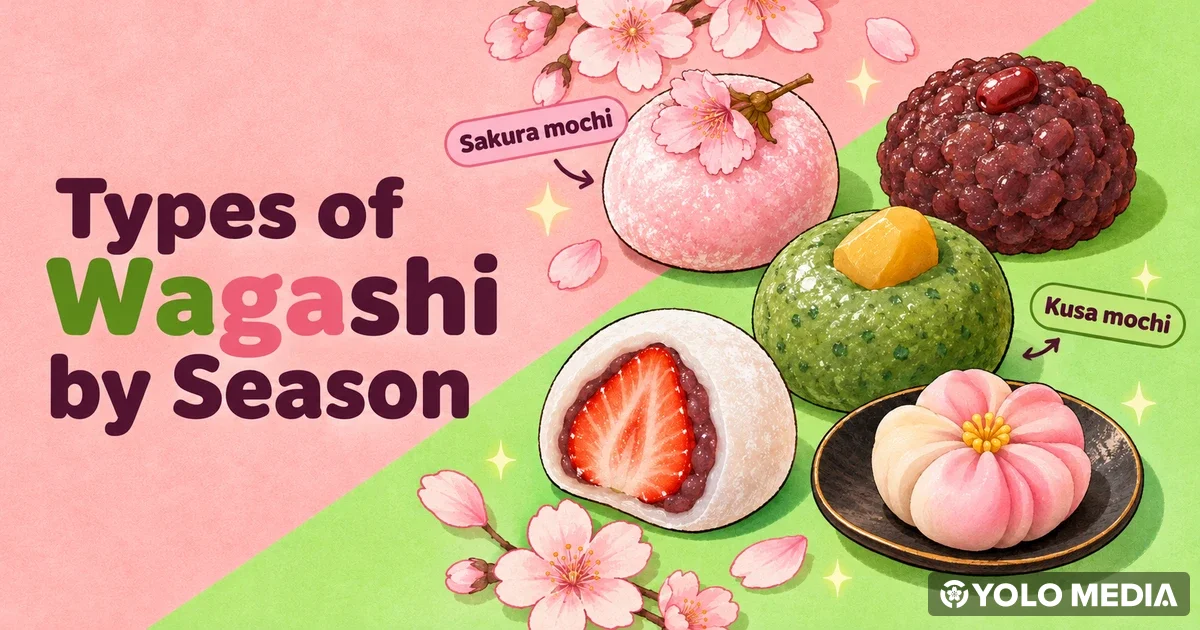
Stand in front of the wagashi counter at a Japanese supermarket or department store basement and it is hard not to freeze. There are pink rice cakes, green dumplings, jelly that looks like glass, and tiny sweets shaped like flowers. Many of us have picked one just because it looked pretty, bitten in, and been surprised to find a sweet bean paste inside.
Wagashi are traditional Japanese sweets made mostly from plant-based ingredients such as rice and azuki beans. Even in the same shop, the display in spring looks nothing like the display in autumn. This guide covers how wagashi differ from Western sweets, the basic vocabulary, 14 popular types, a seasonal calendar, shelf life and buying tips, tea ceremony manners, long-established shops in Tokyo and Kyoto, and what vegans and people with allergies should check.
How Wagashi Differ from Western Sweets, and the Basic Vocabulary
Ingredients
Western sweets lean on butter, cream, eggs, and wheat flour. Wagashi are built on rice, glutinous rice, azuki beans, agar, kudzu starch (starch from the kudzu plant), chestnuts, and sesame. Because there is little fat, wagashi feel lighter in the mouth and the sweetness is usually gentler.
That said, not every wagashi is purely plant-based. Dorayaki, castella, and some manju contain eggs and wheat flour. The section on vegan and allergy points near the end goes through this in detail.
Looks and seasonality
Wagashi care about appearance as much as taste. Nerikiri in particular shows plum blossoms, cherry blossoms, maple leaves, or goldfish in a form that fits in your palm. That is why so many people want to take a photo before the first bite.
Seasons matter too: sakura mochi in spring, mizu yokan in summer, chestnut sweets in autumn, and hanabira mochi in January. The lineup changes with the calendar. For more on how seasonal events shape daily life in Japan, see our guide to annual events and traditions.
(Read more in Experience Japan’s Four Seasons: A Guide to Annual Traditions and Seasonal Events.)
 Culture & Society
Experience Japan’s Four Seasons: A Guide to Annual Traditions & Seasonal Events
Want to enjoy Japan's seasonal traditions to the fullest? From spring Hanami (cherry blossom viewing) to summer Obon, au…
Read related article
A short history
Japanese sweets go back a long way. From before the common era, people are said to have ground nuts into flour, removed the bitterness, and eaten them as dumplings. In the Muromachi period, Lin Jingyin, who came from China, is said to have brought manju to Japan. From around the 16th century, contact with Portugal and Spain brought sweets such as castella to Nagasaki. In the Edo period, Japan began making its own sugar. On November 17, 2022, the craft of nerikiri and konashi sweets was registered as a Registered Intangible Cultural Property under the name “namagashi with confection names.”
The word yokan originally meant a soup made with lamb in China. Zen monks who did not eat meat are thought to have made a plant-based soup from azuki and other ingredients to stand in for lamb. It later turned into a sweet confection and settled in as one in the Edo period.
June 16 is Wagashi Day. It is based on the kajo ritual of 848, when the emperor offered sweets and rice cakes in multiples of 16 to the gods to pray for health. The kajo ritual was practiced until the Meiji era, and Wagashi Day brings it back today. Summer wagashi start to fill the shelves around then.
(Source: Ministry of Agriculture, Forestry and Fisheries, "Nippon Dento Shoku Zukan: Confectionery" / Toraya, "About Yokan" / National Wagashi Association, "Wagashi Day")
What if you do not like anko?
Anko is azuki beans simmered with sugar into a paste, and it is the base flavor of wagashi. If sweet beans are new to you, it can feel odd at first. Before giving up, it helps to know that there are plenty of wagashi without it.
- Warabi mochi and kuzumochi come with kuromitsu (brown sugar syrup) and kinako (roasted soybean flour), and kuzukiri comes with just kuromitsu. None of them use anko
- Mitarashi dango is all about a sweet and salty soy sauce glaze
- Konpeito and rakugan (pressed sugar and rice flour sweets) are about pure sugar
- Dorayaki is a pancake-style sandwich, so it feels close to Western sweets
- Shiro-an (white bean paste) is made from white kidney beans and is milder than azuki anko
Basic vocabulary
Wagashi names usually come from ingredients and shapes, so a few words go a long way at the counter.
| Term | Meaning | Found in |
|---|---|---|
| Tsubuan | Anko with the bean shape left in, for a bit of texture | Daifuku, dorayaki |
| Koshian | Smooth anko with the skins removed | Jo-namagashi, manju |
| Mochi | Glutinous rice, steamed and pounded until stretchy | Daifuku, sakura mochi, dango |
| Gyuhi | A soft rice-cake confection made with shiratamako, sugar, and starch syrup | Daifuku, hanabira mochi |
| Kanten (agar) | A seaweed-based setting agent, not animal-derived | Yokan, kingyokukan |
| Kuzu | Starch from the kudzu root, giving a clear, smooth texture | Kuzukiri, kuzumochi |
| Nerikiri | White bean paste mixed with gyuhi, colored and shaped by hand | Tea ceremony jo-namagashi |
| Monaka | Crisp glutinous rice wafers filled with anko | Monaka sold at wagashi shops |
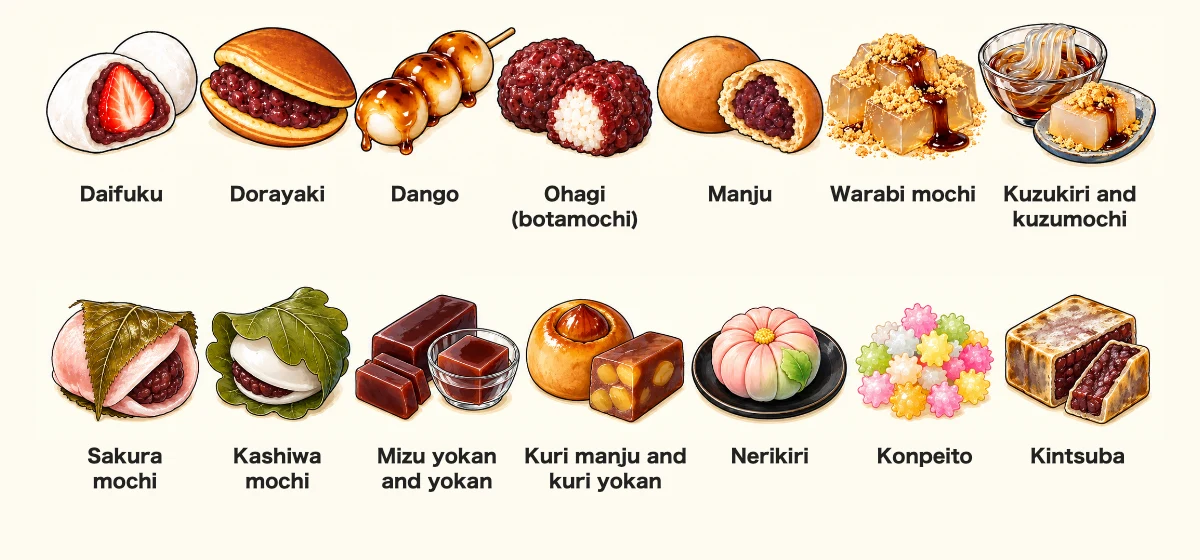
14 Popular Wagashi and How to Choose
Daifuku
A round mochi wrapped around anko, and probably the easiest wagashi to pick up. Ichigo daifuku, with a whole strawberry inside, balances the sweetness with a little sourness, which makes it a good entry point if anko is new to you. It is a winter-to-spring item, although more shops now sell it all year. Other types include mame daifuku, shio daifuku, and matcha daifuku.
Dorayaki
Two pancake-like rounds made from egg and wheat flour with anko between them. It is famous around the world as Doraemon’s favorite snack. Convenience stores sell it, so it is one of the easiest wagashi to try.
Dango
Rice flour dumplings in many varieties, such as mitarashi, yomogi, and three-color dango. Mitarashi dango, glazed with a soy sauce and sugar sauce, tends to work for people who do not like anko. Tsukimi dango, the white dumplings offered to the moon at the mid-autumn full moon, is the autumn version.
Ohagi (botamochi)
Glutinous and regular rice are cooked together, lightly mashed, and covered with anko or kinako. It is eaten during the spring and autumn higan (equinox weeks when people remember their ancestors). One explanation says the spring version is called botamochi after the peony and the autumn version ohagi after the bush clover.
Manju
A steamed bun with a wheat or rice flour skin and anko inside. You see them as souvenirs at hot spring towns. Many skins contain wheat, so anyone with a wheat allergy should check the label.
Warabi mochi
A soft, almost melting mochi made from warabi starch (starch from the bracken fern root), eaten with kinako and kuromitsu. You see it most in summer. Because real warabi starch is expensive, many products use potato starch or kudzu instead.
Kuzukiri and kuzumochi
Kuzukiri is clear noodles made from kudzu, served cold and dipped in kuromitsu. Kuzumochi is a block of kneaded kudzu, usually eaten with kinako and kuromitsu. Both are cooling, which makes them nice on a hot day.
Sakura mochi
A spring classic, wrapped in a salted cherry leaf. It looks different in the east and the west of Japan.
| Kanto style (Chomeiji) | Kansai style (Domyoji) | |
|---|---|---|
| Skin | A thin crepe-like wheat flour sheet | Coarse grains of domyojiko (steamed glutinous rice that is dried and roughly ground) |
| Texture | Moist and soft | Chewy and grainy |
| Shape | Anko rolled inside | Anko wrapped in a ball |
The Kanto style is said to have started in 1717, when Yamamoto Shinroku began selling it in front of Chomeiji Temple by the Sumida River. His shop is still in Mukojima, Tokyo. You can eat the leaf or take it off. The salt and aroma pull the sweetness together if you eat it with the leaf.
(Source: National Diet Library, NDL Image Bank "Sakura mochi" / Chomeiji Sakura Mochi Yamamoto-ya)
Our cherry blossom guide covers how to enjoy the spring season itself.
Kashiwa mochi
Eaten on May 5, Children’s Day (Tango no Sekku), and wrapped in an oak leaf. The oak does not drop its old leaves until new buds come out, so it is a symbol for a family that continues. You take the leaf off and do not eat it.
Mizu yokan and yokan
Yokan is anko set with agar into a dense block. Neri yokan, with less water, keeps well and works as a souvenir. Mizu yokan has more water, is softer, and is eaten chilled in summer.
Kuri manju and kuri yokan
Kuri manju wraps chestnut and anko in a soft skin, an autumn favorite. Kuri yokan has whole chestnuts in the block and also shows up in autumn.
Nerikiri
White bean paste colored and shaped into flowers, fruit, and scenery. Jo-namagashi are the high-grade fresh sweets served at tea gatherings, and nerikiri is a classic example. The design changes every season. It is the sort of sweet that you almost do not want to eat.
Konpeito
A tiny star-shaped sugar candy with little spikes. It is said to have come from Portugal in the 16th century, and there is a story that it was given to Oda Nobunaga. It keeps very well and is light and hard to break, which makes it easy to carry home.
Kintsuba
Firm squares of anko wrapped in a thin wheat flour skin and griddled. It looks plain, but you can taste the anko itself.
Quick guide by purpose
If there are too many choices, start from this table.
| Situation | Try | Why | Where to buy |
|---|---|---|---|
| First time | Ichigo daifuku, dorayaki | Soft texture, easy to get used to anko | Convenience stores, supermarkets, depachika |
| Do not like anko | Warabi mochi, mitarashi dango, konpeito | No anko | Supermarkets, wagashi shops |
| Less sweet | Shio daifuku, small neri yokan | Salt and ingredient flavor stand out | Wagashi shops, depachika |
| Hot day | Mizu yokan, kuzukiri, mizu manju | Served chilled | Depachika, wagashi shops |
| Photo-worthy | Nerikiri | Seasonal shapes | Wagashi shops, depachika |
| Office souvenir | Individually wrapped monaka, yokan assortment | Keeps well and easy to hand out | Depachika, station shops |
| Take home abroad | Konpeito, higashi, vacuum-packed yokan | Keeps at room temperature | Depachika, airports |
| With kids | Dorayaki, dango, konpeito | Easy even without anko | Convenience stores, supermarkets |
The Seasonal Wagashi Calendar
Wagashi taste better when you pair them with a seasonal event. Even the same shop swaps its lineup as the months change, which is a big difference from a Western bakery that sells the same things all year.
| Season | Wagashi | Notes |
|---|---|---|
| Spring (Mar-May) | Sakura mochi, kusa mochi, ichigo daifuku, kashiwa mochi | Kusa mochi is green mochi kneaded with mugwort. Kashiwa mochi on May 5 |
| Summer (Jun-Aug) | Mizu yokan, kuzukiri, warabi mochi, minazuki | Minazuki is a triangle of uiro (steamed rice sweet) topped with azuki beans, eaten in Kyoto around June 30. The azuki are said to ward off bad luck |
| Autumn (Sep-Nov) | Ohagi, tsukimi dango, kuri manju, kuri yokan | Ohagi for the September higan, tsukimi dango for the mid-autumn moon |
| Winter (Dec-Feb) | Hanabira mochi, zenzai, yuzu yokan | Hanabira mochi is a New Year sweet of white miso paste and burdock wrapped in mochi |
Hanabira mochi is said to come from a New Year ritual at the imperial court, and it is often served at the first tea gathering of the year. White miso and burdock sounds strange the first time, but many people find the saltiness easy to eat.
If you live in Japan in spring, try eating a sakura mochi while walking under the cherry trees in March or April. One bite is enough to feel that the season has turned.
Shelf Life, Buying Tips, and Gifts
Namagashi, han-namagashi, and higashi: shelf life at a glance
Sorting wagashi by moisture makes shelf life easy to judge.
| Type | Moisture (approx.) | Shelf life | Examples |
|---|---|---|---|
| Namagashi (fresh) | 30% or more | Same day to 2-3 days | Daifuku, nerikiri, sakura mochi, dango |
| Han-namagashi (semi-dry) | 10-30% | A few days to about 2 weeks | Monaka, yokan, kuri kinton |
| Higashi (dry) | 10% or less | Several weeks to several months | Konpeito, rakugan, senbei |
The moisture figures in the table are rules of thumb. The exact split varies by shop and source, so ask a staff member how long a specific item keeps.
Mochi-based namagashi harden as time passes. That is why there is a word, asanamagashi, for sweets made in the morning and sold the same day. Plan to eat namagashi on the day you buy it. Putting it in the fridge makes mochi stiff, so if you cannot eat it right away, ask staff when it is best to eat.
Giving wagashi as a gift
Japanese wagashi shops and department stores will wrap gifts with a noshi (a paper marking the purpose of the gift). If the gift is a souvenir, tell the staff it is a “temiyage” (hand gift) and they will wrap it appropriately.
For coworkers, individually wrapped, long-lasting, easy-to-share sweets go over well. Monaka and baked wagashi fit that description.
For timing, price range, and etiquette, see our omiyage guide.
(Read more in Be Respected at Work! The Ultimate Guide to Japanese Gift-Giving & Omiyage Etiquette (2026).)
 Culture & Society
Be Respected at Work! The Ultimate Guide to Japanese Gift-Giving & Omiyage Etiquette (2026)
From choosing the perfect omiyage to mastering Ochugen and Oseibo seasonal gifts. Discover the rules, taboos, and secret…
Read related article
For how to shop in a department store food hall, including tasting etiquette, see our depachika guide.
(Read more in How to Enjoy Depachika: Best Stores in Tokyo & Osaka, Tasting Etiquette & Gift Tips.)
 Food & Dining
How to Enjoy Depachika: Best Stores in Tokyo & Osaka, Tasting Etiquette & Gift Tips
Not sure where to go or what to buy at depachika? From Isetan and Hankyu Umeda to tasting etiquette, bento, wagashi, and…
Read related article
Taking wagashi home abroad
Higashi, vacuum-packed yokan, and canned monaka fit easily in a suitcase. Fresh sweets such as daifuku and nerikiri will spoil during the flight, so they are not good for travel. Some countries restrict food and plant-based products, so check the customs rules of the country you are flying to before you leave.
Wagashi at convenience stores
Convenience stores also carry daifuku, dorayaki, and dango. They are inexpensive, so they work as a tasting step before you buy from a specialty shop. For what else to buy there, see our konbini guide.
(Read more in Your First Stop in Japan: The Complete Japanese Convenience Store (Konbini) Guide for Food, Shopping & Everyday Life.)
 Food & Dining
Your First Stop in Japan: The Complete Japanese Convenience Store (Konbini) Guide for Food, Shopping & Everyday Life
Japan's konbini are world-class — this guide covers the Big Three chains' best foods, register phrases, daily necessitie…
Read related article
Tea Ceremony and Wagashi: Manners and Experiences
Why the sweet comes first
In a tea ceremony, you eat the wagashi before drinking the thick matcha. With the sweetness still in your mouth, the bitterness softens and the flavor of the tea comes through. The sweet-then-tea order is a long-standing rule of the tea room.
How to eat wagashi at a tea gathering
- Take the sweet on a kaishi (small paper carried for this purpose)
- Cut it into bite-size pieces with a kuromoji (a wooden pick)
- When you finish, wrap the pick in the kaishi and take it home
If you are new to it, it is fine to watch the people around you and copy them. The host (the person who prepares the tea) often explains the steps, so you do not need to know all the rules ahead of time.
Where to try it
Tokyo and Kyoto have workshops where you make nerikiri yourself. Some offer English, so you can join without strong Japanese. Check the school’s official site for language support and what to bring. Some cafes and tea rooms serve wagashi and matcha as a set.
YOLO DISCOVER, run by YOLO JAPAN, lets you join food, culture, and other experiences for free and share your thoughts on social media. It is not a booking site: you apply, and the people who are selected take part. Wagashi-making or tea ceremony plans are not always open, so sign up and check what is available now.
Making a simple version at home
Shiratamako (glutinous rice flour) and a microwave are enough to make a daifuku-style treat. One recipe mixes 100 g shiratamako, 20 g sugar, and 120 ml water in a heatproof bowl, covers it loosely with plastic wrap, and microwaves it at 600 W for 2 minutes 30 seconds. Stir well, cover again, microwave at 600 W for another 30 seconds, and stir until no lumps remain. Wrap store-bought anko in the mochi and you have an easy daifuku.
(Source: DELISH KITCHEN, sesame daifuku recipe)
Long-Established Wagashi Shops in Tokyo and Kyoto
Opening hours and sale days can change. Check each shop’s official website before you go.
Tokyo
| Shop | Background | Highlights |
|---|---|---|
| Toraya Akasaka | Founded in Kyoto in the late Muromachi period and opened a Tokyo shop when the capital moved in 1869 | The Akasaka shop, rebuilt in 2018, has the Toraya Karyo tea room next to the sales floor, where you can sit with wagashi and matcha |
| Chomeiji Sakura Mochi Yamamoto-ya (Mukojima) | Started selling sakura mochi in front of Chomeiji Temple in 1717 | Kanto-style sakura mochi wrapped in cherry leaves. Check the shop calendar for open days |
| Eitaro Sohonpo (Nihonbashi) | Founded in 1818 | Known for kintsuba baked on a sesame-oil-coated copper plate and “Umeboshi-ame,” a candy shaped like a pickled plum |
(Source: Toraya / Chomeiji Sakura Mochi Yamamoto-ya / Eitaro Sohonpo / Eitaro Sohonpo, "200 Years of Eitaro" / Eitaro Sohonpo, "Kintsuba" / Eitaro Sohonpo, "Umeboshi-ame")
Kyoto
| Shop | Background | Highlights |
|---|---|---|
| Tsuruya Yoshinobu | Founded in 1803, main shop on Imadegawa-dori west of Horikawa | “Kyo-kanze,” created in 1920 (Taisho 9), is still rolled up by hand by the shop’s artisans. It is the shop’s best-known sweet |
| Sasaya Iori | Founded in 1716 | Its stick-shaped dorayaki wrapped in bamboo skin is sold only on the 20th, 21st, and 22nd of each month. Go early |
| Oimatsu | Founded in 1908 | Products and sales periods change by year, so check the official site |
(Source: Tsuruya Yoshinobu / Tsuruya Yoshinobu, "Kyo-kanze" / Sasaya Iori / Kyoto Prefecture, "Sasaya Iori" / Oimatsu)
Sasaya Iori’s dorayaki is nothing like the round dorayaki sold everywhere. Thin, moist skin is rolled around anko into a stick, and since it is sold only three days a month, some people plan their Kyoto trip around it.
Vegan and Allergy Points to Check
Because many wagashi use plant-based ingredients, they can seem like an easy fit for vegans and vegetarians. Not all of them are, so check the points below.
| Ingredient to watch | Often found in | What to check |
|---|---|---|
| Wheat | Dorayaki, manju, kintsuba | Skin made with wheat flour |
| Egg | Dorayaki, castella, some manju | Egg in the batter |
| Milk | Western-style wagashi, cream daifuku | Fresh cream or condensed milk |
| Gelatin | Jelly-type sweets, some mizu yokan | Yokan and kudzu sweets often use agar, but it depends on the product |
| Alcohol | Sake manju, sweets using amazake | Sake or mirin is used. Take care if you avoid alcohol |
| Soy, sesame, nuts | Kinako, sesame paste, sweets with chestnut or walnut | Check the label |
Under Japanese food labeling rules, ingredients such as wheat, egg, and milk must be shown on the package when they are included. Look at the ingredient list on the back, and use a translation app on your phone if you need to. At a counter, you can ask staff, “Do you use egg and milk?”
(Source: Consumer Affairs Agency, "Food Labeling: Allergy Labeling")
Yokan (set with agar), warabi mochi, kuzukiri, and rakugan are easier choices because they often avoid egg and milk. Even so, the same sweet can be made differently from shop to shop. When in doubt, ask before you buy.
For vegan dining in general, read our guide below.
FAQ
Q: Which wagashi should I try first?
A: Ichigo daifuku or dorayaki. They are soft, easy to eat, and a gentle way to get used to anko. You can get both at convenience stores and supermarkets.
Q: Are there wagashi I can enjoy even if I do not like anko?
A: Yes. Warabi mochi, kuzukiri, mitarashi dango, konpeito, and rakugan do not use anko. White bean paste is also milder than azuki anko, so it is another place to start.
Q: Are wagashi vegan, vegetarian, or allergy-friendly?
A: Many use plant-based ingredients, and yokan, warabi mochi, and kuzukiri are easier to choose. That said, dorayaki and castella use eggs and wheat flour, and some sweets use gelatin or milk. Check the ingredient list before you buy, and ask the staff “does this contain egg or milk?” when you shop at the counter.
Q: Where can I buy wagashi?
A: Wagashi specialty shops, depachika, supermarket wagashi sections, and convenience stores. For jo-namagashi and seasonal items, specialty shops and depachika have the best selection.
Q: Can I enjoy wagashi without doing a tea ceremony?
A: Of course. Cafes and wagashi shops with seating serve wagashi and matcha as a set. A place like Toraya Karyo at the Akasaka shop lets you sit and take your time.
Q: What do kids like?
A: Dorayaki, dango, konpeito, and ichigo daifuku are popular. Cut mochi and dango into small pieces for children so they do not choke.
Q: Can I eat namagashi the next day?
A: It tastes best on the day you buy it. Mochi and nerikiri get hard or dry over time. If you will eat it the next day, ask the staff how long it keeps before you buy.
Key Takeaways
Wagashi get more fun the more you learn. Start with what is close to you.
- ✅ When in doubt, start with ichigo daifuku or dorayaki
- ✅ Even if you do not like anko, warabi mochi, dango, and konpeito are anko-free
- ✅ Eat namagashi on the day you buy it. For souvenirs, choose monaka, yokan, or higashi
- ✅ Follow the seasons: sakura mochi in spring, mizu yokan in summer, chestnut in autumn, hanabira mochi in winter
- ✅ If you have dietary restrictions or allergies, check the ingredient label or ask staff
- ✅ When you have time, sit down at a place like Toraya Karyo and have wagashi with matcha
Wagashi is something to enjoy slowly, in the order of looks, aroma, texture, and taste. Peek into a shop each season, and you will find one more small pleasure in living in Japan.