Last Updated: March 23, 2026
Reading Time: Approx. 12 min
Category: Culture
Introduction: Why Do Japanese People Value “Omiyage” So Much?
“Why do people always buy snacks for the office after a trip? Why do they choose individually wrapped items instead of what they actually want to eat? And why does it feel slightly awkward if you’re the only one who didn’t bring anything back?”
If you live in Japan, you will surely encounter these questions.
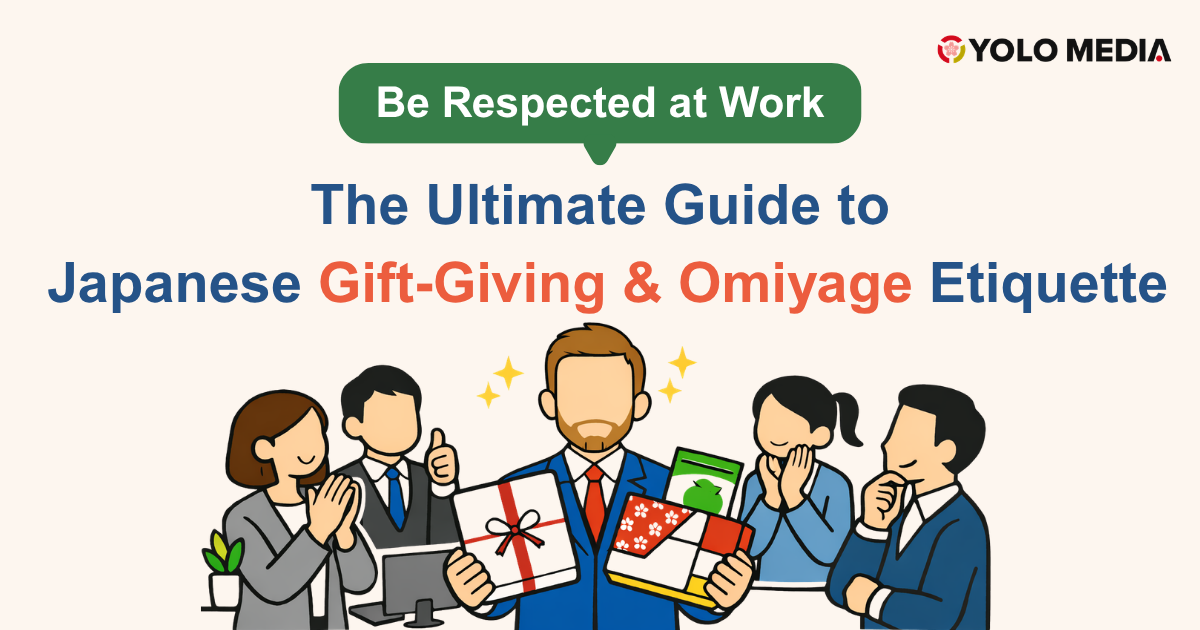
Gift-giving culture in Japan is more than just handing over an object. It is a silent message: “I am thinking of you.” From travel omiyage to summer ochugen and winter oseibo, gifting serves as a vital tool for maintaining smooth social connections and harmony (wa).
At first, it might feel like a chore. But once you understand the simple rules, it becomes a powerful way to bridge the gap with colleagues and neighbors. This guide explains everything an expat needs to know, flavored with real-life insights.
Summary (TL;DR)
- Omiyage is a unique Japanese custom of sharing regional specialties from travels. It is rooted in Edo-period pilgrim culture.
- Gifts follow strict rules for wrapping, presentation, and timing.
- Main gift seasons: Ochugen (July), Oseibo (December), returning from travel, moving, and life milestones.
- Avoid 4 and 9: Never give items in sets of 4 or 9 (homophones for “death” and “suffering”).
- Workplace Manners: “Individual packaging, regional specialty, one box is enough” is the golden rule.
- Foreigner’s Edge: Sweets from your home country are highly appreciated and make great icebreakers.
What is Omiyage? More Than Just a “Souvenir”
The Difference from “Souvenir”
While omiyage (おみやげ) is often translated as “souvenir,” the meaning is quite different. In English, a souvenir is primarily for oneself—a memento of a trip. In Japan, omiyage is primarily for others—coworkers, family, and neighbors who looked after things while you were away. It is about sharing the experience of your destination with your community.
Three Golden Rules for Choosing Omiyage
To pick the right omiyage, remember these three points:
| Point | Content | Why It Matters |
|---|---|---|
| Regional Specialty | Must be local to your destination | Shows effort and “specialness” of the trip |
| Individual Packaging | Items should be individually wrapped | Easy to share hygienically in an office setting |
| Polite Packaging | Boxed, with department store branding | Shows respect and sincerity through careful handling |
A local specialty found only at a specific station or airport is ideal. The sense of “I could only get this there” is the essence of omiyage.
Historical Roots: The Pilgrims of the Edo Period
The culture of omiyage dates back to the Edo period (17th–19th centuries). Back then, pilgrimages to the Ise Grand Shrine (Ise Jingū) were a major life event. Those who couldn’t make the trip would give money to a representative pilgrim. In return, the pilgrim would bring back charms or local products, which were believed to carry the divine blessings of the shrine.
This spirit of “sharing the blessings of travel with everyone” continues in modern Japan.
(Reference: National Museum of Japanese History “Travel and the Japanese” exhibition materials)
“On” and “Wa”: The Values Behind Gifting
Two Japanese concepts underpin this culture: On (on – 恩), a sense of gratitude or social debt, and Wa (wa – 和), social harmony. By giving a gift, you acknowledge the support of others and reinforce the bond within the group.
While the pressure to bring something is loosening in modern, globalized workplaces, observing how your colleagues behave is the best way to judge.
Omiyage vs. Temiyage: Understanding the Difference
It is easy to confuse omiyage with temiyage (手土産). Here is a quick breakdown.
| Omiyage (omiyage) | Temiyage (temiyage) | |
|---|---|---|
| Timing | Returning from travel | Visiting a home or office |
| Purpose | Sharing travel experience / Gratitude | Saying “hello” / Thanking a host |
| What to give | Regional specialties | Sweets from famous shops, alcohol |
| Recipient | Coworkers, family, neighbors | The host of the visit |
Think of temiyage as a “visiting gift” and omiyage as a “returning gift.”
The Yearly Gifting Calendar: When and What?
Japan has specific seasons for formal gifts. Keeping this calendar in mind will help you stay ahead.
1. Ochugen (お中元) — Summer Gifts (July)
A gift for bosses, business partners, teachers, and relatives. It originates from a mix of Daoist traditions and the Japanese Obon festival.
Budget: ¥3,000–¥10,000
Standard items: Beer sets, fruit juices, somen (thin white noodles), ham, jelly.
How to send: Department store gift catalogs are the easiest. Just pick, pay, and they handle the logistics.
💡 Pro Tip: Timing varies by region. Kanto (Tokyo area) is early to mid-July; Kansai (Osaka area) is mid-July to mid-August. If you send in early July, you’ll be safe nationwide.
2. Oseibo (お歳暮) — Year-End Gifts (December)
Sent to the same people as ochugen, but oseibo is considered even more important as it marks the end of the year.
Budget: ¥3,000–¥10,000 (usually slightly more than ochugen).
Standard items: Alcohol, sweets, seafood, cooking oil, ham.
Timing: Should arrive between early December and around the 20th.
If you can only afford to send one, prioritize Oseibo.
3. Travel Omiyage — The Most Casual Gift
The most frequent type of gift. One box for the whole office is standard.
Budget: ¥1,000–¥3,000 per box.
Timing: Hand it out on your first day back at work. If you forget, a simple “Sorry for the delay” is fine.
4. Moving Greetings (Hikkoshi Aisatsu)
Greeting your new neighbors (usually the two houses next to you and three across the street).
Standard items: Towels, soap, sweets.
Budget: ¥500–¥1,000.
Unique item: Hikkoshi-soba (moving noodles), symbolizing a “long and thin” relationship.
5. Life Milestones
| Event | What to give | Estimate |
|---|---|---|
| Wedding | Goshugi (celebratory cash) | ¥30,000 (for friends/colleagues) |
| New Baby | Baby clothes, practical items | ¥5,000–¥10,000 |
| Promotion | Gift or card | ¥3,000–¥5,000 |
| Hospital Visit | Fruit, flowers (not potted), books | ¥3,000–¥5,000 |
Note: Wedding cash should consist of brand-new bills (shinsatsu). You can request these at any bank counter.
Workplace Omiyage: Etiquette and “Reading the Air”
This is where most expats experience gift-giving first.
When to share?
Lunch breaks or tea times are best. Avoid busy morning hours.
How to share?
- Shared Space: Leave a box in the pantry or common area with a note: “Omiyage from [Location]. Please help yourself!”
- Direct Handover: For your direct boss or closer colleagues, a quick “I visited [Place] over the weekend, here is a small treat” is very effective.
- The Phrase: Use “Tsumaranai mono desu ga” (It’s a small/boring thing, but…). It sounds self-deprecating but is a standard polite set phrase.
What if you forgot?
Don’t panic. You can make up for it next time. It is better to honestly say “I was too busy exploring!” than to avoid everyone. No relationship is broken by a missing box of cookies.
How to Give: 6 Rules for a Great Impression
1. Presentation is as Important as Content
In Japan, how you wrap is as important as the gift itself.
- Use Department Stores: Their wrapping paper is a mark of quality.
- Furoshiki (Wrapping Cloth): Eco-friendly and elegant.
- Color Choice: Avoid plain white (funeral vibes). Opt for red/white or gold for celebrations.
2. Noshi and Mizuhiki Manners
Formal gifts require noshi paper and mizuhiki (decorative cords).
- Butterfly Knot (Chou-musubi): For events that can happen again (birth, promotion).
- Fixed Knot (Musubi-kiri): For once-in-a-lifetime events (weddings, funerals).
Confused? Just tell the department store clerk what the occasion is, and they will set it up for you perfectly.
3. Use Both Hands
Always present and receive gifts with both hands. A slight bow makes it even more sincere.
4. The “Humble” Phrase
“Tsumaranai mono desu ga” (tsumaranai mono desu ga) literally means “this is a boring thing,” but the meaning is “my selection isn’t worthy of your greatness.” It’s a standard humble expression.
5. Opening it Later
Traditionally, gifts are opened later, after the giver has left, to avoid appearing greedy or critical. Only open it if the giver explicitly says “Please open it now.”
Absolute Taboos: What Never to Do
Number Taboos
- 4 (Shi): Avoid 4 items. Shi sounds like “Death” (死).
- 9 (Ku): Avoid 9 items. Ku sounds like “Suffering” (苦).
- Stick to 3, 5, 7, or 8 (8 is lucky because the kanji 八 widens at the bottom, symbolizing prosperity).
Item Taboos
- White Flowers: Lilies or chrysanthemums are for funerals.
- Potted Plants (for sick people): “Taking root” implies the illness will stay.
- Blades (Knives/Scissors): Symbolizes “cutting ties.”
- Shoes (for superiors): Implies “stepping on” them.
Regional Omiyage Guide: What to Buy Where
| Region | Classic Omiyage | Note |
|---|---|---|
| Hokkaido | Shiroi Koibito, Royce Chocolate | A guaranteed crowd-pleaser. |
| Tokyo | Tokyo Banana, Tokyo Custard Cake | The “Gransta” mall at Tokyo Station is a must-visit. |
| Nagoya | Yukari (Shrimp Crackers) | Light and easy to carry. |
| Kyoto | Nama Yatsuhashi, Matcha Sweets | Cinnamon and matcha flavors are iconic. |
| Osaka | 551 Horai Butaman (Frozen) | Frozen version is safe for trains/planes. |
| Fukuoka | Hakata Torimon | A consistent top-ranked favorite in Japan. |
| Okinawa | Chinsuko, Purple Sweet Potato Tart | Very easy to distribute. |
Okaeshi: The Return Gift Culture
If you receive a significant gift, you are expected to give an okaeshi (return gift).
- Rule of Thumb: Half the value of the original gift (“Han-gaeshi”).
- Timing: Ideally within 1 week to 1 month.
- Note: For casual travel omiyage, a simple “Thank you” is enough.
The Foreigner’s Edge: Your Secret Weapon
You don’t have to follow every Japanese rule perfectly. You have a special weapon: Sweets from your home country.
Coming from another culture, people are curious about what you eat. A bag of chocolates or a box of cookies from your home country is the ultimate conversation starter. It is exotic, rare, and personal.
Tips for Foreign Gifts:
- Storytelling: “This is a candy my grandmother used to give me” adds a lovely touch.
- Safety First: Choose packaged items over homemade for hygiene peace of mind.
- Allergies: Be mindful of nuts, which are becoming a bigger concern in Japan.
FAQ (Frequently Asked Questions)
Q: Do I really need to buy omiyage for every trip?
A: It depends. In traditional firms, yes. In startups, it’s optional. If unsure, a small box is a safe way to build social capital.
Q: What is the average budget?
A: ¥1,000–¥3,000 for an office box. ¥3,000–¥5,000 for individual formal gifts.
Q: How do I thank someone for a gift?
A: Use both hands to receive it and say “Arigato gozaimasu.” If it was particularly nice, mention how much you enjoyed it (e.g., “The cookies were delicious!”) the next day.
Q: What about funerals?
A: You give Kōden (cash). Use a black-and-white envelope, avoid new bills, and follow the lead of your Japanese colleagues on the amount (usually ¥5,000–¥10,000).
Q: Can I buy omiyage online?
A: For Ochugen/Oseibo, yes. For travel omiyage, it is better to buy it at the location to keep the “story” authentic.
Conclusion: One Step at a Time
Japanese gift-giving culture might seem complex, but it boils down to one simple thing: Showing you care.
You don’t need to be perfect. Start small—maybe just a box of cookies after your next weekend trip. Remember to use both hands, avoid the numbers 4 and 9, and add a humble phrase.
And remember, your colleagues aren’t judging your knowledge of 18th-century pilgrim history. They are just happy you thought of them.