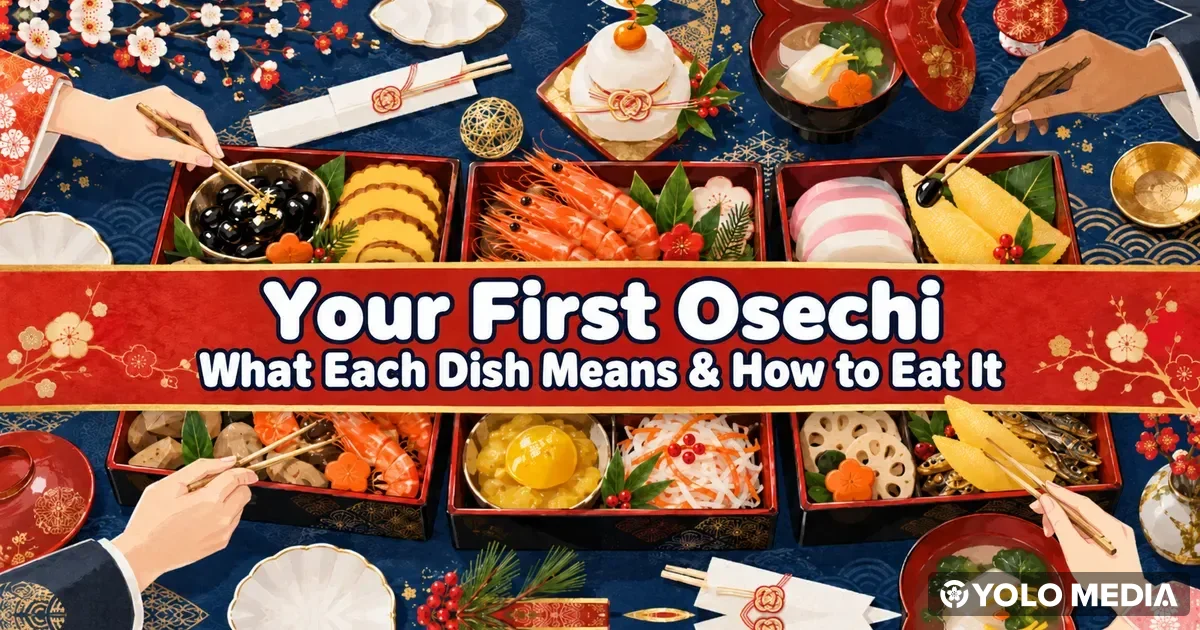
From around autumn, convenience stores, supermarkets and department stores in Japan start putting up posters that say “osechi yoyaku uketsukechu” (now taking osechi orders). The photos show beautiful boxes filled with black beans, yellow rolled omelets and many other small dishes. You may have wondered: “What is this?” “Why is it so expensive?” “Can I eat it too?”
Osechi ryori is the celebration food people in Japan eat at New Year. Each dish carries a wish, such as “may I live a long life” or “may I never be short of money.”
In this guide, we explain what osechi is, what each dish means, when people eat it, where to buy it, and what to do if there are ingredients you can’t eat. We based it on information from Japan’s Ministry of Agriculture, Forestry and Fisheries (MAFF) and other sources. Whether this is your first New Year in Japan or you just want something to talk about with friends and coworkers, we hope it helps.
This article is based on information as of October 2026. Prices and order deadlines change every year. Please check the store’s official website before you buy.
1. What Is Osechi? The Quick Answer
Here are the key points in one table.
| Question | Answer |
|---|---|
| What is it? | Celebration food for New Year. Each dish carries a wish |
| When do people eat it? | Generally from New Year’s Day (January 1). In Hokkaido, many homes eat it on New Year’s Eve (December 31) |
| How is it served? | Packed in jubako (stacking boxes) and shared by the family |
| Where can I get it? | You can make it at home, or order it from convenience stores, supermarkets, department stores and online shops |
| How much is it? | It varies a lot. Sets for 2 people start from about 10,000 yen at convenience stores and supermarkets (see Section 5) |
Originally, “osechi” meant the food made for sekku, the seasonal festival days throughout the year. New Year was the most important of these, so the word came to mean New Year food. The original form of osechi is said to have appeared in the late Edo period.
In Japan, people have long believed that a god called Toshigami-sama visits each home at New Year. Toshigami-sama is a god of the rice fields who brings a good harvest, and also the ancestral god of the family. Osechi began as an offering to this god.
Many osechi dishes keep well for several days. This is also said to give the person who usually cooks a break during the New Year holidays.
(Sources: MAFF "Osechi, food that wishes for a happy year" / MAFF "Packing prayers for happiness into osechi" / Kotobank "Osechi ryori" (Japanese))
2. Osechi Dishes and Their Meanings
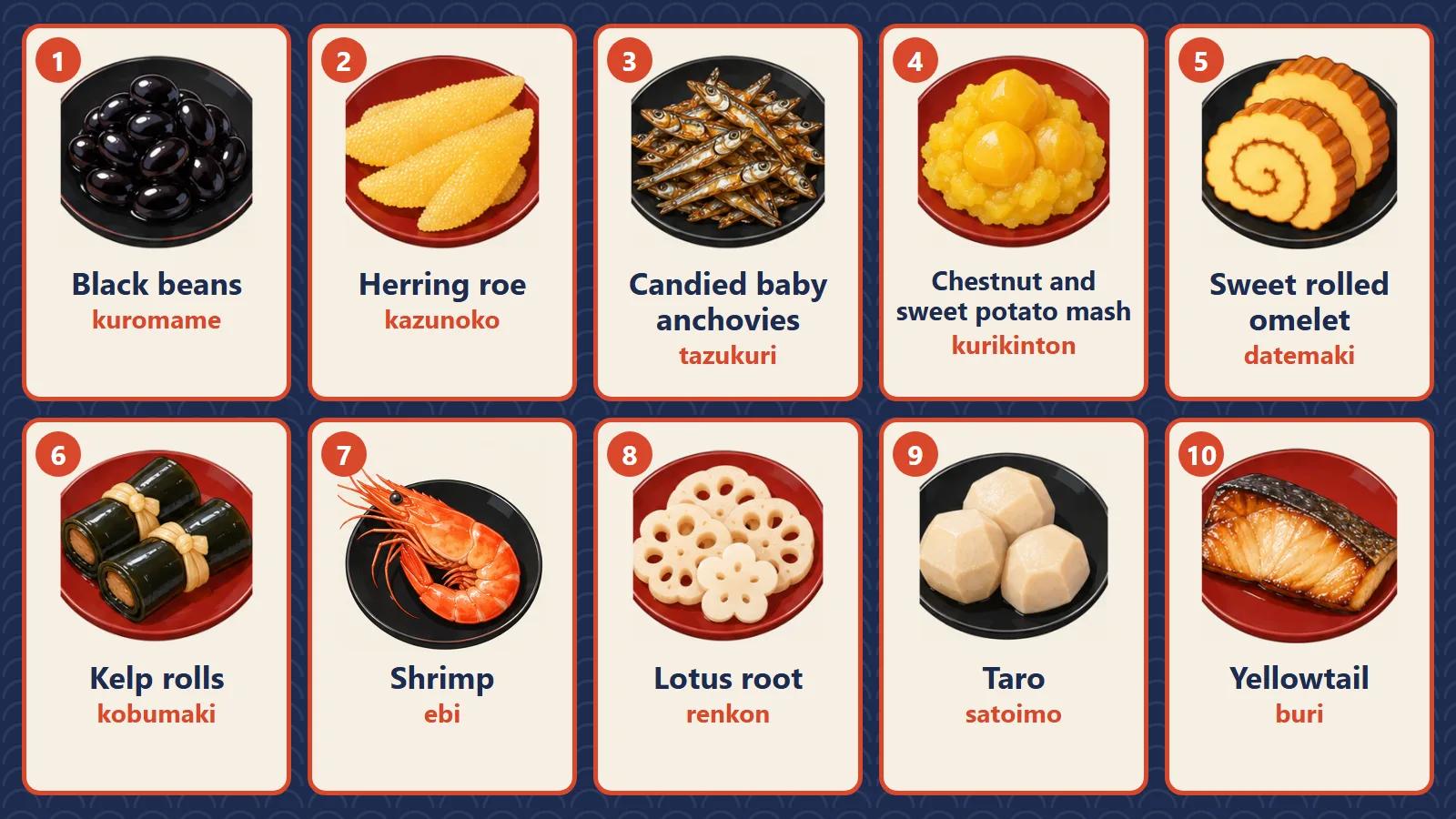
The dishes in osechi differ by family and by store. Here are common ones and what they mean.
| Dish | Reading | What it is | The wish behind it |
|---|---|---|---|
| Black beans | kuromame | Black soybeans simmered until sweet | “May I work hard and stay healthy” (mame means diligent) |
| Herring roe | kazunoko | Eggs of the herring fish | So many eggs means wishing for many children and grandchildren |
| Candied baby anchovies | tazukuri | Small anchovies cooked sweet and salty | These fish were once used to fertilize rice fields, so it wishes for a good harvest |
| Chestnut and sweet potato mash | kurikinton | A sweet, golden dish of sweet potato and chestnuts | Written with the kanji for “gold,” it wishes for money and wealth |
| Sweet rolled omelet | datemaki | Fish paste and egg, cooked and rolled | It looks like a kimono pattern, so it wishes for never being short of clothes |
| Kelp rolls | kobumaki | Fish or other fillings rolled in kelp and simmered | “Kobu” sounds like “yorokobu” (to be happy) |
| Shrimp | ebi | Grilled or simmered shrimp | Wishing for a long life, until your back bends like a shrimp |
| Lotus root | renkon | A vegetable full of holes | You can see through the holes, so it wishes for a clear view of the future |
| Taro | satoimo | A root that grows many small potatoes | Wishing for many children and grandchildren |
| Yellowtail | buri | Grilled fish | Its name changes as it grows, so it wishes for success at work |
The Three Celebration Dishes (Iwai-zakana Sanshu)
Black beans, herring roe and candied baby anchovies are called “iwai-zakana sanshu,” the three celebration dishes. They are considered essential for the New Year. Tazukuri is also called “gomame.”
Knowing the Meaning Makes It More Fun
Many osechi dishes are sweet or served cold, so some people find the taste surprising at first. You don’t have to eat everything. Try a little of whatever catches your eye, and remember its meaning as you eat. It really adds to the New Year feeling.
(Sources: MAFF "Osechi, food that wishes for a happy year" / MAFF "Packing prayers for happiness into osechi" / Kotobank "Osechi ryori" (Japanese))
3. Why Is Osechi Packed in Stacked Boxes?
Osechi is usually packed in jubako, square boxes that stack on top of each other. People stack the boxes to express the wish to “pile up good fortune” and “have one happy thing after another.”
How Many Tiers?
The number of tiers depends on the family or store. Store-bought osechi comes in one-tier (ichidanju), two-tier (nidanju) and three-tier (sandanju) boxes, among others. In FamilyMart’s lineup, for example, three-tier boxes range from sets for 3 people to sets for 5, so you can choose based on how many will eat.
The top box is called “ichi no ju,” followed by “ni no ju” and “san no ju.” What goes in each box also differs. For example, one of FamilyMart’s three-tier sets has classic osechi dishes in the first box, seafood and meat in the second, and Western and Chinese style dishes in the third.
Tips for Eating
- It’s common to take food from the boxes onto your own plate
- Using serving chopsticks (toribashi) to take the food is a safe choice
For more on chopstick manners, see our guide to Japanese table manners and chopsticks.
 Food & Dining
Japanese Table Manners & Chopstick Etiquette: Rules and Taboos You Might Not Know
Japanese table manners have specific rules that may surprise international residents. This guide covers everything: prop…
Read related article
(Sources: MAFF "Packing prayers for happiness into osechi" / FamilyMart news release on 2027 osechi / Kotobank "Osechi ryori" (Japanese))
4. When Do People Eat Osechi?
Generally From New Year’s Day
Osechi is generally eaten from New Year’s Day (January 1). There is also a custom of eating ozoni, a soup with rice cakes, on the morning of New Year’s Day. Because osechi keeps well, it can be eaten little by little over the New Year holidays.
In Hokkaido, on New Year’s Eve
In Hokkaido, many homes are said to eat osechi on New Year’s Eve, December 31. In Hokkaido and the Tohoku region, lucky Japanese sweets called kuchitori-gashi are also often served alongside osechi on New Year’s Eve.
Separate from osechi, some areas of Miyazaki Prefecture still have a custom of the whole family eating a special feast called “toshitori-zen” on the evening of New Year’s Eve.
Why New Year’s Eve? Under the old calendar, a new day was thought to begin at sunset. So the celebration of the new year started on the evening of December 31.
How It Differs From Toshikoshi Soba
There is also a custom of eating toshikoshi soba (year-crossing noodles) on New Year’s Eve. An easy way to remember: soba is for New Year’s Eve, and osechi is for New Year (or from New Year’s Eve in some areas). For an overview of how people spend New Year’s Eve and New Year, see our guide to Japan’s seasonal traditions.
 Culture & Society
Experience Japan’s Four Seasons: A Guide to Annual Traditions & Seasonal Events
Want to enjoy Japan's seasonal traditions to the fullest? From spring Hanami (cherry blossom viewing) to summer Obon, au…
Read related article
Coworkers or friends may ask you, “Did you have osechi this New Year?” If you can name one dish, like “It was my first time eating kuromame. It was sweet and delicious,” the conversation will go much further.
(Sources: MAFF Hokkaido Office "Year-end events and food" / MAFF "Toshitori-zen (Miyazaki)" / Rural Electronic Library "Year-end and New Year food" (Japanese))
5. How to Buy and Order Osechi
You can make osechi at home, but you can also buy it. In a 2026 FamilyMart survey, people who made all of their osechi by hand spent an average of 5 hours 10 minutes preparing it, while people who bought all of it spent an average of 52 minutes (a survey of 498 people in their 40s to 60s who prepared osechi themselves for New Year 2026).
Where Can I Buy It?
| Where | What to know |
|---|---|
| Convenience stores | Some sets can be ordered at the store, others only online. Some can be picked up at the store |
| Supermarkets | Besides pre-ordered sets, some sell single dishes like black beans and datemaki at the end of the year |
| Department stores | Sets from famous shops and ryotei (high-end Japanese restaurants) |
| Online shops | Delivered to your home. Some arrive frozen |
Order Deadlines (2027 Guide)
Order deadlines differ by store. For New Year 2027, convenience stores and supermarkets close orders from just after December 20 to around December 28, and department stores from around December 20 to around December 25. If you order for home delivery or online, or choose to pay at a convenience store, orders may close earlier.
| Store | Order deadline | Early discount (hayawari) |
|---|---|---|
| 7-Eleven | December 28 for store pickup (December 12 for delivery) | 10% off eligible sets if you order on the app (until November 30) |
| Lawson | 6:00 p.m. on December 25 for store pickup (December 10 for delivery) | None |
| FamilyMart | 11:00 p.m. on December 22 (9:00 a.m. for Yaohiko Honten sets) | 10% off 15 eligible sets (until 9:00 a.m. on November 30) |
| Ito-Yokado | December 24 | 1,000 yen off delivery of three eligible sets (ended September 30) |
| Takashimaya (online) | 10:00 a.m. on December 25 | Free delivery if you order early (until 10:00 a.m. on November 9, some items excluded) |
| Daimaru and Matsuzakaya | 10:00 a.m. on December 22 | None |
| Isetan (online) | 10:00 a.m. on December 21 | None |
Most stores hand over or deliver osechi on December 30 or 31. Sets with limited stock may close before the deadline.
How Much Does It Cost?
Osechi prices vary a lot depending on the number of people, tiers, dishes and where you buy. Looking at New Year 2027 sets from convenience stores, supermarkets and department stores, prices are roughly as follows (all including tax).
| Serves | Rough price | Examples |
|---|---|---|
| 1 person | From the 6,000 yen range | 7-Eleven “Wa no Osechi” one tier, 6,912 yen; Ito-Yokado “Sairan” one tier, 6,912 yen |
| 2 people | About 10,000 to 15,000 yen at convenience stores and supermarkets | Ito-Yokado “Meoto Gozen” two tiers, 9,504 yen; FamilyMart “Yaohiko Honten” one tier, 10,778 yen |
| 3 to 4 people | Many three-tier sets at convenience stores and supermarkets cost 20,000 to 25,000 yen. Expensive ones are around 40,000 yen | 7-Eleven “Wa no Osechi” three tiers, 22,032 yen; 7-Eleven “Kyokujin,” 41,040 yen |
| Department stores | A wide price range. Takashimaya’s online store lets you choose by budget, from under 20,000 yen to 40,000 yen and up |
Prices can go down with early discounts, and delivery may cost extra. Check the store’s official website before you buy.
Frozen or Chilled?
Osechi from online shops and convenience stores arrives either frozen or chilled. In FamilyMart’s New Year 2027 lineup, 30 of the 36 sets are frozen. Frozen osechi needs to be thawed before eating. How to thaw it and how long it takes depends on the product, so read the instructions when it arrives.
If You Missed the Order Deadline
Don’t give up. At the end of the year, supermarkets and depachika (department store food floors) sell osechi dishes like black beans, kamaboko (fish cake) and datemaki one by one. Buying only the dishes you like and making your own small osechi is fun too. Check out our depachika guide and konbini food guide.
 Food & Dining
How to Enjoy Depachika: Best Stores in Tokyo & Osaka, Tasting Etiquette & Gift Tips
Not sure where to go or what to buy at depachika? From Isetan and Hankyu Umeda to tasting etiquette, bento, wagashi, and…
Read related article
 Food & Dining
Your First Stop in Japan: The Complete Japanese Convenience Store (Konbini) Guide for Food, Shopping & Everyday Life
Japan's konbini are world-class — this guide covers the Big Three chains' best foods, register phrases, daily necessitie…
Read related article
(Sources: FamilyMart news release on 2027 osechi / 7-Eleven order period / 7-Eleven early discount / 7-Eleven one-tier set / 7-Eleven three-tier set / 7-Eleven Kyokujin / Lawson news release / Ito-Yokado news release (PDF) / Takashimaya ordering guide / Takashimaya osechi / Daimaru and Matsuzakaya osechi / Isetan ordering guide / Takashimaya early-order free delivery campaign (Japanese))
6. Halal, Vegetarian or Allergies: What to Check
Osechi often uses fish, eggs and alcohol. If there are ingredients you can’t eat, check before you buy.
Ingredients to Watch For
| Ingredient | Often found in | Who should check |
|---|---|---|
| Shrimp and crab | Shrimp dishes, seafood dishes | People with shrimp or crab allergies |
| Egg | Datemaki, rolled omelets | People with egg allergies |
| Fish and fish roe | Kazunoko, tazukuri, buri, kobumaki | Vegetarians |
| Katsuo dashi (stock made from dried bonito) | Nishime and many simmered dishes | Vegetarians and vegans |
| Mirin and sake | Sweet simmered dishes and other nimono (simmered dishes) | People who avoid alcohol |
| Pork and beef | Western and Chinese style osechi | Halal and vegetarian diners |
Hon-Mirin Counts as Alcohol
Hon-mirin (true mirin), a sweet seasoning common in Japanese cooking, is classified as an alcoholic beverage under Japan’s Liquor Tax Act. If you avoid alcohol, check whether the ingredient list says mirin (みりん), sake (酒) or alcohol (アルコール).
Today’s Osechi Can Include Meat
These days, you can also find Western and Chinese style osechi with roast beef or subuta (sweet and sour pork). For example, one of FamilyMart’s three-tier sets for New Year 2027 includes black vinegar sweet and sour pork. Osechi isn’t always just fish and vegetables, so read the product description carefully.
How to Check the Ingredients
- Packaged osechi: By law, packaged processed foods must list major allergens such as shrimp, crab, egg, wheat and milk. Check the label or the product page online
- If you avoid pork or beef: Labeling pork and beef as allergens is not required. Don’t rely on the allergen section alone; read the full ingredient list
- Food sold loose at the counter: Food that isn’t packaged is not covered by this labeling requirement. Ask the staff
- Halal or vegan: If the product description doesn’t say, the surest way is to ask the seller directly
Build Your Own Osechi
If there are many ingredients you can’t eat, you can skip the set and choose dishes one by one. Even dishes with the same name can use different ingredients depending on the product, so check the label before you choose.
(Sources: Consumer Affairs Agency "Food allergy labeling" / Consumer Affairs Agency "Food allergy labeling handbook" (PDF) / NTA "Classification of alcoholic beverages under the Liquor Tax Act" / FamilyMart news release on 2027 osechi (Japanese))
7. Iwai-bashi Chopsticks and Ozoni Soup
Iwai-bashi (Celebration Chopsticks)
At New Year, some homes use iwai-bashi, white wooden chopsticks, instead of their everyday ones. Iwai-bashi are said to be offered to the gods at New Year and used by people as well. They are made from wood such as willow and are thick and long.
Ozoni Differs by Region
There is also a custom of eating ozoni at New Year. Ozoni is a soup with mochi (rice cakes) in it. The fun part is that it’s completely different depending on the region.
Mochi shape
| Region | Mochi shape |
|---|---|
| East of Sekigahara (Gifu Prefecture) | Mostly square mochi (kakumochi) |
| West of Sekigahara | Mostly round mochi (marumochi) |
There are exceptions. Some eastern areas use round mochi (such as the Shonai area of Yamagata Prefecture), and some western areas use square mochi (such as Kochi and Kagoshima prefectures).
Soup type
| Soup type | Example |
|---|---|
| Clear soup (sumashi, made with bonito and kelp stock) | Edo or Tokyo style ozoni |
| White miso | Ozoni with round mochi and vegetables cut into circles |
| Sweet azuki bean soup | The San’in region (Tottori, Shimane and nearby) |
In Okinawa, it is said that people traditionally did not eat ozoni. Try asking a coworker or friend, “What’s your family’s ozoni like?” It can lead to a fun conversation about where they’re from.
(Sources: Kotobank "Iwai-bashi" / MAFF "Mochi shapes by region" / MAFF "Ozoni across Japan" (Japanese))
8. FAQ
Q. Can I eat osechi even if I’m not Japanese?
Of course. Osechi is New Year celebration food, and anyone can enjoy it. You can buy it at convenience stores or online, so trying a small osechi for one person during your first New Year in Japan is a great idea.
Q. When should I order osechi?
It depends on the store. For New Year 2027, convenience stores and supermarkets close orders from just after December 20 to around December 28, and department stores from around December 20 to around December 25. Many stores offer early discounts until the end of November, so once you decide what you want, order early.
Q. Do I have to eat every dish?
No. Some dishes are sweet or have flavors you may not be used to. Start with the ones that interest you and try a little at a time.
Q. What if I can’t finish it?
Many osechi dishes keep well, but for store-bought osechi, follow the storage method and date on the package. Keep it in the fridge and finish it soon to be safe.
Q. Is there halal osechi?
Whether halal products are available differs by year and by store. If the product description doesn’t say, contact the seller. You can also choose dishes you can eat one by one instead of buying a set (see Section 6).
(Sources: FamilyMart news release on 2027 osechi / 7-Eleven early discount / AEON Net Super osechi (Japanese))
Summary
- Osechi is New Year celebration food. Each dish carries a wish for things like long life, money or success at work
- Black beans, herring roe and candied baby anchovies are the “three celebration dishes” and are especially important
- It’s generally eaten from New Year’s Day. In Hokkaido, many homes eat it on New Year’s Eve
- You can order it from convenience stores, supermarkets, department stores and online shops. Deadlines and prices vary, so check the official website
- If there are ingredients you can’t eat, check the label or ask the store. You can also pick dishes one by one
For your first New Year in Japan, why not start by learning the meanings and trying one dish that catches your eye? For other New Year events, see our guide to Japan’s seasonal traditions.