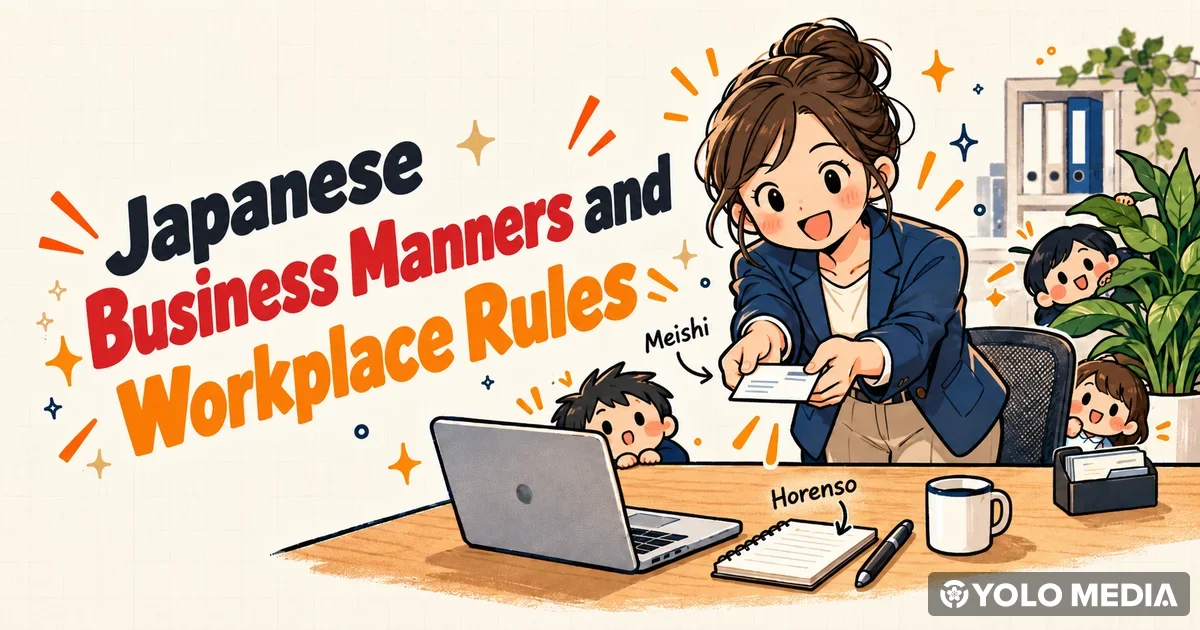
Japanese workplaces have customs that aren’t written in your employment rules or contract: how to greet people, how to report on your work, how to receive a business card, and how to talk things through before a meeting. You can do your job without knowing them, but knowing them makes working with the people around you much easier.
At the same time, some things, like working hours, paid leave, and harassment, are governed by law. If you separate “workplace customs” from “legal rules,” it’s easier to tell what to adapt to and what you’re free to say no to.
In this guide, we cover:
- Greetings and the sense of time
- Horenso (reporting, informing, consulting)
- Business card exchange and seating order
- Polite language and indirect expressions
- Nemawashi and ringi
- Rules on working hours, overtime, and paid leave
- Drinking parties and souvenirs
- Dress and grooming
- Where to get help
Customs vary by company and industry. When in doubt, the surest way is to ask a senior colleague or your manager.
1. Greetings and the Sense of Time
Everyday workplace greetings
Japanese workplaces use set greetings for different situations. Learning these five will cover most of your daily interactions.
| Situation | Greeting | Notes |
|---|---|---|
| Arriving in the morning | Ohayo gozaimasu (Good morning) | Some workplaces use it for your first meeting of the day, even in the afternoon |
| Meeting coworkers; opening internal emails | Otsukaresama desu | With people outside your company, use osewa ni natte orimasu instead |
| Leaving before others | Osaki ni shitsurei shimasu (Excuse me for leaving first) | Said to people who are still working |
| When someone else leaves | Otsukaresama deshita | The reply to someone leaving |
| Going out / coming back | Itte mairimasu / Tadaima modorimashita | Not every workplace uses these |
For greetings with people outside your company and phrases for email and phone, see Japanese Business Email & Phone Guide 2026: Work Templates.
 Japanese Language
Japanese Business Email & Phone Guide 2026: Work Templates
Copy-paste Japanese business email templates and phone scripts for working in Japan: addressing, set phrases, requests, …
Read related article
Japanese Language
Japanese Business Email & Phone Guide 2026: Work Templates
Copy-paste Japanese business email templates and phone scripts for working in Japan: addressing, set phrases, requests, …
Read related article
Be on time
For meetings, the basic rule is to arrive a little before the start time and be ready. Some workplaces also see the start of the workday not as “the time you reach your desk” but as “the time you’re ready to start working.”
If you might be late, contact your workplace as soon as you know. If your train is delayed, the station may give you a delay certificate (chien shomeisho). How lateness is handled differs by company, so it’s a good idea to check when you join.
2. Horenso
Horenso (報連相) combines three words: hokoku (reporting), renraku (informing), and sodan (consulting). It refers to reporting, informing, and consulting with your manager and coworkers, and is considered essential for running a business efficiently.
(Reference: Kotobank "報連相" (Japanese))
| Meaning | Example | |
|---|---|---|
| Hokoku (report) | Share the results or progress of work you were asked to do | “The materials for X are ready.” |
| Renraku (inform) | Tell the people involved about decisions or schedule changes | “Tomorrow’s meeting has moved to 15:00.” |
| Sodan (consult) | Ask for advice when you’re unsure or a problem comes up | “Could I ask your advice about X?” |
The key to horenso is telling people early. Bad news in particular, like a mistake or a delay, gives others time to respond when you share it early. Telling your manager “I’m partway through, and here’s where I am” before you finish also counts as reporting.
How often to report depends on your manager. Asking at the start, “When would you like me to report on this?” helps avoid misunderstandings.
3. Business Cards and Seating Order
Exchanging business cards
When you meet a client for the first time, you may exchange business cards (meishi). Details differ slightly between companies, but here’s one way to do it.
When giving your card
- Stand up and hold your card so the other person can read it
- Say your company and name as you offer it (e.g., “I’m X from Y Company”)
When receiving a card
- Receive it with both hands
- Check the name and company. If you’re not sure how to read the name, it’s fine to ask then and there
- Keep it on the table during the meeting
- Put it in your card holder afterward. Don’t fold it or write on it in front of the person
For who offers first, or the order when exchanging with several people, just follow your manager or senior colleague.
Some companies make business cards for you when you join. It’s a good idea to get a card holder before you start.
Senpai and kohai
Senpai (先輩) means someone older or higher in position or experience than you, or someone who joined the same school or workplace before you did. At work, people who joined the company before you may be called senpai.
(Reference: Kotobank "先輩" (Japanese))
When you have questions, a nearby senpai is a good first person to ask. Once you have a kohai (後輩, someone who joined after you), you’ll be the one teaching.
Seating order (kamiza and shimoza)
Meeting rooms and dinner tables have a seating order.
- Kamiza (上座): The top seat. It’s described as the seat farthest from the entrance, or the seat with its back to the alcove (tokonoma)
- Shimoza (下座): The seat for junior people; the lowest seat
(Reference: Kotobank "上座" (Japanese) / Kotobank "下座" (Japanese))
The basic rule is to offer the kamiza to guests or people in senior positions and to sit near the entrance yourself. When you enter a meeting room, don’t take a seat at the back on your own. Wait to be shown where to sit, or follow the people around you.
4. Polite Language and Indirect Expressions
Start with desu and masu
Polite language (keigo) is used at work. Keigo has traditionally been explained as three types: respectful, humble, and polite. The Council for Cultural Affairs’ report “Guidelines for Keigo” (2007) divides it into five types: respectful language, humble language I, humble language II (courteous language), polite language, and refined language (bikago).
(Reference: Kotobank "敬語" (Japanese))
Using all of them correctly from day one is hard. Start by speaking in the polite desu/masu form. It makes a much better impression than talking to your manager or clients the way you talk to friends. From there, you can gradually learn common words like moshimasu, itashimasu, and irasshaimasu.
Indirect expressions
In Japanese workplaces, people sometimes soften what they say instead of saying “I can’t” directly. The following phrases are sometimes used to decline or disagree.
| Phrase | What it may mean |
|---|---|
| Chotto muzukashii desu ne (“That’s a bit difficult”) | It’s hard to accept under the current conditions |
| Kento shimasu (“We’ll consider it”) | We can’t decide right away. Sometimes a no |
| Maemuki ni kangaemasu (“We’ll think about it positively”) | Positive, but not decided yet |
These phrases are sometimes meant literally, too. If you can’t tell, it’s fine to check gently: “Which part is difficult?” or “When might we hear back from you?” Checking prevents misunderstandings better than moving ahead with something unclear.
You may also hear kuuki wo yomu (“reading the air”). It means sensing the situation from the atmosphere and judging what you should or shouldn’t do.
(Reference: Kotobank "空気を読む" (Japanese))
If reading the atmosphere is hard, you don’t have to guess. Just ask.
5. Nemawashi and Ringi
Nemawashi
Nemawashi (根回し) means laying the groundwork in advance so that negotiations or meetings go smoothly.
(Reference: Kotobank "根回し" (Japanese))
At work, it refers, for example, to explaining a new proposal to the people involved one by one and hearing their views before the meeting.
- Explain the proposal to the people involved beforehand
- Listen to their concerns and opinions, and reflect them in the proposal
- Present the refined proposal at the meeting
If you bring up a proposal out of the blue at a meeting, people may feel “this is the first I’ve heard of it,” and the discussion may stall. The bigger the proposal, the more smoothly things go if you talk to your manager first.
Ringi
Ringi (稟議) is a system where the person in charge drafts a proposal and circulates it to the people involved for approval. It’s used to save the trouble of holding a meeting. The document is called a ringisho (稟議書).
(Reference: Kotobank "稟議" (Japanese))
Some companies require a ringi to buy equipment, hire an outside company, or go on a business trip. Some companies circulate paper with stamps, while others approve in a system. Several approvals may be needed, so start early on anything urgent. To avoid having it sent back, state the purpose, amount, and deadline clearly.
6. Rules on Working Hours, Overtime, and Paid Leave
From here on, these aren’t workplace customs but rules set by law.
Working hours and breaks
In principle, employers may not have employees work more than 8 hours a day or 40 hours a week. Breaks must be at least 45 minutes when working hours exceed 6 hours, and at least 1 hour when they exceed 8 hours.
(Reference: Ministry of Health, Labour and Welfare "Working Hours and Holidays" (Japanese))
Overtime limits
The upper limit on overtime is, in principle, 45 hours a month and 360 hours a year. It can’t be exceeded without temporary special circumstances. This has applied to large companies since April 2019 and to small and medium-sized companies since April 2020.
(Reference: Ministry of Health, Labour and Welfare "Upper Limit on Overtime Work | Work Style Reform Special Site" (Japanese))
You may feel it’s hard to leave while others are still working. If you haven’t been told to work overtime, it’s fine to say osaki ni shitsurei shimasu and go home once your work is done.
For a company to have employees work overtime beyond the legal working hours, it must sign a labor-management agreement called a “36 Agreement” (saburoku kyotei) with a labor union organized by a majority of the workers, or with a person representing a majority of the workers, and file it with the government authorities. At companies that have signed and filed a 36 Agreement, overtime beyond the legal working hours is permitted. If overtime is difficult because of your health or family circumstances, explain the reason and talk to your manager.
(Reference: Ministry of Health, Labour and Welfare "Working Hours and Holidays" (Japanese))
Paid leave
If you work continuously for 6 months from your hiring date and attend at least 80% of all working days, you’re entitled, in principle, to 10 days of annual paid leave. Since April 2019, employers have been required to make sure that employees who are granted 10 or more days of paid leave a year take at least 5 of them.
When you take time off, tell your manager early and hand over your work. If you want a longer break, such as a trip home, ask especially early.
For the documents you need when joining a company and what to check in your employment contract, see Full-Time Job Documents in Japan: A Guide for New Graduates, Job Changers, and Overseas Hires. If you work part-time, see Part-Time Job Documents in Japan: What to Prepare.
 Work & Career
Full-Time Job Documents in Japan: A Guide for New Graduates, Job Changers, and Overseas Hires
A practical breakdown of the documents you need before starting a full-time job in Japan, organized by three paths: new …
Read related article
Work & Career
Full-Time Job Documents in Japan: A Guide for New Graduates, Job Changers, and Overseas Hires
A practical breakdown of the documents you need before starting a full-time job in Japan, organized by three paths: new …
Read related article
 Work & Career
Part-Time Job Documents in Japan: What to Prepare
A practical guide to the paperwork for a part-time job in Japan: the five documents almost everyone needs, handling My N…
Read related article
Work & Career
Part-Time Job Documents in Japan: What to Prepare
A practical guide to the paperwork for a part-time job in Japan: the five documents almost everyone needs, handling My N…
Read related article
7. Drinking Parties and Gifts
You can usually choose whether to join
Workplaces hold nomikai (飲み会), such as welcome parties and year-end parties, where coworkers eat and drink together. They’re a chance to talk outside of work. Unless you’ve been instructed to attend as part of your job, you can decide for yourself whether to join. Some companies treat events like welcome parties as working hours, so check if you’re unsure.
Fewer companies hold spring cherry blossom viewing or welcome parties than before the pandemic. In a Tokyo Shoko Research survey (April 2025, 5,628 companies responding), 23.8% of companies held spring cherry blossom viewing, welcome, or social gatherings, compared with 51.8% before the pandemic. Among the companies holding these events, 18.5% counted them as working hours.
If you do go, these points are good to know.
- You don’t have to drink alcohol. Order oolong tea or a soft drink
- If you can’t eat certain foods for religious, health, or other reasons, tell the organizer in advance
- If the timing doesn’t work, saying “Thank you. I can’t make it this time, but please invite me again” is enough
- Trying to make someone drink is called alcohol harassment (aruhara). If you can’t or don’t want to drink, it’s fine to say no clearly
(Reference: Kotobank "アルコールハラスメント" (Japanese))
For how to order and toast at an izakaya, see Your First Izakaya Experience Otoshi, Kanpai & Ordering: What You Need to Know.
 Food & Dining
Your First Izakaya Experience Otoshi, Kanpai & Ordering: What You Need to Know
The complete guide to read before your first izakaya visit. Covers the confusing otoshi charge, when to join the kanpai …
Read related article
Food & Dining
Your First Izakaya Experience Otoshi, Kanpai & Ordering: What You Need to Know
The complete guide to read before your first izakaya visit. Covers the confusing otoshi charge, when to join the kanpai …
Read related article
Souvenirs
Some workplaces have a custom of handing out souvenirs (omiyage) after a trip or a visit home. People tend to choose things that are easy to share, like individually wrapped snacks. To learn more, see Be Respected at Work! The Ultimate Guide to Japanese Gift-Giving & Omiyage Etiquette (2026).
 Culture & Society
Be Respected at Work! The Ultimate Guide to Japanese Gift-Giving & Omiyage Etiquette (2026)
From choosing the perfect omiyage to mastering Ochugen and Oseibo seasonal gifts. Discover the rules, taboos, and secret…
Read related article
Culture & Society
Be Respected at Work! The Ultimate Guide to Japanese Gift-Giving & Omiyage Etiquette (2026)
From choosing the perfect omiyage to mastering Ochugen and Oseibo seasonal gifts. Discover the rules, taboos, and secret…
Read related article
8. Dress and Grooming
Dress codes vary a lot by company. Some require suits, while others allow casual clothes. Asking “Is there a dress code?” before you start will put your mind at ease.
When in doubt, keep these points in mind.
- For the first few days, wear neat business-casual clothes, then adjust to match the people around you
- On days you meet clients, dress more formally than usual
- Keep a clean look: clothes without wrinkles or stains, and tidy hair
- Go easy on perfume
In summer, some workplaces switch to lighter clothing under “Cool Biz.” Cool Biz is an initiative the government has promoted since fiscal 2005 to stay comfortable in summer without relying too much on air conditioning. People dress lightly based on their own judgment, depending on the temperature and their work. The Ministry of the Environment announced that in 2026 it would run Cool Biz intensively at its head office in Tokyo from May 1 to September 30.
(Reference: Ministry of the Environment "Cool Biz in Fiscal 2026" (Japanese))
When it’s OK to stop wearing a tie or jacket differs by workplace, so check with the people around you.
9. Where to Get Help
Adapting to workplace customs is different from putting up with unfair treatment. Power harassment (pawahara) is defined as behavior that meets all three of the following:
- It’s based on a position of power, such as being senior to the other person
- It goes beyond what is necessary and appropriate for the work
- It harms the working environment of the person affected
(Reference: Ministry of Health, Labour and Welfare "What Is Power Harassment | Akarui Shokuba Oendan" (Japanese))
First, talk to a manager you trust or your company’s consultation desk. If it’s hard to talk about it inside the company, you can use these services.
| Where to go | What they offer |
|---|---|
| General Labor Consultation Corners | Consultation on all kinds of labor issues, including bullying, harassment, power harassment, and dismissal. No appointment needed, free of charge |
| Telephone Consultation Service for Foreign Workers | Phone consultation on working conditions in 13 languages, including English, Chinese, Vietnamese, and Nepali. Open 10:00 to 15:00 (closed 12:00 to 13:00). Available days differ by language. Calls are charged (numbers start with 0570) |
(Reference: Ministry of Health, Labour and Welfare "General Labor Consultation Corners" (Japanese) / Ministry of Health, Labour and Welfare "Counseling Services and Hotlines in Foreign Languages")
Quick Reference
| Situation | What to do |
|---|---|
| Arriving in the morning | Say ohayo gozaimasu |
| Leaving before others | Say osaki ni shitsurei shimasu |
| In the middle of a task | Report your progress. The worse the news, the sooner |
| Receiving a business card | Take it with both hands, check the name, and keep it on the table |
| Entering a meeting room | Wait to be shown a seat. The back seat is the kamiza |
| Hearing kento shimasu | If unsure, gently ask when you might hear back |
| Before a big proposal | Explain it to the people involved first and hear their views |
| Invited to a drinking party | Unless it’s a work instruction, you can decide whether to join, and you don’t have to drink |
| When you’re in trouble | Talk to your manager, your company’s desk, or a General Labor Consultation Corner |
FAQ
Q: Do I have to follow every Japanese business manner perfectly?
A: No, you don’t need to be perfect. Start with the daily basics like greetings, being on time, and horenso. It’s fine to ask your senpai or manager when you’re not sure.
Q: I’m not good at keigo. What should I do?
A: Start by speaking in the polite desu/masu form. Then gradually learn words you often hear at work, like moshimasu and itashimasu. Templates make set phrases for email and phone much easier.
Q: Can I turn down a drinking party?
A: Unless you’ve been instructed to attend as part of your job, you can decide for yourself whether to join. Some companies treat events like welcome parties as working hours, so check if you’re unsure. Even if you go, you don’t have to drink. Pressuring someone to drink counts as alcohol harassment.
Q: Can I refuse overtime?
A: If you haven’t been told to work overtime, you can go home once your work is done. If your company has signed a 36 Agreement and filed it with the government authorities, overtime beyond the legal working hours is permitted, so you may be instructed to work overtime. Whether you can refuse depends on your employment contract and the company’s work rules. Even then, the upper limit is, in principle, 45 hours a month and 360 hours a year. If it’s difficult because of your health or family circumstances, explain the reason and talk to your manager.
Q: When can I start using paid leave?
A: In principle, you get 10 days of paid leave after working continuously for 6 months and attending at least 80% of all working days. Check your company’s work rules for the exact timing.
Q: Where can I get help with problems with people at work?
A: First, talk to a manager you trust or your company’s consultation desk. If that’s hard, you can use the Ministry of Health, Labour and Welfare’s General Labor Consultation Corners, or the Telephone Consultation Service for Foreign Workers, which offers help in other languages.
Key Takeaways
- ✅ Greet people and be on time: Say ohayo gozaimasu and osaki ni shitsurei shimasu, and be ready a little early
- ✅ *Practice horenso early*: Share bad news especially early
- ✅ Follow others on business cards and seating: Take cards with both hands; the back seat is the kamiza
- ✅ It’s fine to ask about unclear phrases: Check indirect expressions gently
- ✅ Know the legal rules too: Overtime limits, paid leave, and where to get help with harassment
Knowing workplace customs makes relationships at work smoother. At the same time, things like working hours, time off, and harassment are protected by law. If you separate what to adapt to from what you can ask for help with, you can work in Japan in a way that suits you.