Introduction
You get your payslip every month, but have you ever actually confirmed whether your company has filed the required employment notification with Hello Work? Most people haven’t. It’s a process handled entirely by the employer, so it’s easy to overlook from the worker’s side.
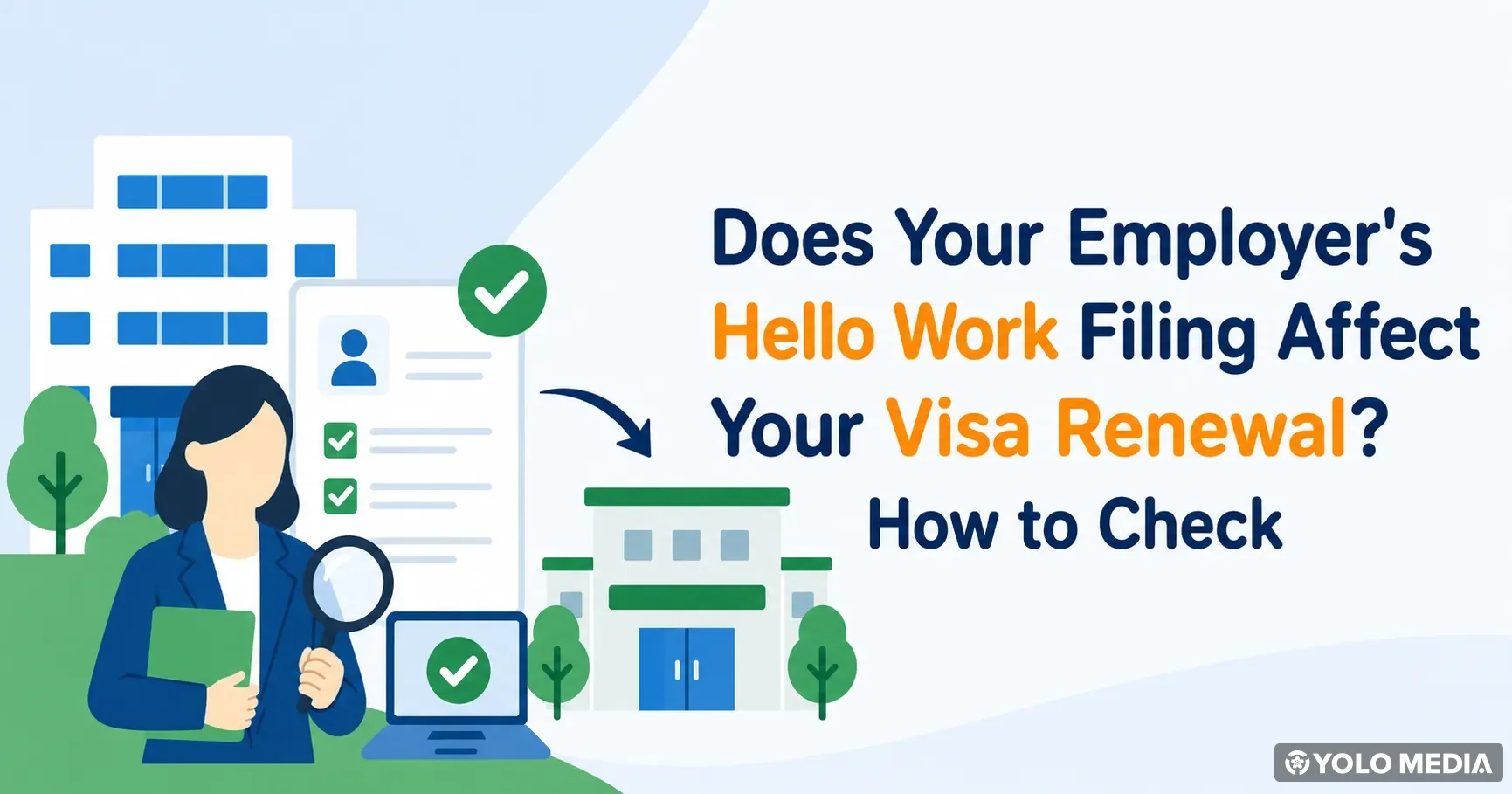
On June 14, 2026, Japan’s Ministry of Health, Labour and Welfare revised the rules around this filing. Employers who fail to file, or who submit false information, now face an explicitly stated fine of up to ¥300,000. The penalty is on the employer, not you. But if your employer hasn’t filed correctly, your visa renewal could be affected.

TL;DR
- Japan revised the rules around employer Hello Work filings, effective June 14, 2026
- Non-filing or false filing by employers carries a penalty of up to ¥300,000
- The filing obligation is on the employer, not you
- Missing filings can affect your visa renewal review
- It’s completely fine to ask HR: “Has my employment been filed with Hello Work?”
Disclaimer: This article is based on reporting from Nikkei Shimbun and public information from the Ministry of Health, Labour and Welfare as of June 12, 2026. Confirm details with your local Hello Work office or the MHLW website.
What Is This Hello Work Filing?
In Japan, every time you join or leave a company, your employer is required to notify Hello Work. The system is officially called Gaikokujin Koyō Jōkyō no Todokede (Employment Status Notification), and it is required by law.
The employer must report your name, visa category, visa expiration date, nationality, and your start or end date. The government uses this data to track who is working under which visa and to manage visa compliance.
(Source: MHLW — Employment Status Notification)
What Changed on June 14, 2026?
Penalties Are Now Explicitly Stated
The notification obligation existed before this revision. What changed is that the consequences are now spelled out clearly: employers who fail to file, or who submit false information, face a fine of up to ¥300,000. “We didn’t know” is no longer a valid defense.
Every Employer Must File — Regardless of Company Size
The obligation applies to all employers, no matter how large or small — including small shops and sole proprietors (kojin jigyō nushi, such as freelancers). Company size does not matter. The deadline is by the end of the month following your hire or departure date. That means what happens right after you join a company is the most important moment to pay attention to.
The filing obligation is entirely on your employer, not you. However, if a filing is missing or incorrect when discovered, it can work against you during your visa renewal review.
(Source: Nikkei Shimbun report, May 2026)
How Missing Filings Can Affect Your Visa Renewal
The Ministry of Health, Labour and Welfare and the Immigration Services Agency share data. Employer notification records can be checked during your visa renewal.
There are two situations to watch for: ① you work on a work-based visa (gijinkoku, Specified Skilled Worker, etc.) but your employer hasn’t filed; or ② the company listed in the notification doesn’t match where you actually work. Either situation can cause problems at renewal.
If you change jobs frequently, work on short-term contracts, or have been seconded to another company, each transition creates a new filing event — and a new chance for a gap.
How to Check Your Employer’s Filing Status
The filing is your employer’s responsibility, but you can verify it from your side. If Japanese isn’t your strongest language, it’s natural to assume the company is handling things — but since your visa depends on this, a quick check is worth it.
- When you start or leave a job, ask HR whether they’ve notified Hello Work
– “Has the required notification been filed for my employment?” is a completely normal question to ask
- Ask for a copy of the document confirming the notification was filed
– Once filed, Hello Work issues a confirmation letter to the employer. You can ask HR: “Could I get a copy of the notification confirmation for my employment?” — it’s a completely normal request
- Know your own visa category and expiration date
– Many missed filings trace back to mismatched visa categories or overlooked renewals
Ask your HR team: “Has the Hello Work notification been filed for my employment?” If they can show you the record, you’ll know right away.
Checklist for Upcoming Visa Renewals
- [ ] Confirmed with HR that Hello Work has filed the notification for my current employer
- [ ] For each job change or resignation, checked whether the notification was filed
- [ ] I know my own visa category and expiration date on my residence card
- [ ] I’ve seen or asked for a copy of the notification confirmation record
- [ ] I plan to check my filing status 3–6 months before my next visa renewal
FAQ
Does the ¥300,000 penalty apply to workers too?
No. The filing obligation and the penalty are entirely on the employer. You are not subject to this fine. However, if your employer’s filing is missing or incorrect, your visa renewal can still be affected.
Does this apply to part-time and short-term jobs?
Yes. Even if you work part-time or on a short-term contract, your employer is still required to file. Full-time, part-time, and contract workers are all covered. Regardless of how you work, it’s worth asking your employer whether the notification has been filed when you join.
Does my visa category matter?
Not just work-based visas like gijinkoku and Specified Skilled Worker — those on status-based visas such as permanent residents and spouses of Japanese nationals are also included. If you work part-time on a student or family visa, your employer still needs to file. No matter which visa you hold, checking with your employer is a good idea.
How can I check my own filing status?
The most direct way is to ask your company’s HR department to show you the notification record. You can also visit or call your local Hello Work office. If you’re applying for a visa renewal, you can also ask at the Immigration Services Agency window.
I’ve been working here since before the revision. Am I affected retroactively?
The revision clarifies enforcement going forward — penalties won’t be applied retroactively. But any ongoing filing gaps are now covered. Use this as a reason to confirm your current employer’s filing is up to date.
Key Takeaways
- ✅ If your visa renewal is coming up, check now. Ask HR: “Is the Hello Work notification for my employment on file?”
- ✅ Job changes, contract endings, and transfers are the most common points for missed filings — check every time
- ✅ Make sure the company listed in your notification matches where you actually work (especially after transfers or secondments)
- ✅ Work-based visas like gijinkoku and Specified Skilled Worker are most directly affected by filing gaps
- ✅ The obligation is on your employer — but “they’ll handle it” isn’t always a safe assumption
The 3–6 months before your visa renewal is the best time to verify. One conversation with HR is usually enough to confirm everything is in order. If something is off, catching it before the renewal window closes gives you time to fix it.
For more on work-related visa changes, see Japan Expands Specified Skilled Worker Program to 1.23 Million (2026). If you also need to sign up for health insurance after arriving, check out Japan’s National Health Insurance Prepayment System.