Introduction
You got the job. Everything was going smoothly right up until your manager said, “So just bring your documents on the first day,” and you froze because you had no idea what that meant.
At most workplaces in Japan, onboarding happens entirely in Japanese. And it usually comes all at once: “Do you know your My Number?” “Do you have a bank account?” You say yes in the moment, then get home and cannot remember a single thing you were supposed to prepare. This happens to almost everyone.
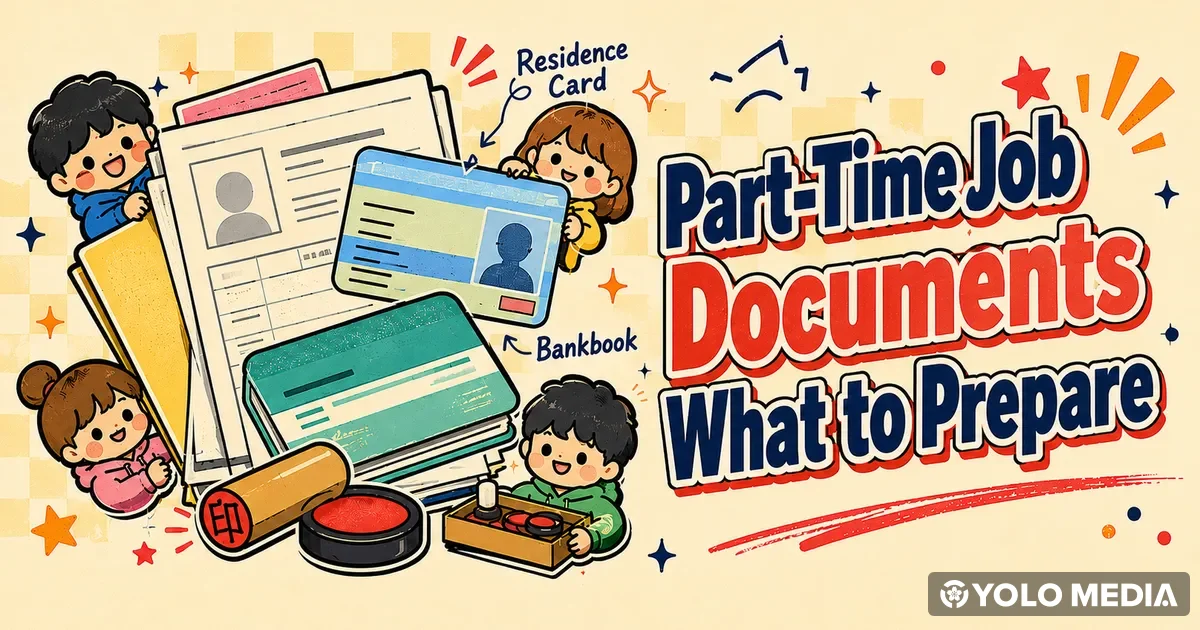
This guide walks through the paperwork you hand over when starting a part-time job (arubaito), in the order it actually comes up. It is not about how the system works in theory. It is about what to bring, where to get it, and by when. If you have not yet read about the 28-hour weekly limit or the permit you need to work on a student visa, our guide covers that in detail.
This article is for informational purposes only and does not constitute legal advice. Rules can change, so please verify details on the official websites before starting any procedure.
Think of the Paperwork in Three Groups
Documents feel confusing because very different things get lumped together. In reality they fall into three groups.
- What almost everyone is asked for (five items)
- What depends on your situation (working hours, past jobs)
- What the company gives you (you receive these, not prepare them)
Once you see the difference, nothing your manager says will catch you off guard.
Quick Reference: What to Get and Where
| Document | What it’s for | Where to get it | How long it takes |
|---|---|---|---|
| Residence card (zairyu card) | Confirming you are allowed to work | You already have it | — |
| My Number (card or residence certificate) | Tax and insurance procedures | City or ward office | Card takes about a month; certificate is same-day |
| Bank account details | Salary transfer | Bank or post office | Same day to two weeks |
| Japanese phone number | Shift communication | Mobile shop or online | Same day to a few days |
| Emergency contact | Accidents or sudden illness | You decide | — |
Counting Backwards From Day One
The tricky part is that some documents can only be obtained at a government office. You cannot sort them out on the morning of your first day. Work backwards instead.
| When | What to do |
|---|---|
| 2 weeks to 1 month before | If you do not have the work permit yet, apply at immigration. This comes first |
| 1 to 2 weeks before | Open a bank account if you do not have one. Arrange a Japanese phone number |
| 3 days before | Without a My Number Card, go to the city office for a residence certificate showing your number |
| The day before | Check the back of your residence card. Pack everything in one place |
| Day one | Bring the originals of your residence card and passport. Copies alone are not enough |
Depending on how busy immigration is, the work permit takes two weeks to a month. Starting work first and applying later does not work. Every hour worked before the permit is issued is treated as illegal employment.
If you are still looking for work, the YOLO JAPAN job features page lets you filter by Japanese level, area, and shift conditions.
The Five Items Almost Everyone Needs
Residence Card: Always Check the Back
Look at the back of your residence card. Near the bottom there is a box for permission to engage in activity other than that permitted under your status of residence (shikakugai katsudo kyoka). If it has been stamped, you are cleared to work part-time, generally up to 28 hours per week and not in adult entertainment venues.
If that box is blank and you start working anyway, it counts as illegal employment even if you had no bad intent. It can block your visa renewal or, in the worst case, lead to your status of residence being revoked (source: Immigration Services Agency, "Application for Permission to Engage in Activity Other Than That Permitted").
Workplaces usually copy both the front and the back of the card. The back is copied specifically to check that permission box. Employers are also required to report hiring international staff to Hello Work, so being asked for a copy is a legitimate part of the process.
If you are working on a Dependent visa, the same permit applies. Our guide explains how that status works in detail.
Bring the physical card. It is tempting to rely on a photo saved to your phone, but nearly every workplace asks to see the original.
My Number: Without the Card, You Need a Residence Certificate
Most people get stuck here.
Employers collect your My Number for tax filings and social insurance paperwork. The law requires them to do two things: confirm the number is correct, and confirm you are the person it belongs to. That means you may need two separate documents (source: National Tax Agency, "Main Identity Verification Documents").
What you hand over depends on what you have.
| What you have | What to submit |
|---|---|
| My Number Card | The card alone (front proves identity, back proves the number) |
| Notification Card, if the name and address still match your residence record | Notification Card plus residence card |
| Neither | Residence certificate showing your My Number, plus residence card |
Here is the catch: the Individual Number Notification does not work. The My Number Notification Card was discontinued on May 25, 2020, and people newly assigned a number since then receive a paper called the Individual Number Notification (kojin bango tsuchisho) instead. That paper cannot be used to prove your number, and it cannot be used for identity verification either (source: Ministry of Internal Affairs and Communications, "Individual Number Notification").
So if you arrived in Japan and never applied for the My Number Card, *you will need to get a residence certificate (juminhyo) from your city office with your My Number printed on it*. When you request it, say clearly that you want your My Number included. Otherwise you will be handed a version without the number, which is useless here.
One useful thing to know: your residence card works as an identity verification document on its own.
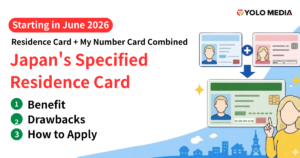
Since June 2026, the Specified Residence Card has combined the residence card and the My Number Card into a single card. If you have not made either yet, our guide covers this in detail so you avoid doing the work twice.
 Visa & Legal
Japan’s Specified Residence Card Launches June 2026: Benefits, How to Apply, and What to Know About the Combined Card
A plain-English guide to Japan's Specified Residence Card, launching June 14, 2026. What changes when your Residence Car…
Read related article
Visa & Legal
Japan’s Specified Residence Card Launches June 2026: Benefits, How to Apply, and What to Know About the Combined Card
A plain-English guide to Japan's Specified Residence Card, launching June 14, 2026. What changes when your Residence Car…
Read related article
A Bank Account for Salary Transfer
Wages are paid by bank transfer. You will need to provide the bank name, branch name, account number, and account holder name. Copies of your passbook or cash card are often requested too, so hold on to the paperwork you received when you opened the account.
The common snag is how the name is written. Japanese accounts register the holder’s name in katakana, so if the romanized spelling on your passport and the katakana on the account do not line up, transfers can be rejected. Copy it character for character from the document the bank gave you.
Also, some companies will not accept online-only banks for salary transfers, because their work rules specify which financial institutions can be used. If an online bank is all you have, check before your first day.
If you do not have a Japanese account yet, options are limited during your first six months in the country, so it pays to move early.
A Japanese Phone Number
Shift changes and last-minute coverage requests come by phone, SMS, or LINE. Overseas numbers often fail to receive SMS, so if you do not have a Japanese number yet, you will almost certainly be asked for one.
If you still need a number, services like YOLO MOBILE, the SIM card for international residents let you sign up with just your residence card. Our guide compares the options in detail.
An Emergency Contact
The company calls this person if you are injured or fall ill at work. Most employers want someone reachable inside Japan, and a number in your home country alone is often turned down.
Pick one person in advance: a teacher from your school, a roommate, a relative living in Japan. Then tell them you have listed them. People often end up scrambling to fill this in at the last minute.
Documents That Depend on Your Situation
These come up for some people and not others. You do not need to prepare them all.
*Withholding tax statement (gensen choshuhyo)* Only if you worked somewhere else earlier in the same calendar year. It is used for year-end tax adjustment. Your previous employer should have given you one when you left; if you cannot find it, you can ask them to reissue it.
Employment insurance number Only if you have been enrolled in employment insurance before. Students working for the first time will not have one.
Basic Pension Number Notification Sometimes needed for pension paperwork. Note that the pension handbook was discontinued in April 2022. Anyone who joined the pension system after that received a Basic Pension Number Notification instead. So if you are asked for a pension handbook, not having one is completely normal (source: Japan Pension Service).
On top of that, filing via My Number now removes the need to check the pension handbook or notification at all. Saying you do not have one is usually enough for the company to proceed. For the bigger picture, see our guide.
Health check certificate Sometimes requested for part-time roles, though the legal obligation applies only to certain workers. A pre-employment health check is required when someone is expected to work for a year or more and works at least three-quarters of the hours of a full-time employee (source: Industrial Safety and Health Act Article 59 and its Ordinance Article 43, as summarized by a regional labour bureau). If full-time is 40 hours, the threshold is around 30 hours.
Student visa holders are capped at 28 hours per week, so they fall below that line and are not legally covered. Employers may still ask, in which case it is worth asking whether your school’s health check results can be used instead. Paying out of pocket runs roughly ¥5,000 to ¥10,000.
Residence certificate Usually the version showing your My Number. Available at the city or ward office counter, or from a convenience store copier if you have a My Number Card. The counter charges around ¥300; convenience stores are often cheaper.
What the Company Gives You, and What to Check Before Signing
These are documents you receive rather than prepare.
*Notice of working conditions (rodo joken tsuchisho) This one matters most. It sets out your hourly wage, shifts, workplace, duties, and contract period in writing, and employers are legally obliged to provide it*. Part-time workers are covered.
Since April 2024, the list of items that must be stated has expanded. Employers now have to describe not only your current workplace and duties but also the scope of possible future changes. For fixed-term contracts, any cap on renewals must be stated as well. Failing to comply carries a fine of up to ¥300,000 (source: Ministry of Health, Labour and Welfare, "Changes to Working Condition Disclosure Rules from April 2024").
Employment contract Often overlaps with the notice of working conditions, and some companies combine them into one document. Before signing, check these five points yourself.
- The hourly wage, and the premium rates for late-night and overtime hours
- How shifts work: how many days and hours per week, and how to submit your availability
- Whether transport costs are covered, and any cap
- Whether there is a trial period, and whether the wage is lower during it
- The contract length and whether it renews
Confidentiality agreement An agreement not to share customer information or internal procedures. It sometimes includes restrictions on social media posts.
If you are told “we’ll give you the paperwork later, just start today,” be careful about beginning work on a verbal agreement alone. If a dispute comes up over wages or hours, there is nothing to point to without a written record.
For your rights once you have started, including paid leave and overtime rules, our guide covers this in detail.
What Happens With Insurance
“Do part-timers get insurance?” comes up constantly. The answer splits sharply depending on whether you are a student.
Workers’ accident compensation insurance: everyone is covered This covers injuries at work or while commuting. It applies to every worker automatically, regardless of hours or employment type, with no enrollment procedure and no premium to pay. If you are injured on shift, this is what you use rather than health insurance. Worth remembering.
Employment insurance: daytime students are exempt The general rule is enrollment at 20 or more hours per week with an expected 31 days of employment, but students attending daytime programs are excluded, on the reasoning that studying is their main occupation. Student visa holders are capped at 28 hours anyway, so the situations where this applies are limited. Evening students, correspondence students, and those on leave of absence can be exceptions and may be enrolled (source: Ministry of Health, Labour and Welfare, "Employment Insurance System").
Health insurance and employees’ pension: daytime students are generally exempt too Most international students are already enrolled in National Health Insurance and simply continue with that.
In short, a student working a normal part-time schedule will rarely be enrolled in workplace insurance. There is no need to worry about deductions eating into your pay. The picture changes for people who are not students, such as those on a Dependent visa or long-term resident status working 20 or more hours a week.
Tax is a separate matter. Income tax is withheld from your pay, and depending on annual earnings there can be effects on dependent status and even your visa. See these guides for more detail.
 Money & Finance
Japan’s ‘103-Man Resident Tax Wall’ Becomes 123-Man in June 2026: How Part-Time Spouses and Student Workers Take Home More
From June 2026, Japan's resident tax reform expands the 103-man-en wall to 123-man-en. The minimum employment income ded…
Read related article
Money & Finance
Japan’s ‘103-Man Resident Tax Wall’ Becomes 123-Man in June 2026: How Part-Time Spouses and Student Workers Take Home More
From June 2026, Japan's resident tax reform expands the 103-man-en wall to 123-man-en. The minimum employment income ded…
Read related article
Five Things That Trip People Up
1. Starting work without checking the permit on the back of the card The most common mistake and the most damaging. Even if your manager never checks, the person held responsible is you. Look at it yourself before day one.
2. Not mentioning a second job If you work multiple jobs, the 28-hour limit is calculated across all of them combined. Keeping quiet at one workplace does not hide it, since tax filings reveal it anyway. There is also a dependent deduction form that can only be submitted to one employer, so hiding a second job throws off your tax calculation.
3. Katakana and romanized names that do not match The transfer bounces and your pay arrives late. Copy it from the paperwork the bank gave you.
4. Giving your My Number verbally with no record Someone asks for “just the number,” you say it out loud, and later the documents are needed anyway. Employers have a verification obligation, so paperwork will be requested regardless. Bringing the certificate or card from the start is faster.
5. Finding out on the day that you need a personal seal Some companies still ask for a stamp (hanko) rather than a signature, and pre-inked stamps are sometimes rejected. You can buy one at a hundred-yen shop, so it is easy insurance.
FAQ
Q: My work permit has not been issued yet. Can I go in on the first day?
A: Not to work. Even a training or orientation day counts as employment if you are being paid for the time. Explain the situation and ask to push the start date back. Most workplaces will wait if you are upfront. Starting quietly is a far bigger risk.
Q: I do not have a My Number Card. What should I submit?
A: Go to your city or ward office and request a residence certificate with your My Number printed on it, then submit that together with your residence card. That combination completes the verification. Remember to specifically ask for the My Number to be included, since a certificate without it cannot be used.
Q: Can I have my salary paid to an overseas account or an online bank?
A: Overseas accounts are generally not accepted. Online banks depend on the employer, since work rules sometimes specify which institutions are allowed. Check before your first day.
Q: Do I definitely need a personal seal?
A: It varies. Signatures are increasingly accepted, but some workplaces still require a stamp, and occasionally they specify a traditional one used with red ink rather than a pre-inked type.
Q: Do I have to tell a new employer that I already have another job?
A: Yes. The 28-hour cap is measured across all your jobs combined, so if one employer does not know, you can exceed it without realizing. Going over directly affects your visa renewal.
Q: Are the documents the same on a Dependent visa?
A: The five basics are the same. Insurance is where it differs, since non-students working 20 or more hours a week can fall under employment insurance. The work permit requirement is identical to the student visa.
Q: My employer never gave me a notice of working conditions. What can I do?
A: Start by asking for it in writing. Providing it is the employer’s obligation, so requesting it is entirely reasonable. If nothing comes, you can consult the Labour Standards Inspection Office for your area. Many labour bureaus offer consultation in multiple languages.
Key Takeaways: A Final Check on the Morning of Day One
Taken one at a time, none of this paperwork is difficult. The only real problem is that some of it requires a trip to a government office, so realizing late means missing your start date.
Before you leave the house, confirm the following.
- Residence card (the original, with the permit on the back already checked)
- Passport
- My Number Card, or a residence certificate showing your My Number plus your residence card
- Bank details (passbook or cash card, and the katakana spelling of your name)
- Your Japanese phone number, ready to write down
- Emergency contact name and number, with that person’s agreement
- A personal seal, just in case
And when you receive the notice of working conditions on day one, read it there and then. Hourly wage, shifts, transport costs. Even confirming just those three against what you were told is worth the minute it takes. If something turns out differently later, that document is what protects you.
Once the paperwork is sorted, the next step is finding shifts that actually fit your schedule. YOLO JAPAN lets you filter by Japanese level and area, so there are roles you can apply for even while your Japanese is still coming along.