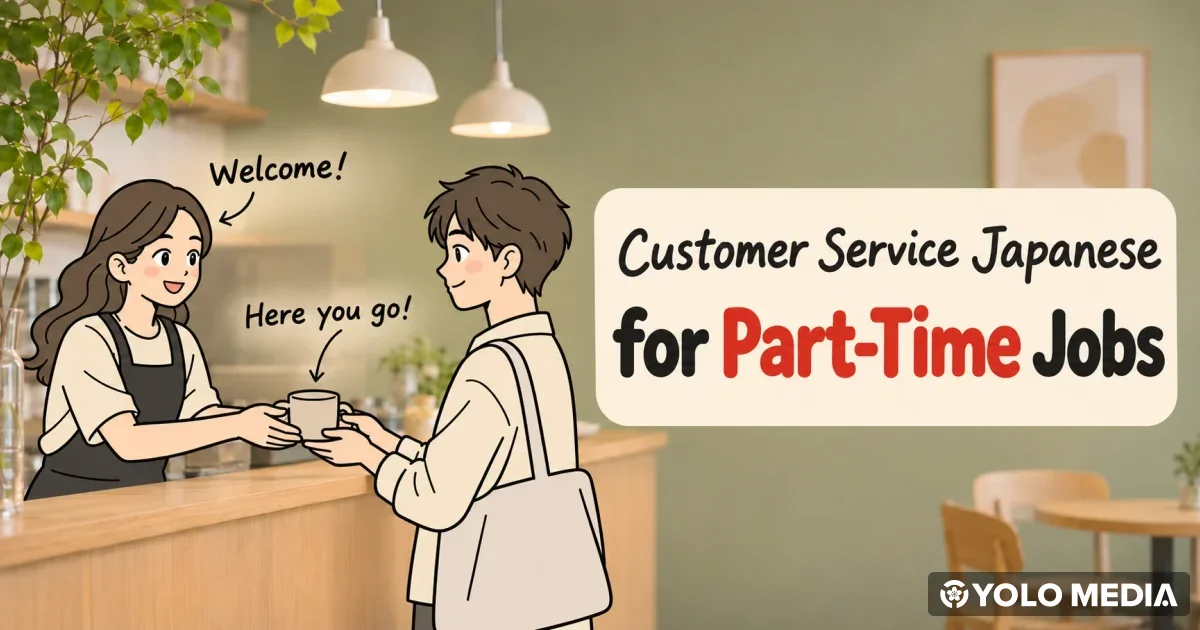
Once a part-time job is settled, the next question is what you’re actually supposed to say to customers. You may know polite desu/masu Japanese from class, but shop phrases like kashikomarimashita and omatase itashimashita don’t come up much in textbooks.
Customer service Japanese uses a fairly fixed set of phrases for each situation. You don’t need to say everything on day one; learn a little at a time and you can do the job. This guide focuses on phrases that appear in a study text for restaurant workers and in the Japan Foundation’s Japanese course Irodori, scene by scene: restaurants, registers, convenience stores, and phone calls and complaints.
What Customer Service Japanese Should I Learn First?
If you can say irasshaimase, kashikomarimashita, shōshō omachi kudasai (one moment, please), and mōshiwake gozaimasen on your first day, you’ll get through a lot. Beyond those, the study text for restaurant workers lists seven core customer service words. Convenience stores and supermarkets use almost the same words.
The “Food Service Industry Specified Skilled Worker (i) Skills Test Study Text: Customer Service,” published by the Japan Food Service Association, lists the following as basic customer service words.
| Word | When to use it |
|---|---|
| Irasshaimase (いらっしゃいませ) | Greeting customers when they come in |
| Arigatō gozaimasu / arigatō gozaimashita (ありがとうございます/ありがとうございました) | When customers leave, or when a customer does something for you |
| Omatase itashimashita (お待たせいたしました) | When you’ve kept a customer waiting a little |
| Shitsurei itashimasu (失礼いたします) | When you approach or leave a customer’s table |
| Kashikomarimashita (かしこまりました) | When you accept a customer’s request |
| Osoreirimasu (おそれいります) | To show thanks, or to apologize, to a customer |
| Mōshiwake gozaimasen (申し訳ございません) | When you apologize to a customer |
Shōshō omachi kudasai isn’t in the table, but it’s a common phrase that appears in the same text’s section on phone calls and in the Japan Foundation materials.
Kashikomarimashita is a polite way of saying wakarimashita (I understand). The Japan Foundation’s Irodori: Japanese for Life in Japan also explains it as “kashikomarimashita (= wakarimashita).”
(Reference: Japan Food Service Association "Food Service Industry Specified Skilled Worker (i) Skills Test Study Text: Customer Service" (Japanese, PDF)/Japan Foundation *Irodori: Japanese for Life in Japan* Elementary 2, Lesson 3 (Japanese, PDF))
What Do I Say on a Restaurant Floor?
Staff speak to customers in roughly the same order from the moment they arrive until they leave: greeting, taking orders, serving, checkout, and seeing them off. Lesson 3 of Irodori Elementary 2 includes a scene with a staff member at a set-meal restaurant, so let’s follow that flow.
Greeting and seating
| Phrase | Meaning |
|---|---|
| Irasshaimase. Nanmei-sama desu ka? (いらっしゃいませ。何名様ですか?) | Welcome. How many people? |
| Kochira e dōzo (こちらへどうぞ) | This way, please |
| Mōshiwake gozaimasen, manseki to natte orimasu (申し訳ございません、満席となっております) | I’m sorry, we’re full |
The study text gives examples of rephrasing nannin desu ka as nanmei-sama desu ka, and sumimasen, man’in nan desu as mōshiwake gozaimasen, manseki to natte orimasu.
Taking orders
| Phrase | Meaning |
|---|---|
| Gochūmon, okimari desu ka? (ご注文、お決まりですか?) | Are you ready to order? |
| (Gohan no ryō wa) dō nasaimasu ka? ((ご飯の量は)どうなさいますか?) | How would you like (the rice portion)? |
| Kashikomarimashita (かしこまりました) | Certainly |
| Mōshiwake gozaimasen. Tadaima, kirasete orimasu. Kawari ni ○○ wa ikaga desu ka (申し訳ございません。ただ今、きらせております。代わりに〇〇はいかがですか) | I’m sorry, we’re out of it right now. Would you like ○○ instead? |
Serving food
| Phrase | Meaning |
|---|---|
| Omatase itashimashita. ○○ de gozaimasu (お待たせいたしました。〇〇でございます) | Sorry to keep you waiting. Here’s your ○○ |
| Shitsurei itashimasu (失礼いたします) | Excuse me (when approaching or leaving a table) |
Lesson 17 of Irodori Pre-intermediate tells staff to always say the name of the dish when serving it, with the example Omatase itashimashita. Osashimi teishoku de gozaimasu (Sorry to keep you waiting. Here’s your sashimi set meal).
Checkout and seeing customers off
| Phrase | Meaning |
|---|---|
| Goissho de yoroshii desu ka? (ごいっしょでよろしいですか?) | Will you be paying together? |
| Arigatō gozaimashita (ありがとうございました) | Thank you (to customers leaving) |
| Mata, okoshi kudasaimase (また、お越しくださいませ) | Please come again |
In customer service, mata kite kudasai (please come again) becomes mata, okoshi kudasaimase. This is also one of the rephrasing examples in the study text.
(Reference: Japan Foundation *Irodori: Japanese for Life in Japan* Elementary 2, Lesson 3 (Japanese, PDF)/Pre-intermediate, Lesson 17 (Japanese, PDF)/Japan Food Service Association "Food Service Industry Specified Skilled Worker (i) Skills Test Study Text: Customer Service" (Japanese, PDF))
What Do I Say at the Register?
The questions you ask at the register are mostly set. In Lesson 11 of Irodori Elementary 2, a shop clerk says the following.
| Phrase | Meaning |
|---|---|
| Hoka wa, yoroshii desu ka? (ほかは、よろしいですか?) | Will there be anything else? |
| Soredewa, okaikei, kochira e dōzo (それでは、お会計、こちらへどうぞ) | The checkout is this way, please |
| Pointo kādo wa omochi desu ka? (ポイントカードはお持ちですか?) | Do you have a point card? |
| Shōshō omachi kudasai (少々お待ちください) | One moment, please |
When you take a customer’s money, say gosen-en oazukari shimasu (I’ve received 5,000 yen). The study text lists gosen-en kara oazukari shimasu as an incorrect expression and gosen-en oazukari shimasu as the correct one.
What does oshiharai hōhō wa ikaga itashimashō ka mean?
It means “How would you like to pay (cash or card)?” In a collection of “easy Japanese” (yasashii nihongo) case studies put together by the Tokyo Metropolitan Government, the Seven-Eleven Japan example notes that phrases like this are hard to understand for staff who are still new to Japanese. If you don’t catch it the first time, once you know what it means it gets much easier to hear.
(Reference: Japan Foundation *Irodori: Japanese for Life in Japan* Elementary 2, Lesson 11 (Japanese, PDF)/Japan Food Service Association "Food Service Industry Specified Skilled Worker (i) Skills Test Study Text: Customer Service" (Japanese, PDF)/Tokyo Metropolitan Government Bureau of Citizens, Culture and Sports "Easy Japanese Case Study: Seven-Eleven Japan" (Japanese, PDF))
How Is a Convenience Store or Supermarket Different from a Restaurant?
There’s no seating or order-taking, and the job centers on the register. Because you ask nearly the same questions every time, it’s also a job where the phrases become familiar quickly.
| Phrase | Meaning |
|---|---|
| Irasshaimase (いらっしゃいませ) | When a customer comes in |
| Reji-bukuro wa goriyō desu ka? (レジ袋はご利用ですか?) | Do you need a bag? |
| Obentō wa atatamemasu ka? (お弁当は温めますか?) | Would you like your bento heated? |
| Ohashi wa o-tsuke shimasu ka? (お箸はおつけしますか?) | Would you like chopsticks? |
| Arigatō gozaimashita (ありがとうございました) | When the customer leaves |
How staff ask about bags, heating, and chopsticks differs a little from store to store. Once you start working, use the phrases you’re taught in training or in the store manual.
What Do I Say on the Phone or When a Customer Complains?
On the phone, saying shōshō omachi kudasai and passing the call to the right person is enough at first. For complaints, if it was your mistake or the store’s, apologize right away with mōshiwake gozaimasen. If you can’t decide on your own, have your manager or the person in charge take over.
| Situation | Phrase |
|---|---|
| Answering the phone | ○○ no △△ de gozaimasu (〇〇(お店の名前)の△△(自分の名前)でございます) |
| Answering after the phone has rung three or more times | Omatase itashimashita. ○○ no △△ de gozaimasu (お待たせいたしました。〇〇の△△でございます) |
| Passing the call to the right person | ○○ ni kawarimasu node, shōshō omachi kudasai (〇〇にかわりますので、少々お待ちください) |
| The manager isn’t in | Ainiku tenchō wa fuzai desu ga… (あいにく店長は不在ですが……) |
| Receiving a complaint caused by your mistake or the store’s | Mōshiwake gozaimasen (申し訳ございません) |
| When you can’t decide yourself | Sekininsha o yonde mairimasu (責任者を呼んでまいります) |
For handling complaints, the study text shows a flow where, if you can’t make the call yourself, you tell the customer sekininsha o yonde mairimasu (I’ll get the person in charge) and have your manager take over.
For more on answering calls, see Japanese Business Email & Phone Guide 2026: Work Templates.
 Japanese Language
Japanese Business Email & Phone Guide 2026: Work Templates
Copy-paste Japanese business email templates and phone scripts for working in Japan: addressing, set phrases, requests, …
Read related article
How Do I Ask Again When I Don’t Catch Something?
Say sumimasen. Mō ichido, onegai shimasu on the spot. Asking again leads to fewer mistakes than staying quiet.
| Phrase | When to use it |
|---|---|
| Sumimasen. Mō ichido, onegai shimasu (すみません。もういちど、お願いします) | When you didn’t catch something |
| Sumimasen. Mō sukoshi, yukkuri itte kudasai (すみません。もう少し、ゆっくり言ってください) | When someone is speaking fast |
| Hai, sanjū desu ne (はい、30ですね) | To confirm key details like numbers or times |
| Sumimasen, ikutsu desu ka? (すみません、いくつですか?) | When you didn’t catch a number |
| Kono yarikata ga yoku wakaranai n desu ga… (このやり方がよくわからないんですが……) | When you don’t understand how to do a task |
| Mō ichido setsumei shite moraemasen ka? (もう一度説明してもらえませんか?) | When you’d like an explanation again |
Repeating back what you heard, as in hai, sanjū desu ne, is a really useful habit. If you got it wrong, the other person can correct you on the spot.
If a customer asks something you don’t know, don’t guess. Ask your manager or a senior coworker. The study text gives the example of rephrasing wakaranai n desu (I don’t know) as wakarikanemasu ga in customer service.
It can also help to tell your manager and coworkers at the start: Nihongo o benkyō-chū desu. Yukkuri hanashite moraeru to tasukarimasu (I’m studying Japanese. It helps if you speak slowly). It makes it easier for them to figure out how to explain things to you.
(Reference: Japan Foundation *Irodori: Japanese for Life in Japan* Starter, Lesson 2 (Japanese, PDF)/Starter, Lesson 10 (Japanese, PDF)/Elementary 1, Lesson 9 (Japanese, PDF)/Elementary 1, Lesson 13 (Japanese, PDF)/Japan Food Service Association "Food Service Industry Specified Skilled Worker (i) Skills Test Study Text: Customer Service" (Japanese, PDF))
How Do I Greet My Coworkers?
Say ohayō gozaimasu when your shift starts and osaki ni shitsurei shimasu when you leave. Greetings for the people you work with matter just as much as the words you use with customers.
| Phrase | When to use it |
|---|---|
| Ohayō gozaimasu (おはようございます) | When you arrive at work |
| Otsukaresama desu (お疲れさまです) | When greeting coworkers who are working |
| Osaki ni shitsurei shimasu (お先に失礼します) | When you leave before others |
| Otsukaresama deshita (お疲れさまでした) | To someone who is leaving before you |
| Osoku natte, mōshiwake arimasen (遅くなって、申し訳ありません) | When you’re late |
Lesson 1 of Irodori Starter includes the end-of-work exchange Osaki ni shitsurei shimasu / A, otsukaresama deshita. Lesson 14 of Elementary 1 has a scene where someone apologizes for being late with osoku natte, mōshiwake arimasen.
For what to say when you’re running late, see Running Late in Japanese: Phrases for Interviews and Work.
 Japanese Language
Running Late in Japanese: Phrases for Interviews and Work
Japanese phrases for running late to an interview, part-time job, or work: phone scripts, email and LINE examples, phras…
Read related article
What’s the difference between otsukaresama and gokurōsama?
Use otsukaresama desu and otsukaresama deshita with your manager and senior coworkers, not gokurōsama. “Guidelines for Keigo,” a report by the Council for Cultural Affairs, explains that gokurōsama is a way of showing appreciation to someone who did work for you, and is better not used toward people above you.
Otsukaresama, on the other hand, is described as often used when people call out to each other.
For more on workplace manners, see Japanese Business Etiquette: Workplace Rules for Newcomers.
 Work & Career
Japanese Business Etiquette: Workplace Rules for Newcomers
Japanese business etiquette for newcomers: greetings, horenso, business cards, seating, overtime and paid leave, drinkin…
Read related article
(Reference: Japan Foundation *Irodori: Japanese for Life in Japan* Starter, Lesson 1 (Japanese, PDF)/Elementary 1, Lesson 14 (Japanese, PDF)/Council for Cultural Affairs report "Guidelines for Keigo" (Japanese, PDF))
Are Yoroshikatta Deshō Ka and ~ Ni Narimasu Wrong?
At first, it’s fine to use the phrases you’re taught in your store’s manual. Working in a shop, you’ll often hear gochūmon wa ijō de yoroshikatta deshō ka (Was that everything for your order?) and kochira ga reshīto ni narimasu (Here’s your receipt), but the study text lists these as “commonly mistaken expressions” and shows how to correct them.
| Incorrect expression | Correct expression |
|---|---|
| Oryōri wa ijō de yoroshikatta deshō ka | Oryōri wa ijō de yoroshii deshō ka |
| Omizu no hō wa ikutsu omochi shimashō ka | Omizu wa ikutsu omochi shimashō ka |
| Kochira ga reshīto ni narimasu | Kochira ga reshīto de gozaimasu |
| Gosen-en kara oazukari shimasu | Gosen-en oazukari shimasu |
In real shops, though, phrases like these are used a lot. Even Irodori includes a conversation where a set-meal restaurant staff member says happyaku-en ni narimasu (That comes to 800 yen). The Council for Cultural Affairs’ “Guidelines for Keigo” says customer service manuals shouldn’t be treated as the one and only correct answer, while also saying they’re useful as a guide for people who aren’t yet used to keigo.
As you get used to the job, learning the “correct expressions” in the table above will help when you move to another shop or want to sound more polite.
To learn keigo itself, see Keigo for Work in Japan: Sonkeigo, Kenjogo and Key Phrases.
 Japanese Language
Keigo for Work in Japan: Sonkeigo, Kenjogo and Key Phrases
Keigo for the Japanese workplace: the types of keigo, sonkeigo vs kenjogo, how to form them, a word list, talking about …
Read related article
(Reference: Japan Food Service Association "Food Service Industry Specified Skilled Worker (i) Skills Test Study Text: Customer Service" (Japanese, PDF)/Japan Foundation *Irodori: Japanese for Life in Japan* Elementary 2, Lesson 3 (Japanese, PDF)/Council for Cultural Affairs report "Guidelines for Keigo" (Japanese, PDF))
How Can I Learn Customer Service Japanese Faster?
Start with the four first-day phrases, practice out loud, and copy your senior coworkers.
- Practice out loud: Customer service phrases need to come out of your mouth quickly, not just make sense when you hear them. Try repeating them quietly on your commute
- Copy your senior coworkers: The phrases your coworkers use are that store’s standard phrases. Write down what you hear
- Ask about anything unclear the same day: Before it gets awkward to ask, check at the end of your shift
For the documents you need before starting work, see Part-Time Job Documents in Japan: What to Prepare.
 Work & Career
Part-Time Job Documents in Japan: What to Prepare
A practical guide to the paperwork for a part-time job in Japan: the five documents almost everyone needs, handling My N…
Read related article
If you want to keep studying Japanese, check out Best Japanese Learning Apps 2026: Duolingo, WaniKani, Anki & More and JLPT Study Guide 2026: Pass Rates, Levels, Materials & Registration (N5 to N1).
 Japanese Language
Best Japanese Learning Apps 2026: Duolingo, WaniKani, Anki & More — Honest Comparison
A practical comparison of the best Japanese learning apps in 2026. Duolingo, HelloTalk, WaniKani, Anki, Bunpro, LingQ an…
Read related article
 Japanese Language
JLPT Study Guide 2026: Pass Rates, Levels, Materials & Registration (N5 to N1)
A complete guide to the Japanese Language Proficiency Test (JLPT): all five levels and their pass rates explained, with …
Read related article
YOLO WORK is a job service for international residents that lets you search openings by Japanese level, area, and industry. If you’re looking for a part-time job, its Part-Time Jobs feature lists current part-time openings. To narrow it down to jobs where you’ll use customer service Japanese, see the Customer Service & Sales collections.
FAQ
Q: Can I work in customer service if I can’t speak much Japanese?
A: There are jobs you can do even if your Japanese isn’t very good yet. The phrases used in customer service are fairly set, so learn the core words in this guide, and if you don’t understand something, ask again with mō ichido, onegai shimasu. If you’d rather start with a job that involves less talking, check job listings for whether the job includes customer service.
YOLO WORK’s job search lets you filter openings by Japanese level.
For how to find jobs that don’t require Japanese, see Student Part-Time Jobs in Japan With Little or No Japanese.
 Work & Career
Student Part-Time Jobs in Japan With Little or No Japanese
Can't speak Japanese yet? Here are 5 student part-time jobs in Japan you can start with little or no Japanese, plus work…
Read related article
Q: Are the phrases different at a convenience store and a restaurant?
A: The core customer service words are almost the same. Restaurants add phrases for seating, taking orders, and serving food, while convenience stores center on the questions you ask at the register, such as bags, heating, and chopsticks.
Q: What’s the difference between kashikomarimashita and wakarimashita?
A: They mean the same thing. Kashikomarimashita is the polite version of wakarimashita, used when you accept a customer’s order or request.
Q: What should I do if I can’t catch what a customer said?
A: Ask again politely, for example mōshiwake gozaimasen. Mō ichido, onegai shimasu. If you don’t know the answer to a question, don’t answer it yourself. Ask your manager or a senior coworker to take over.
Q: Is it OK to use yoroshikatta deshō ka?
A: If that’s what your store’s manual taught you, it’s fine to use it at first. A study text for restaurant workers lists yoroshii deshō ka as the correct expression, so it’s good to know both.
Q: Can I say gokurōsama desu to my manager?
A: It’s considered better not to use gokurōsama with people above you. Use otsukaresama desu or otsukaresama deshita instead.
Key Takeaways
- ✅ Start with four phrases: irasshaimase, kashikomarimashita, shōshō omachi kudasai, mōshiwake gozaimasen
- ✅ Learn them as a flow: greeting, taking orders, serving, checkout, and seeing customers off each have fairly set phrases. Convenience stores center on register questions
- ✅ Asking again isn’t rude: confirm with mō ichido, onegai shimasu or sanjū desu ne. For complaints you can’t judge on your own, say sekininsha o yonde mairimasu and have your manager take over
- ✅ Greetings for coworkers matter too: otsukaresama desu, osaki ni shitsurei shimasu. Don’t use gokurōsama with people above you
- ✅ Following your store’s manual is fine at first: learn more polite phrasing as you get used to the job
Customer service Japanese starts coming out naturally as you use it every day. Even if it doesn’t come out right at first, adding one phrase at a time is enough.