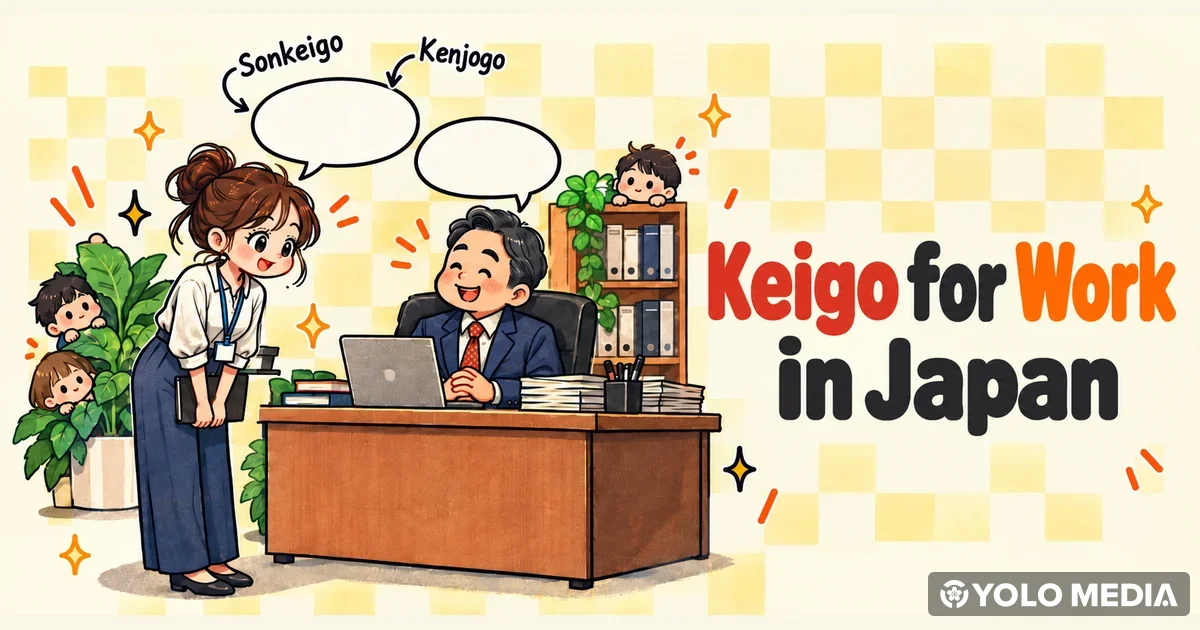
In Japanese workplaces, people use keigo (敬語), or polite and honorific language, when talking to managers, clients, and customers. Keigo is a set of rules for showing respect through language to the person you’re talking to or the person you’re talking about. There’s a lot to learn, but once you understand how it works, it becomes much easier to know which words to use and when.
Keigo is a topic that Japanese people themselves care about, too. In the Agency for Cultural Affairs’ fiscal 2025 Public Opinion Poll on the Japanese Language, people who were interested in the Japanese language were asked which areas interested them (up to three answers). “The use of keigo” came second at 48.6%, after “everyday wording and ways of speaking” (77.0%).
(Reference: Agency for Cultural Affairs "Summary of the Fiscal 2025 Public Opinion Poll on the Japanese Language" (Japanese, PDF))
In this guide, we cover:
- The types of keigo (three types and five types)
- How to form sonkeigo (respectful language) and kenjogo (also written kenjougo) (humble language)
- A list of common words and their keigo forms
- The difference between ukagau and mairu
- How to talk about people from your own company to outsiders
- Phrases for common workplace situations
- Common mistakes, and what to do when keigo feels hard
For set phrases used in email and on the phone, see Japanese Business Email & Phone Guide 2026: Work Templates. It’s a good companion to this guide.
 Japanese Language
Japanese Business Email & Phone Guide 2026: Work Templates
Copy-paste Japanese business email templates and phone scripts for working in Japan: addressing, set phrases, requests, …
Read related article
Japanese Language
Japanese Business Email & Phone Guide 2026: Work Templates
Copy-paste Japanese business email templates and phone scripts for working in Japan: addressing, set phrases, requests, …
Read related article
1. Types of Keigo
The three types taught in school
In school education and elsewhere, keigo has been explained as three types.
| Type | What it does | Examples |
|---|---|---|
| Sonkeigo (尊敬語, respectful) | Raises the actions of the other person or the person being discussed | irassharu, ossharu |
| Kenjogo (謙譲語, humble) | Lowers the actions of your own side | ukagau, mosu |
| Teineigo (丁寧語, polite) | Speaks politely to the listener | desu, masu |
The five types in the “Guidelines for Keigo”
In 2007, the Council for Cultural Affairs issued a report called the “Guidelines for Keigo,” which divides keigo into five types. It splits humble language into “humble language I” and “humble language II,” and polite language into “polite language” and “refined language.” The report says this doesn’t conflict with the three-type approach.
| Type | Description | Examples |
|---|---|---|
| Respectful language | Describes the actions, things, or state of the other side or a third person in a way that raises that person (you speak highly of the other person’s actions) | irassharu, ossharu, meshiagaru |
| Humble language I | Describes actions from your side toward the other side or a third person in a way that raises the person on the receiving end (you speak modestly of your own actions to raise the other person) | ukagau, moshiageru, ome ni kakaru |
| Humble language II (courteous language) | Describes your own side’s actions courteously to the listener or reader (you speak formally about yourself to the person you’re talking to) | mairu, mosu, itasu, oru |
| Polite language | Speaks or writes politely to the listener or reader | desu, masu |
| Refined language (bikago) | Describes things in a refined way | osake (sake), oryori (food) |
(Reference: Council for Cultural Affairs report "Guidelines for Keigo" (Japanese, PDF) / Kotobank "敬語" (Japanese))
At work, the most important thing is telling respectful and humble language apart. The key question is: whose action is it?
- The action of the other person or a third person (your manager, a client, a customer) → respectful language
- The action of you or someone from your company → humble language
“The manager is coming” becomes bucho ga irassharu, and “I’ll go” becomes watashi ga mairimasu or watashi ga ukagaimasu.
Start with desu and masu
Using all five types correctly from the start is hard. Begin by speaking in the polite desu/masu form. It sounds much more polite than talking to your manager or clients the way you talk to friends. From there, you can gradually learn the respectful and humble words you hear often at work.
2. How to Form Respectful and Humble Language
Some keigo words have a completely different form from the original word, like irassharu (special forms). Others are made by fitting a word into a set pattern (general forms). Learning the general forms lets you turn a wide range of verbs into keigo.
Forming respectful language
| Pattern | Examples |
|---|---|
| o (go) + verb stem + ni naru | tsukau (use) → otsukai ni naru, riyo suru (use) → goriyo ni naru |
| verb + (ra)reru | yomu (read) → yomareru, hajimeru (start) → hajimerareru |
| go + noun + nasaru (for “~ suru” verbs) | setsumei suru (explain) → gosetsumei nasaru |
Forming humble language I
| Pattern | Examples |
|---|---|
| o (go) + verb stem + suru | todokeru (deliver) → otodoke suru, annai suru (guide) → goannai suru |
| o (go) + verb stem + moshiageru | annai suru (guide) → goannai moshiageru |
Forming humble language II
| Pattern | Examples |
|---|---|
| noun + itasu (only for “~ suru” verbs) | riyo suru (use) → riyo itashimasu |
| o (go) + verb stem + itasu (humble I and II) | matsu (wait) → omachi itashimasu, setsumei suru (explain) → gosetsumei itashimasu |
O (go) + verb stem + itasu replaces the suru in omachi suru (humble language I) with itasu (humble language II). It raises the person you’re waiting for while also speaking courteously to your listener. You’ll often hear it at work, as in eki de omachi itashimasu (I’ll wait for you at the station) or shiryo o gosetsumei itashimasu (I’ll explain the materials).
Choosing between o and go
As a rule, o goes with native Japanese words (wago), and go goes with words of Chinese origin (kango, words read with on-yomi).
| Rule | Examples |
|---|---|
| o + native Japanese word | onamae (name), oisogashii (busy), oyomi ni naru, otodoke suru |
| go + word of Chinese origin | gojusho (address), gosetsumei (explanation), goriyo ni naru, goannai suru |
There are exceptions, though. In refined language, some words of Chinese origin take o, like oryori (food) and okesho (makeup), and some words are irregular, like ogenki and okagen. When in doubt, follow how the people around you at work say it.
(Reference: Council for Cultural Affairs report "Guidelines for Keigo" (Japanese, PDF))
O + ni naru is for the other person’s actions, and o + suru is for your own. The patterns look similar, so think about whose action it is before choosing.
- ○ Bucho ga shiryo o otsukai ni naru (The manager uses the materials: the manager’s action → respectful)
- ○ Watashi ga shiryo o otodoke suru (I deliver the materials: my action → humble I)
- × Kacho, sono fairu mo kaigishitsu ni omochi shimasu ka (humble language I used for the section manager’s action)
- ○ Kacho, sono fairu mo kaigishitsu ni omochi ni narimasu ka (Section manager, will you take that file to the meeting room too?)
3. Keigo Forms of Common Words
Here’s a business keigo list of common workplace verbs with their respectful and humble forms. In the humble column, (I) and (II) refer to humble language I and II in the “Guidelines for Keigo.”
| Plain form (English) | Respectful (other person’s action) | Humble (your side’s action) |
|---|---|---|
| iru (be) | irassharu, oide ni naru | oru (II) |
| iku (go) | irassharu, oide ni naru | ukagau (I), mairu (II) |
| kuru (come) | irassharu, omie ni naru, oide ni naru | mairu (II) |
| iu (say) | ossharu | moshiageru (I), mosu (II) |
| suru (do) | nasaru | itasu (II) |
| shitte iru (know) | gozonji da | zonjite iru (II) |
| omou (think) | oomoi ni naru | zonjiru (II) |
| taberu / nomu (eat, drink) | meshiagaru | itadaku |
| miru (see) | goran ni naru | haiken suru (I) |
| miseru (show) | omise ni naru | ome ni kakeru (I), goran ni ireru (I) |
| au (meet) | oai ni naru | ome ni kakaru (I) |
| kiku (ask) | okiki ni naru | ukagau (I) |
| morau (receive) | ouketori ni naru | itadaku (I) |
| ageru (give) | ― | sashiageru (I) |
(Reference: Council for Cultural Affairs report "Guidelines for Keigo" (Japanese, PDF) / Kotobank "戴く" (Japanese))
Cells marked “―” aren’t covered in this table. Oomoi ni naru and ouketori ni naru are respectful forms made with the o + ni naru pattern from Section 2. Itadaku in the sense of “eat” or “drink” isn’t among the examples of humble language I or II in the “Guidelines for Keigo,” so it isn’t marked (I) or (II).
There’s no need to memorize the whole list. Start with the ones you’ll use almost every day at work: irassharu, ossharu, mairu, mosu, itasu, and oru.
4. The Difference Between Ukagau and Mairu
Both ukagau and mairu are humble words for “go” when you’re the one going. But they raise different people.
- **Ukagau (humble I)*: Raises the person you’re going to. Use it when the destination is someone of higher status, as in sensei no tokoro ni ukagaimasu* (I’ll visit my teacher)
- **Mairu (humble II)**: Speaks courteously to your listener. It doesn’t raise the person you’re going to
So ototo no tokoro ni ukagaimasu (I’ll visit my younger brother, with ukagau) is wrong, but ototo no tokoro ni mairimasu (with mairu) is fine. There’s no need to raise your brother; you’re just speaking courteously to your listener.
(Reference: Council for Cultural Affairs report "Guidelines for Keigo" (Japanese, PDF))
At work, use them like this:
| Situation | Phrase |
|---|---|
| Visiting a client’s company | Ashita, onsha ni ukagaimasu (I’ll visit your company tomorrow) |
| Telling your manager you’re heading to the meeting room | Sugu ni kaigishitsu e mairimasu (I’ll go to the meeting room right away) |
| Telling a client your manager will visit | Bucho no Yamada ga ukagaimasu (Yamada, our department manager, will visit you) |
5. Talking About People from Your Own Company to Outsiders
Japanese keigo uses the idea of uchi (inside) and soto (outside). When you talk with someone outside your company (soto), you don’t raise people from your own company (uchi); you treat them as being on your side. Even when talking about your manager, you refer to them as “Yamada” or “Bucho no Yamada” with outsiders and don’t use respectful language.
| Situation | To someone in your company | To someone outside your company |
|---|---|---|
| Your manager isn’t here | Yamada bucho wa irasshaimasen | Yamada wa orimasen / Bucho no Yamada wa tadaima seki o hazushite orimasu |
| Your manager said something | Yamada bucho ga osshaimashita | Yamada ga moshite orimashita |
Calling your manager just “Yamada” to a client is described as a way of speaking based on the uchi/soto relationship, and it’s completely different from being rude by dropping their title.
(Reference: Council for Cultural Affairs report "Guidelines for Keigo" (Japanese, PDF))
In the Agency for Cultural Affairs’ fiscal 2025 Public Opinion Poll on the Japanese Language, people were asked which phrase is best when a company receptionist talks to an outside visitor about Section Manager Suzuki from their own company. Of the four options, “Suzuki wa…,” “Kacho no Suzuki wa…,” “Suzuki kacho wa…,” and “Suzuki-san wa…,” the most common answer was “Suzuki wa…” at 37.4%, followed by “Kacho no Suzuki wa…” at 35.8%.
(Reference: Agency for Cultural Affairs "Summary of the Fiscal 2025 Public Opinion Poll on the Japanese Language" (Japanese, PDF))
Keigo is also used with people from other organizations, such as clients, regardless of age. Even if a client is younger than you, speak to them in keigo.
(Reference: Council for Cultural Affairs report "Guidelines for Keigo" (Japanese, PDF))
For a quick reference on how to refer to your company and theirs (onsha, heisha, and so on), see Japanese Business Email & Phone Guide 2026: Work Templates.
6. Phrases for Common Workplace Situations
Reporting to and consulting your manager
| Situation | Phrase |
|---|---|
| Getting their attention | Ima, sukoshi ojikan yoroshii desho ka (Do you have a moment?) |
| Reporting | ~ no ken de, gohokoku ga arimasu (I have something to report about ~) |
| Asking for advice | ~ no ken de, gosodan shitai koto ga aru no desu ga (I’d like to consult you about ~) |
| Receiving instructions | Shochi shimashita (Understood) |
| Double-checking | Nen no tame kakunin sasete kudasai (Let me just confirm) |
Meetings
| Situation | Phrase |
|---|---|
| Giving your opinion | Watashi wa ~ to kangaete orimasu (I think ~) |
| Asking a question | Itten, ukagatte mo yoroshii desho ka (May I ask one question?) |
| Didn’t catch something | Osoreirimasu ga, mo ichido osshatte itadakemasu ka (Excuse me, could you say that again?) |
| Pointing to materials | Kochira no shiryo o goran kudasai (Please take a look at these materials) |
Taking a day off or running late
| Situation | Phrase |
|---|---|
| Asking for a day off | ~ nichi ni oyasumi o itadakitai no desu ga, yoroshii desho ka (May I take a day off on ~?) |
| Feeling sick | Moshiwake arimasen. Taicho ga warui tame, honjitsu wa oyasumi o itadakenai desho ka (I’m sorry. I’m not feeling well; may I take today off?) |
| Running late | Densha ga okurete iru tame, juppun hodo okuremasu. Moshiwake arimasen (My train is delayed, so I’ll be about 10 minutes late. I’m sorry) |
Serving customers
| Situation | Phrase |
|---|---|
| Welcoming | Irasshaimase (Welcome) |
| Asking them to wait | Shosho omachi kudasai (Please wait a moment) |
| Taking an order or request | Kashikomarimashita (Certainly) |
| Confirming | ~ de yoroshii desho ka (Is ~ correct?) |
| Apologizing | Taihen moshiwake gozaimasen (I’m very sorry) |
Saying thank you and saying no
| Situation | Phrase |
|---|---|
| Someone helped you | Arigato gozaimasu. Tasukarimashita (Thank you. That really helped) |
| Someone made time for you | Oisogashii tokoro, arigato gozaimashita (Thank you for your time when you’re busy) |
| Declining an invitation | Arigato gozaimasu. Ainiku, sono hi wa tsugo ga tsukimasen (Thank you. Unfortunately, I can’t make it that day) |
| Can’t take on a task right now | Moshiwake arimasen. Kyoju ni wa muzukashii node, ashita no gozen demo yoroshii desho ka (I’m sorry. Today would be difficult; would tomorrow morning be all right?) |
When you say no, also giving the reason and what you can do instead makes it easier for the other person to plan their next step.
Words to add before a request or refusal
Adding a short phrase before a request or a refusal softens what you say.
- Osoreirimasu ga (Excuse me, but): could I ask your name again?
- Otesu desu ga (Sorry to trouble you, but): could you please check this?
- Moshiwake arimasen ga (I’m sorry, but): that day doesn’t work for me
- Sashitsukae nakereba (If you don’t mind): could you give me your contact details?
For greetings at work and how to report, inform, and consult (horenso), see Japanese Business Etiquette: Workplace Rules for Newcomers.
 Work & Career
Japanese Business Etiquette: Workplace Rules for Newcomers
Japanese business etiquette for newcomers: greetings, horenso, business cards, seating, overtime and paid leave, drinkin…
Read related article
Work & Career
Japanese Business Etiquette: Workplace Rules for Newcomers
Japanese business etiquette for newcomers: greetings, horenso, business cards, seating, overtime and paid leave, drinkin…
Read related article
7. Common Keigo Mistakes
Using respectful language for your own actions
- × Ashita, watashi ga irasshaimasu
- ○ Ashita, watashi ga mairimasu
Irassharu is respectful language for the actions of the other person or a third person. For your own actions, use the humble mairu or ukagau.
Using humble language for the other person’s actions
- × Bucho ga mairaremasu
- ○ Bucho ga irasshaimasu
Mairu is humble language II, which describes your own side’s actions courteously, so it isn’t used for the actions of people you want to raise, such as your manager. In the fiscal 2019 poll, 77.4% of people said the phrase okyakusama ga mairarete imasu (“the customer has come,” using mairu) bothered them.
(Reference: Agency for Cultural Affairs "Summary of the Fiscal 2019 Public Opinion Poll on the Japanese Language" (Japanese, PDF))
Is gojisan kudasai wrong?
Gojisan kudasai (please bring) and omoshide kudasai (please let us know) contain mairu and mosu, humble language II words used for your own side. However, the “Guidelines for Keigo” says that mairu and mosu in these phrases don’t work as humble language II, so they are fine to use for the other person’s actions. Some people still find them a little off, so if that bothers you, you can also use the following alternatives.
| Phrase some find off | Alternative |
|---|---|
| Gojisan kudasai | Omochi kudasai |
| Omoshide kudasai | Osshatte kudasai |
(Reference: Council for Cultural Affairs report "Guidelines for Keigo" (Japanese, PDF))
Double keigo
Using the same type of keigo twice on one word is called “double keigo” (niju keigo). For example, oyomi ni narareru adds the respectful -reru to oyomi ni naru, which is already respectful. Double keigo is generally considered inappropriate.
Some double keigo has become established through habit, though.
| Type | Established examples |
|---|---|
| Respectful | omeshiagari ni naru, omie ni naru |
| Humble I | oukagai suru, oukagai itasu, oukagai moshiageru |
(Reference: Council for Cultural Affairs report "Guidelines for Keigo" (Japanese, PDF))
Oukagai itashimasu is fine to use at work. What to avoid is adding -reru to a word that’s already respectful, as in oyomi ni narareru. Oyomi ni naru alone is enough.
Overusing sasete itadaku
Sasete itadaku is described as a form for things you do with the other person’s permission and that benefit you. Using it where these conditions don’t apply can sound unnatural.
- Situations that need the other person’s permission, such as kopi o torasete itadakemasu ka (may I make a copy?) or kakunin sasete itadakemasu ka (may I confirm?) → natural
- Situations unrelated to anyone’s permission, such as “~ koko o sotsugyo sasete itadakimashita” (I graduated from ~ High School) → “~ koko o sotsugyo shimashita” is usually enough (in a context where you’re thanking your teachers, it’s said not to be unnatural)
(Reference: Council for Cultural Affairs report "Guidelines for Keigo" (Japanese, PDF))
Slipping into casual speech
To keep casual phrases like ~ da yo ne or ~ jan out of your speech, make a habit of speaking in desu/masu at work.
8. Keigo on the Phone and in Email
The phone and email involve a lot of set phrases. Knowing the common ones will help you stay calm.
| Situation | Phrase |
|---|---|
| Answering the phone | Odenwa arigato gozaimasu. ~ kabushiki gaisha no ~ de gozaimasu (Thank you for calling. This is ~ from ~ Company) |
| The person they want isn’t available | Moshiwake gozaimasen. Tadaima seki o hazushite orimasu (I’m sorry. They’re away from their desk right now) |
| You’ll call back | Kakunin shite, orikaeshi gorenraku itashimasu (I’ll check and get back to you) |
| The person in charge will call back | Tanto no mono kara, orikaeshi gorenraku itashimasu (The person in charge will get back to you) |
| Opening an email to someone outside your company | Itsumo osewa ni natte orimasu (Thank you for your continued support) |
| Closing an email | Yoroshiku onegai itashimasu (Thank you in advance) |
For templates and how to transfer calls, see Japanese Business Email & Phone Guide 2026: Work Templates.
9. What to Do When Keigo Feels Hard, and How to Practice
If you’re not sure, say so honestly
When you’re not confident in your keigo, it’s safer to speak honestly in polite language than to force difficult words.
- Mada keigo ga kanpeki de wa arimasen ga, benkyo shite imasu (My keigo isn’t perfect yet, but I’m studying)
- Kakunin shite kara, aratamete gorenraku itashimasu (I’ll check and get back to you)
- Ima no iikata de shitsurei ga nakatta ka, oshiete itadakemasu ka (Could you tell me if the way I just said that was rude?)
How to practice
- Start with phrases you use every day: Shochi shimashita, otsukaresama desu, moshiwake arimasen, and so on
- Save the list from Section 3 on your phone: so you can check it before you use a word
- Copy the people at work: listen to how your manager and senior colleagues change their wording for people inside and outside the company
- Practice in email: you can review written language, so it’s easier to check your keigo forms
- Note down phrases you don’t understand and ask: ask a senior colleague you trust, a few at a time
If you want to study for the Japanese-Language Proficiency Test (JLPT) at the same time, see JLPT Study Guide 2026: Pass Rates, Levels, Materials & Registration (N5 to N1). The JLPT’s official level descriptions don’t mention keigo, so it’s best to think of test levels and workplace keigo separately.
 Japanese Language
JLPT Study Guide 2026: Pass Rates, Levels, Materials & Registration (N5 to N1)
A complete guide to the Japanese Language Proficiency Test (JLPT): all five levels and their pass rates explained, with …
Read related article
Japanese Language
JLPT Study Guide 2026: Pass Rates, Levels, Materials & Registration (N5 to N1)
A complete guide to the Japanese Language Proficiency Test (JLPT): all five levels and their pass rates explained, with …
Read related article
(Reference: Japanese-Language Proficiency Test official site "N1-N5: Summary of Linguistic Competence Required for Each Level")
FAQ
Q: Do I have to use keigo at work even if I’m not Japanese?
A: When talking to managers, clients, or customers, keigo is the basic expectation. You don’t have to use every form correctly from the start. Begin with desu/masu, then gradually add the respectful and humble words you use most.
Q: How do I choose between respectful and humble language?
A: Decide based on whose action it is. Use respectful language (irassharu, ossharu) for the actions of the other person or a third person, and humble language (mairu, mosu) for the actions of you or people from your company.
Q: Oukagai itashimasu is double keigo. Shouldn’t I avoid it?
A: It’s fine to use. The Council for Cultural Affairs’ report “Guidelines for Keigo” lists oukagai suru and oukagai itasu as examples of double keigo that have become established through habit.
Q: Why shouldn’t I call my manager “Yamada bucho” to people outside the company?
A: When talking to outsiders, you treat people from your company as uchi (inside) and don’t raise them. You say “Yamada wa…” or “Bucho no Yamada wa….” This is a keigo convention, not rudeness.
Q: Should I use keigo with clients who are younger than me?
A: Yes. Keigo is used with people from other organizations, such as clients, regardless of age.
Q: What should I do if I use keigo incorrectly?
A: When you notice, simply correct yourself: shitsurei shimashita. ~ to moshiageru beki deshita (Excuse me, I should have said ~). Ask a senior colleague or your manager about phrases you weren’t sure of, and you’ll be able to use them next time.
Key Takeaways
- ✅ *Start with desu/masu***. Then gradually learn common respectful and humble words
- ✅ Choose based on whose action it is. Respectful for the other person or a third person, humble for your side
- ✅ Don’t raise people from your own company to outsiders. Even your manager becomes “Yamada wa…“
- ✅ Watch out for double keigo. But oukagai itashimasu is an established phrase
- ✅ If you’re unsure, be honest in polite language. You don’t need to be perfect; you’ll learn as you go
You don’t learn keigo all at once. Keep using it in daily conversations and emails, and add a little more over time.