Introduction
You show your passport at a drugstore or an electronics store in Japan, but the cashier says, “That will be the tax-included price.” Isn’t this supposed to be tax-free?
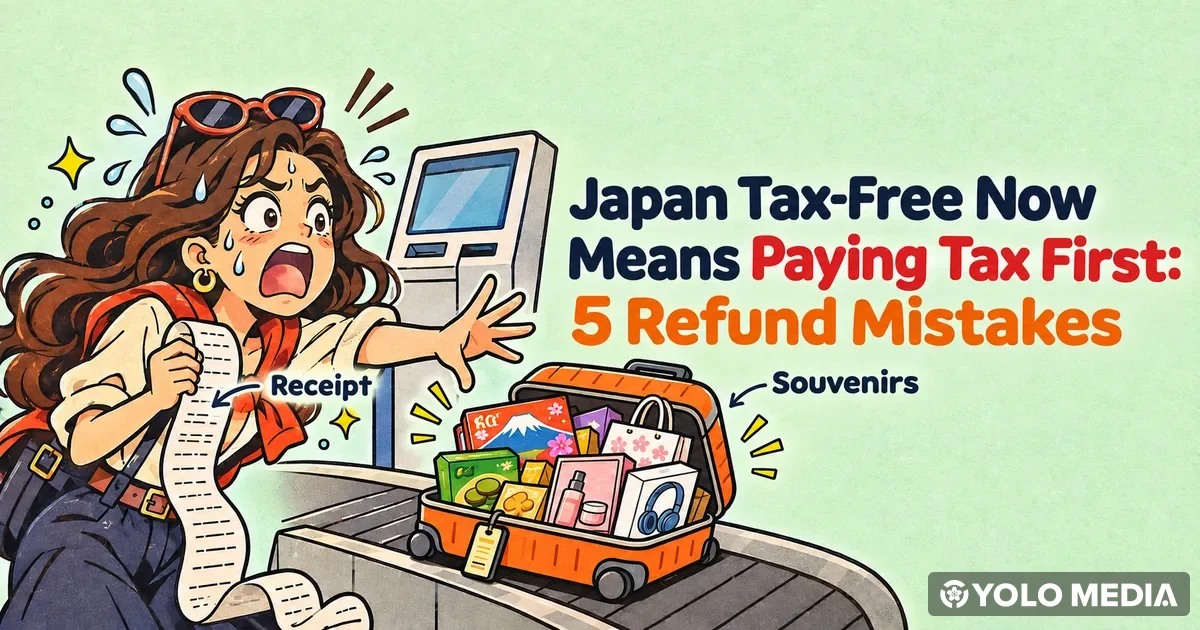
The store hasn’t made a mistake. Since November 1, 2026, tax-free shopping for travelers in Japan works like this: you pay the full price including consumption tax at the store, and get the tax back when you leave Japan. This new system is called the “refund method” (refund hoshiki).
Paying first means the refund only comes back if you follow the rules at the airport, and a few common habits can cancel it. In this article, we explain what changed, who can use it, and 5 mistakes that cost you the refund. If you live in Japan and have family or friends coming to visit, share this with them before they arrive.
Disclaimer: This article is based on information published by the Japan Tourism Agency, the National Tax Agency, and the Ministry of Finance, as of November 5, 2026.
First: People Who Live in Japan Can’t Use It
Tax-free shopping is for people who are only in Japan for a short time, such as tourists. If you live in Japan for work or study, you can’t use it, under either the old or the new system.
According to the National Tax Agency, people who can shop tax-free are “non-residents” (people who don’t live in Japan). For non-Japanese nationals, this means:
- People with “Temporary Visitor” (tanki taizai), “Diplomat,” or “Official” status
- People on temporary landing permission, such as cruise passengers stopping at a port
- U.S. military personnel and others who entered Japan under the Status of Forces Agreement
(Source: National Tax Agency, Q&A on the Tax-Free Sales System (Refund Method), Q3, Japanese)
On the other hand, the following people are not eligible (from the National Tax Agency’s Q&A):
- People who have an address or place of residence in Japan
- People who work at an office in Japan
- People who have been in Japan for 6 months or more since entry
(Source: National Tax Agency, Q&A on the Tax-Free Sales System (Refund Method), Q5, Japanese)
The Japan Tourism Agency’s eligibility table also says that non-Japanese nationals must be able to show they entered Japan less than 6 months ago (except diplomats, officials, and U.S. military personnel).
(Source: Japan Tourism Agency, Page for Travelers, Japanese)
If you live in Japan, you can’t shop tax-free. The people who can are your family or friends themselves, visiting on “Temporary Visitor” status.
It works the same way as the Japan Rail Pass for visitors. You can’t use it yourself, but you can help guests who come on short-term stays. For more, see our Japan Rail Pass guide.
What Changed: October vs. November
The biggest change is when you pay.
| Until October 2026 | From November 1, 2026 | |
|---|---|---|
| Paying at the store | Pay the price without consumption tax | Pay the price including consumption tax |
| The tax amount | Never paid | Refunded after customs checks your items when you leave Japan |
In addition, you now need to get the customs check at the airport or seaport you leave from within 90 days of the purchase date.
(Source: Japan Tourism Agency, Page for Travelers, Japanese)
The rules on what you can buy have also changed. Here is a summary based on the Japan Tourism Agency’s comparison table.
| Item | Until October 2026 | From November 1, 2026 |
|---|---|---|
| Separate rules for general goods (clothes, electronics, etc.) and consumables (food, cosmetics, etc.) | Yes | Removed |
| ¥500,000 limit on consumables and special sealed packaging | Yes | Removed |
| Check that items are not for business use | Yes | Removed. But you can only buy “as much as you can carry with you when you leave Japan” |
| Minimum purchase per store per day | ¥5,000 or more (before tax) | No change (¥5,000 or more, before tax) |
| Items not eligible | Items for business or resale, gold and platinum bullion, items not subject to consumption tax | Gold and platinum bullion, gold and platinum coins, items not subject to consumption tax |
(Source: Japan Tourism Agency, Page for Travelers, Japanese)
The special sealed packaging is gone, but keep items in their original boxes and bags until you leave Japan. The National Tax Agency notes that if you separate items from their packaging, or throw away boxes showing model numbers, customs may not be able to confirm they are tax-free items. (Source: National Tax Agency, Q&A on the Tax-Free Sales System (Refund Method), Q39, Japanese)
Why the System Changed
The goal is to stop fraud, such as reselling tax-free items inside Japan.
Under the old system, stores removed the consumption tax at the time of purchase. Under the new system, shoppers pay the tax first, and get it back only after customs confirms the items are actually leaving Japan.
The Ministry of Finance says the change is meant to deal with fraud such as tax-free items being diverted and sold within Japan.
(Source: Ministry of Finance, FY2025 Tax Reform (Consumption Taxes), Japanese)
5 Mistakes That Cost You the Refund
These are the points where the new system most easily goes wrong. If you live in Japan, these are also the 5 things to tell visiting family and friends.
1. Letting someone who lives in Japan buy for you
Only the visitor on a short-term stay can shop tax-free, and they show their passport at the store. At departure, the person who bought the items takes them through the customs check. Rather than paying at the register for them as a resident, let your visitor make the purchase themselves.
2. Not asking how the refund will be paid
In the Japan Tourism Agency’s diagram of the process, shoppers “register the refund method” when they buy.
The law does not fix how refunds are paid. The National Tax Agency gives examples such as bank transfer, credit card, app transfer, and cash at the departure airport. The method depends on the store. It’s a good idea to ask at the register: “How will I get my refund?”
(Source: National Tax Agency, Q&A on the Tax-Free Sales System (Refund Method), Q57, Japanese)
3. Checking in your bag before the customs check
For the customs check, they need to have all the items they bought with them. Once a suitcase is checked in at the airline counter, they can’t do the procedure, and checked bags can’t be taken back.
Remind them to do the tax-free procedure before checking in their bags. The procedure or an inspection can take time, so arrive at the airport early. The Japan Tourism Agency says that if the tax-free procedure takes too long and you miss your flight, neither the airline nor customs will compensate you.
(Source: Japan Tourism Agency, Page for Travelers, Japanese)
4. Giving away or losing one item from a receipt
This is the most important point. Refunds are decided per receipt (per purchase).
In the Japan Tourism Agency’s example, a receipt lists 3 items (¥3,000, ¥75,000, and ¥13,000). If only the ¥13,000 item is missing, none of the 3 items on that receipt are tax-free.
If your family gives one of the items to someone in Japan as a gift, they lose the refund for every other item on the same receipt. For things they plan to leave in Japan, they should buy them separately, without tax-free, on a different receipt.
For tips on choosing gifts for people in Japan, see our guide to Japanese gift-giving and omiyage.
 Culture & Society
Be Respected at Work! The Ultimate Guide to Japanese Gift-Giving & Omiyage Etiquette (2026)
From choosing the perfect omiyage to mastering Ochugen and Oseibo seasonal gifts. Discover the rules, taboos, and secret…
Read related article
5. Eating or using tax-free food or cosmetics in Japan
For consumables such as food, medicine, and cosmetics, if any part is eaten or used in Japan, the items can’t pass the customs check. Because the check is done per receipt, nothing on that receipt is refunded. Buy anything they plan to eat or use in Japan separately, without tax-free, on a different receipt.
If consumables have been used, travelers should skip the terminal and tell a customs officer at the counter. Non-consumables such as clothes or electronics can still pass the check even if used in Japan, as long as they are taken out of the country in the end.
(Source: National Tax Agency, Q&A on the Tax-Free Sales System (Refund Method), Q39, Japanese)
What Happens at the Airport
Based on the Japan Tourism Agency’s diagram, departure day looks like this:
- Show your passport at a tax-free procedure terminal (kiosk, etc.) at the airport or seaport
- If the result is GREEN, the tax-free procedure is complete
- If the result is RED, a customs officer checks the items. If confirmed, the procedure is complete. If not, no refund is given
- After the procedure, check in your luggage at the airline counter
- After the customs check, the refund is paid by the tax-free store or others (the store you bought from, or a company the store has hired to handle refunds)
At Narita, Haneda, Kansai, Chubu, New Chitose, Fukuoka, and Naha airports, you can also complete the procedure using Visit Japan Web (the online service for entering Japan) instead of a terminal.
(Source: Japan Tourism Agency, Page for Travelers, National Tax Agency, Q&A, Q57, Japanese)
If you take a domestic flight from a regional airport and connect to an international flight, do the procedure at the last airport you leave Japan from.
Airport rules for power banks also changed in 2026. Before your family’s flight home, check our guide to carrying power banks on flights.
 Travel & Explore
Power Banks Banned for In-Flight Use from April 24, 2026: Japan’s Complete Guide to the New Carry-On Rules
Japan's new power bank rules take effect April 24, 2026: max 2 units under 160Wh, no in-flight charging or use, violatio…
Read related article
FAQ
Q. Can non-Japanese nationals who live in Japan shop tax-free?
A. No. For non-Japanese nationals, only non-residents with a status such as “Temporary Visitor” are eligible. People with an address in Japan, people who work at an office in Japan, and people who have been in Japan for 6 months or more since entry are not eligible.
Q. What about items bought tax-free in October?
A. The new system applies to items bought on or after November 1, 2026. If you’re unsure how items bought in October or earlier are handled at departure, check with the store or customs at the airport.
(Source: Japan Tourism Agency, Page for Travelers, Japanese)
Q. When and how is the refund paid?
A. After customs checks the items at departure, the refund is paid by the store or others. The method (bank transfer, credit card, app, cash at the airport, etc.) is not fixed by law and depends on the store. Ask the store when you buy, including when you’ll receive it.
Q. How many days after buying do I need to leave Japan?
A. You need to get the customs check at your departure airport or seaport within 90 days of the purchase date.
Q. Is there a limit on how much I can buy tax-free?
A. The ¥500,000 limit on consumables has been removed. However, you can only buy “as much as you can carry with you when you leave Japan.” The general rule that you must spend ¥5,000 or more (before tax) at one store in one day has not changed.
Key Takeaways
- ✅ From November 1, 2026, tax-free shopping means “pay the tax, get a refund when you leave”
- ✅ People living in Japan can’t use it. Only family or friends visiting on a short-term stay can
- ✅ Ask the store how the refund will be paid, and register it when you buy
- ✅ On departure day, do the customs check before checking in luggage
- ✅ If even one item on a receipt is missing or used up, nothing on that receipt is refunded
Whether you’re visiting Japan or hosting family who are, keep these 5 mistakes in mind. Two points matter most: “do the procedure before checking in bags” and “buy items you’ll use or leave in Japan on a separate receipt.” Knowing these two can make a big difference in how much money comes back.