Introduction
Ramen is one of Japan’s proudest culinary exports. Ramen shops line the streets of every neighborhood, and locals debate their choice with real seriousness, weighing tonkotsu against miso like it actually matters. Ramen isn’t just fast food here. It’s a dish with deep regional pride behind it.
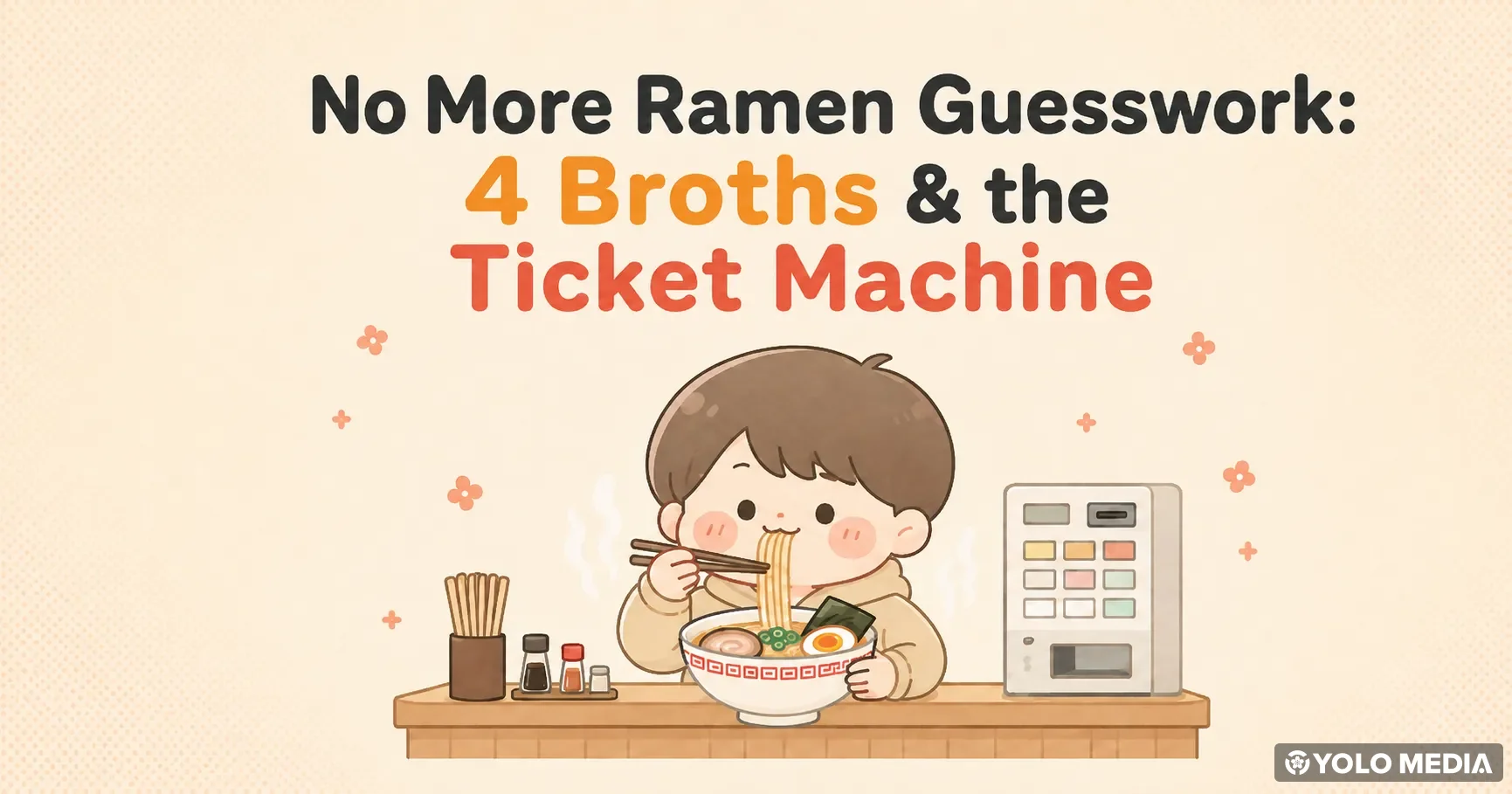
Step into an established ramen shop and a ticket machine usually greets you right at the door. The menu is in Japanese, and the regular ahead of you hands over a ticket while rattling off “firm noodles, extra rich broth” without a second thought. Freezing in front of that machine, unsure which button to press, and just going with the top one is a rite of passage almost everyone goes through at least once.
But don’t worry. By the end of this article, you’ll be able to walk into any ramen shop and order with confidence. We’ve covered the four main broths, how to use the ticket machine, famous chains, regional specialties with recommended shops, and how to find options if you have dietary restrictions.

TL;DR
- Japan’s ramen is built around four main broths: shoyu, shio, miso, and tonkotsu
- Buy a ticket at the shokken-ki (食券機), the ticket machine, before you sit down
- Some shops let you pick noodle firmness (soft, normal, firm, extra firm) and broth richness (light, normal, rich)
- Slurping is welcome, and people genuinely appreciate it
- Kaedama (替え玉), at shops that serve it, lets you add a fresh serving of noodles to the broth you already have
The Four Main Ramen Types by Broth
The broth is the first thing worth understanding. Say “ramen” and people picture very different bowls depending on the broth, so knowing these four types makes ordering at any new shop much easier.
Ramen broth starts with dashi (a stock made from chicken bones or pork bones) and is finished with a tare (a seasoning base like soy sauce or miso). Change that combination and you get an entirely different bowl, even though it’s all still called “ramen.”
Shoyu Ramen (醤油)
Broth: A clear, brown broth made from chicken or pork bones, finished with a soy sauce tare. Balanced and savory, and the most popular of the four.
Flavor: The soy sauce umami and aroma stand out, making this the most familiar flavor for most Japanese people. Mild enough that almost anyone enjoys it.
Origin: Tokyo
Typical toppings: Chashu (braised pork), menma (bamboo shoots), green onion, nori
Best for: Anyone trying ramen for the first time, or looking for a safe choice that’s hard to get wrong.
Shio Ramen (塩)
Broth: The lightest of the four, a clear broth usually made from chicken or seafood.
Flavor: Gentle and clean, letting the ingredients speak for themselves.
Origin: Hakodate (Hokkaido)
Typical toppings: Chashu, wakame, green onion
Best for: Anyone who prefers a lighter meal. It’s easy on the stomach, so it also works well for asa-ra (ramen eaten in the morning) or the morning after a big night out.
Miso Ramen (味噌)
Broth: A rich broth built on a miso base, with real body and heft.
Flavor: Bold and slightly sweet, perfect on a cold day.
Origin: Sapporo (Hokkaido)
Typical toppings: Chashu, corn, butter, bean sprouts
Best for: Anyone who loves bold flavor or wants to warm up in cold weather. Corn and butter are the combo you shouldn’t skip.
Tonkotsu Ramen (豚骨)
Broth: A cloudy, milky-white broth made by simmering pork bones for hours. Creamy and rich with fat.
Flavor: A distinctive savory depth that’s easy to get hooked on.
Origin: Fukuoka / Hakata
Typical toppings: Chashu, kikurage (a type of black wood ear mushroom), beni shoga (red pickled ginger), sesame
Best for: Anyone who loves a rich, heavy bowl. This is the signature style of Hakata.
Beyond the Four Main Types
Once you know the classic four, a few variations are worth seeking out. It’s remarkable how different these can taste while still falling under the same word, “ramen.”
Kara Miso (辛味噌)
A spicy version of miso ramen with chili heat, originating in Sapporo. Popular on cold days, and many shops let you choose your spice level, so it works whether you want serious heat or just a little kick.
Tantanmen (担々麺)
Inspired by Chinese dan dan noodles, this is a spicy sesame broth with the aroma of Sichuan pepper. The numbing heat and the ground meat topping give it a more grown-up flavor. If you’re not used to spicy food, ordering a milder version the first time is a safe move.
Tori Paitan (鶏白湯)
A cloudy broth made by simmering chicken bones for hours. Lighter than tonkotsu, and one of the fastest-growing categories in recent years, especially popular with women.
Tsukemen (つけ麺)
Noodles and broth arrive on separate plates, and you dip the noodles (served cold or warm) into a concentrated sauce. Portions tend to be generous, making it a solid choice when you want a filling lunch.
Abura Soba (油そば)
No broth at all, just noodles tossed in oil and tare. Large and extra-large portions are common, and it’s popular with students and anyone watching their budget.
Jiro-kei (二郎系)
A hearty style known for extra-thick noodles, a huge mound of boiled vegetables, back fat, and garlic. It’s been gaining a following on social media in recent years. After you order, staff will usually ask if you want garlic, and answering involves a unique custom called a “call,” where you specify how much garlic, vegetables, back fat, or tare you want using words like mashi (extra) or mashi mashi (double extra). First time in, ordering a smaller portion and saying “sono mama” (as is) for the call is a safe way to start.
If any of these catch your eye, give one a try the next time you’re at a ramen shop.
Noodle Types
The pairing between broth and noodle matters, and it varies by region and shop.
| Type | Characteristics | Pairs well with |
|---|---|---|
| Thin, straight | The classic noodle for Hakata tonkotsu, designed for a smooth feel as you swallow. It cooks fast and holds a firm bite well | Tonkotsu |
| Medium, slightly curved | Common in Tokyo-style shoyu ramen, offering a springy texture and good balance | Shoyu |
| Thick, curly | Often used in miso ramen, giving a firm, satisfying chew | Miso |
There are also regional specialties, like the flat, wavy noodles from Kitakata (Fukushima). Paying attention to the noodle style, not just the broth, makes choosing a ramen shop even more interesting.
The Ramen Shop Experience: How to Use the Ticket Machine
Walking into a shop and being met with a ticket machine, unsure what to do, is something almost everyone goes through when they first arrive in Japan. Once you know the order of operations, though, you’ll never hesitate again.
Shokken-ki (食券機) Step-by-Step
- Pick your base bowl: Choose shoyu, shio, miso, tonkotsu, or another option using the buttons
- Add toppings (optional): Press the button for ajitama (marinated soft-boiled egg), extra chashu, nori, or anything else available
- Insert your payment: Payment methods vary by shop. Some only accept cash, while others let you tap an IC card like Suica or Pasmo
- Take your ticket: Change comes out automatically
- Hand it to staff: Give the ticket to staff once you’re shown to your seat, or hand it over at the counter
(For how to set up and use an IC card, see our Suica & PASMO Commuter Pass Guide)
Most buttons come with photos, so choosing by looks works fine. Some chains also offer English order sheets.
Seating
- Counter seats: Great for solo diners, and you get a front-row view of the kitchen
- Booths / sunken floor seating (where you can rest your feet below the table): Ideal for groups
- Private-style booths (Ichiran-style partitions): Good if you want to eat alone without distractions
Customizing Your Order
Whether you can specify noodle firmness or broth richness depends on the shop. Tonkotsu-style places take requests fairly often, while shops where the chef has already dialed in the balance between noodles and broth sometimes don’t take them at all. Look for firmness or kaedama buttons on the ticket machine, or a notice posted at the counter, and you’ll usually know where a shop stands.
Noodle Firmness (Katasa)
| Japanese | Meaning |
|---|---|
| Yawa | Soft |
| Futsu | Normal |
| Katame | Firm |
| Chō katame / barikata | Extra firm (popular in Hakata) |
Broth Richness (Kosa)
| Japanese | Meaning |
|---|---|
| Assari | Light and thin |
| Futsu | Standard |
| Kotteri | Rich, extra fatty |
Fat Level (Abura), often asked at tonkotsu and Jiro-kei shops
| Japanese | Meaning |
|---|---|
| Sukuname | Less fat |
| Futsu | Standard |
| Ōme | Extra fat, richer flavor |
Garlic (Ninniku), often asked at tonkotsu-style and Jiro-kei shops
| Japanese | Meaning |
|---|---|
| Ari | With garlic |
| Nashi | Without garlic |
You don’t need complicated Japanese to get exactly what you want. At a shop that takes requests, a simple “katame, kotteri de” (firm noodles, rich broth) is enough to get you much closer to your ideal bowl. And if you’re not comfortable customizing yet, it’s completely fine to just answer when staff asks.
Famous Ramen Chains
If you’re not sure where to start, these well-known chains are a solid first step.
Ichiran (一蘭)
Known for its private-style booths. The order sheet lets you fine-tune spice level, broth richness, noodle firmness, and garlic amount. English order sheets are available, and you’ll find locations nationwide.
Ippudo (一風堂)
Popular for high-quality Hakata tonkotsu, with English menus at some locations. Shiromaru Motoaji and Akamaru Shinaji are the two signature bowls.
Kourakuen (幸楽苑)
A budget-friendly chain with bowls starting around ¥500. A solid pick if cost is your main concern.
Sumire (すみれ)
A celebrated Sapporo miso specialist, with its flagship shop drawing crowds in Sapporo’s Ramen Yokocho.
What Ramen Costs
Price is always on people’s minds, so here’s a rough guide.
| Shop type | Basic bowl | With toppings |
|---|---|---|
| Budget chains | ¥500–¥700 | ¥700–¥900 |
| Standard shops | ¥800–¥1,200 | ¥1,000–¥1,500 |
| Premium / popular shops | ¥1,200–¥2,000 | ¥1,500–¥2,500 |
Ajitama (soft-boiled egg) usually adds ¥100–150, and extra chashu adds ¥200–300. At shops that serve kaedama, an extra portion of noodles runs around ¥100–200. Carrying some cash is a good idea for busy times, since many shops don’t accept credit cards.
Ramen by Region: Specialties and Where to Try Them
Ramen looks completely different depending on where you are. Trying the local style while traveling is a great way to make the trip more memorable.
| Region | Specialty | Recommended shops |
|---|---|---|
| Sapporo | Miso with corn, butter, and bean sprouts, made for cold weather | Sumire, Shirakaba Sansō, Ajino Sanpei |
| Tokyo | The birthplace of shoyu ramen. Now a competitive scene with everything from tori paitan to tsukemen | Fuunji (tsukemen), Kagari (tori paitan), Mutekiya (tonkotsu) |
| Kyoto | A cloudy broth topped with green onion on one side, in the “back fat” style (broth finished with rendered pork fat) | Several dedicated back-fat specialists around the city |
| Osaka | Light to medium richness, with the subtle seasoning typical of Kansai | Jinrui Minna Menrui, Kurawanka |
| Hakata / Fukuoka | Thin tonkotsu noodles, and the birthplace of the kaedama tradition of adding more noodles to the same broth | Ichiran (main shop), Ippudo, Shin-Shin |
| Kitakata (Fukushima) | Flat, curly noodles in a light shoyu broth, one of Japan’s “big three” ramen styles | Long-established shops throughout Kitakata |
| Wakayama | A tonkotsu-shoyu blend with a dark, rich color | Specialty shops scattered around Wakayama City |
Making the Most of Your Ramen
There are a few things worth knowing that will help you enjoy ramen shops even more.
- Slurping is welcome, and honestly encouraged. Making noise while you eat is taken as a sign you’re enjoying it, and it also helps cool the noodles as you go
- Customization: at shops that take requests, feel free to speak up about noodle firmness or broth richness. At tonkotsu places, staff will often ask you first
- Kaedama: where it’s offered, you can order a fresh batch of noodles (around ¥100–200) while broth remains in your bowl. A kaedama button on the ticket machine, or a notice on the table or at the counter, is your cue. Just tell staff “kaedama onegaishimasu”
(For more on Japanese table manners, including the slurping custom, see our Japanese Table Manners & Chopstick Etiquette Guide)
A late-night bowl after a night out is also a Japanese tradition. This closing ramen, known as shime, is often talked about alongside izakaya culture.
(For more on that world, see our First-Time Izakaya Guide)
If You Have Dietary Restrictions
Dietary restrictions can make ramen feel out of reach, but your options aren’t zero. It’s true that the more restrictions you have, the harder it gets, but knowing where to look makes a real difference.
Vegetarian / Vegan
Because most ramen is built on dashi (often fish-based) or pork bones, it’s genuinely hard to find a traditional shop that can accommodate these diets. Tokyo does have dedicated specialty shops, though, including T’s TanTan (near Tokyo Station, fully vegan) and Soranoiro (vegetable-based broth). Searching “vegetarian ramen” or “vegan ramen” in Japanese will turn up more options.
(For a broader look at eating this way in Japan beyond ramen, see our Vegetarian & Vegan Dining Guide)
Halal
Halal-friendly ramen shops are becoming more common. You can find them by searching in major cities.
Gluten-free
Since ramen noodles are wheat-based, asking a traditional shop to accommodate gluten-free needs is genuinely difficult. That said, specialty shops using gluten-free noodles are slowly increasing, so it’s worth searching for one.
FAQ
Q: How much does ramen usually cost?
A: A basic bowl runs ¥800–¥1,200. With toppings, expect ¥1,000–¥1,500, and upscale shops can run ¥1,500–¥2,000.
Q: Are ticket machines in English?
A: Many use photos, so you can choose without reading Japanese. Some chains also offer English order sheets.
Q: What is kaedama?
A: Adding a fresh serving of noodles to the broth you already have. It started in Hakata, and plenty of shops offer it today, mostly tonkotsu-style ones, usually for ¥100–200. Not every shop does, so check the ticket machine buttons or the notices posted inside.
Q: Is ramen gluten-free?
A: No, the noodles are wheat-based. You’ll need to look for a dedicated gluten-free specialty shop.
Q: Is there vegetarian ramen available?
A: Yes, mainly in and around Tokyo, where you’ll find dedicated vegetarian and vegan specialty shops.
Q: Do I have to get garlic?
A: No. At tonkotsu-style and Jiro-kei shops, you can usually choose “without.” It’s entirely up to your taste.
Q: What’s the difference between ramen and instant cup noodles?
A: Restaurant ramen uses a broth simmered for hours, fresh noodles, and carefully prepared toppings, making it a much more involved dish. Cup noodles have their own appeal in convenience, so it’s really about picking the right one for the moment.
Q: Can I get ramen at a convenience store?
A: Yes. Convenience stores carry chilled, fresh-noodle ramen from various brands, along with frozen ramen developed with input from specialty shops. It’s a handy way to get something closer to the real thing without going to a restaurant.
Q: Are ramen shops open late at night?
A: Many shops in entertainment districts stay open until 2 or 3 a.m., and some run 24 hours. That’s exactly what makes a bowl of shime ramen after drinks possible.
Key Takeaways
Once you’ve finished reading, go find a ramen shop nearby. Starting with shoyu or tonkotsu is a great way in.
- ✅ If it’s your first time, start with shoyu or tonkotsu. Trying both back to back is the fastest way to understand the difference
- ✅ Don’t stress over the ticket machine. Choosing by photo works fine, and even a mistake makes for a good story later
- ✅ Don’t hold back on slurping. Staying quiet is actually the unusual choice here
- ✅ Next time, try customizing your order. At a shop that takes requests, adding “katame, kotteri de” takes your bowl up a notch
- ✅ At shops that serve kaedama, order your extra noodles while there’s still broth left in the bowl
- ✅ If you have dietary restrictions, search a food app or “vegetarian ramen Tokyo” before you head out
The more ramen you try, the clearer your own “go-to style” becomes. Use this article as a starting point to eat your way through different regions and styles.