Category: Visa & Legal
Introduction
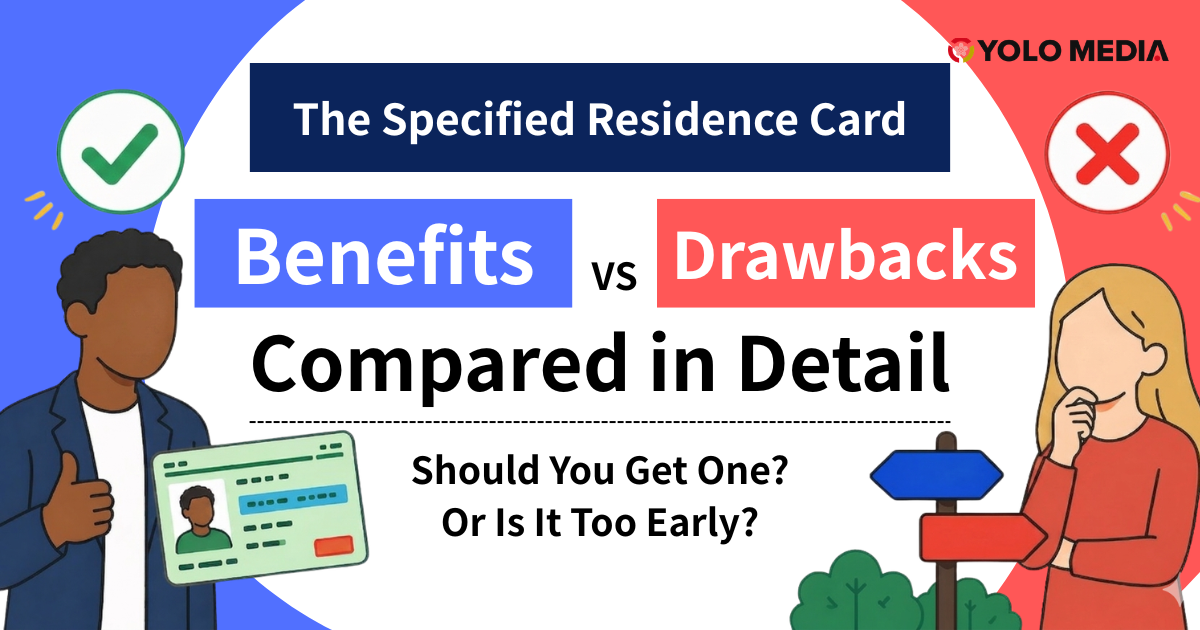
“Is the Specified Residence Card actually worth getting?” With the June 2026 launch coming up, a lot of us are stuck on this question. News stories say it’ll be “more convenient,” but it’s surprisingly hard to find a clear summary of what you actually gain and what the hidden downsides are. Visa-related cards are the foundation of life here in Japan, and nobody wants to switch impulsively and regret it later.
This article gives you a side-by-side comparison of the benefits and drawbacks in a single table, then walks through when switching makes sense based on your situation: visa renewal approaching, moving soon, don’t have a My Number Card yet, and so on. By the time you finish reading, you’ll have a clear answer for yourself.
Key Points
- The main benefit: visa renewal and moving procedures happen in one stop, and carrying one card is simpler
- The main drawback: issuance takes longer, and losing the card doubles the damage
- If your visa renewal is within 6 months, switching now makes a lot of sense. If renewal is over a year away, no rush
- If you don’t have a My Number Card, you can’t apply in the first place
Disclaimer: This article is based on information available as of April 21, 2026. Always verify the latest information on the Immigration Services Agency’s official website. This article is for informational purposes only and does not constitute legal advice.
For a full overview of the Specified Residence Card system, see our complete guide to the Specified Residence Card. This article focuses specifically on comparing benefits and drawbacks to help you decide whether to get one.
Benefits and Drawbacks at a Glance
Let’s start with the big picture.
| Benefit | Drawback | |
|---|---|---|
| Procedures | Visa renewal + My Number update in one stop | No online applications (in-person only) |
| Card management | 2 cards → 1 card, simpler | Losing it knocks out both functions at once |
| Moving | Moving-in notification updates My Number info simultaneously | — |
| ID verification | Covers a wider range of ID scenarios with one card | — |
| Processing time | — | Takes about 10 days longer to issue than a regular Residence Card |
| Grace period | — | Risk of the My Number function expiring during grace period |
At first glance, the benefits outnumber the drawbacks. But some of those drawbacks carry a bigger impact than the table suggests. Let’s dig into each one.
A Closer Look at the Benefits
Benefit 1: One-Stop Visa Renewal + My Number Update at Immigration
This is the biggest benefit, and for a lot of people, it’s the tipping point.
Here’s the old flow. You go to Immigration to extend your period of stay and receive a new Residence Card. But the period-of-stay info stored on your My Number Card is now outdated, so you have to head to city hall or your ward office on a separate day to update it.
“Why am I doing the same update twice at two different offices?” If you’ve ever thought this, you’re not alone.
With the Specified Residence Card, your visa renewal at Immigration automatically updates the My Number Card information too. No extra trip to city hall. For anyone who has trouble taking weekdays off, this alone can be worth the switch.
Benefit 2: One Fewer Card in Your Wallet
Mid-to-long-term residents aged 16 or older are legally required to carry their Residence Card at all times. And My Number Cards show up more and more these days: bank accounts, phone contracts, tax returns, all kinds of online procedures.
Carrying two cards around every day is a subtle kind of stress. If you lose your wallet, you’re suddenly reissuing both at once, which is the worst-case scenario you don’t want to imagine. From a risk management angle, having one card to begin with can actually be safer.
The flip side is also true, which we’ll cover in the drawbacks section.
Benefit 3: Smoother Moving Procedures
When international residents move in Japan, the list of things to do is long. Moving-out notification, moving-in notification, Residence Card address change, My Number Card address change. All at different counters, all with different forms.
With a Specified Residence Card, filing a moving-in notification at your new city or ward office simultaneously updates the My Number information stored on the card. One fewer procedure means meaningfully less time at the ward office on moving day.
Benefit 4: Broader ID Coverage
“I showed my Residence Card, and they asked me to also show my My Number Card.”
Plenty of us have been there. Hotel check-ins, phone contracts, opening bank accounts. In a growing number of ID scenarios, a Residence Card alone isn’t enough.
Since the Specified Residence Card also functions as a My Number Card, one card covers a wider range of ID situations. Not having to say “let me pull out another card” every time is a small daily-life benefit you’ll actually feel.
A Closer Look at the Drawbacks
Drawback 1: Issuance Takes About 10 Days Longer
A regular Residence Card can sometimes be issued on the spot at the Immigration counter. The Specified Residence Card, however, requires setting up the My Number Card functions, and that adds about 10 extra days to the issuance time.
If you consider that the visa renewal review itself can take 1 to 3 months, an extra 10 days may not feel like much. Still, the period without a card in hand is genuinely longer. It’s worth checking in advance what ID alternatives you’ll rely on during that gap.
During the review period, you can sometimes use the “application receipt slip” issued by Immigration, or combine your passport with a provisional release permit, as ID. Check with your local Immigration office ahead of time to confirm.
Drawback 2: Losing It Takes Down Both Functions at Once
This is the most significant drawback.
If you carry your Residence Card and My Number Card separately and lose one, the other is still in your pocket. But if you lose your Specified Residence Card, you lose both your Residence Card and your My Number Card in a single moment.
The reissue process gets more complex too. Temporarily suspending the My Number function (toll-free hotline 0120-95-0178), filing a police report, and applying for reissue at Immigration, all multiple steps, all within a 14-day window.
For step-by-step loss recovery, see the complete guide’s loss recovery section.
Drawback 3: No Online Application
As of April 2026, you cannot apply for the Specified Residence Card online. It’s in-person only at Immigration.
Standard visa renewals have moved toward online applications via My Number Card, but choosing the Specified Residence Card means you’re back to in-person procedures. Online support may expand in the future, but right now it’s counter only. Anyone who has sat in an Immigration waiting room on a busy day knows this could be the deal breaker.
Drawback 4: Grace Period Risk to My Number Functions
If your visa renewal review runs long and passes your original period-of-stay expiration, you enter a “grace period” (up to 2 months). During this time, your Residence Card functions remain valid, but the My Number Card functions may expire.
If the My Number functions lapse, you’ll have to visit your city or ward office anyway to extend them, and the “one-stop at Immigration” benefit evaporates at the worst possible moment.
The way to avoid this: apply for your visa renewal at least 3 months before your period-of-stay expiration date. For managing renewal timing, see our visa renewal complete guide.
Should You Get One Right Now? A Decision Guide
Now that you understand the benefits and drawbacks, let’s look at your specific situation.
You Should Switch Now If…
| Your situation | Why it makes sense |
|---|---|
| Your visa renewal is within the next 6 months | Switch during renewal with almost no extra effort |
| You have a move coming up | Apply at the same time as your moving-in notification. One fewer step |
| Your My Number Card is also nearing expiration | You’re going to renew anyway, may as well consolidate |
| You’re tired of pulling out two cards every time someone asks for ID | Daily friction goes away |
It’s Fine to Wait If…
| Your situation | Why you can wait |
|---|---|
| Your visa renewal is more than a year away | Making a trip to Immigration just to switch is not efficient |
| You don’t have a My Number Card | You don’t meet the prerequisite. Get a My Number Card first |
| You want to apply for visa renewal online | Specified Residence Card requires in-person, adds an extra counter visit |
| You barely use your My Number Card | The benefit of combining cards is limited |
If you’re on the fence, “wait until your next visa renewal” is a safe default. Getting the Specified Residence Card is optional, not mandatory, so there’s no need to rush.
Frequently Asked Questions
Q: Who benefits most from switching?
A: People on work visas (Engineer/Specialist in Humanities/International Services, and similar) who renew every 1 or 3 years benefit the most. The back-and-forth between Immigration and city hall disappears. On the other hand, Permanent Residents only renew their Residence Card validity every 7 years, so the benefit of switching shows up less often.
Q: Is there a way to avoid the drawbacks?
A: For the biggest drawback (“loss risk”), smartphone-based My Number Card functions are expected to roll out more broadly over time. However, as of April 2026, support for international residents is still limited, so check for the latest updates. For the “grace period risk,” applying for your visa renewal 3 months in advance basically eliminates the problem.
Q: Can I switch back to a regular Residence Card if I change my mind?
A: Yes. You can return the My Number Card function built into your Specified Residence Card. Once you do, and as long as your status of residence is valid, a regular Residence Card will be issued to you instead. So “I tried it and didn’t like it” is a reversible choice, not a permanent one.
Summary: The Best Time to Switch Is “At Your Next Renewal”
Comparing benefits and drawbacks, the balance becomes clearer: the convenience of one-stop procedures versus the inconveniences of higher loss impact and no online support.
For most people, the optimal call looks like this:
- Visa renewal or a move is coming up → switch at that timing
- Both are still a long way off → keep gathering info and revisit at your next renewal
The system is just getting started, so improvements like online application support will likely come in time. What matters most is matching the switch to your own schedule, so you actually capture the benefits when you do it.
For a full system overview, see our complete guide to the Specified Residence Card. For a detailed explanation of whether it’s mandatory, check out Is the Specified Residence Card Mandatory or Optional?.