Last Updated: April 21, 2026
Reading Time: About 15 min
Category: Visa & Legal
Introduction
Living in Japan, have you ever felt confused about why Residence Card business goes through Immigration while My Number Card business goes through city hall? Two cards, similar-looking procedures, but completely separate counters.
After queuing for hours at Immigration to renew your visa, you then have to head over to city hall to update your My Number Card’s digital certificate. A lot of us have done this office-hopping routine more than once.
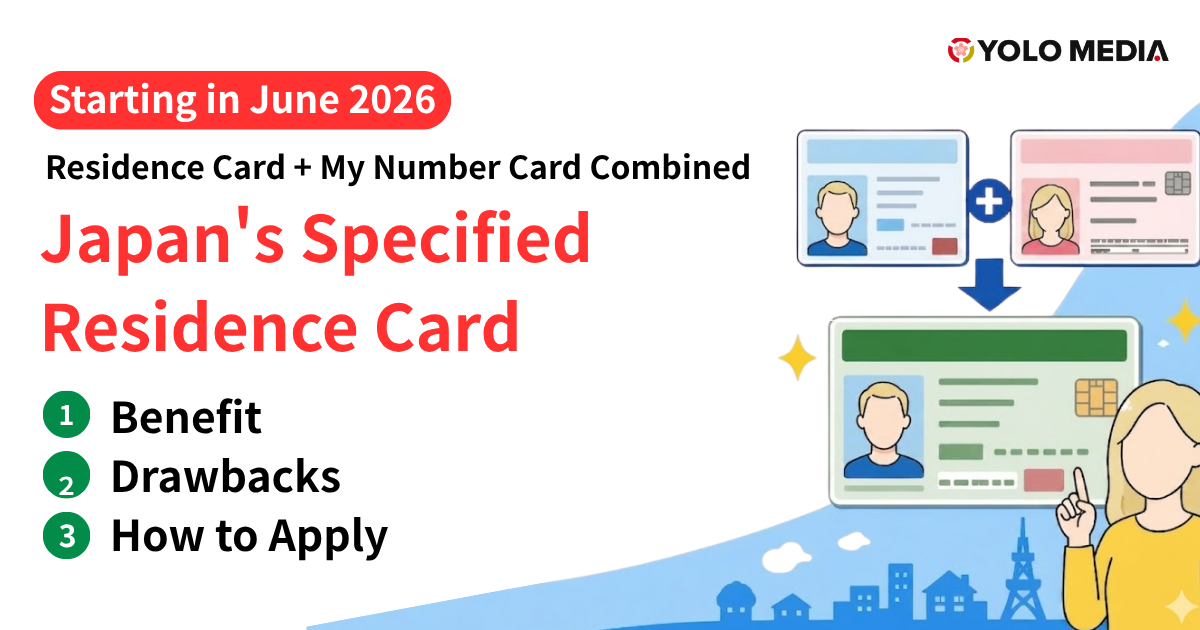
The *Specified Residence Card (Tokutei Zairyu Card / 特定在留カード)*, launching June 14, 2026, is designed to solve this “two-card problem.” In this article, we’ll break down what the new system means from the perspective of international residents actually living in Japan.
- “What exactly is a Specified Residence Card?”
- “Should I get one? Or is it still too early?”
- “What does the application process and required paperwork look like?”
If any of these questions have been on your mind, read on. Let’s start with the big picture.


Key Points
- The Specified Residence Card launches on June 14, 2026, merging your Residence Card and My Number Card into a single card
- Getting one is optional. You can keep carrying two separate cards if you prefer
- The biggest benefit: visa renewals and My Number Card updates are handled in one stop at Immigration
- Applications are accepted at Immigration Bureaus or your municipal office (city/ward hall). Online applications are NOT available
- If you lose it, both functions go down at the same time. Suspend it immediately via the toll-free hotline
Disclaimer: This article is based on information available as of April 21, 2026. Details may change, so always verify the latest information on the Immigration Services Agency’s official website. This article is for informational purposes only and does not constitute legal advice.
What Is the Specified Residence Card? When Does It Start?
To recap, managing two cards (your Residence Card and My Number Card) is more of a hassle than it sounds. They add bulk to your wallet, and it always seems to be the day you left one at home that someone asks for ID.
The whole idea behind the Specified Residence Card is to roll that hassle into a single card.
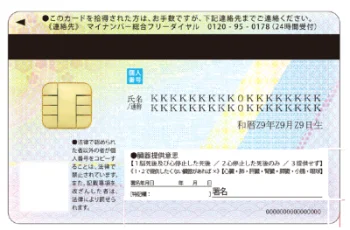
Source: Immigration Services Agency, "Application for Specified Residence Card, etc."
Operations Start June 14, 2026
This has been a “someday” system for a while, but the launch is finally just around the corner. The Specified Residence Card officially begins operation on June 14, 2026 (Reiwa 8). Since that’s a Saturday, the first day you can actually apply at an Immigration office is the next business day: Monday, June 15.
(Source: Immigration Services Agency, "Application for Specified Residence Card, etc.")
Getting It Is Optional: No Need to Rush
Here’s the most important thing to know: getting the Specified Residence Card is entirely optional. Nobody is being forced to switch.
You can keep your existing Residence Card and My Number Card as two separate cards with zero problems. Switch only when the timing works for you and the benefits make sense.
The Specified Residence Card is optional. It’s not an obligation, so take your time deciding. For a deeper look at the “optional vs. mandatory” question, including “What if my company tells me to get one?”, see our detailed article on this topic.
For reference, Special Permanent Residents will receive an equivalent card called the “Specified Special Permanent Resident Certificate” (Tokutei Tokubetsu Eijusha Shomeisho). The mechanics are essentially the same.
(Source: Immigration Services Agency, "Residence Card and My Number Card Integration Q&A")
Your Residence Card Is Getting a New Look Too
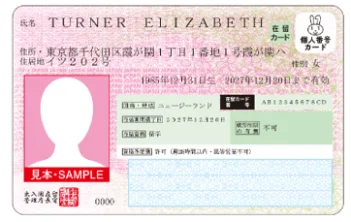
Regardless of whether you choose the Specified Residence Card, every Residence Card issued on or after June 2026 will have a new design. In other words, even if you skip the My Number-integrated version, your next card will look different from the current one. This is an easy detail to overlook.
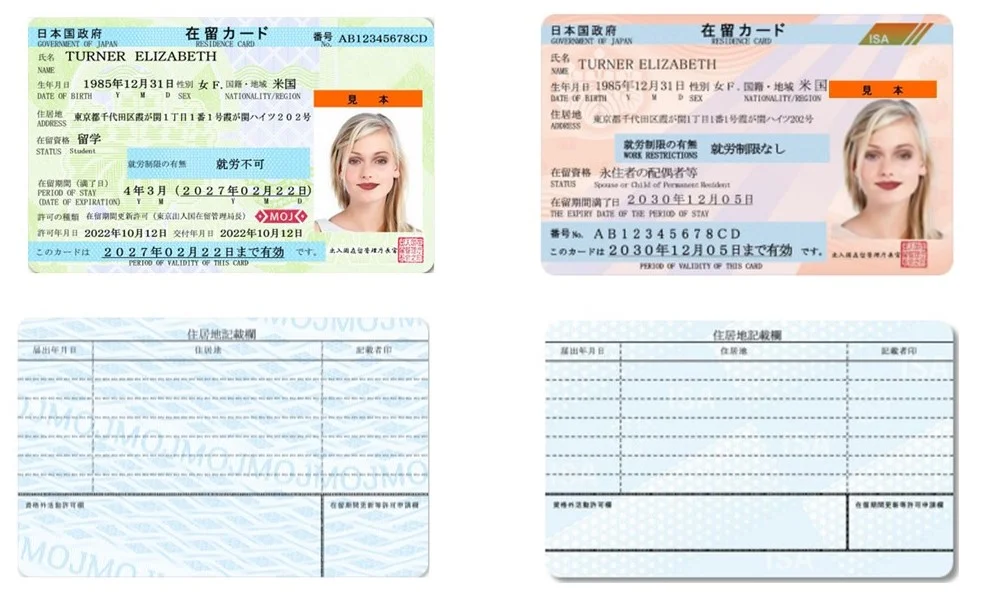
Source: Immigration Services Agency, "What Kind of Card Is a Residence Card?"
What Stays on the Card, What Moves to the IC Chip
The new format cleans up the information printed on the front of the card. Here’s what changes:
Still printed on the front of the card:
- Name, date of birth, sex, nationality
- Address
- Status of residence (e.g., Engineer/Specialist in Humanities/International Services)
- Date of expiration of period of stay (e.g., June 14, 2029) ← your visa expiry is still visible on the card, just like before
- Residence Card number, card expiration date
- Work restriction status, permission for activities outside status
Removed from the front and recorded on the IC chip only:
- Period of stay (e.g., duration entries like “3 years” or “5 years”)
- Type of permission and date of permission
- Date of card issuance
In other words, “when does my visa expire?” is still something you can check at a glance from the card. However, details like “how long was my granted period of stay?” or “when exactly was I granted permission?” will no longer be visible on the surface.
Your visa expiration date stays printed on the front of the card, so nothing really changes in how you check it day-to-day. That said, setting a reminder in your phone’s calendar about 3 months before expiry is a smart way to make sure you never miss a renewal.
For Specified Residence Card (My Number integrated) holders, your My Number (Individual Number) is printed on the back of the card in addition to the items above. If you choose the new-format card without My Number integration, your My Number is not printed anywhere on the card. Everything else on the front is the same.
Benefits and Drawbacks of the Specified Residence Card
“If it’s optional, maybe I don’t need it.” That’s a fair instinct. Switching really helps in some situations, and in others, sticking with two cards is honestly easier. Here are the main points to help you decide.
| Benefit | Drawback | |
|---|---|---|
| Procedures | Visa renewal + My Number update in one stop | No online applications (in-person only) |
| Card management | 2 cards → 1 card, simpler | Losing it means both functions go down at once |
| Moving | Moving-in notification updates My Number info simultaneously | None |
| ID verification | Covers a wide range of ID scenarios with one card | None |
| Processing time | None | Takes about 10 days longer than a regular Residence Card |
| Grace period | None | Risk of the My Number function expiring during grace period |
The biggest upside is the one-stop experience: one visit to Immigration handles both your visa renewal and your My Number update. The flip side? Losing the card doubles the damage, and there’s no online application path. Both are easy to miss until it matters.
“Should I get one? Is it too early?” For a full breakdown of how to decide based on your situation, see our dedicated article: Specified Residence Card: Benefits vs. Drawbacks Compared in Detail.
If you apply for a visa renewal at the last minute, there’s a real risk that your My Number Card function expires during the grace period. Apply for renewal at least 3 months before your expiration date to avoid this.
How to Apply and What You’ll Need
Decided to go for it? Here’s how the application process works. There are two places you can apply:
Option 1: Apply at Immigration (Regional Immigration Services Bureau)
You can apply for the Specified Residence Card alongside any of the following procedures:
- Application for extension of period of stay (visa renewal)
- Application for change of status of residence
- Application for renewal of Residence Card validity (e.g., Permanent Residents)
- Other Residence Card-related notifications
If your visa is up for renewal soon, that’s by far the smoothest time to apply.
Option 2: Apply at Your Municipal Office (City/Ward Hall)
You can apply when filing a moving-in or change-of-address notification (tennyu todoke / tenkyo todoke). Since you can handle it at the same time as your address change, this option works well if you’re planning to move.
Required Documents
You’ll need the following three items:
| Document | Details |
|---|---|
| Specified Residence Card Application Form | Available at Immigration or municipal offices |
| PIN Setup Request Form | Needed to set PINs for the My Number Card function |
| 1 Photo | 4cm × 3cm, taken within the last 6 months |
On top of these, bring any documents required for the procedure you’re combining the application with (visa renewal paperwork, moving notification, etc.).
Immigration offices get crowded, so have everything ready before you go. For the photo, using a station photo booth (shoumeishashin-ki) ahead of time saves you from scrambling on the day.
(Source: Immigration Services Agency, "Application for Specified Residence Card, etc.")
Lost Your Specified Residence Card? A 3-Step Recovery Plan
With two functions packed into one card, the impact of losing it is definitely bigger than losing a regular Residence Card. Before the “what if someone misuses my My Number?” panic sets in, follow these steps calmly.
Step 1: Suspend the My Number Card Function Immediately
The top priority is to temporarily suspend the My Number Card function to prevent misuse. Call the following toll-free number:
My Number General Toll-Free Hotline: 0120-95-0178
Lost/stolen temporary suspension is available 24/7, 365 days a year.
Press 2 in the voice menu.
Available in English, Chinese, Korean, Spanish, and Portuguese.
(Source: My Number Card Official Site, "Lost Card / Temporary Suspension")
Step 2: File a Report with the Police
Go to your nearest police station or police box (koban) and submit a lost property report (ishitsu todoke). You’ll receive a certificate showing a reference number, so hold onto it. You’ll need it for the reissue application.
Step 3: Apply for Reissue at Immigration
Within 14 days of realizing the card is lost, apply for a Residence Card reissue at your regional Immigration Services Bureau.
Documents needed for reissue:
- Residence Card Reissue Application Form
- 1 photo
- Statement of loss/theft
- Police lost property report certificate
You are legally required to apply for reissue within 14 days. Missing this deadline can lead to penalties, so act quickly.
(Source: Immigration Services Agency, "Reissue of Residence Card Due to Loss")
Frequently Asked Questions
Q: How long can I keep using my current Residence Card and My Number Card?
A: Residence Cards issued before June 14, 2026 remain valid until the expiration date printed on the card. There’s no need to rush a switch. You can decide whether to go for the Specified Residence Card at your next visa renewal.
Q: What if I don’t have a My Number Card?
A: To apply for the Specified Residence Card, you must already have a My Number Card. If you don’t, you’ll need to apply for a My Number Card first. Note that international residents who don’t hold a My Number Card will still be issued the new-format Residence Card (without My Number Card functions) from June 2026 onwards.
Q: Is there a fee?
A: No additional fee is expected for the Specified Residence Card application itself. However, standard fees for visa renewals or status changes still apply. Since April 2025, renewal and change applications cost ¥6,000 (¥5,500 for online applications). For the latest on visa fees, see our article on visa fee increases.
Q: Do I have to carry it at all times?
A: Yes. Like a regular Residence Card, mid-to-long-term residents aged 16 or older are legally required to carry it at all times. The Specified Residence Card is no exception.
Q: Can Permanent Residents switch to the Specified Residence Card?
A: Yes. Permanent Residents are also eligible. You can apply for the Specified Residence Card when renewing the validity period of your Residence Card (every 7 years).
Summary: Switch When the Timing Makes Sense for You
The Specified Residence Card is designed to solve two long-running headaches for international residents in Japan: “too many cards to carry” and “running between two different offices for overlapping procedures.” If you’ve ever spent half a day bouncing between Immigration and city hall, this is going to save you serious time.
On the other hand, there are things worth knowing before you apply: no online application, higher stakes if you lose the card, and the grace period expiry risk.
The big takeaway is this: there’s no rush. It’s optional, so take your time and weigh the benefits against the drawbacks in light of your own visa renewal or moving schedule.
Want to dig deeper? Check out these related articles too:
- Benefits vs. Drawbacks Compared: Should You Get One? Or Is It Too Early? A Situation-by-Situation Guide
- Is the Specified Residence Card Mandatory or Optional? A Clear Answer from the Legal Basis
- Visa Fees Going Up: When, and What to Prepare for Now
2026 is shaping up to be a big year for system changes affecting international residents: the new Residence Card format, visa fee increases, and more. Stay on top of accurate information one step at a time, and keep your life in Japan running smoothly.
![Japan’s Specified Residence Card Applications Open June 15 — Residence Card & My Number Integration: What to Bring [June 2026]](https://media.yolo-japan.com/wp-content/uploads/2026/06/tokutei-zairyu-card-start-0614-en-768x403.webp)