Introduction
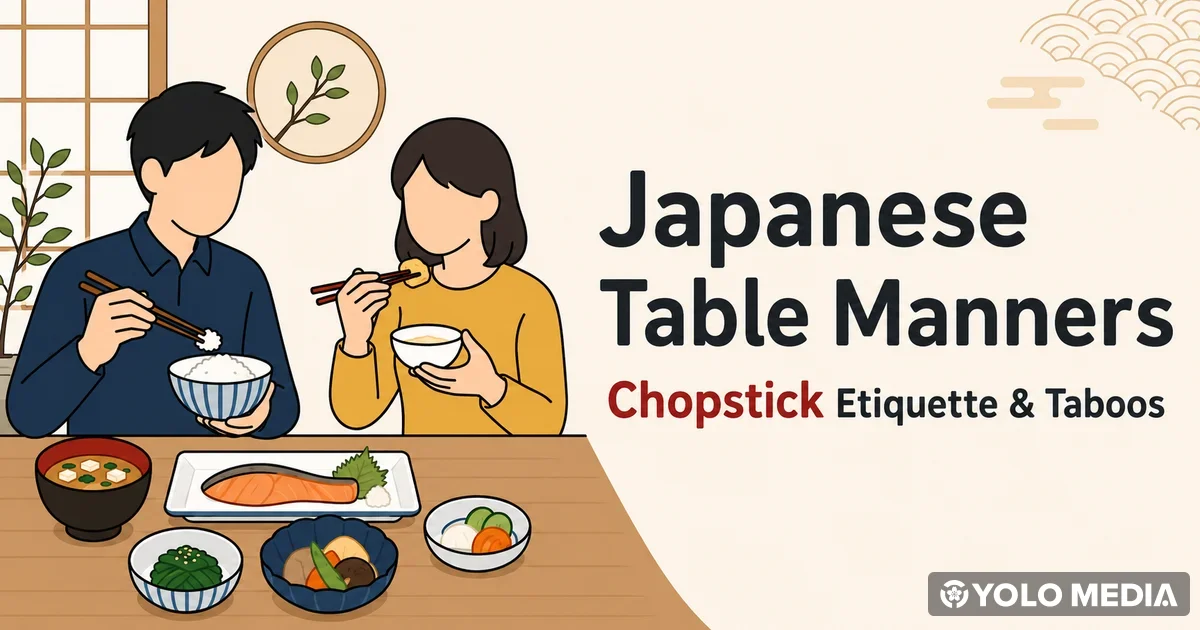
Japanese dining has its own set of rules. Holding your chopsticks correctly matters, of course — but knowing what not to do matters just as much, and some of the taboos are serious enough that they trace back to funeral customs. The short phrases said before and after a meal carry cultural weight too, and once you understand what they actually mean, you’ll find they bring you noticeably closer to the people around you.
This article covers the table manners you’ll want to know when eating in Japan — from casual restaurants to izakaya and business dinners — organized by situation. For each rule we explain the why behind it, so it sticks as practical knowledge rather than something you have to memorize. None of this is about being perfect; it’s about understanding enough to relax and enjoy the meal.

Summary
- Always say “Itadakimasu” and “Gochisosama deshita” — these greetings before and after meals are fundamental to Japanese dining culture
- Never do tatebashi, watashibashi, or sashibashi — these chopstick actions are tied to funeral customs and considered highly disrespectful
- Lift your rice and soup bowls to eat — don’t leave them on the table and lean in
- Slurping noodles is fine — in fact, welcome — it’s accepted as a sign of enjoyment
- No tipping — in Japan, tipping can even come across as rude
Meal Greetings
“Itadakimasu” and “Gochisosama deshita” are two phrases worth knowing if you live in Japan. They have nothing to do with religion — everyone uses them from childhood, so just being able to say these two goes a long way toward putting people at ease with you, even if your Japanese isn’t fluent yet. You’ll hear them everywhere: at family tables, in school cafeterias, at company lunches, and in restaurants.
Itadakimasu is said before you start eating. It carries gratitude toward the food itself, the lives that went into it, the people who cooked it, and the simple fact of being able to eat at all. It’s a distinctly Japanese concept with no clean English translation, and many people press their palms together lightly as they say it — though that gesture is optional. The norm is to wait until everyone at the table is ready before saying it; starting to eat before others have settled in is considered poor form.
When the meal is over, say Gochisosama deshita. It literally means “thank you for the feast,” but it’s used just as naturally after a meal someone cooked for you and after a quiet solo lunch. The feeling is closer to gratitude for the meal itself — people say it after finishing a bento at their desk, or to the staff on the way out of a set-menu restaurant. In casual settings, a shorter “Gochisosama” works fine.
A few more phrases round this out. If you’re about to start before others, “Osaki ni itadakimasu” (“excuse me for starting first”) is the polite thing to say. If you’d like someone else to go ahead, just say “Dōzo.” And when someone serves you food, “Arigatō gozaimasu” is the natural response.
One small detail that makes a good impression: when you’re handed a refill of rice, hold your bowl out with both hands. Offering or receiving with both hands, rather than one, signals “I’m accepting this gratefully.” In Japan, using both hands to give or receive something — a bowl, a business card, a gift — is a basic mark of respect, and it’s an easy habit to pick up.
The Chopstick Rules: Correct Use and Absolute Taboos
Don’t worry if your chopstick grip is a little awkward — plenty of people, Japanese included, don’t hold them textbook-perfectly. What matters far more is knowing the things you must not do. Let’s go through correct use first, then the taboos.
Correct use: hold them in your writing hand like a pencil, ① moving only the upper chopstick while ② keeping the lower one fixed in place. For a shared dish that has no serving utensil, take food with the clean (back) end of your chopsticks — the end you haven’t put in your mouth. When you’re not using them, rest them on a hashioki (chopstick rest) or lay them across the edge of your plate — never directly on the table, and never sticking out of your food.
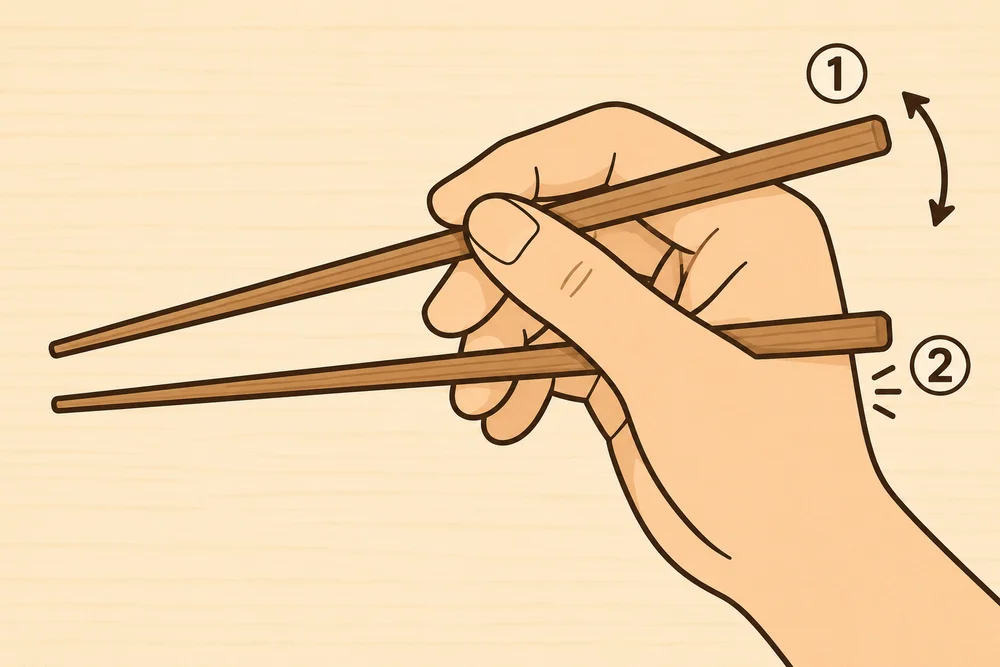
The taboos below are worth learning by name. Several of them look harmless if you don’t know the background, which is exactly why they catch people off guard.
| Japanese Name | What It Is | Why It’s Taboo |
|---|---|---|
| Tatebashi (立て箸) | Sticking chopsticks upright in a bowl of rice | The same shape as the rice offered to the deceased at a Buddhist funeral. A very bad omen and deeply disrespectful |
| Watashibashi (渡し箸) | Passing food directly chopstick-to-chopstick | The same gesture used for passing cremated bones at a funeral. Never do this |
| Sashibashi (刺し箸) | Spearing food with your chopsticks | Chopsticks aren’t skewers — considered bad manners |
| Mayoibashi (迷い箸) | Hovering your chopsticks over the dishes while you decide | Seen as lacking refinement |
| Saguribashi (探り箸) | Digging through a shared dish for the “good bits” | Makes others uncomfortable — take from the near side instead |
| Neburibashi (ねぶり箸) | Licking your chopsticks | Unhygienic and impolite |
Tatebashi and watashibashi in particular are recognized by nearly all Japanese people as absolutely forbidden, precisely because of their funeral associations. Doing either one unknowingly can cause genuine discomfort at the table, so if you remember only two rules from this whole article, make it these.
Source: MAFF Consumer Advice: Chopstick Manners / Hashi Culture Research Group: Chopstick Taboos
Holding Bowls, Soup & Noodles
Your rice bowl and soup bowl are meant to be picked up while you eat. Leaving a bowl on the table and leaning your face down toward it looks ill-mannered. Lift the bowl with your left hand, bring it up toward chest height, and use your chopsticks with your right hand. Flat plates holding grilled fish or simmered dishes are the exception — those stay on the table and don’t need to be lifted.
Soup works the same way: pick up the bowl and sip directly from it. For the solid ingredients inside — tofu, vegetables, and so on — use your chopsticks, or a renge (れんげ), the deep ceramic spoon served with ramen and Chinese-style dishes.
Slurping ramen, soba, or udon is completely fine in Japan — in fact it’s often welcomed as a sign you’re enjoying the meal, and it helps cool the noodles as you eat, so there’s no need to hold back or eat silently. Miso soup is different, though: there’s no custom of slurping it loudly the way you would noodles, so drinking it quietly is the norm.
Shared Dishes
Sharing dishes from a central platter is an everyday part of life in Japan — at izakaya, over home cooking, at casual get-togethers. When a big communal plate lands on the table, a few simple habits make a real difference.
- If serving utensils are provided: use the shared chopsticks or spoon resting beside the platter
- If not: use the clean (back) end of your own chopsticks to take your portion
- Where to take from: the side nearest you, not the center or the far side
- Don’t hoard: take only what you need for now, not a large portion all at once
Practical Restaurant Manners
When you sit down, you’ll usually be handed an oshibori — a rolled damp towel, or a disposable wet wipe. It’s for cleaning your hands before you eat; using it on your face or neck is considered poor manners. When you’re done, fold it back up and set it neatly at the edge of the table or return it to its tray.
To call staff over, say “Sumimasen,” or press the call button on the table if there is one. Unlike many Western restaurants, Japanese staff won’t keep circling back to check on you, so flagging them down yourself when you need something is completely normal — no need for big gestures. And if chopsticks are difficult, just ask “Fōku wo itadakemasu ka?” (“Could I have a fork?”). Most places will bring one without any fuss.
If you have a food allergy, it’s safest to say so before ordering. The basic pattern is “[allergen] arerugī ga arimasu” (“I have a [allergen] allergy”):
| Allergen | How to say it |
|---|---|
| Shrimp / crab | Ebi arerugī ga arimasu |
| Nuts | Nattsu ga taberaremasen (“I can’t eat nuts”) |
| Wheat (gluten) | Komugi arerugī ga arimasu |
| Dairy | Gyūnyū arerugī ga arimasu |
| Egg | Tamago arerugī ga arimasu |
For a serious allergy, carrying a card with the details written in Japanese is the surest approach. One more thing worth knowing: most Japanese restaurants don’t let you take leftovers home, largely out of food-safety concern over temperature control. Ordering an amount you can actually finish is the norm.
Drink-Pouring Customs
At Japanese gatherings, there’s a natural habit of noticing when the glass next to you is empty and offering to refill it — looking out for others before yourself. When someone pours for you in return, hold your glass with both hands as you receive it; it reads as polite and appreciative. At sake-focused meals, small ceramic cups called choko sometimes appear, and the same two-handed approach applies there too.
You don’t have to keep score of who poured for whom — it’s meant to be a relaxed, attentive gesture, not a rigid ritual. For more on how to order drinks and read an izakaya menu, see our Izakaya Guide.
Tipping Culture: Not Required
In Japan, you don’t tip. The common thinking is that good service is already built into the price, so leaving extra money can actually come across as rude or confusing. Rather than trying to express gratitude with cash, express it in words: “Gochisosama deshita” or “Arigatō gozaimashita” on your way out is exactly the right thing to say, and it’s genuinely appreciated.
When a Colleague Invites You Out: Kaiseki and Business Dining
Once you’ve settled into a workplace, there’s a good chance a senior colleague will invite you out to dinner somewhere a step up from the usual lunch spot. That’s often where kaiseki — Japan’s traditional multi-course cuisine — comes in. Think of it like a French tasting menu: dishes arrive one at a time, in a set order — an appetizer, a clear soup (osuimono, a dashi-based broth), sashimi, a grilled dish, a simmered dish. Because the kitchen sets the pace, there’s no need to rush; just follow the flow of the courses. If a soup or rice bowl comes with a lid, set it back the way it was once you’ve finished.
Source: Japanese Culinary Academy: Kaiseki Cuisine
At meals like this, the unspoken rule is to wait until the most senior person picks up their chopsticks before you start. Japan’s workplace culture runs on seniority, and that hierarchy carries naturally into the dining room. Don’t dive into work talk right away, either — the first stretch of the meal is for settling in and enjoying the food, with the real business discussion usually coming toward the end. The senior person often handles both the ordering and the bill; if you’re treated, a sincere “Gochisosama deshita” is the simplest and most natural way to say thank you.
Dining at a Japanese Home
Take your shoes off at the genkan (the entryway), and rather than leaving them however they land, turn them to face the door and set them neatly to the side — it makes a quietly good impression. Showing up empty-handed feels less natural than bringing a small temiyage (a gift) such as sweets, fruit, or drinks; it doesn’t need to be expensive (see our Gift-Giving & Omiyage Guide for what works well). And as at a restaurant, wait until your host says “dōzo” or starts eating before you dig in.
Manners by Restaurant Type
| Type | Key Point |
|---|---|
| Kaiten-zushi (conveyor-belt sushi) | Very casual — no strict etiquette to worry about. For formal sushi manners, see our Sushi Guide |
| Ramen shops | Many use a ticket machine — buy your meal ticket first, then take a seat. Counter seating is common, so it’s easy to go solo. Slurping is welcomed |
| Yakiniku (grilled meat) | You grill it yourself at the table; offering to grill for others first is a thoughtful gesture. Use the shared tongs or serving chopsticks if they’re provided |
| Izakaya | An unordered otoshi appetizer (¥300–500) usually arrives first and is hard to decline — think of it as a seating charge. The night often opens with a group “kanpai” (cheers). See our Izakaya Guide |
Imperfect Is Fine
You don’t need to learn every rule at once. What matters more than knowing all of them is coming to the table with respect for the people you’re with. Even if your chopstick grip is clumsy or you stumble over a phrase, as long as you say “Itadakimasu” and “Gochisosama deshita” and avoid tatebashi, watashibashi, and sashibashi, you’ll be treated with plenty of respect. If you make a mistake, don’t dwell on it — apologize with a smile and do better next time. Relax and enjoy Japanese food culture.
FAQ
Why hold the rice bowl in your left hand?
If you’re right-handed, your right hand is busy with the chopsticks, so supporting the bowl with your left is the natural flow. Lifting the bowl also makes it easier not to drop food and keeps your posture looking neat. Left-handed diners simply reverse this — right hand on the bowl, left hand on the chopsticks.
Can I cut noodles before eating?
You can, but slurping them whole in bite-sized mouthfuls is the more common style, and it’s the way that looks most natural at a ramen or soba shop.
Is it OK to leave food uneaten?
In Japan, finishing what you’re served is generally seen as polite, and this is felt most strongly with home cooking and traditional Japanese meals. At Western or casual restaurants, if a portion looks too large, it’s fine to say so honestly when ordering and have it adjusted.
What if I drop my chopsticks?
Don’t panic — just say “Sumimasen” and ask for a new pair. Restaurants deal with this all the time, so there’s no reason to feel awkward about it.
What if something I don’t like is served?
If you know in advance, the smoothest approach is to mention it before you’re invited or when ordering: “I’m not great with [X].” If you only realize at the table, you don’t have to force yourself — a light “I’m not so good with this” is enough. Japanese people generally won’t push you to eat something, so being natural and honest about it is perfectly fine.
Key Takeaways
- “Itadakimasu” and “Gochisosama deshita” — using these two phrases helps close the distance with the people around you
- Tatebashi and watashibashi are in a different category from other chopstick slips — people notice immediately, so keep these two top of mind
- Slurping noodles is fine — there’s no need to hold back
- At gatherings, keep an eye on the glasses around you and offer to refill when someone runs empty
- No tipping — a single “Gochisosama deshita” conveys all the thanks you need
You don’t have to memorize everything. Make “Itadakimasu” and “Gochisosama deshita” a habit, steer clear of tatebashi and watashibashi, and the rest will come naturally as you eat out more. Don’t overthink it — just enjoy the table first.