Last Updated: March 29, 2026
Reading Time: About 9 min
Category: Culture
Introduction
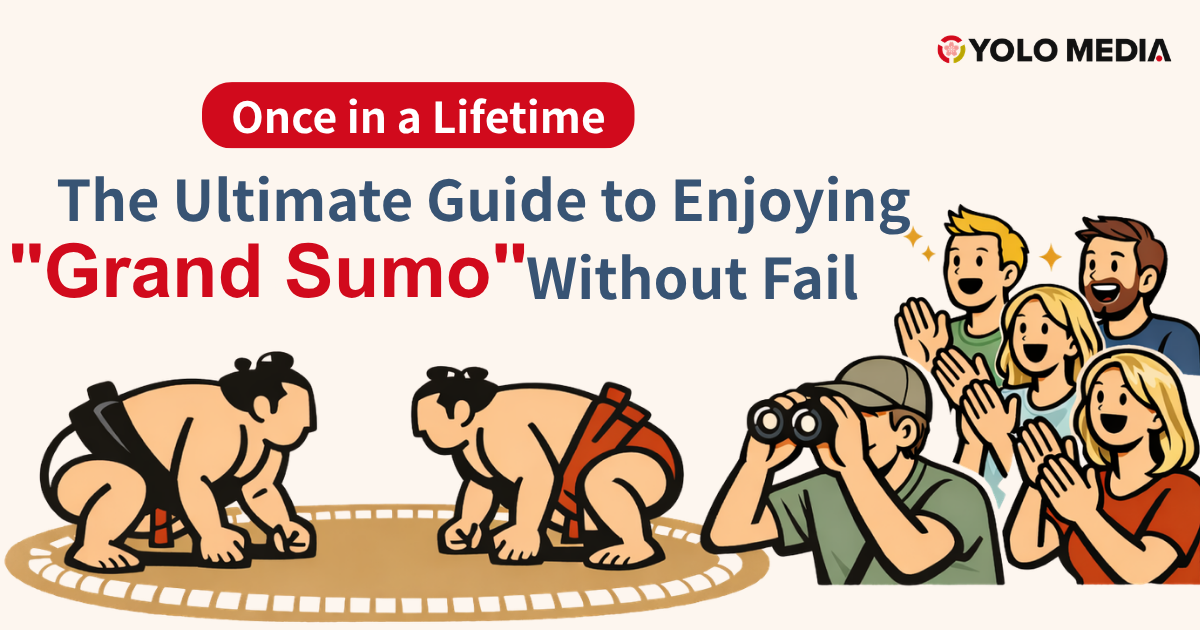
Two giant men stare each other down in a clay ring, wearing only a loincloth (Mawashi). In the hushed air, they suddenly collide with a thunderous thud. You only truly understand the appeal of Japan’s traditional sport, \”Sumo,\” when you see it live, rather than on TV.
For many first-time viewers, the surprise isn’t just the fighting; it’s the realization that it’s a sacred Shinto ritual. Actions like throwing salt to purify the ring fascinate and draw people in. In this guide, we’ve summarized everything from the simple rules and English ticket buying to the famous \”Chanko-nabe\” stew. Why not immerse yourself in the heat and excitement of the Kokugikan?
TL;DR
- What is Sumo?: A 1,500-year-old national sport. It originated as a sacred ritual (Ritual) for the gods.
- Ultra-Simple Rules: You win by pushing the opponent out of the ring (Dohyo) or making any part of their body (except the soles of their feet) touch the ground.
- When & Where: Six official tournaments are held annually in Tokyo, Osaka, Nagoya, and Fukuoka.
- Buying Tickets: Buy via the official English website. The traditional \”Masu-seki\” floor seating is a must-try recommendation.
- Secret Tip: Get a free, close-up look at the intense action by visiting a sumo stable for \”Asageiko\” (morning practice).
History and Beautiful Rituals of Sumo
Sumo began as a Shinto ritual dedicated to the gods (Kami), held at shrines to pray for a good harvest. During the Edo period (1603-1868), it became organized as \”Grand Sumo\” (Ozumo), similar to the professional sport today, and enthralled the townspeople.
Because of this, modern sumo still strongly reflects its Shinto history:
- Salt Throwing (Shiomaki): A purification ritual where wrestlers throw salt into the ring to ward off evil.
- Shikiri: A psychological battle where both sides crouch in the center and stare each other down for several minutes.
You watch the tension build during the Shikiri as they repeatedly stand up and reset… and then the actual match ends in just 3 seconds! Almost every foreigner seeing sumo for the first time experiences this \”moment\” (lol). This gap between \”Stillness\” and \”Motion\” is exactly what makes sumo so interesting.
The World’s Simplest Rules
The rules of Sumo are incredibly easy. There are only two conditions for winning or losing:
- Lose if any part of your body other than the soles of your feet (hands, knees, etc.) touches the ground.
- Lose if you step outside the ring (Dohyo) before your opponent.
There are no weight classes. It’s common to see a 100 kg wrestler face a 200 kg giant. The moment a smaller wrestler uses speed and high technique to flip a larger opponent with a \”throw\” is when the stadium erupts in a roar.
Ranks (Banzuke)
Strength is represented by the Banzuke rankings. Only a handful of people in history have reached the highest rank, Yokozuna. Once you become a Yokozuna, there is no demotion, but you are required to \”retire\” if you can no longer win.
Tournament Schedule and Ticket Guide
The \”Honbasho\” (official tournaments) are held six times a year in odd-numbered months.
| Tournament | Month | City | Venue |
|---|---|---|---|
| Hatsu Basho | January | Tokyo | Ryogoku Kokugikan |
| Haru Basho | March | Osaka | Edion Arena |
| Natsu Basho | May | Tokyo | Ryogoku Kokugikan |
| Nagoya Basho | July | Nagoya | Dolphins Arena |
| Autumn Basho | September | Tokyo | Ryogoku Kokugikan |
| Kyushu Basho | November | Fukuoka | Fukuoka International Center |
How to Buy Tickets
Official tickets go on sale about 1-2 months before each tournament, but they are extremely popular and sell out quickly.
- Official Website (English): The Japan Sumo Association’s official ticket site, \”Ticket Osumo,\” allows for English-language purchases.
- Use Foreign-Friendly Tours: Tours that include English guides explaining history and rules are also popular (bookable via Viator, Klook, etc.).
Which Seats to Choose?
- Chair Seats (Isu-seki): Standard seats on the upper levels. Affordable (~¥3,000 – ¥9,000) and provide a clear view.
- Box Seats (Masu-seki): Traditional Japanese box seats where you remove your shoes and sit on four cushions (Zabuton). Strongly recommended for families or friends (~¥40,000+/4 people).
Beyond the Match: Morning Practice and Chanko-nabe
1. Training Stable (Asageiko) Viewing
In Tokyo’s downtown areas like Ryogoku, there are many \”Sumo Beya\” (stables) where wrestlers live and train. Some allow the public to watch their intense morning practice (7:00 AM – 10:00 AM) for free.
The sound of bodies colliding from just inches away might be even more powerful than the main tournament.
- Recommended: Stables like Arashio-beya are popular with foreign tourists because you can watch through a window (check their website for viewing days).
2. Chanko-nabe: The Source of Power
The nutritious hot pot that builds a wrestler’s body is called Chanko-nabe. It’s a stew of meat, fish, and plenty of vegetables. Ryogoku is full of delicious Chanko-nabe restaurants run by former wrestlers. You can’t go home without trying this after a match!
FAQ
Q: Can women watch Sumo? Can they enter the ring?
A: Anyone can enjoy the matches! However, due to Shinto tradition, the \”Dohyo\” (ring) is off-limits to women (nyonin kinzei), and this rule remains strictly observed today.
Q: Can I enjoy it without knowing Japanese?
A: Absolutely! The sound of bodies clashing, the wrestlers’ expressions, and the roar of the crowd are a universal language. You can also rent a radio at the venue for English commentary.
Key Takeaways
Honbasho are in Jan, Mar, May, Jul, Sep, and Nov. Check your travel calendar!
[!TIP]
Use the official site to buy in English. If with friends, secure a traditional Masu-seki.
[!TIP]
If you’re an early bird, experience the overwhelming power of Asageiko at a sumo stable for free.
[!TIP]
The best way to end a sumo day is eating traditional Chanko-nabe around Ryogoku.
Sumo is more than just a sport; it’s an experience of Japan’s deep history. Try stepping into the heat and excitement of the Kokugikan on your next trip!