Last Updated: February 18, 2026
Reading Time: About 9 min read
Category: Culture
Introduction
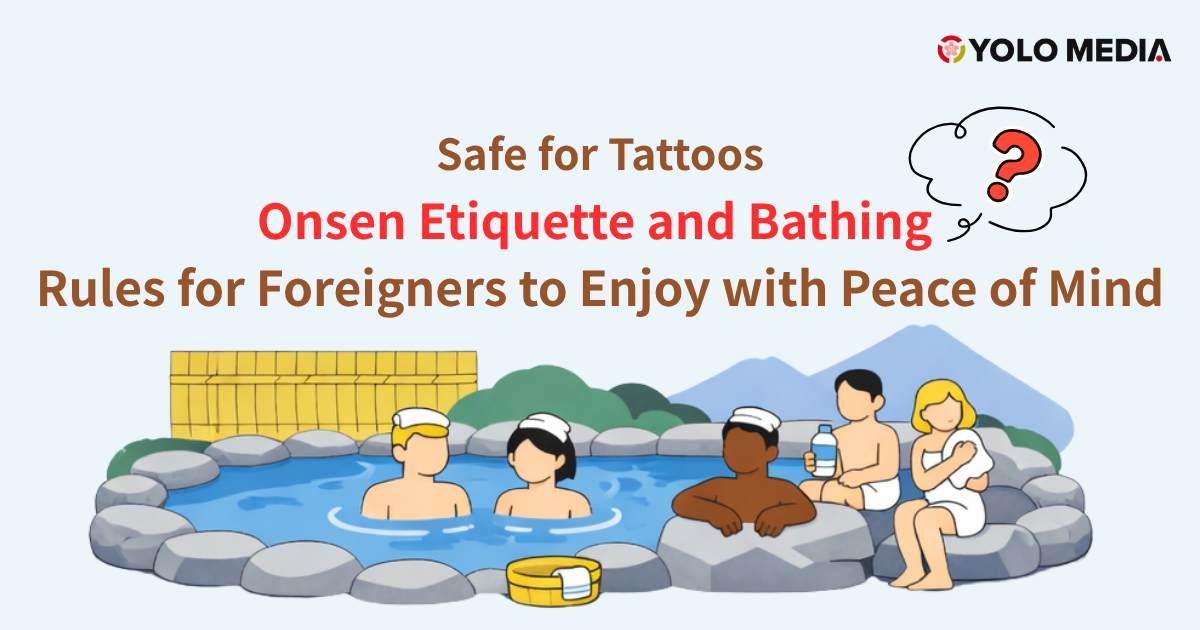
Soaking in warm water while looking at a snowy landscape or the mountain greenery. When it comes to the ultimate relaxation experience in Japan, it’s definitely the \”Onsen.\”
However, don’t you feel very nervous when going to an onsen for the first time? \”Do I really have to be completely naked?\” \”Will I be turned away because of my tattoos?\” These are anxieties that every person from abroad goes through. In this article, we’ll clearly explain everything from basic bathing methods to specific solutions for foreign travelers with tattoos, so you can make your onsen debut with total peace of mind!

TL;DR
- It is an absolute rule in Japan to wash your entire body with a shower before entering the bath.
- Do not put your towel in the bathtub. Folding it and placing it on your head is the Japanese style.
- Swimwear is not allowed in Onsen. As a rule, you bathe completely naked.
- While tattoo bans have historical roots, an increasing number of facilities accommodate them with cover stickers or private baths (Kashikiri-buro).
- Avoid loud conversations and enjoy a quiet relaxation time to warm your body.
Onsen vs. Sento (What is Onsen?)
Japan is said to have about 27,000 hot spring sources. Knowing the difference between an \”Onsen\” and a \”Sento\” is useful when choosing where to go.
- Onsen (温泉)
Uses \”natural hot spring water\” heated by geothermal heat. It is rich in minerals.
Price Estimate: ¥500–¥3,000
- Sento (銭湯)
A public bathhouse in the city. Most use heated tap water.
Price Estimate: Around ¥500
- Super Sento
A large bathing facility equipped with saunas, restaurants, and rest areas.
Price Estimate: ¥1,000–¥2,500
Step-by-Step Guide: The Correct Procedure for Entering an Onsen
The most important part of onsen etiquette is not just \”what you do,\” but \”in what order you do it.\” Once you remember this, you have nothing to fear.
Step 1: Prepare in the Changing Room (Datsuijo)
Receive a small face towel and a large bath towel at the reception.
Remove all your clothes at the locker in the changing room. While some spa resorts allow swimwear nowadays, swimwear is a NO at typical traditional onsen. Traditional Japanese bathing culture is about being naked, based on the idea that \”everyone is in the same state, so there’s nothing to be ashamed of.\” Enter the bathing area with only your small towel.
Step 2: Always Wash (Kakeyu) Before Entering the Bath
This is the most important part! Before entering the bathtub, perform Kakeyu (pouring water over yourself) or wash your entire body with soap in the shower area.
Japanese onsen are sacred places where everyone shares clean water. It is an absolute rule to sit on a low stool in the washing area and wash off dirt from your hair and body before heading to the bathtub.
💡 Pro Tip: After using the stool and basin, lightly rinse them with your hot water and return them to their original state. This is a smart move that makes locals think, \”This person knows what they’re doing.\”
Step 3: Enter the Bath Quietly
The water temperature is quite hot, around 40–43°C. It might surprise you if you jump in, so enter slowly starting from your feet. Since it’s not a pool, swimming or jumping in is prohibited.
Step 4: Do Not Put Your Towel in the Bath
You must never dip the small towel you brought into the bathwater. This is to prevent bacteria from mixing into the water. Fold it and place it on your head (this is the authentic Japanese style!) or leave it by the side of the tub.
Many people try to hide their bodies with a towel out of shyness, but please take the plunge and soak in the water. You might be nervous at first, but once you blend into the onsen culture and find yourself in a space where everyone is quietly relaxing, you’ll find you can truly relax from the heart.
Step 5: Wipe Your Body Before Leaving
Before getting out of the bath and returning to the changing room, always lightly wipe off water droplets with your small towel. This is important etiquette to avoid wetting the changing room floor.
The Reality of Tattoo Rules at Onsen
The biggest concern for foreigners with tattoos is: \”Can I actually enter an onsen?\”
Why Have Tattoos Been Banned?
Historically in Japan, tattoos (Irezumi) have been associated with \”anti-social forces (Yakuza).\” To protect an environment where general guests can relax without fear, many facilities have established the rule of \”banning people with tattoos.\”
Due to the recent increase in foreign travelers, it’s becoming understood that tattoos are fashion or culture, and the Japan Tourism Agency is reviewing its policies. However, about 60% of facilities still have tattoo policies today. (Reference: Japan Tourism Agency Survey)
4 Ways to Enjoy Onsen Even with Tattoos
You don’t have to give up completely. You can definitely enter an onsen using the following methods.
- Use Tattoo Cover Seals
For palm-sized tattoos, more and more facilities are allowing entry if they are hidden with waterproof, flesh-colored cover stickers. You can buy these on Amazon, at pharmacies like Don Quijote, or sometimes directly at the onsen reception.
- Book a Private Bath (Kashikiri-buro)
This is the most reliable and relaxing method. Many onsen ryokans and day-trip facilities have private baths that can be used by families or couples for a set time. Since you aren’t sharing with other guests, tattoos are not an issue.
- Price Estimate: Bathing fee + ¥2,000–¥5,000 / 45–60 min
- Choose Tattoo-Friendly Facilities
Look for onsen that accept tattoos from the start. You can easily search for tattoo-OK onsen and gyms nationwide using English database sites like \”Tattoo Friendly Japan.\”
- Go to Relatively Lenient Onsen Areas
Resort onsen in areas with many foreign skiers, like Niseko and Hakuba, or Oita Prefecture’s Beppu Onsen, have many facilities that are historically accepting of global perspectives and tattoos.
⚠️ Watch Out: Trying to hide a tattoo thinking \”It’s small, they won’t notice\” only to be asked to leave by staff later is a very awkward experience. The most reliable way, which also shows respect, is to ask the front desk first: \”I have a tattoo; can I use the bath if I cover it with a sticker or use a private bath?\”
FAQ
Q: Can I bring a smartphone or take photos inside an onsen?
A: It is strictly prohibited. To protect the privacy of other guests, bringing cameras or mobile phones into the changing room or bathing area is forbidden without exception. If you want to take a photo of the scenery, do so from outside or check if it’s possible only in a private bath.
Q: For women, what should I do during my period?
A: Generally, using the large public bath during your period should be avoided as a matter of etiquette. While it’s said that water pressure can stop menstrual flow, the best choice for hygiene and consideration for others is to use a private bath or the bath in your guest room.
Q: Can children enter together?
A: Small children can bathe with a parent of the same sex. The age for switching between genders varies by facility (around 10 years old is a common guide).
Key Takeaways
- ✅ Follow the absolute rule of washing your body \”completely\” in the shower before entering the bath.
- ✅ Do not put your towel in the bathtub. Wipe your body before returning to the changing room to avoid wetting the floor.
- ✅ If you have tattoos, use cover stickers or book a \”Kashikiri-buro\” (private bath) to enjoy without worries.
- ✅ Don’t fear the cultural difference—enjoy the unique Japanese experience of completely naked relaxation!
Now you’re perfectly prepared with the basic manners. Next, please experience that healing for yourself at a real onsen. The feeling of warming up to the core of your body will surely captivate you.