Last Updated: March 18, 2026
Reading Time: 10 min read
Category: Culture
Introduction: Why Should Expats Know Japanese History?
Living in Japan brings a series of little mysteries every day.
“Why do Japanese trains arrive without a single minute of delay?”
“Why do official procedures require you to use paper and a personal stamp (hanko) right next to a cutting-edge computer?”
“Why do people apologize so much?”
“Why do you receive such excessively polite customer service even for the smallest purchases?”
Through your daily life or work, have you ever wondered, “How did Japanese culture get to be like this?”
The answers to these everyday “whys” are actually hidden in the historical background of the past.
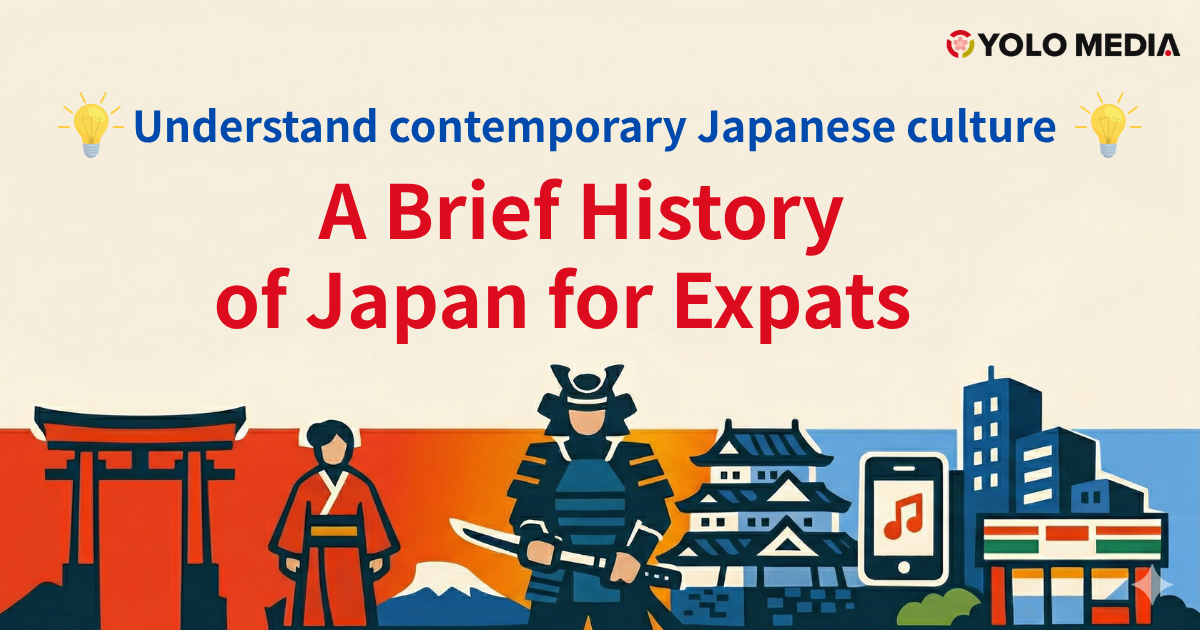
This article is not for memorizing dates like a textbook. It’s a practical history guide for expats living in Japan to finally have that “Aha! So that’s why Japanese people are like this!” moment. Once you read this, your life in Japan starting tomorrow should look a little different.
TL;DR
- Over 2,600 years of history and unique geography have nurtured Japan’s culture of “Wa” (Harmony).
- The three key points expats should know are the Edo Period’s isolation (Sakoku), the Meiji Restoration, and the post-war Economic Miracle.
- Unique rules, such as workplace group-orientation and strict punctuality, all have concrete historical reasons.
- Knowing history will clearly answer the “whys” of everyday life and business in Japan.
Ancient & Medieval History: Agricultural Culture and the Birth of the Samurai
How did Japan become a country that places such importance on the “group”? The roots go back to the distant past.
Rice Cultivation and the Spirit of “Wa” (Yayoi Period, etc.)
Japan was originally a hunter-gatherer society, but it changed drastically when rice cultivation was introduced from the continent (around 300 BCE). Growing rice requires everyone in the village to cooperate to manage water, plant seedlings, and harvest the crops. If one person acts selfishly, the whole village could starve. This laid the foundation for Japan’s spirit of Wa (Harmony), where getting along with others is valued above all else.
It’s fascinating to think that the strong “let’s decide together” atmosphere in Japanese workplaces actually started way back then.
The Elegance of Aristocrats and the Rise of the Samurai (Heian to Kamakura Periods)
Later, there was an era when aristocrats centered in Kyoto fostered a highly elegant culture (Heian Period, 794–1185). Their appreciation for the changing seasons and mono no aware (a sensitivity to the fleeting beauty of things) is still very much alive today. The way everyone gets restless and excited for the cherry blossoms to bloom in spring is like DNA passed down from this era.
Meanwhile, in the provinces, powerful warriors (samurai) began to rise (Kamakura Period, 1185–). They created the foundation of Bushido (the way of the warrior), which values loyalty, honor, and strict discipline.
💡 Expat Experience
Have you ever noticed how subordinates treat their bosses with absolute respect and deference in a Japanese office? While modern workplaces are certainly becoming more egalitarian, the underlying attitude of “respecting your superiors and devoting yourself to the organization” is heavily influenced by the historical values rooted in the era of the samurai.
(Reference: Kenneth Henshall, “A History of Japan”, Toyo Keizai Inc.)
The Edo Period (1603–1868): 265 Years of Peace Shapes Japanese Culture
When learning about Japanese history, you absolutely cannot skip the Edo Period. Once you understand this era in a simple way, most of the mysteries surrounding modern Japanese culture will be solved.
The Tokugawa Shogunate and Isolation (Sakoku)
After more than a century of civil war (the Sengoku Period), Tokugawa Ieyasu unified Japan and established his military government (shogunate) in Edo (present-day Tokyo). Astonishingly, they adopted a policy called Sakoku (national isolation), cutting off almost all interactions with foreign countries for about 265 years.
This more than 200 years of peace and isolation allowed Japan to evolve in an entirely unique direction.
The “Edo” Temperament that Remains Today
What did people do during a peaceful era with no foreign influence coming in? They polished their own culture to the extreme. Kabuki theater, ukiyo-e woodblock prints, the tea ceremony, and the mind-blowing skills of artisans—everything became highly refined.
The roots of the “obsessive attention to detail” and the “otaku culture” that we feel in modern Japan are right here. Furthermore, the concept of murahachibu (social ostracization) was born during this time. To maintain peace in a confined space, it was customary to exclude those who broke unwritten rules.
People often ask, “Why is Japan so safe?” It’s because the mindset of “worrying about what others think” and “following the rules is a given,” which was cultivated during this long isolation period, is still firmly alive today.
(Reference: National Museum of Japanese History, https://www.rekihaku.ac.jp/)
Exploring the Meiji Restoration (1868–1912): The Shift to a Modern Nation
The peace of the Edo period suddenly came to an end with the arrival of the “Black Ships” (American Commodore Perry’s fleet). What started then was modernization at a breakneck speed unprecedented in the world at the time: the Meiji Restoration.
Absorbing Western Culture and Wakon-Yosai
Faced with the overwhelming military and technological power of the West, Japanese people took astonishing actions despite the confusion. They cut off their topknots, laid down their swords, and began absorbing Western laws, educational systems, and lifestyles at a furious pace.
However, they didn’t just blindly copy the West. They cherished the stance of wakon-yosai (Japanese spirit, Western learning), which meant adopting excellent systems from Europe while keeping their spirit and foundation Japanese.
Historical Impact on Japanese Business
Actually, for expats working in Japanese companies, this wakon-yosai can still be a high hurdle today.
For example, a company might introduce the latest overseas software or evaluation system, but for some reason, the way it’s used is very “Japanese” and inefficient, or you still absolutely need a physical stamp (hanko) for approval. The habit from the Meiji era of not wanting to change the inner “Japanese essence” (the attitude of valuing processes and human relationships), even when changing the outer system, has not faded away.
The Pacific War and Post-War Japan (1941–1952): Restarting from the Ashes
Having gained confidence from its successful modernization, the military eventually took power, plunging Japan into a world war.
Defeat and the Birth of Pacifism
The Pacific War, which began with the attack on Pearl Harbor, had a massive impact on Japanese society and the hearts of its people. Many cities suffered severe damage from air raids, and in the summer of 1945, atomic bombs were dropped on Hiroshima and Nagasaki. This event serves as a profoundly important lesson deeply engraved in modern Japanese society.
After the war, the newly drafted Constitution included the famous “Article 9” (renunciation of war). The reason Japanese people try to avoid fierce political confrontations and place such a high value on peace is because of the pain of the past and the strong desire to “never let it happen again.”
(Reference: John W. Dower, “Embracing Defeat: Japan in the Wake of World War II”, W.W. Norton & Company, 1999)
From the Economic Miracle to Modern Times (1950s–Present)
From such massive devastation, how did Japan get back on its feet? The path to recovery from here on is also an essential episode for understanding Japan today.
Starting from Zero to Becoming an Economic Superpower
The Japanese people demonstrated their inherent diligence and teamwork, reviving the economy at an unbelievable speed. They successfully hosted the Tokyo Olympics in 1964, and by the 1980s, Japan had climbed to become one of the world’s top economic superpowers.
During this era when brands like Sony, Toyota, and Honda swept the world, the word Kaizen (continuous improvement) was born. “Better, more efficient, higher quality.” Under this slogan, all company employees worked together as one big family.
💡 Expat Experience
Have you ever noticed how in Japanese workplaces, very detailed meetings are held repeatedly asking “How can we make this better?”, or how small mistakes are shared with the whole team to devise preventive measures? This working style of “the whole team coming together to improve quality (Kaizen)” is exactly a culture deeply rooted in this era of economic growth.
The Lost Two Decades and Japan’s Future
However, following the collapse of the bubble economy in the early 1990s, Japan entered a long period of economic stagnation known as the “Lost Two Decades.”
The lifetime employment system began to slowly crumble, and a growing number of young people started to question the old value of “dedicating your life to the company.” Japan today is in a transitional phase where old collectivism and new individualism are mixing together.
The fact that young employees are now declining drinking parties after work, and changing jobs has become the norm, symbolizes the shift in this era.
Quick Reference: Keywords Behind Japanese Culture
Based on the history we’ve covered, here is a summary of the characteristics often seen in modern Japanese society.
| Historical Experience | Tendencies in Modern Japan |
|---|---|
| Agricultural/Rice Culture | Group cooperation, consensus building, unwritten local rules |
| Samurai and Bushido | Diligence, discipline, loyalty to superiors, emphasis on honor |
| 200 Years of Isolation | Unique cultural evolution, peer pressure, reluctance to change |
| Meiji’s Rapid Modernization | Adopting foreign systems while keeping Japanese identity (Wakon-Yosai) |
| Defeat and Pacifism | Strong pacifism, an atmosphere avoiding radical political debates |
| High Economic Growth | Strong obsession with quality, customer-first mindset, remnants of long working hours |
FAQ: Common Questions About Japan
Q: Why do Japanese people apologize so much?
A: It’s a consideration for “not disturbing the harmony of the group” that continues from the agricultural society and the isolation period. Rather than “I’m sorry,” it is used as “lubricant to make human relationships run smoothly.” For this reason, the frequently heard sumimasen is very often not an admission of fault, but rather an expression of gratitude meaning “Thank you (for going out of your way for me).”
Q: Why do old and new things exist at the same time?
A: The concept of wakon-yosai continuing from the Meiji era is highly influential. It’s the stance of “accepting excellent foreign technology while protecting the traditional Japanese spirit and methods.” Therefore, we have a society where technology and tradition coexist—such as preferring “paper and hanko” for the final confirmation even after introducing the latest IT systems, or conductors giving polite, old-fashioned bows to passengers inside the world’s most technologically advanced Bullet Trains (Shinkansen).
(Reference: Multilingual Living Information CLAIR http://www.clair.or.jp/tagengo/ )
Key Takeaways
- ✅ Japan’s “collectivism” was wisdom for everyone to survive together, born from being an agricultural society on an island nation.
- ✅ The long-lasting peace of the Edo period nurtured Japan’s unique “fine consideration for others,” “craftsmanship,” and “otaku culture.”
- ✅ Because modern Japan is a mix of old and new values, it’s very important to understand the history and background of the people you interact with.
By understanding the flow of Japanese history, the everyday things that used to feel “weird” probably look a bit more three-dimensional now. Japanese culture is complex, but once you realize the “consideration for others and society” behind it, your life here will become much richer and more enjoyable. Please use this as a hint for your workplace conversations and city strolls starting tomorrow!