Introduction
You wake up with a high fever and aching joints. If you have never been to a Japanese hospital, it is not obvious where to go, what to bring, or where to pick up medicine.
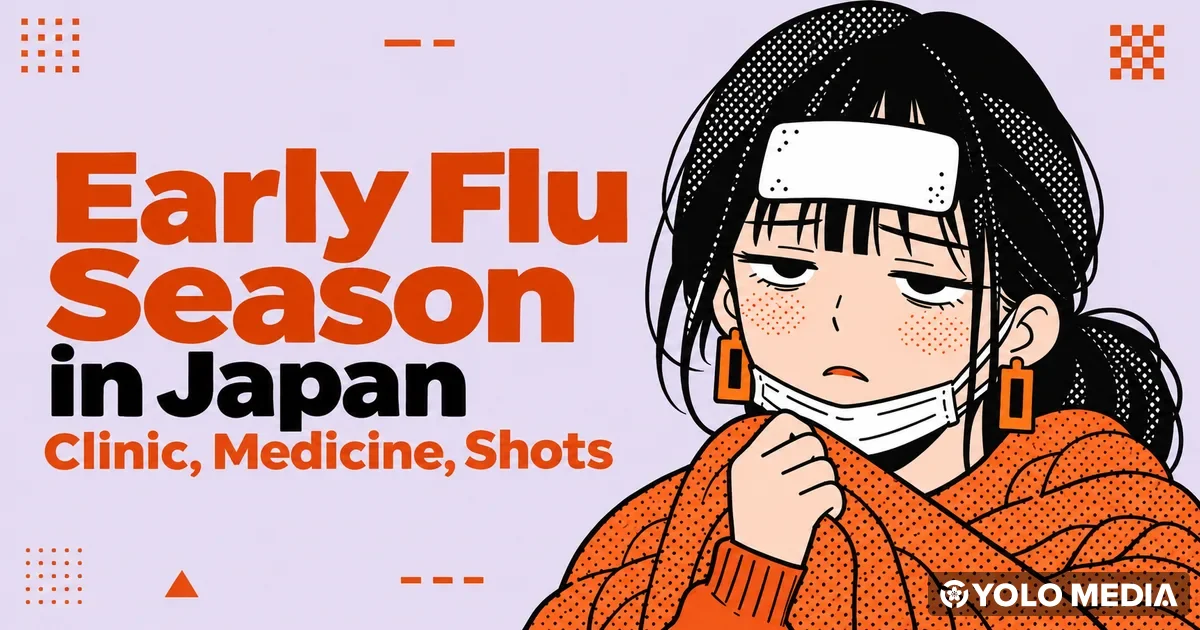
This season’s flu started earlier than usual. According to the latest data from the Ministry of Health, Labour and Welfare (MHLW), released on November 13 for the week of November 2 to 8, national case reports rose for the third week in a row.
If you have not had a flu shot yet, now is a good time to act. This article covers where the outbreak stands, how a clinic visit works, how to think about over-the-counter medicine, and the basics of vaccination. Our separate guide covers children’s vaccinations.
What you will learn
- This season’s flu epidemic began second-earliest since 1999 (not counting 2023)
- For November 2 to 8, sentinel clinics nationwide reported 41,071 cases, a third straight weekly increase
- If you have a fever, go to a neighborhood internal medicine clinic first, not a large hospital
- It is best to get a flu shot before the usual peak from late December into January. Children’s vaccinations are covered in a separate guide
Disclaimer: This article is based on the MHLW announcement of November 13, 2026 and Weathernews reporting. Information is current as of November 17, 2026. It is not medical advice. If you have symptoms or a chronic condition, consult a doctor or pharmacist.
This season’s flu started earlier than usual
In late August, the national average reports per sentinel clinic (the number of cases reported by each designated clinic) passed 1.00, the threshold for the start of an epidemic. Since the current counting method began in 1999, only 2009 had an earlier start (not counting 2023, when the previous season’s outbreak had carried over). Last season’s start was announced in October 2025.
(Source: Weathernews, "Flu Season Has Begun, More Than a Month Earlier Than Last Year")
Reports have kept climbing. For November 2 to 8, sentinel clinics reported 41,071 cases, or 11.00 per clinic, up for a third week running. On the other hand, the number of schools and childcare facilities with closures (whole school, grade, or class) fell to 1,325, down from 2,451 the week before.
(Source: MHLW, "Influenza situation," November 13, 2026)
The season started early, but the latest count is about half of the same period last year (84,183 cases). That is also worth keeping in mind.
Even so, flu usually rises from late December into January. Lower numbers than last year do not mean the winter wave is over before it starts. Regional differences are large too: Hokkaido had the highest figure at 28.32 per clinic, while Kagawa had the lowest at 3.96.
If you have a fever: how a clinic visit works in Japan
If you suspect the flu, go to a neighborhood internal medicine clinic (naika). For children, contact the pediatric clinic you usually visit. Walking into a large hospital without a referral letter can add an extra charge (a “selected medical care fee”) on top of the first-visit fee.
Here is the usual flow.
- Check the clinic’s website before you go. Some clinics use a separate entrance or waiting area for patients with a fever. Look for a notice for patients with a fever, and use online booking or an online questionnaire if the clinic has one. You can find clinics that support other languages on Iryo Joho Net (Navii), the MHLW’s medical facility search site. If the website does not answer your questions, ask someone who speaks Japanese to call for you.
- Reception. Show your My Number insurance card (a My Number Card registered for health insurance use) or your eligibility certificate (shikaku kakuninsho). Old health insurance cards can no longer be used. At a first visit you fill out a questionnaire about your symptoms. A translation app works fine if your Japanese is limited.
- Exam and test. The usual test is a nasal swab with a rapid result. Right after the fever starts, the result can be negative, so some clinics retest later.
- Payment. Small clinics sometimes accept cash only.
- Prescription. Flu antivirals cannot be bought without a doctor’s prescription. Take it to a nearby pharmacy.
(Source: MHLW, "Using the My Number Card as a Health Insurance Card (My Number Insurance Card)", MHLW, "How to Use Iryo Joho Net (Navii)")
For the difference between the My Number insurance card and the eligibility certificate, and what to do if you have neither yet, see our separate article.
 Living in Japan
Your Old Insurance Card Stops Working July 31, 2026. Here’s How to Switch to the My Number Insurance Card
Japan's grace period for expired health insurance cards ends July 31, 2026. After August 1, you'll need the My Number In…
Read related article
For how first-visit costs and the 30% copay work, see our basic guide to the healthcare system.
 Living in Japan
How to See a Doctor in Japan: Insurance & Costs (2026)
How to see a doctor in Japan, from reception to pharmacy. My Number insurance card, 30% copay, the High-Cost Medical Exp…
Read related article
If you do not have your My Number insurance card or eligibility certificate with you, tell reception first. Some clinics let you pay in full for now and claim a refund later.
Some medical facilities now offer paid reservations (yoyaku shinsatsu). We covered how cancellation fees work for them in a separate article.
 Living in Japan
Hospital Appointment Cancellation Fees Now Allowed in Japan from June 2026, But Only at a Small Number of Facilities
Starting June 2026, some hospitals in Japan can charge cancellation fees for missed appointments. This only applies to a…
Read related article
Can you manage with over-the-counter medicine?
No over-the-counter medicine cures the flu itself. The drugs that act on the virus are prescription only. Cold medicine and fever reducers sold at pharmacies only ease fever and pain.
At a pharmacy or drugstore, describe your symptoms (fever, sore throat) and the pharmacist will help you choose. Ask a pharmacist or doctor instead of choosing yourself if:
- You are pregnant or breastfeeding
- You have a chronic condition and take other medication
- The medicine is for a child (some ingredients are not suitable depending on age)
If you have a persistent high fever, trouble breathing, cannot keep fluids down, or feel confused, do not wait it out with over-the-counter drugs. See a doctor. For nights and weekends, look up your city’s emergency guidance and medical consultation hotline (#7119 works in some areas).
Should you stay home from school or work?
Under the School Health and Safety Act, schools keep children home until 5 days have passed since symptoms began and 2 days (3 days for preschool-age children) since the fever went away. If you have children, check the notice from their school or daycare.
(Source: e-Gov Law Search, "Enforcement Regulations of the School Health and Safety Act")
For adults, there is no nationwide rule. It depends on your company’s work rules. If you have a fever, contact your workplace before heading in and confirm how to take time off.
For when your child suddenly gets a high fever and you are not sure whether to call an ambulance, see our guide.
 Family & Life
Ambulance or Clinic? A Decision Guide for International Parents When a Child Gets Sick in Japan
When your child gets suddenly sick in Japan, this guide walks international parents through calling 119 with an English …
Read related article
Think about the flu shot early
The flu vaccine does not block every infection. Its purpose is to reduce the chance of getting sick and of severe illness. It takes about two weeks after the shot to take effect, so it is best to get it before the usual peak from late December into January.
For healthy adults, the shot is self-paid because health insurance does not cover it, and each clinic sets its own price. People aged 65 and over may get the shot at a lower price through a subsidy from their city or ward. Check the city or ward website.
(Source: MHLW, "Q&A on the FY2026 Winter Comprehensive Measures Against Acute Respiratory Infections")
Most clinics take bookings online or by phone, and slots fill up quickly during an outbreak. You can check whether you can get one, what it costs, and whether slots are open on the clinic’s website or online booking page.
The flu vaccine is reformulated every year to match the strains expected to circulate. Even if you had a shot last year, you need a new one this season.
For children’s vaccinations, our separate guide explains the difference between routine and optional vaccines and how the process works.
 Family & Life
Japan Childhood Vaccination Schedule 2026: A Parent’s Guide
Japan's 2026 childhood vaccination schedule from birth to high school, recent changes like the 5-in-1 and PCV20, catch-u…
Read related article
FAQ
Q. Can I see a doctor if I only speak English?
A. Some clinics in Tokyo, Osaka, and other cities support English, but reception is often Japanese only. A note of your symptoms or a translation app makes the visit smoother.
Q. Can I get the vaccine without Japanese health insurance?
A. Adult flu shots are self-paid, because health insurance does not cover them. Policies differ by facility, so when you book, say “I do not have a My Number insurance card or an eligibility certificate” and confirm.
Q. Can I still get the flu after being vaccinated?
A. Yes. The vaccine does not completely prevent infection. It reduces the chance of illness and severe symptoms.
Q. Should I get tested as soon as my fever starts?
A. Right after the fever starts, the test can come back negative. Follow the clinic’s instructions and, if needed, return later for a retest.
Key Takeaways
- ✅ This season’s flu began second-earliest since 1999 (not counting 2023), with 41,071 reports for November 2 to 8, a third straight weekly rise
- ✅ The latest count is about half of last year’s same period, but cases tend to rise from late December into January
- ✅ With a fever, check the clinic’s website first, then go to a neighborhood internal medicine clinic. Antiviral medicine needs a prescription
- ✅ Flu shots take about two weeks to work, so act before the usual peak from late December into January. Our guide covers children’s vaccinations
If you have not been vaccinated yet, check a nearby clinic’s website or online booking page this week for the price and availability. To avoid scrambling once you have a fever, keep your My Number insurance card or eligibility certificate handy and decide in advance which clinic you would go to.