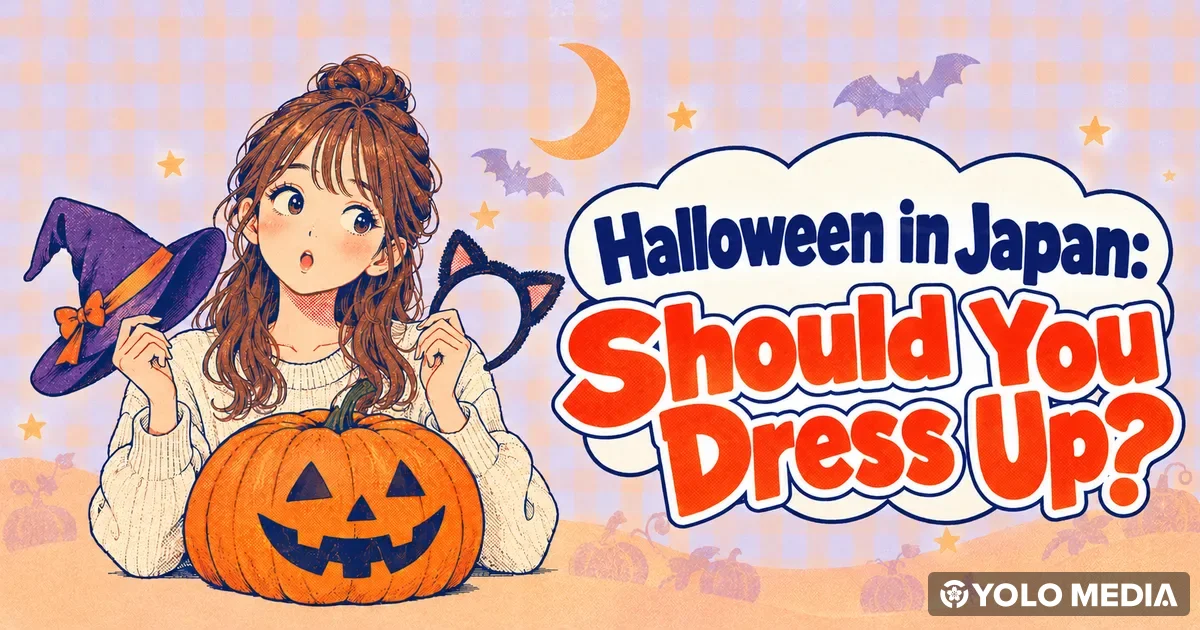
Once October starts, supermarkets fill up with orange pumpkin sweets, and decorations pop up around the train stations. Costumes come up in your work chat, or your child’s nursery school sends home a notice about them, and Halloween quietly shows up in more corners of daily life than you’d expect. If this is your first October in Japan, it’s easy to feel unsure how much to get involved.
Halloween in Japan has grown in a slightly different way from the one you may know from home. Going door to door for candy is not very common. Instead, Halloween has taken root as a costume event for adults, or as a kids’ event at nursery schools and local shopping streets. That makes it hard to tell who takes part, and how far, and the atmosphere can make it feel awkward to ask.
In this article, we walk through the situations where Halloween comes up in daily life, in this order: work, nursery school and school, and your neighborhood. Rules vary from one school or company to the next, so where we can’t say “this is how it works,” we have included extra tips on how to check and Japanese phrases you can use to ask.
Halloween in Japan Is Mostly a Costume Event for Adults
The Halloween you see in Japan today became noticeable only in the last few decades. The toy store Kiddy Land’s Harajuku shop planned a Halloween parade in October 1983 as a sales promotion and invited the general public to join. The company describes it as the first Halloween parade in Japan. In 1997, Tokyo Disneyland held its first Halloween event. It was reportedly a small event in Toontown on October 31 only.
(source: Kiddy Land, "About the Harajuku Halloween Parade," October 19, 2007 / Walkerplus, "The 20-Plus-Year History of Disney Halloween," October 25, 2019)
Rather than a religious occasion, many people see it as an autumn event for seasonal decorations and dressing up.
(From spring cherry blossom viewing to winter New Year, we cover Japan’s year in our guide to Japanese annual events.)
 Culture & Society
Experience Japan’s Four Seasons: A Guide to Annual Traditions & Seasonal Events
Want to enjoy Japan's seasonal traditions to the fullest? From spring Hanami (cherry blossom viewing) to summer Obon, au…
Read related article
Here is a quick table of how Halloween looks in Japan, seen from the point of view of daily life.
| Setting | Common way to spend it | Things to keep in mind |
|---|---|---|
| Workplace | A small costume for the day, swapping sweets | Joining is usually optional. Keep it within what doesn’t interfere with work |
| Nursery school (hoikuen) / Kindergarten (yochien) | Kids come in costume, with sweets and games at school | Policies differ a lot from school to school |
| School | Introduction in English class, local events | Some schools don’t allow costumes |
| Neighborhood / Apartment building (manshon) | Local events for kids | Ringing the doorbells of private homes is not the expectation |
| Downtown areas | Adults gather in costume | Crowds and restrictions mean it’s best to check before you go |
One thing is the same in every setting: you won’t be rude if you don’t take part. You can join in at whatever level feels comfortable, so relax and read on.
When You’re Invited to a Costume Day or Event at Work
When a coworker asks, “Want to dress up for Halloween?” you may wonder whether saying no will come across badly. The short answer is that Halloween at work is optional in most cases. The mood does differ from company to company, though, so it’s safer to check lightly the first time before you decide.
What to check first
When you get an invitation, it helps to ask a coworker or your boss about the following, so you aren’t caught off guard on the day.
- Is everyone expected to join, or only people who want to?
- How far does the costume go (is a hat or headband enough, or a full costume)?
- Is it during work hours, or a gathering after work?
- What should people do if they have meetings with customers or clients?
If you’re not sure how to ask, you can use these Japanese phrases as they are.
| What you want to know | What you can say |
|---|---|
| Do I need a costume? | 「仮装は必要ですか?」(Kasou wa hitsuyou desu ka?, “Do I need to wear a costume?”) 「普段の服装のままでも大丈夫ですか?」(Fudan no fukusou no mama demo daijoubu desu ka?, “Is it okay to wear my usual clothes?”) |
| Is joining optional? | 「参加は自由ですか?」(Sanka wa jiyuu desu ka?, “Is participation voluntary?”) |
| Bringing sweets | 「お菓子の持ち込みはできますか?」(Okashi no mochikomi wa dekimasu ka?, “Can I bring sweets?”) |
| Declining | 「今回は予定があって、参加できません。楽しんできてください」(Konkai wa yotei ga atte, sanka dekimasen. Tanoshinde kite kudasai, “I have plans this time, so I can’t join. Have fun!”) |
When you decline, you don’t need to explain in detail. A simple 「ありがとうございます、今年は遠慮しておきます」(Arigatou gozaimasu, kotoshi wa enryo shite okimasu, “Thank you, I’ll pass this year”) is not a problem at most workplaces.
If you do join, keep it light
If it’s your first time, start with small items such as cat ears, a headband, or a witch’s hat rather than a full-body costume. It’s not unusual for a few people to arrive in elaborate costumes while everyone else stays in their regular clothes.
Costumes to avoid at work include the following.
- Masks that cover the whole face, or costumes with a lot of fake blood
- Prop weapons that look real
- Anything that suggests a religion, a country, or a specific person in a way that could make someone uncomfortable
- Anything that shows a lot of skin
If you’re unsure whether a costume is okay, the quickest way is to show a coworker a photo and ask, “Is this level okay?” (「この程度で大丈夫ですか?」, Kono teido de daijoubu desu ka?). People are usually glad you thought of them.
If you’re handing out sweets
Putting individually wrapped sweets on a desk or passing them around is a common sight at work. Some people have allergies, so individually wrapped items with ingredient labels you can read on the back of the package are a good choice. The way sweets are exchanged here also connects to Japan’s gift culture (omiyage).
(For the feel of sweets and gifts at work, see our guide to omiyage and gift-giving customs.)
 Culture & Society
Be Respected at Work! The Ultimate Guide to Japanese Gift-Giving & Omiyage Etiquette (2026)
From choosing the perfect omiyage to mastering Ochugen and Oseibo seasonal gifts. Discover the rules, taboos, and secret…
Read related article
Halloween at work is often optional. If you’re unsure, ask a senior colleague or a coworker.
Halloween at Nursery School, Kindergarten, and School
In families with children, a notice often arrives in October, and that’s when you first learn about “come to school in costume.” Finding a printout the night before that says “Tomorrow is costume day” and rushing out to the store is a classic experience.
Policies differ from school to school
Halloween at nursery schools and kindergartens varies widely depending on each school’s policy. For example, these patterns exist.
- Children come in costume and get sweets or play games at school
- No costumes, only decorations and crafts (such as making pumpkin cards)
- No Halloween events at all
The surest way to find out which applies to your school is to check the school’s notices or its messaging app.
What to ask the teacher, in Japanese
If you can’t make sense of the Japanese in the notice, or you want to know the details of the costume rules, feel free to ask your child’s homeroom teacher.
| What you want to know | What you can say |
|---|---|
| Do they need a costume? | 「ハロウィンの日は、仮装して登園するのでしょうか?」(Halloween no hi wa, kasou shite touen suru no deshou ka?, “On Halloween, do the children come to school in costume?”) |
| Costume rules | 「仮装で気をつけることはありますか?」(Kasou de ki o tsukeru koto wa arimasu ka?, “Is there anything we should be careful about with the costume?”) |
| Sweets | 「お菓子を持たせる必要はありますか?」(Okashi o motasete hitsuyou wa arimasu ka?, “Do I need to send sweets with my child?”) |
| Food allergies | 「アレルギーがあるのですが、当日のお菓子は食べても大丈夫ですか?」(Arerugii ga aru no desu ga, toujitsu no okashi wa tabete mo daijoubu desu ka?, “My child has an allergy. Is it okay to eat the sweets on the day?”) |
| Not taking part | 「仮装はしない予定ですが、問題ありませんか?」(Kasou wa shinai yotei desu ga, mondai arimasen ka?, “We’re planning not to wear a costume. Is that okay?”) |
When children come in costume, outfits that are easy to move in and safe tend to be preferred. Some schools ask families to avoid long capes, masks that cover the face, or hard props, so reread the notice before you buy anything.
Elementary and junior high school
Some schools introduce Halloween in English class or as an event, while others don’t allow costumes at all. For school events, the basic rule is to follow the school’s announcements.
Schools hold many events throughout the year. If you get a sense of the whole picture, including sports day and field trips as well as Halloween, reading the notices becomes much easier.
(For the yearly flow at elementary school, see our guide to the Japanese school events calendar.)
 Family & Life
Japanese Elementary School Annual Event Guide: Entrance Ceremony, Sports Day, and PTA for International Parents
"Lost on dress codes," "anxious about PTA," "can't read the handouts" — the 3 stumbling blocks international parents fac…
Read related article
If you’re not sure about the difference between a hoikuen and a yochien, check this first. It will make the school’s notices easier to understand.
(For the differences between nursery schools, kindergartens, and certified centers for early childhood education and care, see our guide to choosing between hoikuen and yochien.)
 Family & Life
Hoikuen vs Yochien vs Nintei Kodomo-en: A Foreigner’s Guide to Choosing the Right Childcare in Japan (2026)
What are the differences between hoikuen, yochien, and nintei kodomo-en? Compare ages, jurisdictions, free education sub…
Read related article
At Home, in the Neighborhood, and at Local Events: Doorbells and Apartment Building Etiquette
The neighborhood may be where Halloween in Japan feels most confusing. If you wonder whether trick-or-treating is possible in Japan, it’s probably because the custom of going from house to house for sweets is hard to see here.
Visiting private homes is not the expectation
In Japan, the practice of children ringing the doorbell of a house they don’t know to get sweets is not widely established. Because of that, some residents are startled when the doorbell rings. Costumed children going around pressing doorbells can sometimes be taken as a prank.
On the other hand, it seems that in some places, neighbors talk it over in advance and decide which houses will hand out sweets. In that case there are set rules, and you’re fine as long as you follow them.
If you’d like to try it with your child, this order is a safe way to go about it.
- Talk first to a neighbor family you’re on good terms with
- Check with them that it’s okay to hand out sweets
- Keep it to the early evening and finish quickly
- Don’t ring the doorbell of any home that isn’t taking part
What to watch for in an apartment building (manshon)
In an apartment building, what people tend to care about is how the shared areas are used. Management rules differ from building to building, so it’s safer to check the following with the management company or the residents’ association.
| Situation | What to check |
|---|---|
| Decorating the front door or hallway | Whether you’re allowed to place or stick things in shared areas |
| Buildings with auto-lock entrances | Whether children who don’t live there can come and go |
| Noise at night | Whether the sound of a home party will carry |
| Trash | How and when to put out trash after a party |
Even if you only want to decorate in front of your door, some buildings ban taping things to doors or leaving things in the hallway. It’s best to ask before you decorate.
If you’re hosting a party, keeping it from running late and letting your neighbors know in advance makes a good impression. Something like 「ハロウィンパーティーをするので、少し賑やかになるかもしれません」(Halloween paatii o suru node, sukoshi nigiyaka ni naru kamoshiremasen, “We’re having a Halloween party, so it may get a little lively”) is enough.
Handing out sweets at Halloween varies by area and by household. It helps to check whether a notice has been posted on the bulletin board of your local government, neighborhood association, or apartment building.
Enjoying it with your kids: local events are a good option
If you’d like to give your child a Halloween memory too, local kids’ events are a good option. Shopping street stamp rallies, parks, children’s centers (jidokan), and shopping malls sometimes hold events where children in costume can get sweets. The dates change every year, so it helps to know where to look.
Where to look
- Your city or ward’s newsletter and official website (check the “kids” and “events” sections)
- Bulletin boards at children’s centers and childcare support centers
- Posters and social media of nearby shopping streets
- Notices from your child’s nursery school, kindergarten, or school
- Official websites of nearby shopping malls, parks, and other facilities
Searching with terms like “place name + ハロウィン (Halloween) + 子ども (kids)” or “place name + ハロウィン + スタンプラリー (stamp rally)” makes events easier to find.
What to check on the flyer
It’s reassuring to look at the target age, whether advance registration is needed, whether costumes are required or optional, the conditions for getting sweets (such as collecting stamps), and what happens when it rains. Events that require registration can fill up early.
If you’re looking for places near Tokyo where your child can play in costume, it helps to know the parks you can visit regularly.
(For parks that are easy to visit with children, see our guide to the best parks for families in Tokyo.)
 Family & Life
10 Best Parks for Families in Tokyo: Resident’s 2026 Guide
A practical guide to 10 family-friendly parks in Tokyo for international residents. Covers stroller-accessible routes, B…
Read related article
Choosing a Costume and Costume Manners (2026 Trends, Trains, Streets)
It helps to know what’s popular when you pick a costume. Beyond that, if people who enjoy dressing up also keep others from feeling uneasy, everyone has a better time.
In 2026, easy costumes are catching on
Don Quijote’s Halloween trend forecast, announced in October 2026, gives “stylish,” “easy,” and “Instagram-worthy” as the keywords. Easy-to-wear styles are spreading in place of full-body costumes, and the company says it has roughly doubled its range of items you can wear on your upper half only compared with last year. Face-showing character suits, such as a banana or a hot dog, which were popular around 2016, are also back after about ten years.
(source: Don Quijote, "2026 Halloween Trend Forecast")
You don’t need a full outfit, either. Face paint stickers or eyeshadow alone can set the mood, which works well if you don’t want to carry extra items. Halloween makeup supplies are available at drugstores and in the Halloween section of 100-yen shops. If you have sensitive skin, check the package for a low-irritation label before using it.
Even without confidence in full makeup, a few spiderweb-pattern nail stickers or a light sweep of red and black eyeshadow around the eyes can get the look across. Keep some cleansing oil on hand for removal.
Manners on trains, on the street, and around your neighborhood
There is no single correct answer for costume manners, but here are the rules of thumb for situations you’re most likely to run into in daily life.
| Situation | Rule of thumb |
|---|---|
| Trains and buses | Avoid big props, capes, and wide items like wings. Many people change at the venue |
| Streets and sidewalks | Leave enough room for others to pass. Don’t stop for photos for too long |
| Convenience stores and shops | You may be asked to take off a costume that hides your face before you enter |
| Public places | Prop weapons that look real can lead to misunderstandings or a call to the police |
| Your neighborhood | Don’t make loud noise at night |
Trains are the situation where people are most unsure. Some people travel in costume and others change after they arrive. Large bags or a hidden face can make people around you uneasy, so when in doubt, keep it compact.
When you take photos, make sure strangers haven’t ended up in the frame. It’s natural to ask someone in costume, 「写真を撮ってもいいですか?」(Shashin o totte mo ii desu ka?, “May I take your photo?”), but get their permission first.
If you are 16 or older and hold a Residence Card (Zairyu Card), the rule to carry it at all times doesn’t change just because you’re in costume. If your costume has no pockets, bring a small bag and keep the card in it. Children under 16 are not subject to the carrying rule.
(source: e-Gov, Immigration Control and Refugee Recognition Act, Article 23)
Going to Shibuya? What to Check Before You Go
When people think of Halloween in Japan, many picture the Shibuya Scramble Crossing. In 2026, Shibuya Ward is calling on people to stop nuisance behavior such as drinking on the street and dropping litter, under the slogan “GOODBYE BAD HALLOWEEN.” The ward mayor has said he doesn’t want to tell people “don’t come,” so the ward is not trying to stop people from enjoying Halloween itself. The message is to enjoy it with good manners, at events run by shops and facilities.
At the same time, the mayor has said he wants people to know that Shibuya on October 31 is not a place where you can dress up and stay out all night. October 31, 2026 falls on a Saturday. If you’re heading out, check the following first.
What has been decided around Shibuya Station in 2026
| When | What’s happening |
|---|---|
| Every day, 6 p.m. to 5 a.m. (year-round) | Drinking is banned in public places such as streets and parks around Shibuya Station |
| Friday, October 30, 6 a.m. to the morning of Sunday, November 1 (planned) | The area around the Hachiko statue is fenced off, and you can’t see the statue |
| Friday, October 30, 4 p.m. to early morning on Saturday, October 31, and Saturday, October 31, 4 p.m. to early morning on Sunday, November 1 | Cars can’t pass through parts of the area around Shibuya Station. Parking meters around the station can’t be used all day |
| Saturday, October 31, 6 p.m. to 5 a.m. | The ward has asked 62 shops that sell alcohol near the street-drinking ban area to refrain from selling it |
- No changing areas or temporary toilets will be provided. If you’re dressing up, change at home before you go, or choose an event venue where you can change.
- Depending on the crowds, how station entrances and exits are used may change. On the day, check announcements from the police and the railway companies before you leave.
- If you want to see the Hachiko statue, the ward advises going by Thursday, October 29, or after the morning of Sunday, November 1.
- If you commute or go to school through Shibuya, expect trips to take longer than usual on the evenings of October 30 and 31. It’s reassuring to leave early or think of another route.
Times and details may change depending on the situation on the day. Before you go, check the Shibuya Ward website for the latest information.
Shinjuku and other downtown areas
Shinjuku Ward also restricts street drinking around Kabukicho and part of Shinjuku 3-chome during Halloween (October 31 and November 1, plus any other period the ward designates). Downtown areas other than Shibuya can end up in a similar situation.
If you want to dress up somewhere other than Shibuya
There are other places where you can enjoy dressing up besides Shibuya.
| Way to spend it | Points |
|---|---|
| Home party with friends or family | You can dress up casually while being considerate of the neighbors |
| Local kids’ events | Easy to join with children. Check the details in advance |
| Theme park and facility events | Check the official website for the dates and costume rules |
| Movies and baking at home | A quiet time away from the crowds |
Skipping the crowds and enjoying it at your own pace is a perfectly good way to spend Halloween.
(source: Shibuya Ward, ordinance on street drinking / Shibuya Ward, street drinking ban (English PDF) / Shibuya Ward, fencing around the Hachiko statue, October 21, 2026 / Shibuya Ward, traffic restrictions during Halloween, October 15, 2026 / Shibuya Keizai Shimbun, Halloween measures, September 30, 2026 / Shinjuku Ward, ordinance on street drinking around Shinjuku Station)
FAQ
Can I go trick-or-treating in Japan?
Going from house to house for sweets is not a well-established custom in Japan. It’s fine if neighbors have talked about it in advance, or if you join an event run by a shopping street or a facility. Avoid ringing the doorbell of a private home out of the blue.
Will not joining the costume day at work affect how I’m evaluated?
Joining is often optional. The atmosphere differs from company to company, though, so if you’re worried, ask a senior colleague or a coworker.
What should I watch for when sending my child to nursery school in costume?
Rules differ from school to school. Check whether the notice specifies a costume, and whether anything is banned (such as long capes or masks that cover the face). If in doubt, asking the homeroom teacher is the surest way.
Can I decorate my front door in an apartment building?
How shared areas can be used is set by the building’s management rules. It’s safest to check with the management company or the residents’ association first.
Can I ride the train in costume?
It isn’t banned, but you need to be considerate of the people around you. It’s best to avoid big props and masks that hide your face.
Summary
- ✅ Halloween in Japan is enjoyed as a costume event for adults and as an event for kids, and taking part is optional
- ✅ At work, ask how far people go in advance and start with a light costume
- ✅ Nursery schools and schools have different policies, so check the notices and ask the teacher
- ✅ In your neighborhood, don’t ring the doorbells of private homes, and make a point of talking to people beforehand
- ✅ If you’re going to Shibuya, check the ward’s announcement for that year first
When Halloween comes up in your daily life, watch how the people around you handle it and join in at your own pace. If you don’t understand something, asking is the quickest way.
If you’d like to learn how to find seasonal events and festivals throughout the year, take a look at this one too.
(For how to find festivals across Japan, see our Japanese festivals (matsuri) calendar.)
Culture & Society
Japan Festival Calendar: The Ultimate Guide to 25 Famous & Hidden Matsuri (2026-2027)
Your comprehensive guide to Japan's 2026-2027 festival dates, delicious street foods, and how to enjoy 'matsuri' like a …
Read related article