Introduction: Garbage Rules Depend on Where You Live
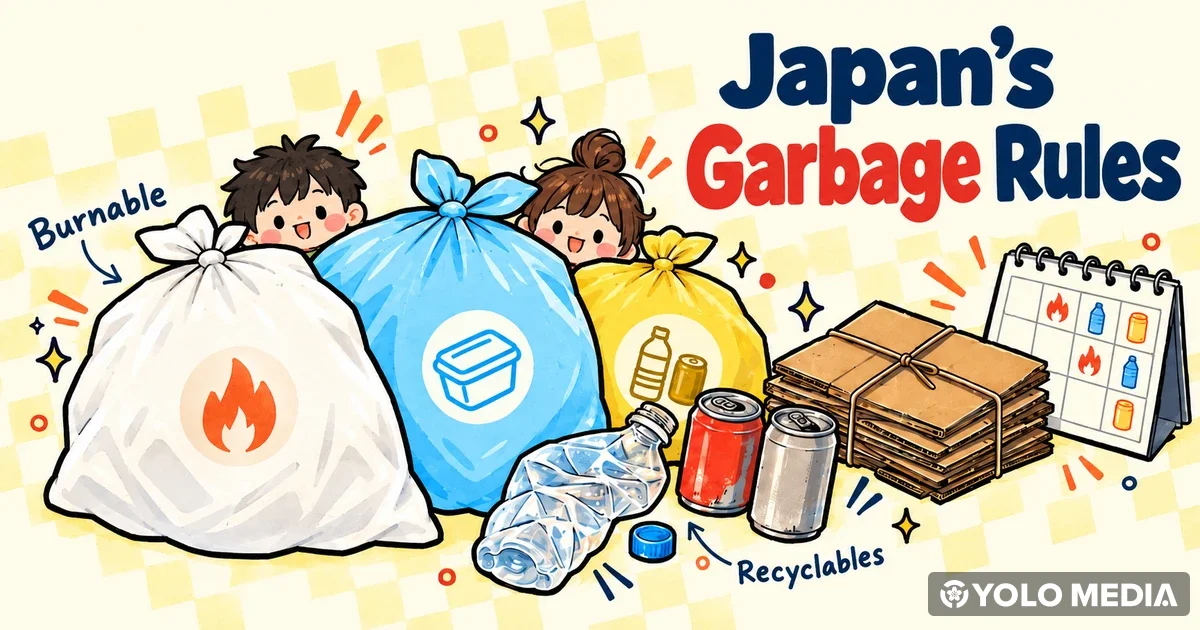
Japan doesn’t have one set of garbage rules for the whole country. Your city, town, or ward decides how to sort garbage, which days to put it out, and which bags to use. Even PET bottle caps go out as plastic in some areas but not in others. If you sort the way you did in your last town, your bag may come back with a “rule violation” sticker on it.
This guide covers:
- How to find your area’s rules
- The main garbage categories, and how to sort plastics
- The basics of when, where, and in what bag to put garbage out
- Dangerous items such as batteries and spray cans that can cause fires
- How to throw away bulky items, appliances, and PCs
- Clearing out before you move or leave Japan
It can feel like a lot at first, but once you have your area’s rules, it becomes a weekly habit. Let’s go through it step by step.
1. First, Get Your Area’s Rules
Since the rules differ by area, the first thing to do is check your own area’s rules. There are three ways to do this.
| Method | Where to find it | Notes |
|---|---|---|
| Your municipality’s official website | Search “(city or ward name) ごみ 分別” (garbage sorting) | Sorting charts, collection days, and where to book bulky item pickup are all in one place |
| A garbage sorting app | From your municipality’s information page | Some apps remind you the day before collection |
| Your management company or landlord | Ask when you move in | They can tell you where your building’s collection spot is and about any building-specific rules |
You may also be able to get a sorting pamphlet or collection schedule at your city or ward office.
Guides in Other Languages and Official City Pages
Some municipalities offer guides in other languages. For example, Shinjuku City in Tokyo has sorting leaflets in Japanese and 10 other languages, including English, Chinese, Korean, Vietnamese, and Nepali. Yokohama City offers the “Yokohama City Garbage Sorting Chatbot” for looking up how to sort items.
(Reference: Shinjuku City "Printed Materials" (Japanese) / Yokohama City "Looking Up How to Sort Garbage" (Japanese))
| City | Official page | What you’ll find |
|---|---|---|
| Tokyo’s 23 wards | Each ward has its own rules | Check your ward’s official website |
| Yokohama City | Garbage and Recycling | English page |
| Nagoya City | ごみの 分け方・出し方 (Japanese) | Page in easy Japanese; English booklet (PDF) available |
| Osaka City | For Comfortable Living | English living guide with a chapter on garbage |
| Kobe City | Garbage Disposal Rules in KOBE | English guide and PDFs |
| Sapporo City | ごみ分けガイド外国語版 (Japanese) | Japanese page; English guide (PDF) available |
| Fukuoka City | Observing Everyday Rules | English page with a section on putting out garbage |
Searching your area’s name with “garbage English” or “ごみ 英語” may turn up a guide.
2. The Main Garbage Categories
The names and number of categories differ by municipality. For example, Minato City in Tokyo uses the following categories.
| Category | Main items | Tips |
|---|---|---|
| Burnable garbage (moeru gomi) | Food scraps, paper scraps, dirty paper | Drain food scraps well |
| Non-burnable garbage (moenai gomi) | Broken glass, ceramics, small metal items | Wrap broken items in paper and write キケン (kiken, “danger”) on it |
| Recyclables (shigen gomi) | Cans, bottles, PET bottles, newspapers, cardboard | Rinse PET bottles lightly. Tie newspapers and cardboard with string |
| Plastics | Food trays, bags, bottles, etc. | Sorting rules vary by area (see Section 3) |
| Bulky items (sodai gomi) | Furniture, bicycles, and other large items | You need to book a pickup (see Section 6) |
(Reference: Minato City "How to Put Out Burnable Garbage" (Japanese) / Minato City "How to Put Out Non-Burnable Garbage" (Japanese) / Minato City "How to Put Out Wastepaper" (Japanese))
Even “non-burnable” means different things in different places
For example, in Osaka City, crockery and glass products also go out as “regular garbage” (futsu gomi). The same name can cover different items, so always check your new area’s sorting chart after you move.
(Reference: Osaka City "Regular Garbage" (Japanese) / City of Osaka "For Comfortable Living")
How to put out PET bottles
For example, Minato City in Tokyo asks residents to put out PET bottles like this:
- Remove the cap and label (some areas collect caps and labels as plastic)
- Rinse the inside lightly
- Crush the bottle
The details vary by area, so check your own area’s sorting chart (see Section 1 for how to find it).
(Reference: Minato City "How to Put Out PET Bottles" (Japanese))
3. Sorting Plastics: Big Differences by Area
Plastic is a type of garbage where rules differ a lot by area.
There are two broad types of plastic:
- Plastic containers and packaging: food trays, snack bags, shampoo bottles, and other containers or wrapping that held a product. Look for the プラ (pura) mark
- Plastic products: plastic toys, hangers, stationery, and other items that were products themselves
The Plastic Resource Circulation Act took effect in April 2022, allowing municipalities to collect these two types together as a resource.
(Reference: Ministry of the Environment Plastic Resource Circulation "Separate Collection and Recycling by Municipalities" (Japanese) / Ministry of the Environment "Plastic Resource Circulation Act" (Japanese) / Ministry of the Environment "Plastic Resource Circulation Act Information Site" (Japanese))
As a result, how plastic products are handled varies by area:
- Areas that collect containers, packaging, and products together as “plastic resources” (for example, Yokohama City from April 2025)
- Areas where plastic products go out as burnable or non-burnable garbage
(Reference: Yokohama City "From April 2025: How to Put Out Plastic Resources" (Japanese))
Toys may have been burnable garbage where you lived before, so check again after you move.
4. The Basics: Time, Place, and Bags
When to put garbage out
In many areas, garbage goes out on the morning of collection day. Minato City and Koto City in Tokyo and Yokohama City, for example, ask for it by 8:00 a.m. In Osaka City, it’s about two hours before the collection time shown on the city’s Garbage Collection Map, or by 8:30 a.m. if you don’t know the time. Fukuoka City works the other way: residents put garbage out between sunset and midnight. Some areas don’t allow garbage at night and others collect only at night, so always check your area’s time.
(Reference: Minato City "How to Put Out Burnable Garbage" (Japanese) / Koto City "FAQ" (Japanese) / Yokohama City "Garbage Disposal Rules" / City of Osaka "For Comfortable Living" / Fukuoka City "Observing Everyday Rules")
Where to put garbage out
If your apartment building has its own garbage spot, use that. If you live in a house, use the designated collection point in your neighborhood. If there’s a net to keep crows away, tuck your bags fully under it so nothing sticks out.
Bags: some areas require designated bags, others don’t
| Example area | Bags |
|---|---|
| Koto City, Tokyo | No designated bags. Use clear or semi-clear bags so the contents can be seen |
| Osaka City | No designated bags. Use clear or semi-clear bags so the contents can be seen |
| Sapporo City | Use the city’s designated bags for burnable and non-burnable garbage |
(Reference: Koto City "FAQ" (Japanese) / Osaka City "How to Put Out Garbage" (Japanese) / Sapporo City "About Designated Garbage Bags" (Japanese))
Designated bags are sold at places such as supermarkets, convenience stores, and drugstores. In some areas, such as Sapporo City, the price of the designated bags is the garbage collection fee.
Garbage that doesn’t follow the rules may get a sticker saying something like “rule violation” and be left behind. If you find one on your bag, check the sorting and the day again, and put it out on the correct day.
5. Dangerous Items That Can Cause Fires
Lithium-ion batteries and power banks
Power banks (mobile batteries), smartphones, heated tobacco devices, wireless earbuds, and similar items contain lithium-ion batteries. If they’re mixed into burnable or non-burnable garbage, they can be crushed and catch fire inside garbage trucks or at processing facilities.
According to a Ministry of the Environment survey, there were 39,282 fire accidents and similar incidents in FY2025 suspected to have been caused by lithium-ion batteries and similar items.
To dispose of them, use one of these methods:
- Follow your municipality’s method (collection boxes, set collection days, etc.)
- Put them in a collection box at a JBRC partner store or partner municipality (for products from JBRC member companies: batteries that can be removed from devices, and power banks. Cover the terminals with vinyl tape. Swollen or damaged batteries, and batteries taken out by disassembling a device, aren’t accepted. For power banks, only those mainly used to charge smartphones are accepted, and heated tobacco devices aren’t accepted)
- Use the manufacturer’s collection service
(Reference: JBRC "How to Dispose of Batteries (What Is and Isn’t Accepted)" (Japanese) / JBRC "How to Hand Over Batteries (What Is and Isn’t Accepted)" (Japanese))
Swollen batteries are especially likely to catch fire. If you’re not sure how to dispose of one, ask your municipality’s garbage office.
For the rules on taking power banks on a plane, see our guide to Japan’s new carry-on rules for power banks.
 Travel & Explore
Power Banks Banned for In-Flight Use from April 24, 2026: Japan’s Complete Guide to the New Carry-On Rules
Japan's new power bank rules take effect April 24, 2026: max 2 units under 160Wh, no in-flight charging or use, violatio…
Read related article
Travel & Explore
Power Banks Banned for In-Flight Use from April 24, 2026: Japan’s Complete Guide to the New Carry-On Rules
Japan's new power bank rules take effect April 24, 2026: max 2 units under 160Wh, no in-flight charging or use, violatio…
Read related article
Spray cans and gas cartridges
Spray cans and gas cartridges for portable stoves should be completely used up before you put them out. Some municipalities used to ask residents to punch holes in them, but some now ask you not to. Follow your area’s rules on whether to make a hole.
(Reference: Sapporo City "How to Put Out Spray Cans and Gas Cartridges" (Japanese))
Dry-cell batteries, broken glass, and cooking oil
- Dry-cell batteries: Some areas use collection boxes or set collection days. Check your area’s sorting chart
- Broken glass and ceramics: Wrap them in newspaper or other paper, and write キケン (kiken, “danger”) on the bag
- Cooking oil such as tempura oil: Pouring it down the drain can cause clogs and water pollution. Soak it into paper or cloth, or solidify it with a store-bought oil solidifier, and put it out as burnable garbage. Some municipalities collect used oil
(Reference: Minato City "How to Put Out Burnable Garbage" (Japanese))
6. How to Put Out Bulky Items
Large items such as furniture and bicycles go out as bulky items (sodai gomi). What counts as a bulky item differs by municipality.
| Example area | What counts as a bulky item |
|---|---|
| Minato City, Tokyo | Items with a longest side of 30 cm or more |
| Yokohama City | Metal items of 30 cm or more; other items of 50 cm or more |
(Reference: Minato City "How Do I Put Out Bulky Waste, and What Does It Cost?" (Japanese) / Yokohama City "How to Put Out Bulky Waste" (Japanese))
How booking works (example)
The following is an example from Minato City in Tokyo.
- Book with your municipality’s bulky waste reception center online or by phone
- You’ll be told the fee and the collection date
- Buy a bulky waste disposal sticker (sodai gomi shori-ken) at a convenience store or similar shop
- Write your name or booking number on the sticker and attach it to the item
- Put the item out at the designated spot by the morning of the collection date
It can take some time between booking and pickup, so book early.
(Reference: Minato City "Garbage Disposal Tickets" (Japanese))
Throwing away a bicycle
Some areas collect bicycles as bulky items. In Japan, crime-prevention registration (bohan toroku) of bicycles is required by law. Before throwing away or giving away a bicycle, it’s a good idea to cancel the registration at a registration point such as a bicycle shop.
(Reference: e-Gov Law Search "Act on Promoting the Safe Use of Bicycles and Comprehensive Measures for Bicycle Parking," Article 12, Paragraph 3 (Japanese) / Tokyo Bicycle Dealers’ Crime Prevention Association "Canceling Crime-Prevention Registration" (Japanese))
7. Throwing Away the 4 Major Appliances and PCs
Air conditioners, TVs, refrigerators, and washing machines can’t go out as bulky items
The following four types of appliances are covered by the Home Appliance Recycling Act and can’t be put out as bulky items:
- Air conditioners
- TVs
- Refrigerators and freezers
- Washing machines and clothes dryers
To dispose of them, you pay a recycling fee and a collection and transport fee. The recycling fee depends on the manufacturer and size.
| Item | Approximate recycling fee (major manufacturers, tax included) |
|---|---|
| Air conditioner | About 550 to 1,000 yen |
| LCD or OLED TV (16 inches or larger) | About 3,000 yen |
| Refrigerator or freezer (171 L or larger) | About 4,700 yen |
| Washing machine or clothes dryer | About 2,500 yen |
These amounts are estimates based on the fees of major manufacturers such as Panasonic, Sharp, and Hitachi. The RKC Home Appliance Recycling Ticket Center’s list covers every manufacturer, and some charge more. Check before disposing of an item.
(Reference: RKC Home Appliance Recycling Ticket Center "List of Recycling Fees" (Japanese))
Four ways to have them taken away
| Method | When to use it |
|---|---|
| Have the store selling your new appliance take the old one | When you’re replacing it |
| Have the store where you bought it take it | When you know where you bought it |
| Apply through the service your municipality recommends | When you don’t know where you bought it |
| Pay the recycling fee at a post office and take the appliance to a designated drop-off site yourself | When you can transport it yourself |
(Reference: Ministry of Economy, Trade and Industry "Quick Guide to Disposing of the 4 Home Appliances Properly" (Japanese) / RKC Home Appliance Recycling Ticket Center "Paying the Fee at a Post Office" (Japanese))
Leaving an appliance at the garbage spot can mean it isn’t collected and can cause trouble. Always use one of the methods above.
PCs are collected by manufacturers
Some municipalities, like Nerima City in Tokyo, don’t collect PCs as bulky items. Manufacturers run a collection system, and PCs with the “PC Recycle Mark” are collected for free. PCs whose manufacturer is unknown, or that you built yourself, are collected for a fee by the PC 3R Promotion Association.
(Reference: Nerima City "Household PCs" (Japanese) / PC 3R Promotion Association (Japanese))
PCs and smartphones contain personal information. Erase your data before you get rid of them.
8. Clearing Out Before You Move or Leave Japan
You’ll have more garbage than usual before moving or leaving Japan. Bulky items and appliances take time to arrange, so it’s best to start planning about a month ahead.
| Rough timing | What to do |
|---|---|
| 1 month before | Sort items into throw away, sell, and give away. Book bulky item and appliance pickups |
| 2 to 3 weeks before | Erase the data on your PC and smartphone and send them for collection. Hand in power banks and other batteries for collection |
| 1 week before | Using your sorting chart, put out your regular garbage a little at a time |
| Final week | Check the last collection day and put garbage out. If anything is left that you can’t put out, ask your management company or landlord |
If you move out leaving furniture or garbage behind, you may be charged for its disposal. Furniture and appliances that still work can be sold at a recycle shop or given to someone you know.
FAQ
Q: Can I put garbage out the night before?
A: It depends on the area, and the rules can be opposite. In many areas, garbage goes out on the morning of collection day. Isogo Ward in Yokohama, for example, asks residents not to put garbage out the night before (Reference: Isogo Ward, Yokohama City "How to Put Out Garbage and Bulky Waste" (Japanese)). Fukuoka City, on the other hand, asks residents to put garbage out between sunset and midnight (Reference: Fukuoka City "Observing Everyday Rules"). Garbage put out at other times can be torn open by crows and cats or cause trouble with neighbors.
Q: Can I use a supermarket plastic bag?
A: It depends on the area. Some areas, like Koto City in Tokyo and Osaka City, accept any bag whose contents can be seen, while others, like Sapporo City, only accept designated bags for burnable and non-burnable garbage.
Q: What happens if I put garbage out on the wrong day?
A: It may get a sticker saying something like “rule violation” and be left behind. If you notice, take it back and put it out again on the correct day.
Q: Are there apps for looking up how to sort garbage?
A: Some municipalities offer sorting apps or chatbots. Try searching “(city or ward name) ごみ アプリ” (garbage app). Some are available in other languages.
Q: Can I put out a bicycle as a bulky item?
A: Some areas accept bicycles as bulky items. Check your area’s sorting chart. Before throwing it away, it’s a good idea to cancel the crime-prevention registration at a bicycle shop or similar place.
Q: Can I put a power bank out with non-burnable garbage?
A: Mixing it with burnable or non-burnable garbage is dangerous. Use your municipality’s method or a collection box at a JBRC partner store or similar.
Q: What should I do if garbage bags are hard to find?
A: In 2026, plastic bags and garbage bags ran short in Japan because of a shortage of raw materials. We covered what to do in our article on the nationwide shortage of plastic bags and garbage bags. Rules on designated bags can also change, so check your municipality’s announcements.
 Living in Japan
Plastic Bag & Trash Bag Shortage in Japan: Naphtha Supply Impact and What You Can Do (May 2026)
In May 2026, free plastic bags vanished from Japanese supermarkets and designated trash bags are running low. The cause:…
Read related article
Living in Japan
Plastic Bag & Trash Bag Shortage in Japan: Naphtha Supply Impact and What You Can Do (May 2026)
In May 2026, free plastic bags vanished from Japanese supermarkets and designated trash bags are running low. The cause:…
Read related article
Key Takeaways
- ✅ The rules depend on your municipality. After you move, get the sorting chart and collection days from the official website or an app
- ✅ Collection times are set by your area. Most areas ask for the morning of collection day (often by 8:00 a.m.), but some, like Fukuoka City, collect at night. Some areas require designated bags, while others accept clear or semi-clear bags
- ✅ Plastic sorting varies a lot by area. Some areas collect products made only of plastic, such as toothbrushes and buckets, as plastic resources
- ✅ Don’t mix batteries with other garbage. Power banks and smartphones can cause fires
- ✅ Large items need arrangements. Book bulky item pickups, and use dedicated routes for the 4 major appliances and PCs
It’s fine to keep the sorting chart nearby at first. As you keep at it, your area’s rules will gradually become second nature. After you move, start by getting your area’s sorting chart.
For how to get a copy of your resident record after registering, see our guide to getting your juminhyo.
 Living in Japan
How to Get a Juminhyo in Japan: Certificate of Residence
Need a juminhyo in Japan? Compare the four ways to get one, what each costs, whether your residence status appears, and …
Read related article
Living in Japan
How to Get a Juminhyo in Japan: Certificate of Residence
Need a juminhyo in Japan? Compare the four ways to get one, what each costs, whether your residence status appears, and …
Read related article