# Your First Izakaya Experience Otoshi, Kanpai & Ordering: What You Need to Know
## Introduction
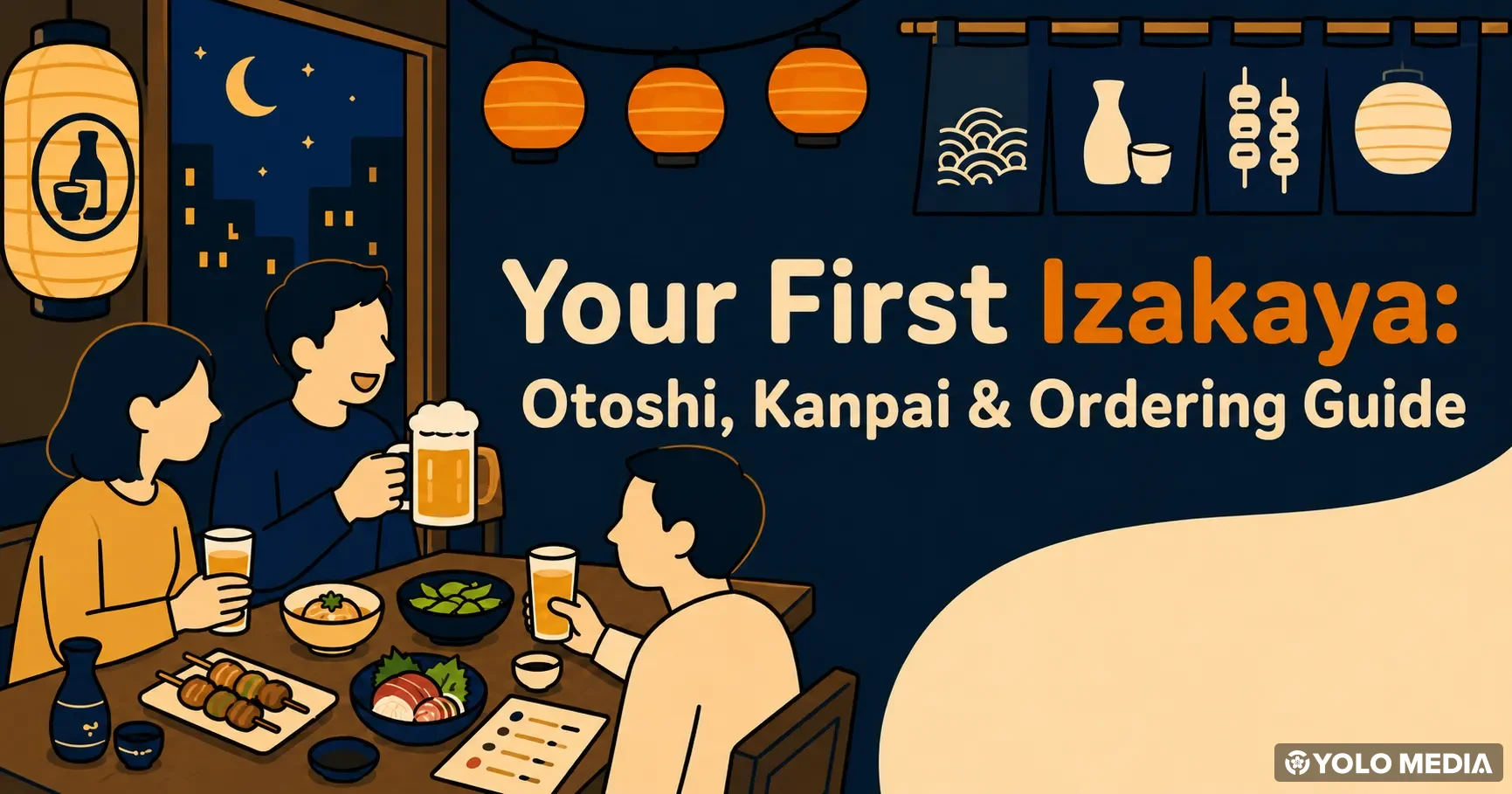
Social life in Japan revolves around the izakaya (居酒屋). Welcome and farewell parties, casual chats with colleagues, weekend drinks with friends the izakaya is where Japanese people build and maintain relationships.
If you’ve ever been surprised by an automatic appetizer you didn’t order, confused by a menu full of kanji, or unsure when to raise your glass — you’re not alone. This guide covers everything you need to walk into an izakaya with confidence.
## TL;DR
– Izakaya (居酒屋) is Japan’s gastropub — casual dining where food and drinks go together
– Otoshi (お通し) is a mandatory cover charge. You can’t refuse it. Expect ¥300–500 per person
– Kanpai (toast) happens once everyone has a drink — beer, oolong tea, or non-alcoholic all count the same
– Must-order dishes: edamame, karaage, yakitori, sashimi platter, hiyayakko, potato salad
– Dietary restrictions are tough, but edamame, hiyayakko, vegetable yakitori, and agedashi tofu can help
## What is an Izakaya?
An izakaya is a casual Japanese gastropub. Unlike restaurants where food takes center stage, and unlike bars where drinks come first — at an izakaya, food and drinks are enjoyed side by side.
Layouts range from cramped standing bars to spacious spots with sunken seating (horigotatsu) and private rooms. Prices vary from budget chains at ¥2,000–3,000 per person to upscale independent spots at ¥5,000+. Weeknight evenings draw salarymen straight from work; weekends bring groups of friends looking to unwind.
## Izakaya Customs You Must Know
The rules might seem intimidating at first, but the essentials are actually pretty simple. Knowing these will help you blend in naturally and earn quiet respect from Japanese colleagues.
### What Is Otoshi?
Otoshi (お通し) is a small dish brought to your table the moment you sit down — whether you ordered it or not. It functions as a cover charge, typically ¥300–500 per person. Refusing is virtually impossible, so when staff bring it out, just accept it and move on. The dish varies by place: pickles, edamame, tsukudani, or vegetable salads are common. Upscale izakaya serve more elaborate otoshi at a higher price.
### Kanpai Rules — Wait Until Everyone Has a Drink
The rule is simple: don’t drink until everyone has a glass. Wait for someone to call “Kanpai!” (乾杯) before raising yours. If there’s a senior person in the group, they’ll usually lead the toast. Touch glasses lightly, say “Kanpai!”, and you’re good. What’s in your glass doesn’t matter — beer, juice, or non-alcoholic all count the same.
### Nomihodai: Worth Using When Available
Not all izakaya offer nomihodai — it’s often tied to course menus or advance reservations. When it is available, it’s a time-limited deal (typically 2 hours) for a flat fee of ¥1,500–2,500 for unlimited drinks. Beer, chuhai, sours, and soft drinks are usually included. Premium whisky or certain cocktails may cost extra, so check the rules before ordering. Note the time limit and the last-order cutoff.
### Ikki: You Can Always Say No
At drinking parties — especially older-generation work events — someone may call out “Ikki!” (一気!) to pressure the group into downing their drinks in one go. This is known as alcohol harassment (aruhara / アルハラ) and is recognized as a social problem even in Japan. You are completely within your rights to decline. “I can’t handle much alcohol” or “I’m not great with drinks” is enough — no detailed explanation needed. Among younger crowds this custom is fading fast, and no one will hold it against you.
### Oshaku — Pouring for Others
In Japan, you pour into others’ glasses before filling your own. When a senior’s glass is empty, offer to refill it. Sometimes seniors will pour for you too. When someone pours for you, hold your glass with both hands — it comes across as considerate.
## How to Order at an Izakaya
### Calling Staff
Raise your hand and call out clearly: “Sumimasen!” (すみませーん!). The space is noisy, so speak up — a quiet voice won’t carry across the room. Some places have a call button on the table or a tablet for ordering and calling staff, so check your table first.
### Ordering Flow
1. First drink — Order whatever you want to drink
2. Otoshi — Served automatically. If staff explain the charge, just listen
3. Food — Order gradually. Place your next order before you finish what’s on the table
4. Extra drinks — Order whenever your glass is empty
### QR Code & Tablet Menus
More and more izakaya now use QR code ordering via smartphone or tablet menus at the table. Many chains have English options — Watami, Torikizoku, and others offer English support.
### Payment — Splitting vs. Senior Pays
Warikan (割り勘) — splitting equally — is the default, but a senior colleague or boss may cover the bill, especially at company gatherings. Which way it goes depends on the setting and the relationships involved, so just follow the room.
## Drink Menu Navigation
| Drink | Description |
|---|---|
| ビール (beer) | The izakaya go-to. Freshly poured draft (nama biru) has a finer head than bottled or canned — if you’re unsure what to order first, start here |
| 酎ハイ (chuhai) | Shochu (Japanese distilled spirit) mixed with soda water. Around 5–7% ABV and very approachable, with lemon, grapefruit, plum and more flavors. The default choice for people who don’t love beer |
| ハイボール (highball) | Whisky mixed with soda — Suntory is the standard at most places. Lighter than it sounds at around 5–7% ABV, with a clean finish that pairs well with food. Many places will adjust the strength on request |
| 日本酒 (nihonshu) | Japan’s rice wine at around 15% ABV. Atsukan (warm) and reishu (chilled) taste completely different — worth trying both. Tell staff whether you lean sweet (amakuchi) or dry (karakuchi) and they’ll point you in the right direction |
| 焼酎 (shochu) | Japanese distilled spirit made from rice, barley, or sweet potato at around 25% ABV — higher than it seems, so it’s usually diluted. Choose from on the rocks, with water (mizuwari), hot water (oyuwari), or soda (soda wari). Imo-jochu (sweet potato) has a bold, distinctive aroma |
| ノンアルコール (non-alcoholic) | Oolong tea, ginger ale, and beer-style non-alcoholic drinks are all readily available. Nomihodai courses often include them — not drinking is never an issue |
| ウーロン茶 (oolong tea) | A Chinese tea that’s been an izakaya staple forever. Unsweetened and pairs well with fried or rich dishes |
For a deeper look at sake varieties and how to choose, check out our Complete Sake Guide — Types, How to Choose & How to Drink.
## Just Order These
When you open the menu and have no idea where to start, this is your safety net. These staples exist at almost every izakaya — and ordering them all usually stays under ¥3,000–4,000 per person.
### Edamame (枝豆)
Boiled salted soybeans. The izakaya classic. Perfect as a light first order.
### Karaage (唐揚げ)
Japanese fried chicken — light, crispy, usually served with mayo and lemon. Goes perfectly with beer.
### Yakitori (焼き鳥)
Charcoal-grilled chicken skewers. Choose by cut: negima (scallion + chicken), momo (thigh), kawa (skin), tsukune (meatball), and more.
### Sashimi Moriwase (刺身盛り合わせ)
Assorted seasonal raw fish. Fresh seafood at its best. For etiquette around sashimi and sushi, see our Sushi & Sashimi Guide.
### Hiyayakko (冷奴)
Chilled tofu with ginger and soy sauce. Simple, healthy, and vegetarian-friendly.
### Potato Salad (ポテトサラダ)
Japanese potato salad is creamy and slightly sweet, heavy on the mayo. A comfort-food favorite.
### Tako Wasa (タコわさ)
Raw octopus with wasabi. Addictively chewy and spicy.
### Shime (〆) — End-of-Night Carbs
Ramen, ochazuke (tea over rice), fried rice, or onigiri ordered at the very end. Closing the night with a bowl of ramen is a distinctly Japanese tradition. Even when full, people say “shime is a separate stomach” — and they’re usually right.
## Main Chain Izakaya
| Chain | Features | English Menu |
|---|---|---|
| Watami (和民) | Nationwide chain. Affordable and consistent | Some branches |
| Torikizoku (鳥貴族) | Yakitori specialist. Everything ¥360 — easy to budget | Yes |
| Uotami (魚民) | Strong on seafood. Sashimi and grilled fish | Varies by branch |
| Kushikatsu Tanaka (串カツ田中) | Fried skewers specialist. Osaka-style kushikatsu | Yes |
| Yoronotaki (養老乃瀧) | Traditional-style chain. Relaxed, old-school atmosphere | Varies by branch |
If you want local character and dishes with real personality, independent izakaya are far more interesting than chains. English menus are rare, but most places have photo menus — and pointing is usually enough to get by.
## Nomikai Culture
At work drinking parties, seating reflects hierarchy. The senior person takes the kamiza — the seat at the back, furthest from the door — and leads the kanpai. If it’s your first time, grab an end seat and follow the room. Declining ikki is always fine, and offering oshaku (refilling someone else’s glass) is one of the easiest ways to blend in.
Nomikai are about building relationships outside the office. Talk about hobbies and life back home, not just work. Japan even coined the word nominication (飲みニケーション) — bonding over drinks. You don’t need perfect Japanese: a smile, nodding along, and the occasional response are enough. Starting a topic yourself is genuinely welcomed.
Understanding Japan’s concept of tatemae and honne — the public face vs. the private feeling — makes navigating nomikai much easier. Our guide on Tatemae vs. Honne — Japan’s Two Faces goes into this in depth.
## Dietary Restrictions at Izakaya
| Restriction | Difficulty | Strategy |
|---|---|---|
| Vegetarian | Limited but doable | Look for edamame, hiyayakko, vegetable yakitori, agedashi tofu |
| Vegan | Very difficult | Dashi (fish stock) is in almost everything. Always confirm in advance |
| Halal | Very difficult | Some chains now offer halal options. Check before visiting |
| Gluten-free | Nearly impossible | Soy sauce contains wheat. Realistically very hard at izakaya |
| Allergies | Requires care | Tell staff clearly. Allergy cards in Japanese can be very helpful |
For a broader look at eating in Japan with dietary restrictions, see our Vegetarian & Vegan Dining in Japan Guide.
## Bill and Payment
– Seating / otoshi: ¥300–500 per person is the norm
– Nomihodai: ¥1,500–2,500 for about 2 hours
– Tabehodai nomihodai: All-you-can-eat and all-you-can-drink combined. Usually ¥3,500–5,000 for 2 hours — great value for groups
– Per-person estimate: ¥3,000–5,000 (chains), ¥4,000–7,000 (independent)
– Warikan: Usually split equally. Cashless payment is increasingly common — PayPay and LINE Pay work at many spots, so having the apps ready doesn’t hurt.
## FAQ
Q: Can I refuse the otoshi?
A: Virtually no. It’s an industry standard across izakaya. Treat it as a seating fee.
Q: I don’t drink alcohol. Is that okay?
A: Absolutely. Just order oolong tea, non-alcoholic beer, or ginger ale — no explanation needed. Join the toast and drink what you like.
Q: Do they have English menus?
A: Major chains like Watami, Torikizoku, and Kushikatsu Tanaka have them. Independent izakaya usually don’t.
Q: What are the nomihodai rules?
A: Time limit (usually 2 hours), some premium drinks excluded, last-order cutoff. Confirm at entry.
Q: Is it rude to refuse ikki?
A: Not at all. A polite “I’m not strong with alcohol” is completely accepted. Never force yourself.
Q: Do I need to tip?
A: No. Japan has no tipping culture.
Q: Is it okay to go alone?
A: Yes. Counter seating at izakaya is made for solo visitors. Going alone after work is totally normal in Japan.
## Key Takeaways
The izakaya might feel intimidating at first, but it’s one of the most welcoming social spaces in Japan. Here’s how to walk in ready.
– ✅ Budget ¥300–500 for otoshi — it’s the cover charge, and you can’t opt out, so don’t be caught off guard
– ✅ Just have a drink ready when the toast comes — beer, oolong tea, non-alcoholic, anything works
– ✅ Order edamame and karaage first — they work everywhere and buy you time to explore the menu
– ✅ Check a neighbor’s empty glass and refill it — one small gesture that signals you’re tuned in to Japanese social rhythm
– ✅ Ikki can always be declined — “Sumimasen, taishitsu-teki ni…” works every time
– ✅ Save room for shime ramen — even when full, closing the night with noodles is an izakaya tradition worth trying
Izakaya is where relationships get built in Japan. Don’t overthink it — show up, order something, and let the evening unfold.