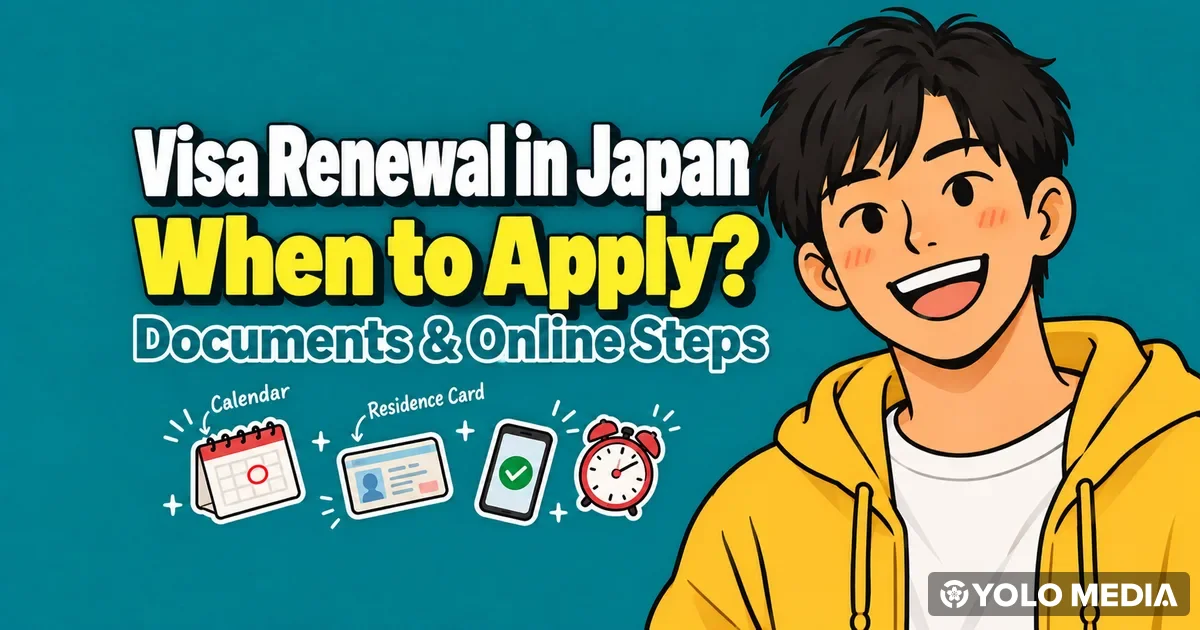
Ever looked at your Residence Card (Zairyu Card) and realized the expiry date is closer than you thought? Visa renewal, officially called an Application for Extension of Period of Stay (Zairyu Kikan Koshin Kyoka Shinsei), lets you stay in Japan longer under the status of residence you already have. If you stay even one day past the expiry date (the last day of your period of stay, printed on your Residence Card), you become an overstayer.
The process changed a lot in 2026. From October, the fee depends on how long a period you are granted, and in January the online application system was replaced. Even if you renewed a few years ago, doing things the way you did last time could trip you up.
Based on official information from the Immigration Services Agency of Japan (ISA), this guide covers:
- How visa renewal differs from similar procedures
- When you can apply
- The fees from October 2026
- Documents for each status of residence
- How to apply at the counter and online
- How long the review takes, and the “special period” that lets you stay while you wait
- Why you might get 1, 3, or 5 years
- What to watch out for while your application is pending, and what to do if it is denied
Disclaimer: This article is based on official information as of October 2026. It is for general information only and does not constitute legal advice for your specific case. Required documents vary by status of residence and employer. Before applying, check the latest information on the ISA website, or consult a Regional Immigration Services Bureau (the local immigration offices around Japan) or a gyoseishoshi (a licensed specialist who helps prepare immigration applications).
1. What Is Visa Renewal (Extension of Period of Stay)?
Visa renewal is an application to extend your period of stay so you can keep doing the same activity under the same status of residence. For example, someone working under “Engineer/Specialist in Humanities/International Services” (often called gijinkoku) uses it to keep working under that same status.
Several procedures have similar names, so first check which one applies to you.
| Procedure | When to use it | When you can apply |
|---|---|---|
| Extension of period of stay (visa renewal) | You want to stay longer under your current status | From 3 months before expiry (if your period of stay is 6 months or longer) |
| Change of status of residence | You want a different status, such as moving from Student to a work status | When you have a reason to change your status |
| Renewal of the Residence Card’s validity | Permanent residents and Highly Skilled Professional (ii) holders want to extend the card itself | From 3 months before the card’s validity ends |
| Permanent residence | You want to become a permanent resident with no limit on your period of stay | When you meet the conditions |
A common mix-up is “Residence Card renewal.” Permanent residents have no expiry on their period of stay, so they do not do visa renewal. Instead, they renew the validity of the card itself. When you search for something like “residence card renewal fee,” check which procedure the information is actually about.
(Source: ISA "Application for Extension of Period of Stay" / ISA "Application for Renewal of the Validity Period of the Residence Card")
2. When Can You Apply for Visa Renewal in Japan?
The answer: if your period of stay is 6 months or longer, you can apply from 3 months before it expires.
| Your period of stay | When you can apply |
|---|---|
| 6 months or longer (1, 3, 5 years, etc.) | From 3 months before expiry until the expiry date |
| 3 months or shorter | After half of your period of stay has passed |
Applying more than 3 months early
The ISA says it may accept applications earlier than 3 months before expiry when there are “truly unavoidable special circumstances.” Examples include a long business trip or study abroad, an expected birth around that time, or family members applying together. In that case, prepare documents explaining your situation and contact the Regional Immigration Services Bureau where you plan to apply before submitting.
On the expiry date itself, counter only
At the counter, you can apply up to and including the expiry date. Reception hours are weekdays 9:00 a.m. to 12:00 p.m. and 1:00 p.m. to 4:00 p.m. (some procedures have set days or times).
However, you cannot apply online on your expiry date. If you assume you can apply online late on the last night, you will miss the deadline. If you are applying online, finish by the day before at the latest.
Our tip: as soon as you receive your Residence Card, put the date 3 months before expiry into your phone calendar. Some documents must come from your employer or city hall, so collecting everything can take time.
(Source: ISA "Application for Extension of Period of Stay" / ISA "Immigration and Residence Q&A" Q22 / ISA "Online Residence Application Notes")
3. Visa Renewal Fees in Japan: When and How Much You Pay
For applications received on or after October 1, 2026, the fee depends on the period of stay you are granted. For example, at the counter, 1 year costs ¥33,000 and 5 years or more costs ¥75,000 (it used to be ¥6,000). If you are granted more than 3 months, applying online is cheaper even after adding the separate payment fee. Applications received by September 30, 2026 still pay the old amount, even if they are approved after October 1.
For the full list of fees by period (counter and online) and the conditions for a reduced fee, see Japan Visa Renewal & PR Fees from October 2026: Full List.
 Visa & Legal
Japan Visa Renewal & PR Fees from October 2026: Full List
Since October 1, 2026, visa renewal and change of status fees in Japan depend on the period granted, from ¥10,000 to ¥75…
Read related article
When and how do you pay?
You pay when your application is approved, not when you apply. You will not know the exact amount until your period of stay is decided.
- If you applied at the counter: When the approval postcard arrives, buy revenue stamps (shunyu inshi, stamps used to pay government fees, sold at post offices and elsewhere) for the amount written on it, and bring them when you pick up your new Residence Card
- If you applied online: Pay by convenience store payment or bank payment (Pay-easy or online banking). Credit cards and QR code payments are not accepted. Online applications from October 1, 2026 cannot be paid with revenue stamps
Payment emails for online applications come from “@service-dgft.com.” The ISA warns that any email asking you to pay the fee from a different address is a scam.
(Source: ISA "Application for Extension of Period of Stay" / ISA "Paying Fees for Online Applications" / ISA "Buying Revenue Stamps")
4. Japan Visa Renewal Documents: What Everyone Needs and What Depends on Your Status
Required documents vary a lot by status of residence. Gather what everyone needs first, then check the documents for your own status.
What everyone needs
- Application for Extension of Period of Stay (downloadable from the ISA website)
- 1 photo (4 cm tall × 3 cm wide, taken within 6 months before applying, no hat, facing forward, plain background, your name written on the back)
- Your passport and Residence Card (shown at the counter)
Certificates issued in Japan (such as resident tax certificates) must be issued within the last 3 months. If you collect them too early they will expire, so time your requests to match your application date.
Main documents by status of residence
| Your status of residence | Main documents you prepare yourself | Main documents you ask your employer, school, or family for |
|---|---|---|
| Engineer/Specialist in Humanities/International Services (employer in Category 1 or 2) | Application form, photo | Proof that your employer is Category 1 or 2. Other documents are basically not needed |
| Engineer/Specialist in Humanities/International Services (employer in Category 3 or 4) | Resident tax certificate (taxable or non-taxable) and tax payment certificate | The “for the organization” pages of the application form; for Category 3, a copy of the previous year’s statutory report summary (the company’s annual summary of salary payments filed with the tax office); for Category 4, documents explaining why it cannot be submitted, etc. From April 15, 2026, a “Declaration Regarding the Representative of the Organization” is also required |
| Spouse or Child of Japanese National | Certificate of residence (juminhyo) listing everyone in your household | Your Japanese spouse’s family register (koseki tohon, an official Japanese record of family relationships), a letter of guarantee (signed by your Japanese spouse as guarantor), and the resident tax certificate and tax payment certificate of the person who pays your living expenses |
| Student | Application form, photo | Depends on the type of school and the school itself (check the tables on the ISA website) |
| Dependent | Documents proving your family relationship | A copy of your supporter’s (spouse’s, parent’s, etc.) Residence Card or passport. If your supporter works, their certificate of employment and their resident tax certificate and tax payment certificate |
For Engineer/Specialist in Humanities/International Services, the “category” depends on your employer’s size and other factors. Category 1 includes listed companies, and Category 2 includes companies whose withholding tax (income tax deducted from salaries in advance) paid in the previous year was ¥10 million or more. The fastest way to find out your company’s category is to ask HR.
Resident tax certificates are issued by the city where you lived on January 1 of that year. If you have moved since, you need to request them from your previous city. A single certificate that shows both your annual income and tax payment status is enough. For how to get a certificate of residence, see How to Get a Juminhyo in Japan: Certificate of Residence.
 Living in Japan
How to Get a Juminhyo in Japan: Certificate of Residence
Need a juminhyo in Japan? Compare the four ways to get one, what each costs, whether your residence status appears, and …
Read related article
(Source: ISA "Engineer/Specialist in Humanities/International Services" / ISA "Spouse or Child of Japanese National" / ISA "Student" / ISA "Dependent" / ISA "Photo Requirements")
5. How to Apply for Visa Renewal: At the Counter or Online
There are two ways to apply: at the counter or online. Which one suits you depends on which cards you have and how soon you need the result.
| Point | At the counter | Online |
|---|---|---|
| Where | The Regional Immigration Services Bureau for your area | From home or anywhere (24 hours a day) |
| What you need | Documents, passport, Residence Card | My Number Card, a smartphone with the Mynaportal app, digital copies of documents |
| On the expiry date | You can apply | You cannot apply |
| Fee | Paid with revenue stamps | Paid by convenience store or bank payment (cheaper than the counter if granted more than 3 months) |
| New Residence Card | Picked up at the counter | By mail or at the counter |
| Specified Residence Card application | Can be done at the same time | Not available |
Applying at the counter
- Take your documents to the Regional Immigration Services Bureau for your area and apply
- Once your application is accepted, the back of your Residence Card is marked to show your application is pending
- When the review is finished, you receive a postcard
- Bring the postcard, passport, Residence Card, and revenue stamps for the fee to pick up your new Residence Card
Applying online
Online applications go through the Online Residence Application System. To use it yourself, you must:
- Be a mid- to long-term resident (people with a period of stay of 3 months or less, among others, cannot use it)
- Be 15 or older
- Have a My Number Card
- Have a smartphone with the Mynaportal app installed
A new system started on January 5, 2026, and IC card readers can no longer be used to read your My Number Card. You read it with the Mynaportal app on your smartphone instead. If you applied last time with a computer and card reader, be aware that the process has changed.
The steps are: register as a user and get a user ID, submit a usage request (verifying your identity with your My Number Card and applying to use the system), then upload your application form and document files. For statuses such as Engineer/Specialist in Humanities/International Services, Student, and Dependent, you also attach the application pages filled in by your employer (“for the organization”) or by your supporter (“for the supporter”).
You can choose to receive your new Residence Card by mail or at the counter (in some cases, such as applying for a re-entry permit at the same time, mail is not available).
For how to get a My Number Card, see How to Get a My Number Card in Japan: Apply, Pick Up, Renew.
 Visa & Legal
How to Get a My Number Card in Japan: Apply, Pick Up, Renew
Applying for a My Number Card in Japan? See the four ways to apply, photo rules, PIN setup, pickup steps, and the expira…
Read related article
(Source: ISA "Online Residence Application Procedures" / ISA "The New Online Residence Application System" / ISA "Online Residence Application System FAQ" / ISA "Online Residence Application Notes" / ISA "Application for Extension of Period of Stay" / ISA "Buying Revenue Stamps" / ISA "Specified Residence Card")
6. Japan Visa Renewal Processing Time and the Special Period
“What if I apply but the result does not come before my expiry date?” It is a natural worry. In short, if you apply by your expiry date, there is a period during which you can stay in Japan until the result comes out. This is called the special period (tokurei kikan).
How long the review takes
The ISA’s official standard processing period is “2 weeks to 1 month.” But the actual figures the ISA publishes every month show it takes longer.
| Status of residence (renewal) | Average days from application to approval (approvals in August 2026) |
|---|---|
| Engineer/Specialist in Humanities/International Services | 41.0 days |
| Spouse or Child of Japanese National | 45.0 days |
| Student | 59.3 days |
| Dependent | 39.2 days |
| Specified Skilled Worker (i) | 38.7 days |
| Business Manager | 44.4 days |
These figures include time spent submitting additional documents and the time between the end of the review and the day you receive the approval at the bureau. ISA materials explain that reviews tend to take longer because applications increase ahead of Japanese language school courses starting in April and October (for Student) and ahead of the April hiring season (for work statuses). Rather than expecting it to finish within a month, it is safer to apply at least 2 months before your expiry date.
The special period: staying in Japan while you wait
If you apply by your expiry date, you can stay under your current status until whichever comes first:
- The day the decision is made
- The day 2 months after your expiry date
During this time, you can keep working or going to school as before.
So you can show that your application is pending even after the date on your card has passed, carry the following:
- If you applied at the counter: The back of your Residence Card is marked as “application pending”
- If you applied online: Nothing is written on your card. You must always carry the “acceptance completion email” showing your application number (it arrives the day after your application is accepted)
Your part-time job or employer may tell you, “Your Residence Card has expired.” If that happens, show them the back of your card or the acceptance email and explain that your application is pending.
Traveling abroad while your application is pending
You can leave Japan while your application is pending using a special re-entry permit (minashi sainyukoku kyoka, which lets you leave without a separate re-entry permit if you return within 1 year). But you need to watch the deadline for coming back.
You must return by whichever is earlier: the day 2 months after your expiry date, or 1 year after you leave. After you return, you must also receive the result at the immigration office where you applied before 2 months pass after your expiry date. If 2 months pass after your expiry date, you become an overstayer even though you applied. If you are planning a trip home, check your dates carefully.
(Source: ISA "Application for Extension of Period of Stay" / ISA "Processing Periods for Residence Applications" / ISA "Processing Periods for Residence Applications" August 2026 (PDF) / ISA "What Is a Special Period?" / ISA "Proof of Pending Online Applications" / ISA "Immigration and Residence Q&A" Q23 and Q61)
7. Why Visa Renewal Gives You 1, 3, or 5 Years
“My friend works at the same company and got 5 years, but I only got 1.” You hear this a lot. Your period of stay is decided during the review, within a set range for each status of residence. For Engineer/Specialist in Humanities/International Services, for example, it is 5 years, 3 years, 1 year, or 3 months.
The detailed criteria for which period you get are not published. What the ISA officially explains is the following:
- In general, decisions are based on whether you have filed the notifications required by immigration law, whether you have paid taxes and social insurance contributions, the size of your employer, and similar factors
- For 5 years, the ISA looks at things like whether you have filed the required notifications, whether your school-age children attend school, your past periods of stay and future plans, your employer’s business situation, and the tax payment status of the person who supports the household
Unpaid taxes and insurance affect your renewal
The ISA’s “Guidelines for Change of Status of Residence and Extension of Period of Stay” state that if you have not paid taxes you owe, this “will be evaluated as a negative factor.” The same applies to National Health Insurance (NHI) premiums and similar payments when there are large or long-term unpaid amounts and the case is considered serious. In June 2026, a note was added saying the ISA may make decisions based on tax payment information it receives from other government bodies.
In other words, if you forget to pay resident tax or NHI premiums, your period of stay could be shorter or your renewal could be denied. If you realize you have missed a payment, talk to your city hall before applying and pay what you can. For how taxes connect to your status of residence as a freelancer, see Freelance Visa in Japan? Statuses, Setup, Taxes, Invoices.
 Work & Career
Freelance Visa in Japan? Statuses, Setup, Taxes, Invoices
Freelancing in Japan? There is no freelance visa. Learn which statuses allow it, sole proprietor setup, taxes, invoices,…
Read related article
If you hold a Business Manager visa and want 3 or 5 years at renewal, see Japan Business Manager Visa Renewal 2026: 5 Screening Criteria, Deficit Cases, and How to Get a 1/3/5-Year Status.
 Visa & Legal
Japan Business Manager Visa Renewal 2026: 5 Screening Criteria, Deficit Cases, and How to Get a 1/3/5-Year Status
Japan's Business Manager visa renewal in 2026: the 5 screening criteria immigration looks at, the rules for 1/3/5-year s…
Read related article
(Source: ISA "Immigration and Residence Q&A" Q18 / ISA "Engineer/Specialist in Humanities/International Services" / ISA "Guidelines for Change of Status of Residence and Extension of Period of Stay")
8. What to Watch Out For While Your Application Is Pending, and If It Is Denied
Moving goes to city hall, changing jobs goes to immigration
The two notifications go to different places, so do not mix them up.
| Situation | Where to notify | Deadline |
|---|---|---|
| You moved | The city hall where you now live (bring your Residence Card when you file your Moving-in Notification (Tennyu Todoke) or similar) | Within 14 days of moving |
| You quit or changed jobs (Engineer/Specialist in Humanities/International Services, Specified Skilled Worker, Nursing Care, Skilled Labor, etc.) | The Immigration Services Agency (electronic notification system, counter, or mail) | Within 14 days of leaving or signing a new contract |
The ISA guidelines say the review also looks at whether you have filed these notifications properly. If you change jobs while your application is pending, do not forget to file the notification. For job changes and notifications on an Engineer/Specialist in Humanities/International Services visa, see Changing Jobs on a Gijinkoku Visa: Notifications, the 90-Day Rule, and the N2 Requirement.
 Visa & Legal
Changing Jobs on a Gijinkoku Visa: Notifications, the 90-Day Rule, and the N2 Requirement
A complete guide to changing jobs on Japan's gijinkoku (Engineer/Specialist in Humanities/International Services) visa: …
Read related article
Applying for a Specified Residence Card at the same time
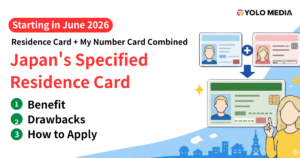
From June 2026, you can get a Specified Residence Card that combines your Residence Card and My Number Card. Getting one is optional. You can apply for it together with your visa renewal, but only at the counter, and it takes about 2 weeks at the earliest to receive. Also, if less than 1 month remains in your special period when the review ends, you may be issued a regular Residence Card instead. For details, see Japan’s Specified Residence Card Launches June 2026: Benefits, How to Apply, and What to Know About the Combined Card.
 Visa & Legal
Japan’s Specified Residence Card Launches June 2026: Benefits, How to Apply, and What to Know About the Combined Card
A plain-English guide to Japan's Specified Residence Card, launching June 14, 2026. What changes when your Residence Car…
Read related article
If your renewal is denied
If your visa renewal is denied, there is no official procedure (appeal) for asking for the decision to be reviewed. If you receive a denial, go to the Regional Immigration Services Bureau where you applied right away and ask what to do next. Your remaining time in Japan is limited, so do not try to deal with it alone. Consulting a gyoseishoshi early is one option.
(Source: ISA "Notification of Change of Residence" / ISA "Notification Regarding the Organization of Affiliation" / ISA "Guidelines for Change of Status of Residence and Extension of Period of Stay" / ISA "Specified Residence Card" / ISA "Application for Extension of Period of Stay")
FAQ
Q: How long does visa renewal take in Japan?
A: The ISA’s standard processing period is “2 weeks to 1 month.” But for approvals in August 2026, the actual average was about 41 days for Engineer/Specialist in Humanities/International Services, about 45 days for Spouse or Child of Japanese National, and about 59 days for Student. Applying at least 2 months before expiry gives you peace of mind.
Q: When can I apply for visa renewal?
A: If your period of stay is 6 months or longer, from 3 months before expiry. If it is 3 months or shorter, after half of the period has passed. If you have circumstances that make it truly necessary, such as study abroad or giving birth, your application may be accepted earlier than 3 months before.
Q: Can I keep working if my Residence Card expires during the review?
A: If you applied by your expiry date, you can keep working as before during the special period. Show the mark on the back of your Residence Card if you applied at the counter, or the acceptance completion email if you applied online.
Q: Can I apply online on my expiry date?
A: No. On the expiry date itself, apply at the counter of a Regional Immigration Services Bureau.
Q: How much is the visa renewal fee, and when do I pay?
A: From October 1, 2026, it depends on the period you are granted. At the counter, 1 year costs ¥33,000 and 5 years or more costs ¥75,000. If you are granted more than 3 months, online is cheaper. You pay when your application is approved, not when you apply.
Q: Can I go home temporarily while my application is pending?
A: You can leave with a special re-entry permit. But you must return by whichever is earlier, 2 months after your expiry date or 1 year after you leave, and receive the result at immigration before 2 months pass after your expiry date. If 2 months pass after your expiry date, you become an overstayer.
Q: I forgot to pay my resident tax. Can I still renew?
A: Unpaid taxes are viewed negatively in the review. If large or long-term unpaid amounts are found and considered serious, you could get a shorter period of stay or a denial. As soon as you notice, talk to your city hall and pay before you apply.
Q: Is renewing a permanent resident’s Residence Card the same as visa renewal?
A: No, it is a different procedure. Permanent residents have no expiry on their period of stay, so there is no visa renewal. Instead, they apply to renew the validity of the Residence Card from 3 months before the card’s validity ends.
Key Takeaways
Visa renewal is much easier if you start preparing 3 months ahead instead of rushing right before the expiry date. Here is a final checklist.
- ✅ Put the date 3 months before expiry in your calendar (online applications must be done by the day before expiry)
- ✅ Check the fees from October 2026 and be ready to pay when you are approved
- ✅ Get resident tax certificates from the city where you lived on January 1, issued within the last 3 months
- ✅ To apply online, have your My Number Card and the Mynaportal app on your smartphone ready
- ✅ After applying, always carry the mark on the back of your Residence Card or the acceptance email
- ✅ If you travel abroad while pending, come back before 2 months pass after your expiry date