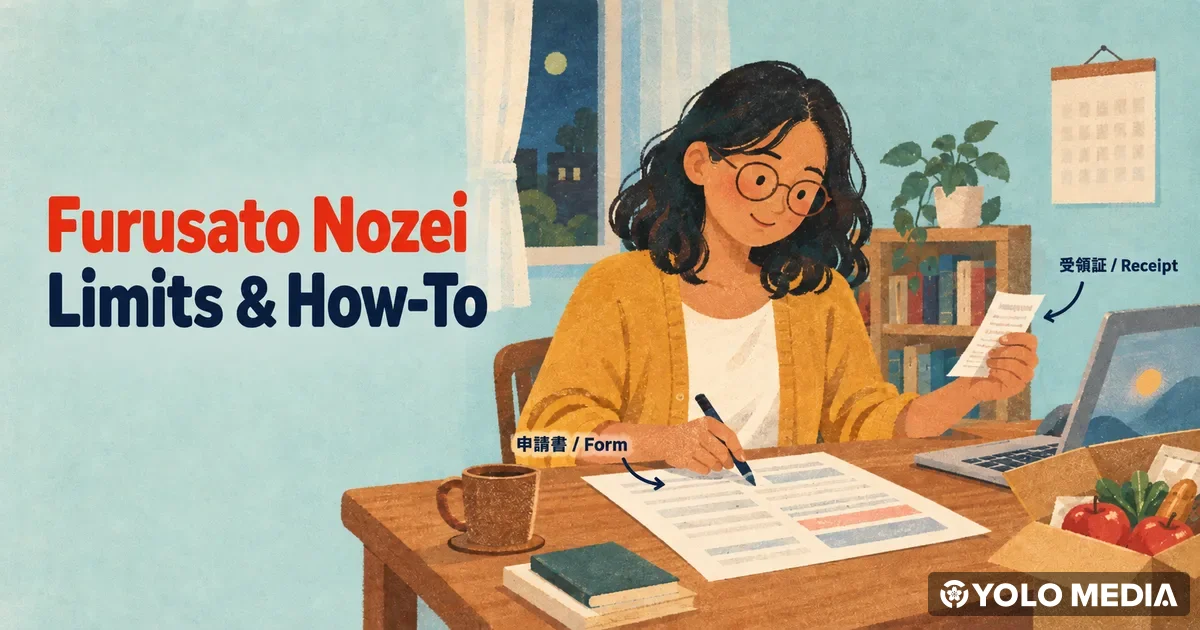
Furusato nozei (hometown tax donation) is a system where, if you donate to a local government of your choice, part of the donation is deducted from your income tax and resident tax. The local government you donate to may also send you a thank-you gift, such as local specialty products.
The Ministry of Internal Affairs and Communications (MIC) says people who pay income tax or resident tax can receive the deduction. MIC’s guidance doesn’t mention any nationality requirement, so if you work and pay taxes in Japan, you can use the system even without Japanese citizenship. However, there are a few things to know, such as the procedures for getting the deduction, the limit on how much is deducted, and what to watch out for if you plan to leave Japan.
In this guide, we cover the following, based on official sources:
- How furusato nozei works
- Who can use it, and what to watch out for if you plan to leave Japan
- How deductions and limits are calculated
- How to donate
- How to get the deduction (One-Stop Exception and tax return)
- Rules for thank-you gifts (including the ban on points from October 2025)
- The yearly flow from donation to deduction
This article provides general information based on official sources as of October 2026. The amount deducted depends on your income, family situation, other deductions, and more. For your own situation, check with your city office or tax office.
1. What Is Furusato Nozei?
MIC describes furusato nozei as a system in which, “if you donate (furusato nozei) to a local government of your choice, the portion of the donation over 2,000 yen is, in principle, fully deducted from your income tax and resident tax” (there is a limit).
For example, if a salaried worker with an annual income of 7 million yen and only a spouse as a dependent makes a 30,000-yen furusato nozei donation, the 28,000 yen above 2,000 yen is deducted from income tax and resident tax.
The 2,000 yen you pay yourself isn’t charged for each donation. It applies to the total of your donations for the year (January to December).
The local government you donate to doesn’t have to be your hometown (it must be a local government designated by the Minister for Internal Affairs and Communications, as explained in Section 6). There’s also no limit on the number of local governments, but there is a limit on how much can be deducted (explained in Section 3).
(Reference: MIC "Overview" / MIC "FAQ" (Japanese))
2. Who Can Use It
| Your situation | Can you receive the deduction? |
|---|---|
| You pay income tax or resident tax (income-based portion) in Japan | Yes, up to the limit |
| Your income is low, and you pay neither income tax nor the income-based portion of resident tax | No |
| You leave Japan by December 31 of the year you donate | Mostly no |
| You leave Japan on or after January 2 of the following year | Yes, up to the limit |
People who pay income tax or resident tax
Yes, you can receive the deduction, up to the limit.
MIC’s FAQ says, “People who pay income tax or resident tax can receive the donation deduction.” To receive the deduction, you also need to donate in the name of the person who pays the tax.
The furusato nozei deduction is taken from the income tax and resident tax you pay. If you don’t pay income tax or the income-based portion of resident tax (the part that depends on your income), you can’t receive the deduction even if you donate.
(Reference: MIC "FAQ" / Nara City "Donation deduction" (Japanese))
If you plan to leave Japan
If you don’t live in Japan on January 1 of the year after you donate, you won’t be charged resident tax for the following fiscal year. That means you can’t receive the part deducted from resident tax (most of the deduction). The One-Stop Exception takes the whole deduction from resident tax, so you’ll get almost nothing back. Even if you file a tax return, only the income tax portion comes back. If you plan to leave Japan by December 31, we don’t recommend furusato nozei that year, because most of the money you donate won’t come back. If you leave Japan on or after January 2 of the following year, you’ll be charged resident tax for that fiscal year, so you can receive the deduction. For procedures before you leave, ask the tax office or your city office.
Individual resident tax is charged by the city (and prefecture) where you have an address on January 1 of that year, and it’s calculated based on your income from January 1 to December 31 of the previous year.
(Reference: MIC "Individual Resident Tax" / Kobe City FAQ (Japanese))
3. How Deductions and Limits Are Calculated
The three deductions
The furusato nozei deduction is divided into three parts: the deduction from income tax, and the deductions from resident tax (basic portion and special portion).
| Deduction | Formula | Main limit |
|---|---|---|
| From income tax | (Donation − 2,000 yen) × income tax rate | Donations eligible for deduction are capped at 40% of total income, etc. |
| From resident tax (basic portion) | (Donation − 2,000 yen) × 10% | Donations eligible for deduction are capped at 30% of total income, etc. |
| From resident tax (special portion) | (Donation − 2,000 yen) × (100% − 10% − income tax rate) | Up to 20% of your income-based resident tax |
Through 2047 (Reiwa 29), the special reconstruction income tax is added to the income tax rate.
For example, here’s a simplified calculation for someone with a 10% income tax rate who donates 30,000 yen (the special reconstruction income tax isn’t included).
| Deduction | Calculation | Amount deducted |
|---|---|---|
| From income tax | (30,000 yen − 2,000 yen) × 10% | 2,800 yen |
| From resident tax (basic portion) | (30,000 yen − 2,000 yen) × 10% | 2,800 yen |
| From resident tax (special portion) | (30,000 yen − 2,000 yen) × (100% − 10% − 10%) | 22,400 yen |
| Total | 28,000 yen |
If the special portion doesn’t exceed 20% of your income-based resident tax, 28,000 yen is deducted and you pay 2,000 yen yourself.
Going over the limit means paying more yourself
If the special portion of the resident tax deduction exceeds 20% of your income-based resident tax, the special portion is capped at “20% of your income-based resident tax.” In that case, you pay more than 2,000 yen yourself.
In other words, there’s no limit on how much you can donate, but there is a limit, based on your income and other factors, on how much you can donate while keeping your own cost at 2,000 yen. The exact limit depends on your income, family situation, and other deductions. MIC advises asking your city office for specific calculations.
For how resident tax works, see Japan’s ‘103-Man Resident Tax Wall’ Becomes 123-Man in June 2026: How Part-Time Spouses and Student Workers Take Home More.
 Money & Finance
Japan’s ‘103-Man Resident Tax Wall’ Becomes 123-Man in June 2026: How Part-Time Spouses and Student Workers Take Home More
From June 2026, Japan's resident tax reform expands the 103-man-en wall to 123-man-en. The minimum employment income ded…
Read related article
Changes for donations from 2027
The FY2026 (Reiwa 8) tax reform set a new cap on the special portion of the resident tax deduction. The special deduction is capped at 1.93 million yen (equivalent to a salary income of 100 million yen). This is the special deduction for a donation of 4.38 million yen. The cap applies to donations from 2027. Even if you go over the cap, you still receive the basic portion of the deduction. It’s a change that affects people with very high incomes.
(Reference: MIC "Tax Deductions" / NTA No.1155 / MIC "Local Tax Act amendments" (PDF) (Japanese))
4. How to Donate
MIC describes the furusato nozei flow as follows.
- Choose a local government you want to support
- Donate to that local government (how to apply and pay differs by local government, so check its website or similar)
- Receive the donation receipt (a document showing that you donated) and keep it safe. If you use the One-Stop Exception, also submit the One-Stop Exception application form to the local government when you donate
- Get the deduction through the procedure in Section 5 (One-Stop Exception or tax return)
If you donate using a furusato nozei payment slip or a payment notice from the local government, the payment slip stub may serve as the document showing that you donated.
(Reference: MIC "The Flow of Furusato Nozei" (Japanese))
5. How to Get the Deduction
To get the furusato nozei deduction, you use either the “One-Stop Exception” or a “tax return.”
| One-Stop Exception | Tax return | |
|---|---|---|
| Who can use it | Salaried workers and others who don’t need to file a tax return, and who donate to 5 or fewer local governments | People who don’t or can’t use the One-Stop Exception |
| Where to apply | The local governments you donated to | The tax office |
| Which taxes are reduced | No deduction from income tax; the full amount is deducted from the following year’s resident tax | Income tax and resident tax |
One-Stop Exception
If you’re a salaried worker or similar who doesn’t need to file a tax return, and you donate to 5 or fewer local governments, you can get the deduction without filing a tax return by applying to each local government you donated to. In this case, nothing is deducted from income tax, and the full deduction, including that portion, is taken from the following year’s resident tax.
From donations made in 2022 (Reiwa 4), some local governments accept online One-Stop Exception applications using a My Number Card. MIC says to ask the local government you donated to whether it supports this.
(Reference: MIC "Tax Deductions" (Japanese))
For how to apply for a My Number Card, see How to Get a My Number Card in Japan: Apply, Pick Up, Renew.
 Visa & Legal
How to Get a My Number Card in Japan: Apply, Pick Up, Renew
Applying for a My Number Card in Japan? See the four ways to apply, photo rules, PIN setup, pickup steps, and the expira…
Read related article
Check the guidance of the local government you donated to for the application deadline and the documents to submit with it.
When the One-Stop Exception doesn’t apply
The One-Stop Exception doesn’t apply in the following cases. You’ll need to get the deduction through a tax return.
- You file a tax return or resident tax declaration, for example for the medical expense deduction
- You apply to 6 or more local governments
- On January 1 of the year after you donated, your address is no longer in the city or town written on your application, but you didn’t submit a change notification
If your address or other details change, submit a change notification to the local government you donated to by January 10 of the year after you donated.
If you buy a home and claim the special deduction for housing loans (mortgage tax deduction), you also need to file a tax return for the first year of the deduction.
For the mortgage tax deduction, see Mortgage in Japan Without Permanent Residency: Buying a Home.
 Money & Finance
Mortgage in Japan Without Permanent Residency: Buying a Home
How to get a mortgage and buy a home in Japan, based on official sources: loans without permanent residency, Flat 35, cu…
Read related article
The National Tax Agency also says that if you file a tax return, your One-Stop Exception application becomes invalid, so you need to calculate the donation deduction including the donations you applied for under the One-Stop Exception.
(Reference: MIC "One-Stop Exception notes" (PDF) / MIC "System Changes (April 1, 2015)" / NTA No.1211-1 / NTA No.1155 (Japanese))
Getting the deduction through a tax return
If you get the deduction through a tax return, you usually file it with the tax office by March 15 of the year after you donated. The income tax portion is deducted from income tax for the year you donated, and some of the income tax you already paid may be refunded. The resident tax portion is deducted from the following fiscal year’s resident tax. If your income tax is 0 yen, for example after year-end adjustment, and you only want the deduction from resident tax, submit a resident tax declaration to your city office.
Attach or present the donation receipts from the local governments you donated to with your tax return. Starting with tax returns for 2021 (Reiwa 3), for furusato nozei, you can instead attach a “certificate for the donation deduction” showing your annual donations, issued by a specified business designated by the Commissioner of the National Tax Agency.
On page 2 of the tax return, fill in not only the “donation deduction” section but also the “donations to prefectures and municipalities (eligible for special deduction)” field under “matters related to resident tax.” If you don’t, the deduction may not be applied to your resident tax. If you applied for the One-Stop Exception but filed a tax return without the donation deduction, you can get the deduction through a request for correction (a procedure to have your filed tax corrected). If your final income tax doesn’t change, consult your city office.
(Reference: MIC "Tax Deductions" / MIC "The Flow of Furusato Nozei" / NTA No.1150 / NTA No.1155 (Japanese))
6. Rules for Thank-You Gifts
The cost of gifts is 30% or less of the donation, and gifts must be local products
The Local Tax Act lists, as conditions for local governments to be eligible for furusato nozei, that the cost of providing thank-you gifts is 30% or less of the donation, and that the gifts are goods produced or services provided in that local government’s area and meet standards set by the Minister for Internal Affairs and Communications.
Since October 2026, the rules on whether gifts are truly local are stricter
Since October 2026, the rules for checking whether a thank-you gift really comes from that area have become stricter. For gifts made with materials from outside the area, the business that makes them must certify that more than half of the gift’s value comes from processing or other work done in that area. For example, fruit grown in another area and simply packed into boxes there, or beer made in another area with the local government’s own sticker added, is not accepted as a thank-you gift.
Only local governments designated by the minister are eligible
From June 1, 2019 (Reiwa 1), a designation system for furusato nozei started. Donations to local governments not designated by the Minister for Internal Affairs and Communications aren’t eligible for furusato nozei.
Since October 2025, collecting donations through sites that give points is banned
Since October 1, 2025, local governments have been banned from collecting donations through websites and other channels that give points.
What’s banned are points given by furusato nozei websites and points from donating through point sites. Points you normally earn when paying by credit card or similar aren’t banned. However, extra points added only for furusato nozei payments are banned.
So when choosing a furusato nozei website, you can’t compare sites by how many points they give. Choose based on the gifts and how the local government uses the donations.
Gifts count as occasional income
Thank-you gifts count as occasional income (income you receive once, not related to your work). Combined with other occasional income, such as prizes from contests or lump-sum life insurance payments, you may be taxed if the total goes over 500,000 yen in a year (only half of the amount over 500,000 yen is included in the tax calculation).
(Reference: e-Gov "Local Tax Act" Article 37-2 / MIC "Review of Designation Criteria" (June 2025) / MIC Q&A (April 2026, PDF) / MIC "Portal Site" / MIC "Review of Designation Criteria" / MIC Q&A (PDF) / MIC "FAQ" / NTA No.1490 (Japanese))
7. The Flow from Donation to Deduction
| When | What to do |
|---|---|
| January to December | Donate to local governments (the 2,000 yen you pay yourself applies to the total for this year) |
| When you donate | If using the One-Stop Exception, apply to the local government you donated to (check its guidance for the deadline and documents) |
| By January 10 of the following year | If your address or other details changed after applying for the One-Stop Exception, submit a change notification |
| By March 15 of the following year (in principle) | If not using the One-Stop Exception, file a tax return (income tax for the donation year is deducted) |
| The following fiscal year | The deduction is taken from your resident tax |
You can check each deadline on the official pages introduced in each section of this article.
FAQ
Q: Can I do furusato nozei if I’m not a Japanese national?
A: MIC says, “People who pay income tax or resident tax can receive the donation deduction.” If you pay income tax or resident tax in Japan, you can receive the furusato nozei deduction (there is a limit). Donate in the name of the person who pays the tax.
Q: Do I pay 2,000 yen for each donation?
A: No. The 2,000 yen applies to the total of your donations for the year (January to December).
Q: How much can I donate while keeping my cost at 2,000 yen?
A: It depends on your income, family situation, and other deductions. The special portion of the resident tax deduction is capped at 20% of your income-based resident tax, and if you go over this, you’ll pay more than 2,000 yen yourself. Check your specific limit with your city office.
Q: I applied for the One-Stop Exception, but now I need to file a tax return for the medical expense deduction.
A: Filing a tax return makes your One-Stop Exception application invalid. Calculate the donation deduction in your tax return, including the donations you applied for under the One-Stop Exception.
Q: Can I get points on furusato nozei websites?
A: You can’t get points from the websites. Since October 1, 2025, local governments have been banned from collecting donations through websites and other channels that give points. Your normal credit card points when you pay aren’t covered by the ban.
Q: I plan to leave Japan during the year. Is it okay to do furusato nozei?
A: If you plan to leave Japan by December 31, we don’t recommend furusato nozei that year. If you don’t live in Japan on January 1 of the year after you donate, you won’t be charged resident tax for the following fiscal year, so you can’t receive most of the deduction. Even if you file a tax return, only the income tax portion comes back. If you leave Japan on or after January 2 of the following year, you can receive the deduction.
Key Takeaways
- ✅ Furusato nozei deducts the portion of your donation over 2,000 yen from income tax and resident tax, basically in full (with a limit)
- ✅ People who pay income tax or resident tax can receive the deduction (with a limit). Donate in your own name
- ✅ There’s a limit on how much you can donate while keeping your cost at 2,000 yen. The resident tax special portion is capped at 20% of your income-based resident tax
- ✅ Get the deduction through the One-Stop Exception or a tax return. The One-Stop Exception is for 5 or fewer local governments and becomes invalid if you file a tax return
- ✅ Since October 2025, collecting donations through sites that give points is banned. The cost of gifts is 30% or less of the donation, and gifts must be local products. Since October 2026, the checks on whether gifts are truly local are stricter
- ✅ If you plan to leave Japan by December 31, we don’t recommend furusato nozei that year. You can’t receive most of the deduction
Once you understand the deadlines and how the deduction works, furusato nozei is a system anyone who pays income tax or resident tax in Japan can use. If anything is unclear, check with your city office or tax office.