Last Updated: 2026-04-25
Reading Time: 12 min read
Introduction
The Monday after Golden Week. Your body feels strangely heavy as you drag yourself out of bed. You open your phone and see photos of friends back home enjoying their long weekend. On the train to work or class, you find yourself wondering, “Why am I this exhausted?”
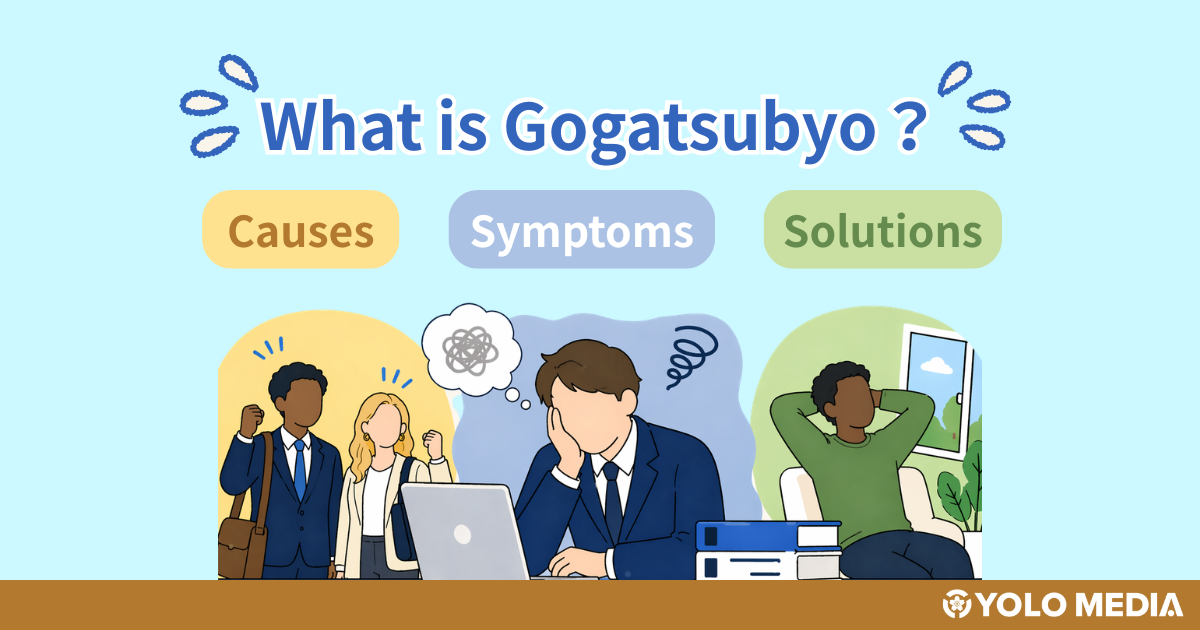
Japan has an actual name for this feeling: Gogatsubyo (五月病) — literally “May sickness,” sometimes translated as May Blues. It describes the mental and physical crash that hits people who’ve been pushing through a new environment since April, once Golden Week breaks the tension.
It’s not a formal medical diagnosis, but the symptoms overlap with adjustment disorder and mild depression. And for foreign residents, language barriers, cultural fatigue, and distance from family stack on top — making the condition often hit harder than it does for Japanese nationals.
This guide covers what Gogatsubyo actually is, a 20-item self-check, why expats are especially vulnerable, persona-based coping strategies, and a curated list of English-language mental health resources in Japan.


TL;DR
- Gogatsubyo is the post-Golden Week crash caused by Japan’s “April-start” social calendar plus the sudden break in tension during the holiday week
- Medically it maps to adjustment disorder, mild depression, or autonomic nervous system dysregulation
- Foreign residents are especially vulnerable due to language fatigue, cultural adaptation stress, and lack of nearby support networks
- Drop perfectionism, reconnect with home, and rebuild the basics: morning sunlight, sleep, exercise
- If symptoms persist 2+ weeks or disrupt daily life, contact an English-language helpline (TELL, Tokyo Mental Health, etc.)
This article is intended as general information and does not substitute for medical diagnosis or treatment. If your symptoms are severe, see a medical professional.
What is Gogatsubyo? Origins and Medical Framing
In Japan, schools, companies, and government bodies almost universally start their year on April 1st. Entrance ceremonies, hiring, transfers, and relocations all happen at once during cherry blossom season — and the pressure of “new beginnings” blankets the whole society.
The term “gogatsubyo” emerged in the late 1960s. New students at the University of Tokyo were noticed falling into apathy after the May holiday week, and Japanese media picked up the phenomenon. Originally framed as a student condition, today it’s recognized in new hires, mid-career transfers, transferees, and international students alike. (Source: Saiseikai, "It Might Be May Sickness")
To clear up a common misconception: Gogatsubyo is not an official medical diagnosis. Doctors classify cases under one of these categories depending on severity and duration:
- Adjustment Disorder — symptoms triggered by an identifiable stressor (a new environment)
- Mild Depression — depressed mood or loss of interest persisting 2+ weeks
- Autonomic Nervous System Dysfunction — when physical symptoms (insomnia, headaches, stomach issues) dominate
(Sources: MHLW Kokoro no Mimi — Adjustment Disorder, Osaka Medical Association — May Sickness)
Japanese media uses “gogatsubyo” casually, but if symptoms persist 2+ weeks or interfere with daily life, don’t self-diagnose — see a doctor.
Why Does Japan Get Hit by Gogatsubyo?
The root cause is Japan’s “April reset culture.”
For the first month of a new environment, most people operate in a high-tension state: “I can’t fail,” “I have to fit in fast.” New bosses, new colleagues, new commute routes, keigo (formal Japanese), business card etiquette, welcome parties — the volume of new information is overwhelming. After roughly four weeks of this comes Golden Week (GW), one of Japan’s few extended holiday periods, late April through early May.
The holiday lets the tension release. Then on the first day back, when you try to return to that high-alert state — the rope snaps. That’s the mechanism behind Gogatsubyo.
Gogatsubyo is triggered by the gap between “an intense month of effort” and “a relaxed holiday.” It’s not weakness or laziness.
Gogatsubyo Self-Check (20 Items)
The more items that apply, the higher the likelihood you’re experiencing Gogatsubyo.
Mental Symptoms
- Can’t get out of bed in the morning (no motivation)
- Nothing feels enjoyable
- Easily irritated or tearful over small things
- Feeling like you’re a failure
- Don’t want to go to work or school
- Trouble concentrating, more mistakes than usual
- Chest-tightening anxiety when thinking about the future
Physical Symptoms
- Trouble falling asleep, or waking up too early
- Loss of appetite, or overeating
- Headaches, stiff shoulders, stomach issues
- Persistent fatigue
- Dizziness or heart palpitations
- Catching colds more easily
Behavioral Changes
- Avoiding contact with friends
- More time spent on alcohol or social media
- Letting personal grooming slip
- Forgetting commitments, procrastinating
- Apartment getting messier
- Loss of interest in hobbies
- Noticeable drop in work or study efficiency
If 5 or more items have persisted for 2+ weeks, consider talking to a professional. If 10+ items apply, seek help sooner rather than later.
Why Foreign Residents Are Especially Vulnerable
There are clear reasons why expats often experience Gogatsubyo more intensely than Japanese nationals.
1. Language Fatigue
For non-native Japanese speakers, every interaction — at work, school, the convenience store, government office — burns extra cognitive energy. The second-language acquisition literature broadly recognizes that operating in a non-native language carries a higher cognitive load than your mother tongue: comprehension, speech production, and response all involve extra processing. Even when you don’t notice it day to day, a month of living in a Japanese-only environment quietly accumulates fatigue.
2. Cultural Adaptation Fatigue (Culture Shock)
In cross-cultural adjustment models (such as Oberg’s U-curve), an early “honeymoon” phase tends to give way to a “shock” phase where frustration and disorientation mount. Timing varies by individual, but the first several months in Japan are commonly when cultural differences start grating — and when this overlaps with an April start at work or school, the load compounds.
3. Missing Support Network
Back home, when you’re struggling, you can call up family or old friends without thinking. In Japan, even with people you can contact, time zones and language barriers make it harder to vent casually. Loneliness is a major amplifier of Gogatsubyo.
4. Visa and Status of Residence Anxiety
A stressor unique to foreign residents — invisible to Japanese nationals. What happens to my visa if I quit? Will my dependent or spouse visa renew? These worries chip away at your mental reserves. Knowing the renewal procedures and required documents in advance alone takes the edge off — see our Visa Renewal Process Guide for the details.
5. The “Don’t Be a Burden” Pressure
Japanese workplace culture quietly demands that you “don’t complain” and “stay in sync with the group.” Phrases like “I need a mental health day” don’t translate well, so many foreign residents push past their limits without speaking up.
Reframing “I’m tired because I’m weak” as “I’m operating in an environment that loads me from three directions — language, culture, and relationships” alone makes self-blame much lighter.
Persona-Based Patterns and Solutions
“Foreigner” covers a wide range of situations. Find the persona closest to yours.
Pattern 1: New Foreign Hire at a Japanese Company
You started in April and got assigned to a team. You’re absorbing training, OJT, keigo, business card rituals, and welcome parties — all in Japanese, all under Japanese workplace customs. Post-GW, “I don’t want to go to work” is the most common feeling.
What to do
- Ask HR if there’s an EAP (Employee Assistance Program). Many large and foreign-capital companies offer free counseling
- Build at least one community of fellow expats — ideally both inside the company (Slack channel) and outside it
- Write your own work notes in English to digest tasks at your own pace
Pattern 2: International Students
Even if you arrived in September or October rather than April, GW often hits you with “all my Japanese friends went home for the holiday and I have nowhere to go” — a strong sense of being left behind.
What to do
- Most universities have an International Student Office with dedicated counselors. Often free, often English-speaking
- For the rest of May, aim for “maintaining” rather than “catching up” on coursework
- Late-May club recruitment (“ni-ji boshu”) tends to be easier to slip into than the April rush
Pattern 3: Trailing Spouses
You came to Japan because of your partner’s job transfer. Without your own work or school routine, daily life centers on kids and the home — and social isolation creeps in fast. This group is often the most prone to severe Gogatsubyo.
What to do
- Local International Exchange Associations run Japanese classes and culture programs that double as community on-ramps
- Recognize that you also have the right to carve out time for your own mental care
- Join one online community from your home country (Facebook group, Discord, etc.)
Pattern 4: Foreigner with a Japanese Partner Going Through Gogatsubyo
Your Japanese partner has Gogatsubyo. They’ve gone quiet, sleeping all weekend, and you’re not sure how to help — and you start feeling drained yourself. This is compassion fatigue.
What to do
- Asking “Are you OK?” usually gets “I’m fine” in Japan. Specific action proposals (a walk, an onsen, a favorite meal) tend to land better
- Protect your own hobbies and friend time so you don’t get pulled under
- If symptoms persist beyond 2 weeks, gently suggest they see a doctor
7 Strategies to Get Through Gogatsubyo
1. Drop the Perfectionism
“I have to master Japanese fast,” “I can’t make mistakes” — pushing yourself like this is counterproductive. Treat the first 3–6 months in any new environment as a baseline where struggling is the default.
2. Schedule Weekly Contact with Home
Conversations in your native language give your brain a real break from constant Japanese-mode switching. If time zones make calls hard, voice messages or letters work too. Joining a monthly meetup of people from your country also helps.
3. The Sunlight–Movement–Sleep Reset
Serotonin (the mood-stabilizing neurotransmitter) needs sunlight, movement, and sleep. The minimum: open the curtains within 30 minutes of waking up and get 5 minutes of morning light. A 30-minute walk 2–3 times a week is enough to make a difference.
4. Eat for Serotonin
Foods rich in tryptophan (a serotonin precursor) are easy to find in any Japanese supermarket:
- Bananas, natto, tofu, eggs, chicken, cheese, nuts
Studies suggest a month of bananas + eggs at breakfast produces a noticeable shift.
5. Use Japan’s Built-in Relaxation
Sento (public bath), onsen (hot springs), and warm tea (matcha, sencha) are self-care tools you only get to access by living in Japan. Even one sento visit on the weekend produces real reset effects. The ideal bath: 40–41°C for about 15 minutes — this regulates the autonomic nervous system.
6. Social Media Detox
During and after GW, friends back home and Japanese coworkers post their best moments. Comparison guarantees a downward spiral. Even moving the apps to a folder on the edge of your home screen reduces how often you open them.
7. Drop Your Output to 70%
In your first week back, don’t operate at 100%. Push critical meetings or deadlines to the following week if you can. Focus your energy on getting through Monday and Tuesday.
“I Just Want to Quit” — When Changing Jobs Becomes an Option
In the middle of Gogatsubyo, it’s easy to jump to extreme conclusions like “this job isn’t for me” or “I should just change careers.” First, postpone any major decisions for 2–3 weeks. Once your mood recovers, the situation almost always looks different in hindsight.
That said, if you’ve rested, recovered, and still feel that the work environment or job style genuinely doesn’t fit you, putting a job change on the table is a healthy decision. As a foreign resident in Japan, narrowing your search to companies actively hiring foreign talent from the start helps you avoid mismatches around visa support and language environment.
YOLO JAPAN is a job platform built specifically for foreign residents in Japan. You can filter by criteria that matter to expats — “visa sponsorship available,” “easy Japanese OK,” “use your native language” — instead of digging through generic Japanese job boards.
Job hunting is mentally and physically taxing. While Gogatsubyo symptoms are heavy, limit yourself to browsing and bookmarking. Save the actual applications and interviews for after you’ve recovered.
Gogatsubyo vs Adjustment Disorder vs Depression
| Item | Gogatsubyo | Adjustment Disorder | Depression |
|---|---|---|---|
| Cause | Post-GW environmental mismatch | Identifiable stressor | Cause may be unclear |
| Duration | A few days to 2 weeks | Within 6 months | 2+ weeks, often longer |
| What helps | Rest, environmental adjustment | Removing the stressor | Medical treatment |
| When to see a doctor | Usually unnecessary | If daily life is impacted | As soon as possible |
People sometimes assume “it’s just Gogatsubyo” when it’s actually depression. If symptoms haven’t improved after 2 weeks, you can’t get to work or school, or you’re having thoughts of self-harm — see a medical professional immediately.
Which Department: Shinryō-naika vs Seishin-ka
| Department | Description | When to choose |
|---|---|---|
| Shinryō-naika (心療内科, Psychosomatic Medicine) | Entry point for people with physical symptoms (insomnia, headaches, stomach issues). Treats stress-related physical conditions | If physical symptoms dominate |
| Seishin-ka (精神科, Psychiatry) | Specializes in mood, emotion, and cognition. Depression and anxiety disorders | If mental symptoms dominate |
| Mental Clinic | The middle ground. Signs usually read “心療内科・精神科” together | When you can’t decide |
Insurance basics and how a first visit typically goes are covered in our Japan Healthcare System Guide.
For English-speaking clinics, look at Tokyo Mental Health and Tokyo International Psychotherapy in Tokyo, or British Counselling Kansai in Osaka. Insurance coverage varies — confirm during your first booking.
English & Multilingual Mental Health Resources in Japan
Use them in order of cost and urgency: free phone lines first, then online counseling, then in-person clinics.
| Service | Languages | Format | Contact / Notes |
|---|---|---|---|
| TELL Lifeline | English | Phone, chat | 03-5774-0992 / Daily / Free |
| Yorisoi Hotline (Foreign Language Line) | English, Chinese, Korean, Portuguese, Spanish, Tagalog, Thai, Vietnamese, Nepali | Phone | 0120-279-338 / 24h / Free |
| Tokyo Mental Health | English and others | In-person, online | Private clinic / Some insurance accepted |
| IMHPJ | English | In-person, online | International Mental Health Professionals Japan |
| Tokyo International Psychotherapy | English | In-person, online | Geared toward expats and professionals |
| British Counselling Kansai | English | In-person, online | Kansai region |
| Himawari (Tokyo Medical Info Service) | English, Chinese, Korean, Thai, Spanish | Phone | 03-5285-8181 / Find English-speaking clinics |
| BetterHelp / Talkspace | English | Online only | Overseas services, accessible from Japan |
If you’re in immediate danger (including thoughts of self-harm), call 110 (police) or 119 (ambulance) — they can connect you to an English interpreter service.
Japanese Phrases for the Doctor’s Office
Useful phrases to lower the barrier to your first appointment:
- “Saikin, kibun ga ochikondeimasu” (最近、気分が落ち込んでいます) — I’ve been feeling down lately
- “Nemuremasen” (眠れません) — I can’t sleep
- “Yaruki ga demasen” (やる気が出ません) — I have no motivation
- “Shokuyoku ga arimasen” (食欲がありません) — I have no appetite
- “Eigo de hanaseru sensei wa imasuka?” (英語で話せる先生はいますか?) — Is there an English-speaking doctor?
- “Gogatsubyō kamoshiremasen” (五月病かもしれません) — I might have May sickness
For your first visit, jot down a timeline of symptoms. List “when it started,” “what symptoms,” and “how often” as bullet points — it makes the consultation much smoother.
FAQ
Q1. How long does Gogatsubyo last?
Usually 1–2 weeks with natural recovery. If it persists 3+ weeks, you may be looking at adjustment disorder or depression — consider seeing a doctor.
Q2. How is “Rokugatsubyo” different?
Rokugatsubyo (六月病, “June sickness”) hits later, around June, when new hires finish their training period and get assigned to actual roles. It tends to be more severe than Gogatsubyo. The cause is the same — environmental adaptation fatigue — but the timing differs. It’s especially common at large or foreign-capital companies with longer training cycles.
Q3. Can children get it too?
Yes. It’s seen in children at international schools and Japanese schools. If your child is saying “I don’t want to go to school” or complaining of stomach aches, it could be Gogatsubyo. Talk to the homeroom teacher or school counselor. For school choice basics, our International vs Public Schools guide is a useful starting point.
Q4. Will I need medication?
For mild Gogatsubyo, lifestyle changes and self-care are usually enough. Medication (anxiolytics, antidepressants, sleep aids) is only prescribed when a doctor diagnoses adjustment disorder or depression. Kampo (traditional herbal medicine) like Yokukansan or Hochuekkito may also be prescribed.
Q5. Should I take time off work?
Taking 1–2 days of paid leave to deliberately rest is highly effective. For longer leave, a doctor’s note (shindansho, 診断書) qualifies you for *sickness benefits (shōbyō teate kin, 傷病手当金)* — about two-thirds of your standard daily wage for up to 1 year and 6 months. (Source: Japan Health Insurance Association — Sickness Benefits)
Q6. Can Gogatsubyo be prevented?
You can’t fully prevent it, but three things in April significantly reduce risk: don’t operate at 100%, protect your weekends, and don’t overschedule Golden Week.
Key Takeaways
- Gogatsubyo is a predictable response to Japan’s social structure (April start + GW), and can happen to anyone
- Foreign residents face compounding pressures — language fatigue, cultural adjustment, missing support networks, visa anxiety — making symptoms hit harder
- Drop perfectionism. Prioritize morning sunlight, sleep, exercise, and contact with home
- If it lasts 2+ weeks, reach out to an English-language resource (TELL, Tokyo Mental Health, etc.)
- You don’t owe anyone an apology for your fatigue. Life in Japan is a marathon — pacing is a right, not a luxury
Just being in a new environment is already a major undertaking. Aim for a sustainable rhythm rather than a perfect Japan life.