Last Updated: April 20, 2026
Reading Time: 6 min read
Category: Living in Japan
Breaking Points (as of April 20, 2026)
- Time: Around 16:52 JST, April 20, 2026
- Epicenter: Off Sanriku, depth ~10 km, magnitude 7.4 (JMA estimate)
- Max shindo: 5+ in Hashikami, Aomori / widespread shindo 5- across Iwate, Aomori, and Miyagi
- Tsunami warning (up to 3m): Iwate Prefecture, Aomori Pacific coast, central Hokkaido Pacific coast
- The situation continues to update. Always check the latest information from JMA, NHK, and your local government.
The information in this article reflects what was available at the time of writing. Tsunami warnings and advisories may be raised, lowered, or lifted, and aftershock guidance can change. Please check the latest information in real time (JMA website, NHK, NERV disaster app, etc.).


Introduction
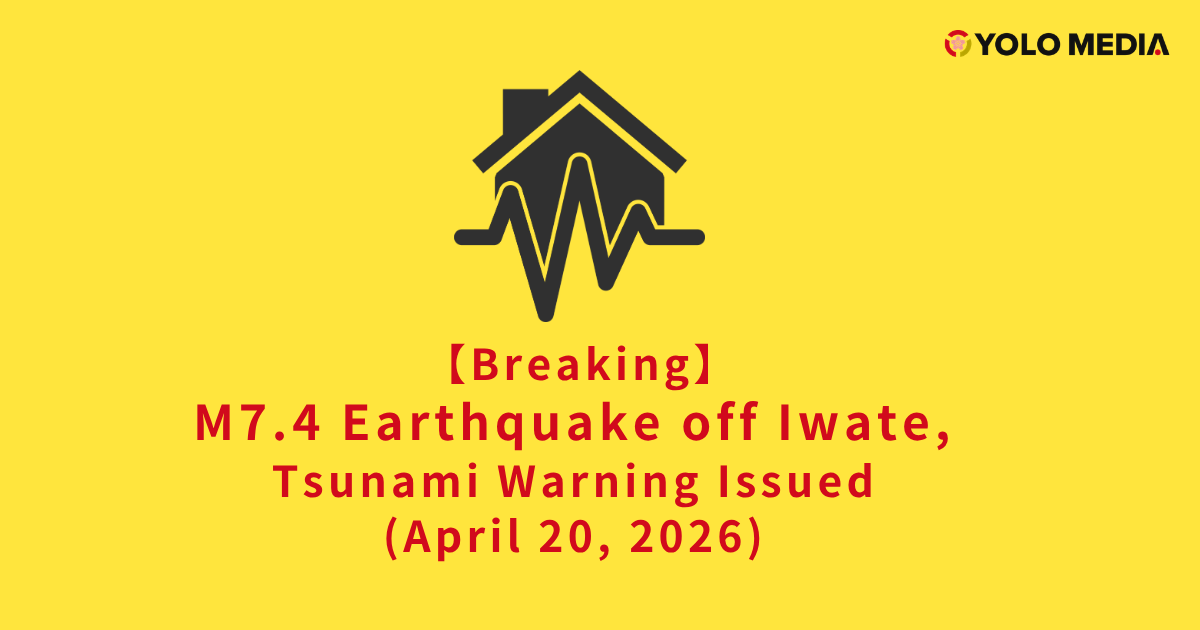
At around 16:52 JST on April 20, 2026, an earthquake struck off the Sanriku coast, and tsunami warnings were issued for the Pacific coasts of Iwate, Aomori, and Hokkaido. Many people in Tokyo may have felt their buildings sway as well.
This article is a calm briefing for international residents in Japan who want to know what to do next. Because information keeps changing moment to moment, please treat this page as a starting point and make it a habit to check official sources roughly once an hour.
TL;DR
- M7.4 off Sanriku; tsunami warning (up to 3m) for Iwate, Aomori, and central Hokkaido Pacific coasts.
- If you are on the coast, move to high ground. Do not return until all warnings are lifted.
- Primary information sources: JMA, NHK, and your local government.
- Handy multilingual apps: NERV Disaster Prevention / Safety Tips / NHK World.
- The situation keeps updating — make checking the latest info a habit.
1. What’s Been Reported So Far (as of writing)
| Item | Details |
|---|---|
| Time | Around 16:52 JST, April 20, 2026 |
| Epicenter | Off Sanriku (about 100 km east of Miyako), depth ~10 km |
| Magnitude | M7.4 (JMA estimate) |
| Max shindo | 5+ in Hashikami, Aomori |
| Key shindo 5- areas | Hachinohe, Shichinohe, Tohoku Town (Aomori); Miyako, Fudai, Morioka, Ninohe, Hachimantai, Yahaba, Hanamaki (Iwate); parts of Miyagi |
| Tsunami warning (up to 3m) | Iwate Prefecture, Aomori Pacific coast, central Hokkaido Pacific coast |
These are preliminary figures as of April 20, 2026. Shindo and magnitude values may be revised after JMA’s detailed analysis. Please confirm the latest values on the official JMA page.
(Source: JMA, NHK, Weathernews, initial reports April 20, 2026)
2. Where to Check the Latest Information First
- JMA earthquake and tsunami info: https://www.jma.go.jp/
- NHK disaster coverage: TV, radio, and NHK World (English)
- NERV Disaster Prevention App: near real-time earthquake and tsunami alerts, English UI available
- Safety Tips: the Japan Tourism Agency’s multilingual disaster app
- Your city or ward website: for shelter openings and local announcements
Don’t rely on a single source — cross-check with at least two. Social media is fast but also carries older footage and misinformation. Use official announcements as your main source and treat social media as supplementary.
3. What to Do in a Tsunami Situation
A tsunami is a separate hazard from the earthquake itself. Even after the shaking stops, coastal areas may not yet be safe. Tsunamis in Japan can arrive within minutes to tens of minutes of the quake.
If you are near the coast or a river
- Move to high ground. Aim for at least 10 m above sea level and 1 km from the shore.
- If no high ground is nearby, go to the 3rd floor or higher of a reinforced concrete building (a tsunami hinan biru).
- On foot rather than by car. Traffic jams can delay evacuation.
- Please do not walk toward the coast or a river to check conditions.
While warnings are active
Tsunamis arrive in waves. Later waves can be larger than the first. Do not return to lower ground until every warning and advisory has been lifted.
- Stay on high ground or an upper floor and wait for updates from the radio or an official app.
- Even if you want to reunite with family, avoid returning to low-lying areas. Your own safety comes first.
If you are inland
- Direct tsunami damage is unlikely, but please be aware of rivers surging upstream.
- Expect aftershocks. Keep away from tall furniture and unstable items.
4. What to Do in an Earthquake Situation
After a quake of this size, aftershocks may continue for hours or even days. Please stay alert.
While shaking (indoors)
- Drop (lower your posture) / Cover (protect your head) / Hold On (stay still).
- Get under a sturdy desk and hold on to a leg of the desk.
- Stay away from windows, bookshelves, and tall furniture.
- If you can do so safely, open a door to keep an exit route available — don’t force it.
- If you are cooking, turn off the stove after the shaking stops.
While shaking (outdoors)
- Protect your head with a bag or your arms and move to an open area.
- Stay away from block walls, vending machines, signs, and utility poles.
- If driving, slow down gradually, pull to the left, and listen to the radio.
After the shaking stops
- Check yourself and your family for injuries.
- Put on shoes (there may be broken glass on the floor).
- Shut off the gas valve and trip the main breaker (to help prevent post-quake electrical fires).
- For messaging, LINE, email, and SNS tend to connect more reliably.
- 171 (disaster message dial) works even if you’re not confident in Japanese.
5. What International Residents Can Check Right Now
“Japanese news is too fast to follow,” or “I’m not sure whether I can use a local shelter” — these are common worries. Even just preparing the items below tonight can make a real difference.
Emergency phone numbers
| Purpose | Number | Notes |
|---|---|---|
| Police | 110 | Crimes, accidents |
| Ambulance / Fire | 119 | Fire, injury, rescue |
| Japan Coast Guard | 118 | Accidents at sea, tsunami |
| Disaster message dial | 171 | Family safety confirmation |
Shelters and local information
- Most city and ward websites offer multilingual pages in English, Chinese, Vietnamese, and more.
- You can find shelters by searching “避難所” or “shelter” on Google Maps.
- During disasters, the free Wi-Fi “00000JAPAN” may be opened for anyone to use.
Your Residence Card and a translation app
- At a shelter, having your *Residence Card (Zairyu Card) and a translation app* on your phone is usually enough for basic communication.
6. Frequently Asked Questions
Q: What’s the difference between a tsunami warning and a tsunami advisory?
A: A tsunami warning (tsunami keihō) covers expected wave heights of more than 1 m and up to around 3 m, and evacuation from coastal areas is required. A tsunami advisory (tsunami chūihō) covers expected heights of up to 1 m — please stop water activities and leave the beach. Today’s alert is a warning.
Q: I live on a high floor of a condo. Do I still need to evacuate?
A: If your building is reinforced concrete and you can reach the 3rd floor or higher, it may function well as a vertical evacuation shelter. Older wooden houses are not safe options. It’s worth checking your city’s tsunami hazard map for your specific address in advance.
Q: My Japanese isn’t strong. Can I still use a local shelter?
A: Yes, you can. Shelters are staffed by city officials and volunteers. Please bring your Residence Card and a translation app.
Q: Can I bring my pet?
A: Policies vary by municipality. Prepare a carrier and pet food, and it’s a good idea to check with your nearest shelter in advance.
Key Takeaways
- ✅ April 20, 2026, 16:52 JST — M7.4 off Sanriku. Tsunami warning (up to 3m) for Iwate, Aomori, and central Hokkaido Pacific coasts.
- ✅ On the coast? Move to high ground. Don’t return until warnings are lifted. Tsunamis come in waves.
- ✅ During earthquakes: Drop, Cover, Hold On. After the shaking, put on shoes and check gas and electricity.
- ✅ Keep NERV Disaster Prevention / Safety Tips / NHK World on your phone.
- ✅ Information keeps updating. Make it a habit to check JMA, NHK, and your local government regularly.
For longer-term preparation, see our Earthquake Preparedness Guide for International Residents in Japan.
This article is based on public information (JMA, NHK, Weathernews, etc.) available as of April 20, 2026. Tsunami warnings, advisories, shindo, and magnitude values may be updated. Please base evacuation decisions on the latest official information and the instructions of your local government. This article is for informational purposes only and does not guarantee any specific course of action.