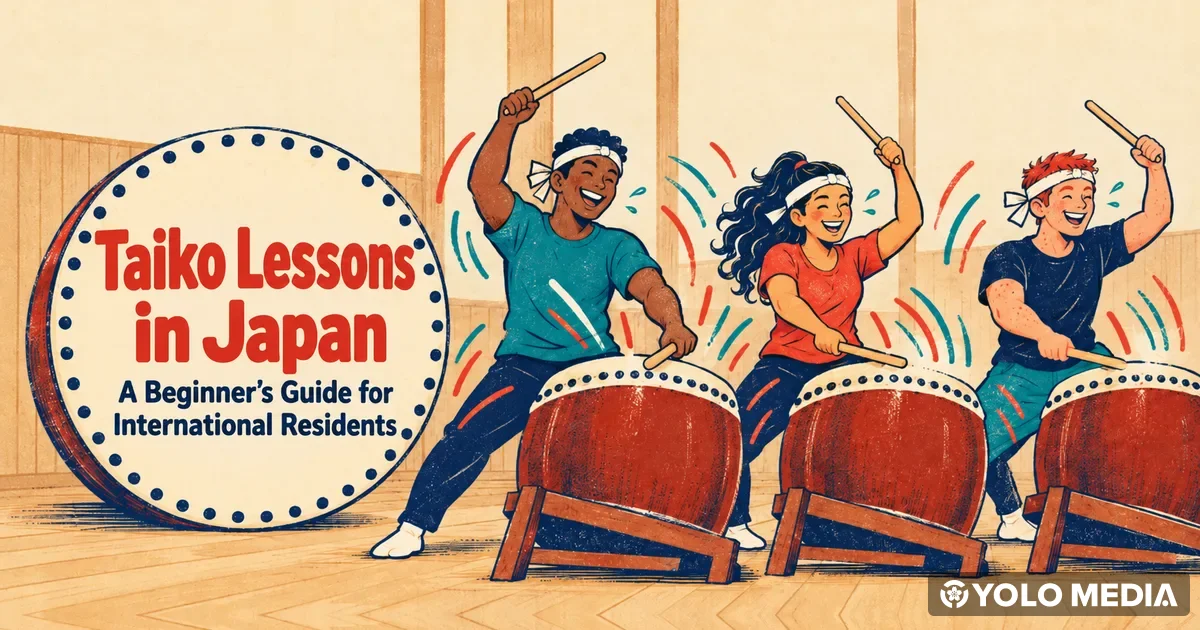
Have you ever felt the boom of a big drum at a Japanese festival? That deep “don” sound hits you right in the stomach, and before you know it, you can’t look away.
Wadaiko (Japanese taiko drumming) isn’t just something to watch. You can play it yourself. In Japan, there are classes for adults, circles that practice at community centers and other places, and local groups that perform at festivals. Some groups in city listings say “no experience needed” or “beginners welcome.”
In this guide, we explain how people living in Japan can start taiko as adults: the types of drums, the different places to learn, fee examples, how to find a group, and what to keep in mind at your first practice. At the end, we introduce a theater in Kyoto where you can watch professional taiko up close.
This article is based on information as of October 2026. Fees and practice days differ by group and may change. Always check with the group before you join.
1. What Is Taiko? The Quick Answer
Here are the key points in one table.
| Question | Answer |
|---|---|
| What is it? | A Japanese drum with cowhide stretched over a wooden body, played with wooden sticks called bachi |
| Where can I hear it? | Festivals, shrines, performances, local events and more |
| Can adults start? | Yes. Some groups in city listings say “no experience needed” or “beginners welcome” |
| Where can I learn? | Classes, community center circles, and local groups (including hozonkai, preservation groups) |
| How much does it cost? | It depends on the group. Examples from city listings range from about 1,000 to 4,500 yen a month (see Section 4) |
| Can I join if I’m not Japanese? | It depends on the group. Start by asking to watch a practice |
The organization that brings together taiko groups across Japan is the Nippon Taiko Foundation (Nihon Taiko Zaidan). It started in 1979 as the All Japan Taiko Federation and became a public interest foundation in 2012. Its goal is to pass on and spread Japan’s taiko traditions.
(Sources: Nippon Taiko Foundation "About us" / Sakai City "Musical instruments (wadaiko)" (Japanese))
2. Types of Taiko Drums
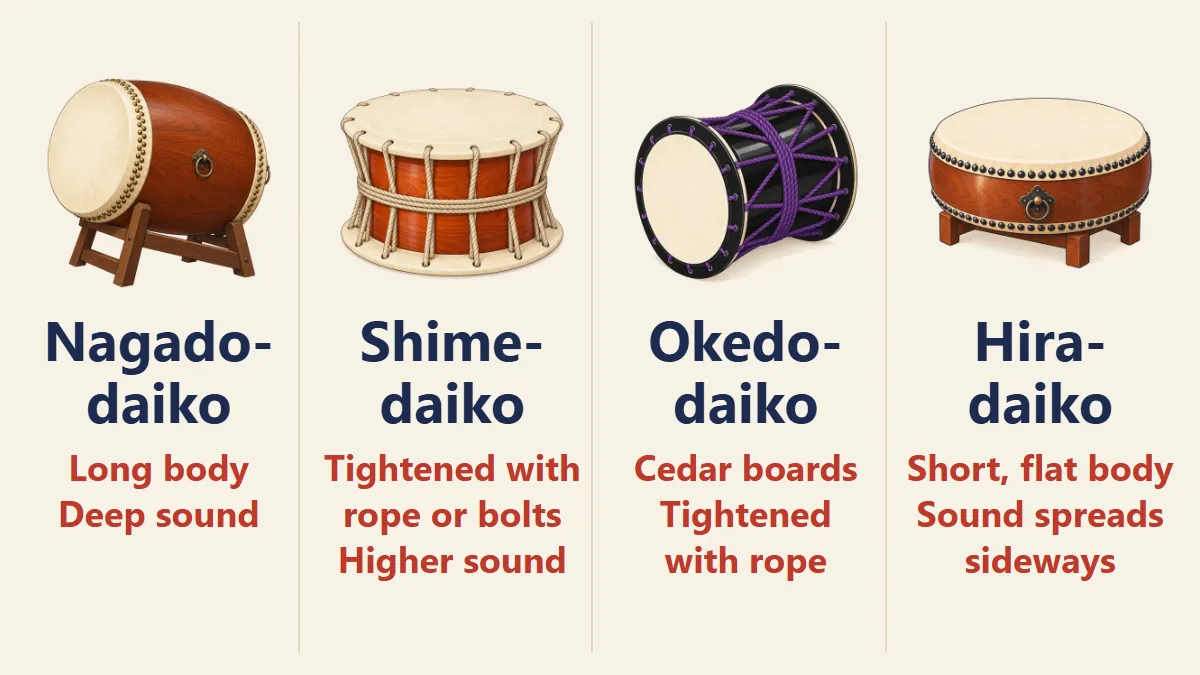
There are many kinds of taiko. So you don’t feel lost when you join a group, it helps to know the names of the common drums.
| Drum | Reading | What it is |
|---|---|---|
| Long-body drum | nagado-daiko | A drum carved from one hollowed-out log, with cowhide fastened by tacks (byo). Its body is long. It’s also called miya-daiko (shrine drum) because shrines use it. Deep sound you feel in your body |
| Tightened drum | shime-daiko | A smaller drum with its skin pulled tight by rope or bolts. Higher-pitched than the nagado-daiko, it keeps the base rhythm |
| Barrel drum | okedo-daiko | Cedar boards put together like a barrel (oke), with the skins tightened by rope. Easy to adjust the sound by changing the rope tension |
| Flat drum | hira-daiko | Same materials as the nagado-daiko, but with a short, flat body. Its sound spreads out sideways |
The wooden sticks are called bachi. They are made from wood such as hinoki cypress or bamboo, and groups sometimes change them depending on the piece. Besides drums, a metal instrument called kane may keep the basic rhythm.
(Sources: Asano Taiko Culture Research Institute "Nagado-daiko" / Asano Taiko Culture Research Institute "Okedo-daiko" / Asano Taiko Culture Research Institute "Hira-daiko" / Ritsumeikan University "Sharing Japan: Wadaiko" (Japanese))
3. A Little History
Taiko has a long history in Japan. A clay figure of a person playing a taiko has been found in a tomb built around the 6th century.
The style you see today at festivals and on stage, where several people play different drums together, is called kumi-daiko (ensemble taiko). Daihachi Oguchi, who led Osuwa Daiko in Okaya, Nagano Prefecture, created fukushiki fukuda, a way for several people to play several drums. This is the form of today’s kumi-daiko.
After that, stage groups centered on taiko were formed.
| Group | About |
|---|---|
| Ondekoza | Formed in 1969 on Sado Island, Niigata Prefecture |
| Kodo | Based on Sado. After performing as “Sado no Kuni Ondekoza,” the group debuted at the Berlin Arts Festival in West Germany in 1981. Since 1988, it has held a festival on Sado called “Earth Celebration” |
Today, taiko is enjoyed not only by professional groups but also by local teams and circles.
(Sources: Kids Web Japan "Roots of the Taiko" / Asano Taiko Culture Research Institute "About Daihachi Oguchi" / Ondekoza official site / Kodo "History" (Japanese))
4. Three Ways for Adults to Learn Taiko
There are three main places where adults can learn taiko.
| Where | What it’s like | Good for |
|---|---|---|
| Classes | A teacher teaches you at your level. Some offer trial lessons | People who want to learn the basics properly |
| Community center circles | Local people meet and practice at a community center (kominkan) | People who want to keep it casual and close to home |
| Local groups and hozonkai | Groups that perform at festivals and events. A hozonkai (preservation group) protects the taiko of its area | People who want to perform in front of others or get to know their neighbors |
Fee examples
Here are fee examples for taiko groups, taken from city listings.
| Example group | Joining fee | Membership fee |
|---|---|---|
| Group A in Sakai City | None | 3,300 to 4,500 yen a month |
| Group B in Sakai City (no experience needed) | 1,000 yen | 4,000 yen a month (including 1,000 yen for transporting and storing drums) |
| A circle in Yamato City, Kanagawa | 1,000 yen | 1,000 yen a month (700 yen for elementary school children) |
Fees vary a lot between groups. You may also need to pay for bachi or for costumes at performances. Before you join, ask what costs what.
(Sources: Sakai City "Musical instruments (wadaiko)" / Yamato City "Circles recruiting members" (Japanese))
Start With a Trial Lesson
Before you join a class, ask whether you can try a lesson or watch first. Trying it once helps you see whether it suits you.
As an example, Taiko Center in Kyoto has an English page for its regular classes, aimed at people who live in Japan and speak some Japanese. The regular classes meet 2 to 3 times a month for 6 months, and you can choose from over 30 studios across Japan. It says some members don’t speak much Japanese, but that it can’t give English support for every instruction.
(Sources: Taiko Center "REGULAR CLASS")
5. How to Find and Join a Taiko Group in Japan
Check your city’s listings
City and ward websites sometimes list circles that practice at community centers, or lifelong learning (shogai gakushu) groups. Try searching “(your city name) 和太鼓 サークル.” You can also ask at the community center counter.
Find a group through the Nippon Taiko Foundation
The Nippon Taiko Foundation has regional branches, with member groups under them. Its website lists the branches and says that membership procedures go through branches across the country. You can contact a nearby branch and ask which groups let you watch a practice.
Ask at a festival
Another good way is to approach a group that played at a local festival and ask, “Can I come and watch a practice?” For festival dates and places, see our Japanese festival calendar.
 Culture & Society
Japan Festival Calendar: The Ultimate Guide to 25 Famous & Hidden Matsuri (2026-2027)
Your comprehensive guide to Japan's 2026-2027 festival dates, delicious street foods, and how to enjoy 'matsuri' like a …
Read related article
Questions to ask when you visit
- Practice days, times and place
- Membership fees and other costs (bachi, costumes, performances)
- Whether there are beginners or people who started as adults
- What language is used at practice (Japanese only or not)
(Sources: Nippon Taiko Foundation "Branches and member groups" (Japanese))
6. Tips for Your First Practice
What to wear and bring
You play taiko with your whole body, so wear clothes that are easy to move in, and bring a towel and a drink. Whether you practice without shoes or can borrow bachi depends on the group, so ask when you sign up to watch.
Practice manners
- Be on time: Before practice, the group may carry and set up the drums. Try to arrive a little early
- Greet people: Say hello at the start and end of practice (see the phrases below)
- Take care of the equipment: Drums and bachi are important to the group. If you don’t know how to use something, ask before touching it
- Help clean up: After practice, help with whatever you can when putting things away
Useful Japanese at practice
| Situation | Japanese |
|---|---|
| Your first visit | “Hajimemashite. (Name) desu. Yoroshiku onegaishimasu.” (Nice to meet you. I’m (name). I look forward to working with you.) |
| Start of practice | “Yoroshiku onegaishimasu.” |
| When you don’t understand | “Sumimasen, mo ichido misete moraemasu ka?” (Excuse me, could you show me once more?) |
| End of practice | “Arigato gozaimashita.” “Otsukaresama deshita.” |
“Otsukaresama deshita” is a greeting you say after doing something together. Saying it after practice helps you feel closer to the group. As you get to know each other, people may start talking to you in casual Japanese (tameguchi). For more on casual speech, see Japanese Slang List: Common Words, Casual Speech and Tips.
 Japanese Language
Japanese Slang List: Common Words, Casual Speech and Tips
Japanese slang and casual speech explained with dictionaries and government surveys: yabai, maji, meccha, social media w…
Read related article
7. If You Want Your Child to Learn
Some groups have children and adults practicing together. For example, a group in Sakai City’s listing is described as having “about 100 members, from age 3 to adults.” The circle in Yamato City is for elementary school children and older.
Some groups have children and adults practicing together, so visiting as a family is a good idea. The minimum age differs by group, so check beforehand. For school events, see Japanese Elementary School Annual Event Guide: Entrance Ceremony, Sports Day, and PTA for International Parents.
 Family & Life
Japanese Elementary School Annual Event Guide: Entrance Ceremony, Sports Day, and PTA for International Parents
"Lost on dress codes," "anxious about PTA," "can't read the handouts" — the 3 stumbling blocks international parents fac…
Read related article
(Sources: Sakai City "Musical instruments (wadaiko)" / Yamato City "Circles recruiting members" (Japanese))
8. See Professional Taiko: DRUM TAO, Steps From Kyoto Station
Watching professionals before you start gives you a goal: “I want to play like that.”
DRUM TAO is a stage group centered on wadaiko. It is based in Kuju, Taketa City, Oita Prefecture, where its facility includes practice halls and a training gym. It describes itself as “non-verbal entertainment” that tells its story through taiko and movement instead of words, and says it has performed in 31 countries and 500 cities, with a total audience of over 10 million (DRUM TAO’s own figures).
In April 2026, DRUM TAO THEATER KYOTO, a theater just for DRUM TAO, opened right next to Kyoto Station.
| Item | Details |
|---|---|
| Address | Avanti Building 9F, 31 Higashikujo Nishisannocho, Minami-ku, Kyoto |
| Access | Right by the Hachijo exit of JR Kyoto Station. 1 minute on foot from Kyoto Station on the subway |
| Shows | Twice a day (Show 1 and Show 2) |
Apply to See DRUM TAO Through YOLO DISCOVER
YOLO DISCOVER, a service for people living in Japan, lets you apply for a ticket to DRUM TAO’s Kyoto performance (normally 10,000 yen) for 0 yen.
- People selected from the applicants get to see the show (there is a selection process)
- After the show, you need to post about it on TikTok, Instagram or Facebook
- Check the page before you apply for show times, companions, age limits and other conditions, and whether applications are still open
Apply to see DRUM TAO on YOLO DISCOVER
(Sources: DRUM TAO "about TAO" / Nomura Real Estate and others, press release on DRUM TAO THEATER KYOTO (PDF) (Japanese) / YOLO DISCOVER "DRUM TAO" project)
9. FAQ
Q. Do I need to read music?
Teaching styles differ by group. Some groups teach by having you watch and copy the movements. Ask when you visit whether you can start without reading music.
Q. What’s the difference between taiko and wadaiko?
In Japanese, “taiko” means drums in general, any instrument you hit to make a sound. “Wadaiko” means Japanese drums.
Q. How old do you need to be to start? Can adults and seniors join?
It depends on the group. For example, Sakai City lists a group with members “from age 3 to adults.” The circle in Yamato City is for elementary school children and older. When you visit, ask what ages they accept and whether some members started as adults.
Q. Is taiko difficult?
Teaching styles differ, but some groups teach by having you watch and copy the movements. Some groups in city listings say “no experience needed” or “beginners welcome.” Start by visiting and watching a practice.
Q. My Japanese isn’t very good yet. Can I join?
The language used at practice differs by group, but there are parts of taiko you can learn by watching. Learning the phrases in Section 6 will help. If you tell the group “Nihongo ga mada jozu dewa arimasen” (my Japanese isn’t good yet) when you visit, people may speak more slowly for you.
Q. Do I need to buy my own bachi?
It depends on the group. Some lend bachi at first. Ask when you visit.
Q. Is taiko good exercise?
You use your whole body, so you’ll sweat after practice. But how hard it is on your body differs from person to person, so if you have health concerns, don’t push yourself.
Q. Where can I see professional taiko?
You can sometimes see taiko at local festivals. For festival dates and places, see our Japanese festival calendar. On Sado Island in Niigata, Kodo holds a festival called “Earth Celebration” (see Section 3). There’s also a theater just for DRUM TAO near Kyoto Station (see Section 8).
(Sources: Sakai City "Musical instruments (wadaiko)" / Yamato City "Circles recruiting members" / Kodo "History" (Japanese))
Summary
- Adults can start taiko. Choose from classes, community center circles or local groups
- Fees differ by group. City listings show examples from about 1,000 to 4,500 yen a month
- To find a group, check your city’s listings, the Nippon Taiko Foundation branches and local festivals
- Wear clothes that are easy to move in for your first practice, and take care with greetings and equipment
- To watch professional taiko, head to DRUM TAO THEATER KYOTO, steps from Kyoto Station
Taiko is an instrument that connects you with others through rhythm, even when words are hard. If you find a group you’re curious about, start by watching a practice. For more about festivals and seasonal events, see our guide to Japan’s seasonal traditions.
Culture & Society
Experience Japan’s Four Seasons: A Guide to Annual Traditions & Seasonal Events
Want to enjoy Japan's seasonal traditions to the fullest? From spring Hanami (cherry blossom viewing) to summer Obon, au…
Read related article