When you first arrive in Japan, the costs pile up fast: rent, food, transportation. If you are worried about money and want to start a part-time job (arubaito, or baito for short) right away, even though your Japanese is not there yet, you are in good company.
The good news is that some jobs are easy to start with little Japanese. What matters most is how much Japanese you need to speak on the job (the amount of conversation) and how clearly the tasks are set out in advance (how standardized the work is). Low-conversation jobs are the easiest to start with, but there is also another approach: choosing a job with more conversation on purpose, so you build your Japanese as you work. This article introduces 5 jobs in order of how little conversation they involve, then explains how to find listings that are easy to apply for, which Japanese phrases to learn for applications and interviews, and how to spot suspicious job ads.
This article is for informational purposes only and does not constitute legal advice. Visa and labor rules may change. Before you start working, check the latest information with your school’s international student office or the Immigration Services Agency of Japan.
Choose Jobs by “Amount of Conversation” and “How Standardized the Work Is”
It is natural to worry that you will not get hired at all if you cannot speak Japanese. In reality, the amount of Japanese needed varies a lot from job to job.
Amount of conversation: how much Japanese you need on the job
Jobs with a lot of customer service, phone calls, or explaining things to customers require you to listen and respond in Japanese on the spot. On the other hand, jobs like sorting items in a warehouse or cleaning, where you work quietly through a set routine, can run smoothly with very little Japanese.
Standardized work: how much the tasks follow fixed steps
In workplaces where the order of tasks and the rules are written in a manual or checklist, the vocabulary and conversations you need to learn at first are limited. When the flow is fixed, such as “start with this shelf, and report when you finish,” beginners find the job easier to learn.
Using these two ideas, the jobs in this article compare like this.
| Job | Conversation | Standardized work | How easy to start with little Japanese |
|---|---|---|---|
| Factory and warehouse light work | Low | High | Very easy |
| Cleaning and bed making | Low | High | Easy |
| Kitchen helper and dishwashing | Low to medium | Medium to high | Easy |
| Delivery support and sorting | Low to medium | Medium | Medium to easy |
| Jobs that use English or your native language | Medium | Medium | Medium (short Japanese still needed) |
While your Japanese is still developing, jobs with less conversation and more standardized work are the easiest to keep up. Once you feel comfortable, you can move to jobs with more conversation and improve your Japanese as you work.
Check Your Work Permission Before You Apply
There is one thing you need to check before you start looking for jobs. On a student visa, you need permission to engage in activity other than that permitted by your status of residence (shikaku-gai katsudo kyoka) in order to work part-time.
- If you have the permission, a summary of it is written on the back of your Residence Card. Check your own card to confirm
- You cannot work without this permission
- While classes are in session, the limit is 28 hours per week. If you have more than one part-time job, ask your school’s international student office how the hours are counted
- During long school breaks, you can work up to 8 hours per day
- You cannot work at businesses regulated under Japan’s Entertainment Business Act, such as cabarets, social clubs where staff entertain customers, and pachinko parlors, even in roles like cleaning or the kitchen
If you have just arrived and do not have the permission yet, get it first and then move ahead with applications. Do not start working “just for now” because you are worried about your Japanese.
For details on how to count the 28 hours and how to apply for the permission, see our separate guide.
If you just arrived and want to check the other procedures you need as well, this guide may also help.
 Living in Japan
What to Do After Arriving in Japan as a Student (2026)
Just landed in Japan as a student? Here's what to do after arriving in Japan, in order: Residence Card, SIM, city office…
Read related article
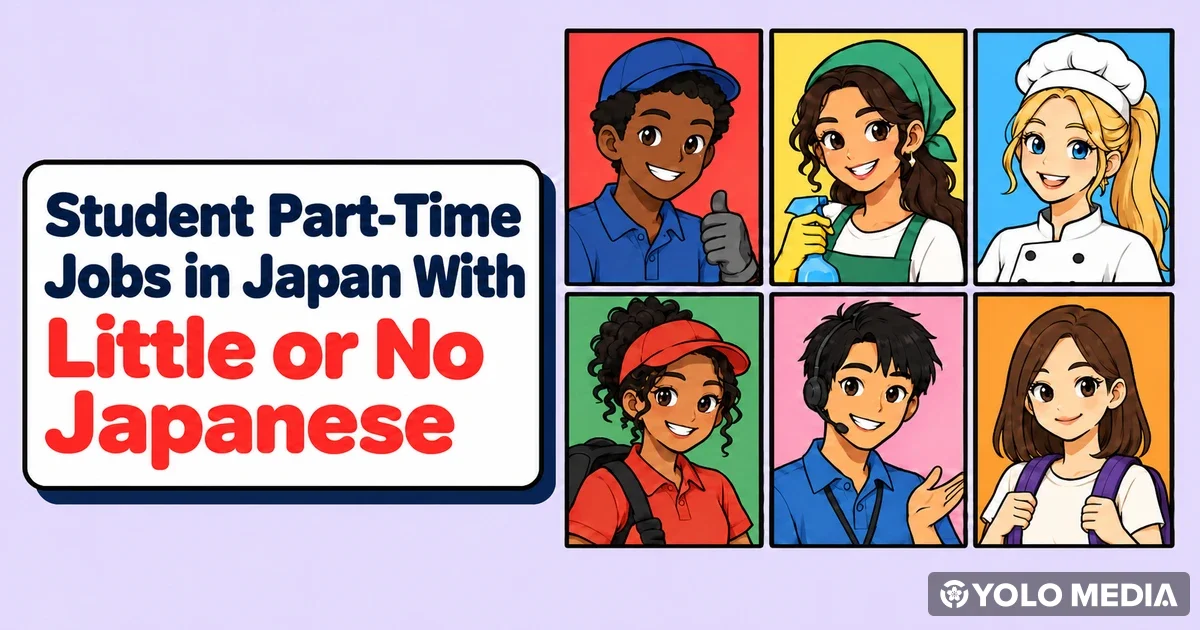
5 Part-Time Jobs You Can Start With Little Japanese
Here are 5 jobs, starting with the least conversation. The details differ from one job ad to another, so always check the listing before you apply.
1. Factory and warehouse light work (sorting and picking)
This work includes sorting products by type and picking items from shelves to fill orders. After someone explains the flow once, the job is often the same set of movements over and over, so it is one of the jobs where you use the least Japanese.
- Conversation: Low (greetings and short confirmations)
- Good for: people who like to work quietly, people who enjoy being physically active
- Words worth learning: words about places, numbers, and time
Factories and warehouses involve machines and heavy items. Safety instructions are important even when they are short, so if you do not catch something, always ask “Mou ichido onegaishimasu” (once more, please).
2. Cleaning and bed making
This is cleaning in hotels or commercial buildings, and bed making in guest rooms. Many workplaces have a checklist for each task and a well-prepared manual. You can get through the day with very little conversation, so it is a calm choice even for a first part-time job.
- Conversation: Low (an explanation at the start and a report at the end)
- Good for: people who work carefully, people who like fixed procedures
- Words worth learning: tools, places, and “Owarimashita” (I’m finished)
Bed making is the same procedure repeated again and again, so your speed picks up naturally. It may take time at first, but if you watch how senior staff move, you will pick it up.
3. Kitchen helper and dishwashing
Even at restaurants, kitchen helper and dishwashing jobs involve much less conversation than serving customers on the floor. Instructions are short, like “do this one” and “next, this one,” and the tasks are set, so these jobs are easy to get into with beginner Japanese.
- Conversation: Low to medium (short instructions inside the kitchen)
- Good for: people who learn by doing, people who like teamwork
- Words worth learning: names of ingredients and tools, “Onegaishimasu” and “Owarimashita“
If a job ad says only “floor staff,” the job is mostly customer service. Look for listings that say “kitchen helper” or “dish station.”
4. Delivery support and sorting staff
The amount of conversation in delivery jobs depends heavily on the role. Jobs where you hand packages to customers involve more Japanese. Support roles, such as sorting packages at a distribution center or preparing items before delivery, involve less.
- Conversation: Low to medium (more if you hand items to customers)
- Good for: people who are punctual, people with good stamina
- Words worth learning: how to read addresses and street numbers, “Otodoke-mono desu” (I have a delivery for you)
Jobs that involve driving a car or motorbike may require a driver’s license. Also, working as a self-employed delivery contractor can require an individual permission instead of the standard comprehensive permission when your working hours are hard to verify.
Check the listing in advance for how much customer contact there is and whether the role is mostly behind the scenes.
5. Jobs that use English or your native language
There are also jobs where speaking another language is a strength, such as guiding tourists, working at tax-free shops, and assisting with interpreting or translation. If you speak English, Chinese, Korean, or Vietnamese, you may have an advantage in hiring.
- Conversation: Medium (your own language or English with customers, Japanese with coworkers)
- Good for: people who like talking with others, people who want to use their language skills
- Words worth learning: greetings and short phrases for guiding customers
Keep in mind that even when a listing says “English only is fine,” you often need short Japanese with coworkers, such as greetings and confirmations. It is safer to assume that jobs with no Japanese at all are rare.
Even if none of these jobs fits you, you can still find listings that use little Japanese. The next section shows how to look for them.
How to Find Jobs That Are Easy to Apply for With Little Japanese
You may be afraid that you will not be hired because you cannot speak Japanese. But small changes in the kind of workplace you choose can make a real difference. Look at two things: whether the workplace has experience hiring staff from overseas, and whether the job is explained clearly.
Narrow down by featured collections on job sites
Some job sites group listings into collections by condition. On YOLO WORK, a job site for people from overseas who want to work in Japan, you can start from collections like these.
| Collection | What it tells you |
|---|---|
| Jobs with No Japanese Required, Japanese beginner OK | Jobs open to any Japanese level. Check these first |
| Experienced in hiring non-Japanese staff | Workplaces with experience working with staff from overseas |
| Training available! | Training is provided, so the job is easier to learn |
| No experience necessary, Simple Work | Good for a first part-time job |
| International students OK | Listings that accept international students |
There is also a story of an international student who was hired through a “Japanese beginner OK” listing.
 Stories
Can You Get Hired on a Student Visa? A 23-Year-Old Chosen From a ‘Japanese Beginners OK’ Listing
A 23-year-old American on a Student Visa, with conversational (N3) Japanese, was hired at an Osaka cafe. Why a 'Japanese…
Read related article
You can search for jobs here.
If you are not confident in your Japanese, start with these collections.
Jobs with No Japanese Required
YOLO WORK is available in many languages, including English and Japanese. Signing up and using it are free.
(Source: YOLO WORK, "How Hiring Works")
3 things to check in a job listing
After narrowing down by collection, read the listing itself. Checking these 3 points reduces mismatches after you start.
- Are the situations that require conversation described specifically? Listings that say whether the job involves customer service, phone calls, or explanations in Japanese leave less room for surprises
- Can you picture how the work flows? When the tasks are specific and there is training or a manual, you only need to learn a limited set of Japanese
- Is there information about staff from overseas working there? Workplaces with experience may speak slowly or find other ways to get the message across
Check these 3 points, then choose from the low-conversation jobs in the previous section. That brings you closer to a job you can actually start now.
Japanese Phrases for Applying and Interviewing
Even if you cannot speak Japanese, deciding on a few phrases ahead of time keeps you calm during applications and interviews. You do not need to memorize long sentences. Short phrases like these are enough.
| Situation | What you want to say | Phrase |
|---|---|---|
| Start of the interview | Tell them your Japanese is still developing | Nihongo wa benkyo-chu desu. Yukkuri hanashite kudasai. (I’m studying Japanese. Please speak slowly.) |
| You did not catch something | Ask them to repeat | Mou ichido onegaishimasu. (Once more, please.) |
| You do not understand | Ask for simpler words | Mou sukoshi kantan ni itte kudasai. (Please say it more simply.) |
| Asked about your schedule | Say the days and times you can work | Getsuyobi to suiyobi no yugata ni hatarakemasu. (I can work Monday and Wednesday evenings.) |
| Work permission | Say you have the permission | Shikaku-gai katsudo kyoka ga arimasu. Shu 28-jikan made hatarakemasu. (I have work permission. I can work up to 28 hours a week.) |
| Stuck at work | Check the steps | Kore wa, dou yarimasu ka. (How do I do this?) |
At work, there will be moments when you say “yes” without really understanding. Asking again is not rude. In fact, it is harder on your coworkers when you make a mistake without checking.
Short Japanese phrases and basic manners for the workplace are covered in a separate guide.
 Work & Career
Japanese Business Etiquette: Workplace Rules for Newcomers
Japanese business etiquette for newcomers: greetings, horenso, business cards, seating, overtime and paid leave, drinkin…
Read related article
Checklist for Avoiding Suspicious Job Ads
When you are not confident in Japanese, it is easy to skip over the details of a listing. Before you apply, check for the warning signs below.
Warning signs to look for before applying
- Vague job description: It says only “easy,” “anyone can do it,” or “earn money fast,” and does not explain the actual tasks
- Conditions that seem too good: It stresses an hourly wage or income far above the typical range
- Unusual contact methods: Right after you apply, you are asked to communicate only through personal social media or a personal LINE account
- Asked to pay first: You are told to pay a registration fee, introduction fee, or materials fee before you start working
- Unclear location: The work address or nearest station is not clear, or the interview location keeps changing
- Pressure to decide fast: You are told “decide today” and given no time to think
Signs of a more trustworthy listing
- The tasks are described specifically enough to picture
- Hourly wage, transportation allowance, shifts, location, and training are all clearly stated
- There is a system for beginners to learn, such as training or multilingual manuals
- The workplace has experience with staff from overseas
Is the hourly wage above the minimum wage?
Your hourly wage must be at or above the minimum wage (saitei chingin, the lowest hourly wage an employer is legally allowed to pay) set for the prefecture. The rule applies to every worker, including part-timers. Minimum wages can be revised each year, so check the latest amount for your area on the Ministry of Health, Labour and Welfare page.
(Source: Ministry of Health, Labour and Welfare, scope of workers covered by minimum wage (in Japanese))
(Source: Ministry of Health, Labour and Welfare, list of regional minimum wages (in Japanese))
Once you are hired, the company gives you a written notice of working conditions (rodo joken tsuchisho, a document stating your hourly wage, working hours, and other terms). We explain, step by step, the documents you need before your first day in a separate guide.
 Work & Career
Part-Time Job Documents in Japan: What to Prepare
A practical guide to the paperwork for a part-time job in Japan: the five documents almost everyone needs, handling My N…
Read related article
Frequently Asked Questions
Q1. Can I take a job interview if I cannot speak Japanese?
Yes. At the start of the interview, say “Nihongo wa benkyo-chu desu. Yukkuri hanashite kudasai” (I’m studying Japanese. Please speak slowly), and the interviewer can adjust how they talk. Practice the phrase table above out loud beforehand.
Q2. Are there jobs where I can use only English?
Yes. However, even when a listing says “English OK,” you often need short Japanese with coworkers, such as greetings and confirmations. You can also find jobs for English speakers on a feature page.
Q3. Can I work right after I arrive in Japan?
You can if you have the permission to engage in activity other than that permitted by your status of residence. You cannot work without it, so get the permission first and then apply. The 28-hour weekly limit and how to apply for the permission are covered in our guide to the student part-time rules.
Q4. Which part-time jobs make it easy to make friends?
Workplaces where people work as a team, or where many staff are around your age, give you natural chances to talk. Kitchen helper jobs and team work in a large warehouse are good examples, because you have coworkers moving alongside you. Another approach is to begin with a low-conversation job and move to one with more conversation once you are comfortable.
Q5. Will my Japanese improve through a part-time job?
The words you use at work every day stick naturally. Even in low-conversation jobs, you will pick up the names of tools, places, time expressions, and phrases like “onegaishimasu” and “owarimashita” just by hearing them repeatedly. Moving to a workplace with more conversation later helps you improve even faster.
Q6. How much of my living costs can a part-time job cover?
It depends on the area and how many hours you work. A separate article explains typical monthly living costs for international students and how much part-time income can cover, with actual amounts.
 Living in Japan
International Student Monthly Living Costs in Japan (2026)
How much do international students spend monthly in Japan? JASSO data breaks down rent, food, tuition, regional gaps, an…
Read related article
Summary: Even If You Are Unsure About Your Japanese, You Can Start Today
- While your Japanese is still developing, choose jobs with low conversation and standardized work
- Before you work, always check the work permission on the back of your Residence Card, and the 28-hour weekly limit
- Narrow down job listings with collections like “Jobs with No Japanese Required” or “Japanese beginner OK” to find workplaces that suit you more easily
- A few short phrases are enough for applying and interviewing. Asking someone to repeat is not rude
- Avoid listings with vague job descriptions or that ask you to pay money first
Start by filtering listings with collections. When you find a job that interests you, check the amount of conversation and whether training is offered, and then apply.