Introduction
Spotting someone in a kimono at a coming-of-age ceremony or a wedding often raises a question: does the color mean something specific? Red is widely seen as the color for celebrations, and black shows up not just at funerals but at plenty of formal occasions too. The more you notice families taking photos outside a shrine for Shichi-Go-San or visitors strolling around in kimono, the more these questions tend to come up.
Kimono colors carry meanings that have been passed down for generations, along with rules about which color fits which occasion. This guide walks through six classic colors, red, blue, white, black, purple, and green, and how each one is chosen for events like coming-of-age ceremonies, weddings, tea ceremonies, and Shichi-Go-San. When we’re invited to a friend’s wedding or trying on a rental kimono, it’s easy to just grab whatever color looks good in the mirror, but knowing the meaning changes the conversation you have while choosing one.
Kimono Colors at a Glance
Let’s start with all six colors side by side. This chart shows what each color means, which occasions and seasons suit it best, and how it pairs with the obi, the wide sash tied around the waist, so keep it handy when choosing a kimono or discussing options with a gift shop or rental store.
| Color | Main Meaning | Common Occasions | Seasonal Feel | Coordination Tip |
|---|---|---|---|---|
| Red | Celebration, energy, youth | Coming-of-age ceremony, weddings, festivals, stage performances | Year-round (adjust the tone by season) | Pair with gold accents for a festive look |
| Blue | Sincerity, purity | Tea ceremony, graduation, theater | Summer, autumn | White or silver obi for a fresh feel |
| White | Purity, new beginnings | Bridal wear, New Year, photo sessions | Winter, year-round | Gold or silver accessories for elegance |
| Black | Dignity, formality | Formal ceremonies, family weddings | Winter, year-round | A lighter-colored obi softens the look |
| Purple | Nobility, refinement, tradition | Tea ceremony, maiko attire, ceremonies | Autumn, winter | Silver or white obi sharpens the tone |
| Green | Nature, harmony, calm | Shichi-Go-San, graduation, sightseeing | Spring, early summer | White or gold obi adds brightness |
Common Traditional Colors
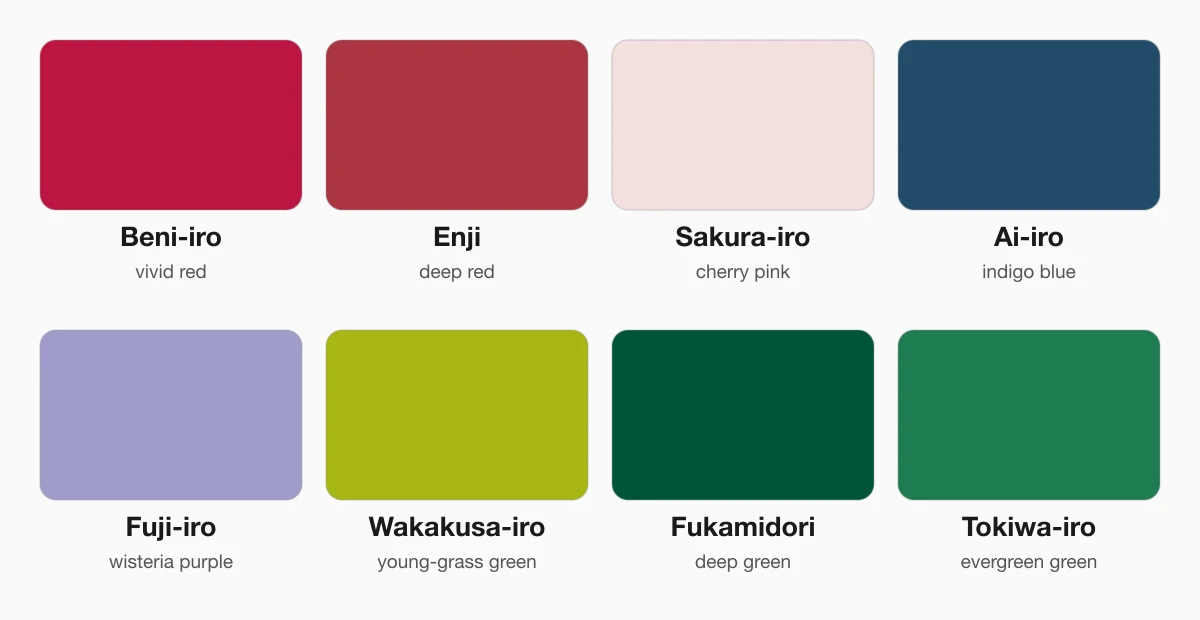
Colors are approximate and may appear differently depending on your screen.
| Color Name | Family | Impression |
|---|---|---|
| Beni-iro | Red | Vivid and bold |
| Enji | Red | Muted, sophisticated |
| Sakura-iro (cherry pink) | Pink | Soft and gentle |
| Ai-iro (indigo) | Blue | Cool, sincere |
| Fuji-iro (wisteria) | Purple | Refined and soft |
| Wakakusa-iro (young grass) | Green | Youthful and light |
| Fukamidori (deep green) | Green | Calm and weighty |
| Tokiwa-iro (evergreen) | Green | A symbol of permanence |
When you’re not sure where to start, thinking in terms of occasion and season keeps things simple. Come back to this chart whenever you’re stuck. Red for celebrations, blue or purple for quieter settings, white or black when formality matters; matching the color to the occasion makes the decision much easier.
Kimono Colors and Their Meanings, One by One
Red Kimono Meaning and When to Wear It
Red holds a special place in kimono culture. It represents energy, vitality, and passion, and has long been associated with new beginnings. That’s exactly why red kimonos and furisode, the long-sleeved style worn by unmarried women, are so popular for coming-of-age ceremonies and weddings.
Red also carries an older belief. If you’ve noticed the bright red torii, the gates that mark a shrine’s entrance, that same shade of red has traditionally been considered protective against bad luck. Some people connect that belief to why a red kimono feels especially fitting for a celebration.
(For more on torii gates and shrine etiquette, see our guide to telling shrines and temples apart.)
 Culture & Society
Shrine vs. Temple in Japan: Never Get Confused Again! (2026)
Confused about the difference between a Shinto Shrine and a Buddhist Temple? This guide explains everything from how to …
Read related article
Culture & Society
Shrine vs. Temple in Japan: Never Get Confused Again! (2026)
Confused about the difference between a Shinto Shrine and a Buddhist Temple? This guide explains everything from how to …
Read related article
Red hasn’t always been free for anyone to wear, either. Under the Nara-period clothing code (Ifukuryo), which assigned a specific color to each official rank, fourth-rank officials wore deep crimson and fifth-rank officials wore a lighter crimson, so the deepest shades of red were tied to high rank rather than open to everyone.
(Reference: National Diet Library Reference Database, on torii gates and warding off evil and on the Nara-period clothing code)
Some people worry that red might stand out too much, but the right tone changes everything. A brighter red suits spring, while a slightly muted red works well in summer. Adding gold to the obi or accessories makes the whole look even more festive.
Red isn’t limited to coming-of-age ceremonies and weddings. It’s also common for the kimono young girls wear at Shichi-Go-San. That same idea of energy and youth carries straight into a celebration of a child’s growth. For a softer look, many people choose sakura-iro, a pale cherry pink, which shows up often on furisode and Shichi-Go-San kimono too.
Blue Kimono Meaning and When to Wear It
Blue represents sincerity, purity, and a sense of calm. It suits occasions where subtlety matters more than standing out. Blue and navy are popular at graduation ceremonies, and indigo and other calm tones are often chosen for tea ceremony as well.
Blue tones also show up often in yukata, which is why you’ll spot them everywhere at summer festivals. Some people assume blue looks plain, but pairing the obi with white or silver instantly brightens the impression. A pale blue feels light and airy in summer, while a deep navy reads as sophisticated in autumn. Both help the outfit feel connected to the season.
Deep indigo kimonos and yukata are often dyed using a traditional technique called aizome. That same shade of blue is sometimes called “Japan Blue.”
White Kimono Meaning and When to Wear It
White represents purity and new beginnings. It’s the reason shiromuku bridal kimono and New Year’s formal wear are so often white: the color symbolizes a clean slate and the start of a new chapter in life.
A white kimono isn’t limited to certain seasons; it’s usable year-round. In photos, a white kimono’s impact depends heavily on the background. A colorful backdrop makes the white stand out even more, and gold or silver accessories add a refined finishing touch.
The shiromuku worn during a wedding ceremony is traditionally the most formal kimono a bride wears, reserved for the ceremony itself. At the reception, brides often change into an iro-uchikake, a colorful uchikake robe worked in red and gold rather than white. That shift from plain white to vivid color marks the turning point of the celebration.
(Reference on the iro-uchikake definition: Japan Hotel School Wedding Glossary)
Black Kimono Meaning and When to Wear It
Black represents dignity and a polished, formal impression. Some people assume black kimonos are only for funerals, but they’re actually worn widely at family weddings and other formal ceremonies where dignity matters.
If an all-black look feels too heavy, pairing the obi with gold or white lightens it up. For photos, shooting outdoors in natural light also softens black’s heavier tone.
The kurotomesode, a black kimono worn by married women at weddings, is the most formal option for women and features patterns only along the hem.
(Reference: National Diet Library Reference Database)
Men’s most formal option follows the same idea: a black montsuki haori (a crested formal jacket) paired with hakama (pleated trousers worn over a kimono).
(Reference: Japan Hotel School Wedding Glossary)
Purple Kimono Meaning and When to Wear It
Purple represents nobility, refinement, and a long history. It’s a common choice for tea ceremony, maiko (apprentice performers of traditional arts, often seen in Kyoto) attire, and formal ceremonies, valued for looking elegant even in understated settings.
Tea ceremony instructors and wedding invitations sometimes point people toward purple, and there’s a real historical reason it became so special. Roughly 1,400 years ago, in 603, Japan established the Twelve Level Cap and Rank System, which placed purple at the highest rank.
(Reference: Nihon Daihyakka Zensho, via Kotobank)
In later eras, deep purple (koki-murasaki) was designated a kinjiki, a forbidden color reserved for people of high status, and wearing it was off-limits for everyone else. That history is part of why purple still carries a sense of “refinement” and “tradition” today.
(Reference: Kotobank: Kinjiki)
A lighter wisteria purple gives a youthful, gentle impression, while a deep purple feels more mature. Pairing the obi with silver or white lets the color speak for itself. Wisteria purple appears on kimono worn across a wide range of ages.
(For more on the seasonal colors used in geisha and maiko attire, see our complete guide to geisha and maiko.)
 Culture & Society
Geisha vs Maiko Explained! Common Mistakes Tourists Make Could Lead to Fines (2026)
What's the real difference between Geisha and Maiko? From their daily schedules and seasonal kimonos to traditional banq…
Read related article
Culture & Society
Geisha vs Maiko Explained! Common Mistakes Tourists Make Could Lead to Fines (2026)
What's the real difference between Geisha and Maiko? From their daily schedules and seasonal kimonos to traditional banq…
Read related article
Green Kimono Meaning and When to Wear It
Green represents nature, calm, and harmony. It suits occasions where a gentle, relaxed mood fits best. Green is a common choice for Shichi-Go-San and graduation, and it also pairs easily with sightseeing in spring or summer.
Factor in the obi and accessories, and green turns out to be one of the more versatile colors to wear. A light, fresh green feels breezy, while a deep green feels weightier. Pairing the obi with white or gold brings out more character in the pattern.
Evergreens like pine and bamboo, which keep their color year-round, have long been called tokiwa in Japanese, a word associated with things that endure. Green kimonos being chosen for milestone events like graduation or Shichi-Go-San ties into that same wish for continued growth and lasting relationships.
(If you’re planning a kimono around a summer festival or seasonal event, our guide to Japan’s festival calendar is a useful companion.)
 Culture & Society
Japan Festival Calendar: The Ultimate Guide to 25 Famous & Hidden Matsuri (2026-2027)
Your comprehensive guide to Japan's 2026-2027 festival dates, delicious street foods, and how to enjoy 'matsuri' like a …
Read related article
Culture & Society
Japan Festival Calendar: The Ultimate Guide to 25 Famous & Hidden Matsuri (2026-2027)
Your comprehensive guide to Japan's 2026-2027 festival dates, delicious street foods, and how to enjoy 'matsuri' like a …
Read related article
How to Pair Colors With Your Obi and Accessories
The color of the kimono itself isn’t the only thing that shapes the overall look; the obi and accessories matter just as much. The basic approach is simple: either match tones for a cohesive look, or contrast them for more visual impact.
| Kimono Color | Matching Tones | Contrasting Look |
|---|---|---|
| Red | Deep red or maroon obi for a settled look | Gold or white obi for extra festivity |
| Blue | Navy or indigo obi for cohesion | White or silver obi for a lighter feel |
| White | Ivory or cream accessories for softness | Gold, silver, or red accessories for formality |
| Black | Gray or black obi to keep it sharp | White or gold obi to brighten it up |
| Purple | Wisteria or pale purple obi for unity | Silver or white obi for contrast |
| Green | Moss green obi for a natural feel | White or gold obi for extra brightness |
If you’re unsure, gold, silver, and white obi pair reasonably well with almost any kimono color, which makes them a safe starting point if this is your first time choosing one. A patterned kimono usually looks best with a plain obi, and a plain kimono pairs well with a patterned one, which helps keep the overall balance in check. Beyond the kimono and obi, adding the same accent color to hair accessories, zori sandals, or a bag ties the whole look together even more.
Common Mistakes When Choosing Kimono Colors
Knowing what each color means doesn’t always prevent mistakes when it’s time to actually choose. Here are four common ones.
The first is wearing a white or near-white kimono as a wedding guest. Since white is so strongly associated with the bride, guests wearing it tend to get noticed, and it’s safer to avoid.
The second is leaning entirely on pale colors for a celebratory occasion, which can make photos look washed out. If you do go with pale tones, adding one deeper color or a touch of gold or silver to the obi or accessories helps the outfit hold together.
The third is picking a color without thinking about the season, based purely on what’s available at a rental shop. Wearing a deep autumnal red during cherry blossom season, for instance, can clash with the scenery in photos. Deciding on one seasonal color ahead of time helps avoid that mismatch.
The fourth is focusing entirely on the kimono’s color and treating the obi as an afterthought. The same kimono can look completely different depending on the obi color, so it’s worth thinking about the two together from the start.
Formality Levels and Color
Kimono also come with formality levels, and the occasion depends on the type of kimono as much as its color. Here’s how the three tiers break down, from most to least formal:
| Formality | Kimono Types | Notes |
|---|---|---|
| Most formal | Furisode, kurotomesode, irotomesode | Irotomesode is a colored, patterned kimono worn regardless of marital status |
| Semi-formal | Homongi, tsukesage | Homongi has more elaborate patterns, tsukesage more understated ones |
| Everyday wear | Komon, yukata | Komon has a small pattern repeated all over |
The same red or purple can suit a wedding or coming-of-age ceremony when worn as a furisode, or work just as well for a casual outing or the theater when worn as a komon. Checking both the color’s meaning and the kimono’s formality level helps you avoid showing up dressed for the wrong kind of occasion.
If you’re attending a wedding as a guest, avoiding white or near-white kimono is standard etiquette. White is considered the bride’s color, and steering clear of it is simply a way of not competing with the person the day is actually about.
How Color Changes With Marital Status
Kimono color and pattern don’t just depend on the season or occasion; they can also depend on whether the wearer is married. The clearest example is the difference between furisode, worn by unmarried women, and tomesode, worn by married women.
Furisode has long sleeves and features bright, vivid colors and patterns like red and pink, and it’s the formal choice for unmarried women attending coming-of-age ceremonies and weddings. Tomesode has shorter sleeves, and the kurotomesode, a black kimono with a pattern limited to the hem, is considered the most formal option, typically worn by the mothers and female relatives of the bride and groom at a wedding.
For men, marital status doesn’t really change which colors are worn. The most formal option is the black montsuki haori and hakama. Men’s kimono are less differentiated by color than women’s, which can simplify the decision.
(Reference: Japan Hotel School Wedding Glossary)
Choosing Colors by Season: A Japanese Tradition
In Japan, choosing a kimono color that fits the season is considered important. Spring favors bright shades reminiscent of cherry blossoms and fresh greenery, summer leans toward cool blues and whites, autumn pairs naturally with the reds and purples of fall foliage, and winter favors deep, muted tones and black.
Picturing one upcoming event, or one scene that captures the season, is usually enough to point you toward a color. Choosing a color with the occasion and atmosphere in mind reflects a kind of consideration that runs through Japanese culture more broadly.
Wearing a soft red or pink kimono during cherry blossom season, for example, blends naturally into the scenery and photographs beautifully. Choosing red or purple during the fall foliage season creates a similar sense of unity with the landscape. That instinct to match color with season is one of the things that defines kimono culture.
Once you know what a color means, the same kimono can look different to you. Red celebrates a new beginning, white represents purity, blue conveys sincerity, and each color carries generations of history and intention behind it.
How to Experience Kimono Colors for Yourself
Reading about what each color means is one thing, but actually wearing a kimono changes how it feels. Putting on a red kimono can genuinely lift your mood, and a blue one has a way of making you sit up a little straighter. We’ve found that once you know what a color means, wearing it changes both how you look in photos and how the rest of the day feels.
If you live in Japan, there are opportunities to try on a kimono for free. YOLO DISCOVER regularly publishes projects that include kimono dressing experiences, and signing in or creating an account lets you see what’s currently available. At many venues, staff are happy to help you choose a color based on your mood or the occasion. Trying a color that matches the season or event tends to make everything in this guide feel a lot more real.
If you’re curious, check out the YOLO DISCOVER project list for kimono-related experiences.
Frequently Asked Questions
Q1. Why is red associated with celebrations?
Red represents energy and vitality. Like the bright red torii gates at shrine entrances, it has long been considered protective against bad luck. It’s chosen for coming-of-age ceremonies and weddings because of this association with energy and a fresh start.
Q2. Are black kimonos only worn for funerals?
No. Black represents dignity and formality, and it’s worn at family weddings and other formal ceremonies where that matters. The kurotomesode is a common formal choice for married women, and the impression it gives changes a lot depending on the obi and accessories.
Q3. What does a white kimono mean?
White represents purity and new beginnings. It’s common for bridal wear and New Year’s outfits, but it can be worn year-round. If you’re attending a wedding as a guest, etiquette calls for avoiding white since it’s considered the bride’s color.
Q4. Why is purple considered a noble color?
Purple was designated the color of the highest rank under Japan’s Twelve Level Cap and Rank System, established roughly 1,400 years ago in 603. In later eras, deep purple was designated a kinjiki, a forbidden color, and restricted to people of high status, and that history is why it still carries a sense of “refinement” and “tradition” today.
(Reference: Kotobank: Kinjiki)
Q5. Why do kimono colors change with the season?
Japan places a lot of value on the four seasons, favoring bright colors in spring, cool colors in summer, colors reminiscent of fall foliage in autumn, and deep, muted tones in winter. Choosing a color that matches the season is one way of showing consideration for nature and the people around you.
Q6. What should I keep in mind when matching the obi and accessories?
Think in terms of two options: matching tones for cohesion, or contrasting for impact. With a red kimono, for example, a gold or white obi reads as festive, while a deep red or maroon obi feels calmer (see “How to Pair Colors With Your Obi and Accessories” above for more combinations). If you’re new to this, pick the kimono color first and adjust the obi afterward; it makes the process much easier.
Q7. Does color choice change between casual and formal settings?
Yes. For casual occasions, colors like blue or green in more subdued tones work fine. For formal occasions like weddings and ceremonies, colors that convey formality, like black and purple, are more commonly chosen, with attention paid to how they fit alongside everyone else’s outfits.
(For an example of a more casual setting, our complete ryokan guide covers what it’s like to wear a yukata during a stay.)
Final Thoughts
Kimono colors each carry meanings shaped by centuries of history: red for energy, blue for sincerity, white for purity, purple for nobility. The same kimono can leave a completely different impression depending on the color you choose.
Knowing what each color means makes dressing for a coming-of-age ceremony, a wedding, or a tea ceremony that much more enjoyable. Reading about it is one thing, but actually trying on a kimono brings that meaning closer to home.
- Narrow down a color by occasion (celebration, formality, everyday) and season
- Match one or two obi or accessory colors, and decide whether to blend in or stand out
- Avoid white or near-white kimono if you’re attending a wedding as a guest