What Changed
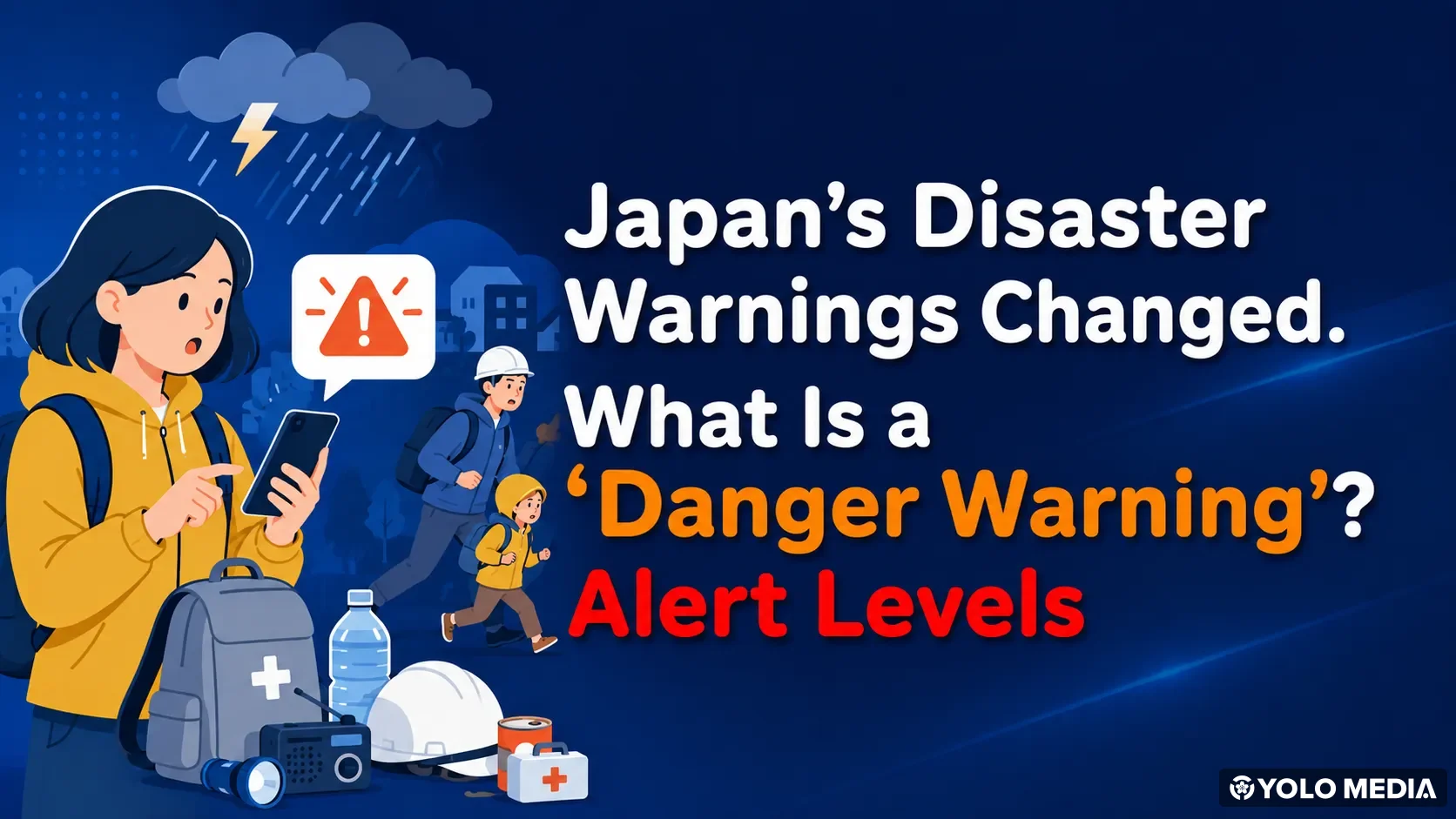
Starting the afternoon of May 28, 2026, the Japan Meteorological Agency (JMA) overhauled how it issues disaster prevention weather information.
You may have noticed new formats on TV or your phone, like “Level 3 Heavy Rain Warning” or “Level 4 Landslide Danger Warning.” Even native Japanese speakers find this confusing, so if you’re still learning Japanese, this can be especially disorienting.
This article explains what changed, what the new warnings mean, and what action you should take when they appear. Read it once, and you won’t have to panic every time a typhoon or heavy rain hits.


TL;DR
- As of May 28, 2026, disaster warnings for heavy rain, river flooding, landslides, and storm surges have been significantly overhauled
- All warnings now include a “Level ○” number (e.g., Level 3 Heavy Rain Warning)
- A new “Danger Warning” (Level 4) has been created. When issued, everyone must evacuate
- Flood warnings and flood advisories have been abolished. Replaced by river-specific “flood information”
- Warnings for storms, waves, heavy snow, and blizzards have not changed
Disclaimer: This article is based on information from the JMA, tenki.jp, and Weather News as of June 1, 2026.
What Changed: 3 Key Points
Point 1: All Warnings Now Include a Level Number
Previously, warnings were issued with names only, like “Heavy Rain Warning” or “Heavy Rain Emergency Warning.” This made it hard to understand how dangerous the situation was or what action to take.
Starting May 28, all warnings include a Level 1–5 number.
| Level | Name | What It Means | What You Should Do |
|---|---|---|---|
| Level 1 | Early Warning Information | Conditions may worsen | Check the latest weather forecast |
| Level 2 | Advisory | Caution needed | Confirm your evacuation site and route |
| Level 3 | Warning | Danger is approaching | Elderly, children, and those with disabilities should start evacuating |
| Level 4 | Danger Warning (NEW) | Dangerous conditions | Everyone in at-risk areas must evacuate |
| Level 5 | Emergency Warning | Disaster is already occurring | Take immediate action to protect your life |
When Level 4 is issued, everyone must evacuate. Level 5 means a disaster is already happening. Waiting for Level 5 is too late.
(Source: Japan Meteorological Agency — "New Disaster Prevention Weather Information (from 2026)")
Point 2: The “Danger Warning” Is New
The biggest change is the creation of the “Danger Warning” at Level 4.
Previously, Level 4 information varied by disaster type. For heavy rain it was “Sediment Disaster Alert Information,” for storm surge it was “Storm Surge Emergency Warning.” Different names, different issuers. This made it confusing to know what “Level 4” actually meant.
From May 28, all Level 4 information is issued in the same format: “Level 4 ○○ Danger Warning.”
| Disaster Type | Previous Name (Level 4 Equivalent) | New Name |
|---|---|---|
| Heavy rain | Sediment Disaster Alert Information | Level 4 Landslide Danger Warning |
| Storm surge | Storm Surge Emergency Warning | Level 4 Storm Surge Danger Warning |
| River flooding | Flood Danger Information | Level 4 ○○ River Flood Danger Warning |
The “Danger Warning” serves as the trigger for municipalities to issue evacuation orders (hinan shiji). If this warning is issued for your area, move to a safe location immediately.
(Source: tenki.jp — "New Disaster Weather Info Starts May 28")
Point 3: “Flood Warnings” Have Been Abolished
As of May 28, the terms “Flood Warning” (kouzui keihou) and “Flood Advisory” (kouzui chuuihou) no longer exist.
They’ve been replaced as follows:
- Major rivers (approx. 400 rivers): River-specific warnings like “○○ River Level 3 Flood Warning” and “○○ River Level 4 Flood Danger Warning”
- Small and medium rivers: Integrated into heavy rain advisories and warnings
If you live near a major river, you’ll see warnings with the specific river name. It’s a good idea to check which rivers are near your home.
(Source: Weather News — "Changes to Disaster Prevention Weather Information")
What Hasn’t Changed
This overhaul covers heavy rain, river flooding, landslides, and storm surges only. The following warnings remain unchanged:
- Storm warnings
- Wave warnings
- Heavy snow warnings
- Blizzard warnings
- Earthquake Early Warning
- Tsunami Warning / Major Tsunami Warning
In short, when you see news about earthquakes, strong winds, or heavy snow, the same wording and judgment criteria as before still apply.
What “Everyone Evacuates by Level 4” Actually Means
This is the basic evacuation rule that was already in place before this overhaul.
| Level | Who Should Evacuate |
|---|---|
| Level 3 | Elderly, infants, people with disabilities, and their caregivers (anyone who needs more time to evacuate) |
| Level 4 | Everyone in the area (including those at work or traveling through) |
| Level 5 | Disaster is already underway. Safe evacuation may no longer be possible. Take the best action you can to protect your life |
You can evacuate to a municipal evacuation shelter, but also to a safe relative’s or friend’s home, or a hotel. If the hazard map confirms your house is in a safe zone, “vertical evacuation” (moving to the second floor or higher) is also an option.
(Source: Cabinet Office — "Guidelines on Evacuation Information")
Getting Information in Your Language
The new warnings are issued in Japanese. Here’s where to get information in other languages.
Multilingual Disaster Apps and Services
| Tool | What It Offers | Provider |
|---|---|---|
| Safety tips | Push alerts in 14 languages (English, Chinese (Simplified/Traditional), Korean, Spanish, Portuguese, Vietnamese, Thai, Indonesian, Tagalog, Nepali, Khmer, Burmese, Mongolian). Covers earthquakes, tsunami, weather warnings, eruptions, and heatstroke alerts | Japan Tourism Agency |
| Tokyo Disaster Prevention App | English, Chinese (Simplified/Traditional), Korean, and Easy Japanese. For people living in or visiting Tokyo | Tokyo Metropolitan Government |
| NHK WORLD-JAPAN | News and disaster info in English and 18 other languages (radio, TV, app) | NHK |
| JMA Multilingual Page | Warnings and advisories in English, Chinese, Korean, etc. | JMA |
| Yahoo! Disaster Alerts | Location-based push notifications (Japanese) | LY Corporation |
(Source: Japan Tourism Agency — "Disaster Tools for International Visitors")
When you turn on location access in Safety tips, you only receive alerts for the area you are actually in. It is built for tourists, but there is no problem using it as a resident.
Municipal Multilingual Disaster Email
Cities with many international residents (Tokyo, Osaka, Aichi, and others) run their own multilingual disaster email services. Search your city or ward’s website for “多言語 防災 メール” (multilingual disaster email), or ask the citizen affairs / international affairs counter how to register. The Immigration Services Agency’s Foreign Residents Support Portal "Emergency / Disaster" also links to each municipality’s resources.
Quick Glossary: Warning Terms You’ll See
If a Japanese alert lands on your phone, recognizing these few words is enough to know what to do.
| Japanese | English | Meaning / Action |
|---|---|---|
| 注意報 (chuuihou) | Advisory | Be cautious |
| 警報 (keihou) | Warning | Danger is approaching |
| 危険警報 (kiken keihou) | Danger Warning | Everyone evacuates |
| 特別警報 (tokubetsu keihou) | Emergency Warning | Disaster is already happening. Act to protect your life |
| 避難指示 (hinan shiji) | Evacuation Order | Municipal order to evacuate. Everyone leaves now |
| 避難所 (hinanjo) | Evacuation Center | Where to take shelter |
(Source: JMA — "Multilingual Dictionary for Earthquake and Tsunami Warnings")
What You Should Do Now
Don’t wait until a warning is issued to figure this out. Prepare now.
1. Check Your Hazard Map
Find out if your home or workplace is in a flood, landslide, or storm surge risk area. Enter your address on the Hazard Map Portal by the Ministry of Land, Infrastructure, Transport and Tourism.
2. Decide on Your Evacuation Site
Where is the nearest evacuation shelter? How do you get there? Talk about this with your family now. Your city or town website has a list of evacuation sites.
3. Install a Disaster Alert App
Install “Safety tips” or “Yahoo! Disaster Alerts” and turn on push notifications. When a warning is issued, your phone will let you know.
4. Prepare an Emergency Bag
Pack water (3 liters per person per day for 3 days), a flashlight, portable battery, regular medications, and a copy of your residence card. Having a bag ready gives you peace of mind.
FAQ
Q: What’s the difference between a “Danger Warning” and an “Emergency Warning”?
A: “Danger Warning” is Level 4, meaning “everyone in at-risk areas must evacuate.” “Emergency Warning” is Level 5, meaning “a disaster is already occurring.” By Level 5, it may be too late to evacuate safely. Complete your evacuation at Level 4.
Q: Flood warnings are gone. How do I know about river flooding?
A: Major rivers (about 400) now get river-specific alerts like “○○ River Level 3 Flood Warning” or “○○ River Level 4 Flood Danger Warning.” Small and medium rivers are covered under heavy rain warnings.
Q: Do storm warnings have level numbers now?
A: No. Storm, wave, heavy snow, and blizzard warnings were not part of this update and remain in their previous format.
Q: Should I evacuate even if no warning has been issued for my area?
A: Evacuating early based on your own judgment is encouraged. The JMA itself says “if you sense danger, evacuate without waiting for an official warning.”
Q: Can I read about the new warnings in my language?
A: The JMA’s English website has basic explanations. The Safety tips app supports 14 languages and includes level-by-level action guidelines.
Key Takeaways
- ✅ Since May 28, warnings for heavy rain, river flooding, landslides, and storm surges use a new format
- ✅ All warnings now include a “Level ○” number, making them easier to understand
- ✅ The new “Danger Warning” (Level 4) means everyone evacuates. Don’t wait for Level 5
- ✅ “Flood Warning” is gone. Major rivers now get river-specific “Flood” alerts
- ✅ Install the Safety tips app to receive multilingual disaster alerts
When you live in Japan, there is no telling when the next typhoon or heavy rain will arrive. Once you remember the names of the new warnings, you can quickly judge from the news whether you need to evacuate right now or whether it is still safe to wait. Installing the apps mentioned in this article and checking the hazard map (a map showing areas at risk of disasters) for your home is something worth doing before the peak of typhoon season. Get familiar with how the JMA delivers information now, so you can protect yourself and your family when it matters.
Related articles: