Introduction
“I heard they added new fields for Specified Skilled Workers.” “What’s Ikusei Shuro?” “Is it true food service stopped accepting new applications?”
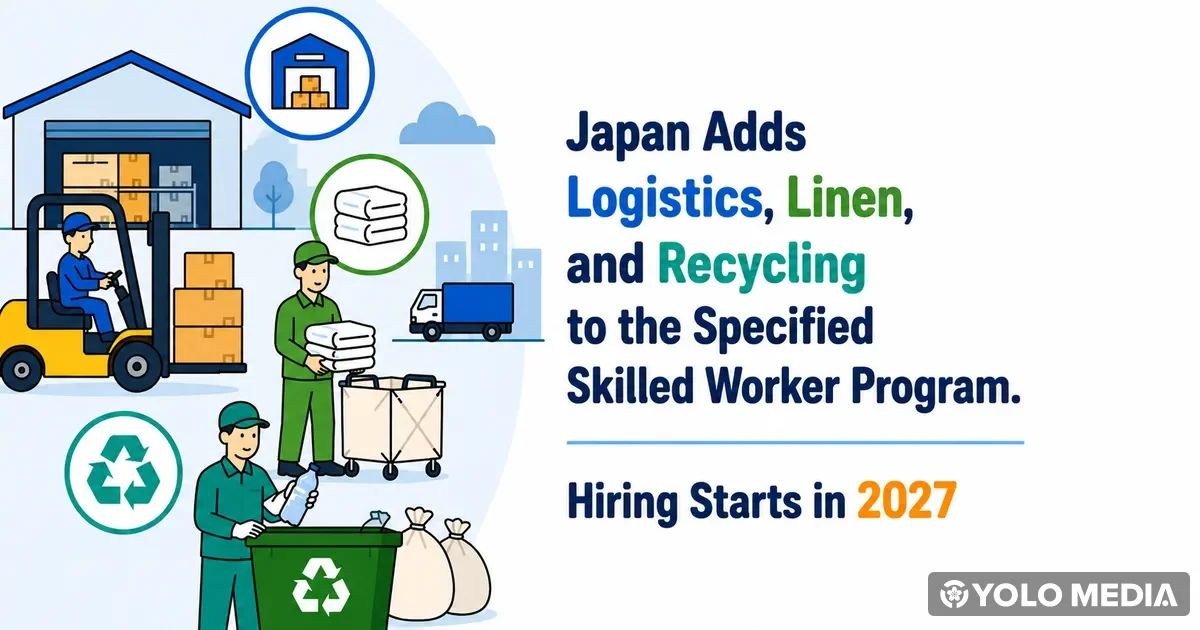
On January 23, 2026, the Japanese cabinet approved a combined cap of 1.23 million for Specified Skilled Workers (tokutei gino) and Ikusei Shuro (ikusei shuro, the new system replacing the Technical Intern Training Program). The total now covers 19 fields, with logistics warehousing, linen supply, and resource recycling newly added.
This article breaks down the numbers by field, explains the new Ikusei Shuro system, and covers what this means for your job.
What You’ll Learn
- The Specified Skilled Worker (SSW) cap is 805,700; Ikusei Shuro is 426,200 — totaling 1.23 million
- Three new fields added: logistics warehousing, linen supply, and resource recycling
- Food service has hit its cap and suspended new applications since April 2026
- The Ikusei Shuro system launches April 1, 2027, with limited job-switching allowed
Disclaimer: This article is based on announcements by the Immigration Services Agency of Japan. Information is current as of May 2026.
The 1.23 Million Breakdown by Field
The intake projections set by the January 2026 cabinet decision cover a five-year period through the end of FY2028.
Specified Skilled Worker (SSW) 1: 805,700 across 19 fields
| Field | Projected Intake |
|---|---|
| Industrial products manufacturing | 173,300 |
| Food & beverage manufacturing | 139,000 |
| Nursing care | 135,000 |
| Construction | 80,000 |
| Agriculture | 78,000 |
| Food service | 53,000 |
| Building cleaning | 37,000 |
| Shipbuilding & marine | 36,000 |
| Motor vehicle transport | 24,500 |
| Accommodation | 23,000 |
| Fisheries | 17,000 |
| Automobile maintenance | 10,000 |
| Aviation | 7,400 |
| Timber industry | 5,000 |
| Railway | 3,800 |
| Forestry | 1,000 |
| Logistics warehousing | Newly added |
| Linen supply | Newly added |
| Resource recycling | Newly added |
Ikusei Shuro: 426,200 across 17 fields
Ikusei Shuro covers 17 of the 19 SSW fields, excluding motor vehicle transport and aviation.
(Source: Immigration Services Agency — Field-specific operational policies)
1.23 million is not the number of new arrivals. It’s the cumulative cap on residents over five years. As of the end of 2025, roughly 390,000 people already hold SSW status.
(Source: Immigration Services Agency — SSW resident statistics)
The 3 Newly Added Fields
The January cabinet decision added three fields to the SSW program.
Logistics warehousing: Receiving, sorting, inspection, inventory management, and operating logistics equipment. The rapid growth of e-commerce has made warehouse staffing shortages critical.
Linen supply: Collecting, washing, finishing, and delivering sheets, towels, and other linens used by hotels and hospitals. Rising inbound tourism has made hiring urgent.
Resource recycling: Intermediate processing of general and industrial waste, including sorting, crushing, and compressing.
Skills assessments for all three fields are still being developed, so actual employment is expected to begin around 2027.
(Source: Immigration Services Agency — Details on new field additions)
Food Service Has Suspended New Applications
Meanwhile, food service has suspended new SSW 1 applications since April 13, 2026. The reason: the field’s projected intake cap of 53,000 has been reached.
If you already hold SSW status in food service, your residence status renewals are not affected. However, if you were planning to get SSW status in food service, you’ll need to wait until the cap is reviewed.
If you were aiming for SSW status in food service, consider switching to food & beverage manufacturing or another field.
What Is Ikusei Shuro? Launching April 2027
Ikusei Shuro is the new residence status replacing the Technical Intern Training Program (gino jisshu).
| Technical Intern Training (current) | Ikusei Shuro (from April 2027) | |
|---|---|---|
| Purpose | “International contribution (skills transfer)” on paper | Directly states “workforce development and recruitment” |
| Duration | Up to 5 years | Up to 3 years |
| Job switching | Not allowed in principle | Allowed with conditions |
| Career path | Return home by design | Opens path to SSW 1 → SSW 2 → permanent residency |
To switch jobs under Ikusei Shuro, you must have worked at the same company for at least one year, passed the basic-level skills test, and have Japanese language ability of N5 or above, among other requirements.
(Source: Immigration Services Agency — Ikusei Shuro system overview)
The system creates a clear career path: Ikusei Shuro → SSW 1 → SSW 2. For those planning to work in Japan long-term, this opens up more options than before.
FAQ
Q. When does the Ikusei Shuro system start?
A. It is scheduled to launch on April 1, 2027. The current Technical Intern Training Program continues until then.
Q. Does this affect people already working under SSW?
A. Your current residence status is not directly affected. However, pay attention to the new fields you might transfer to and any field-specific caps.
Q. What happens when the 1.23 million cap is reached?
A. New applications get suspended, as happened with food service. Each field has its own cap, so check the status for your specific field.
Q. Can you switch jobs under Ikusei Shuro?
A. Yes, within the same field, if you meet the conditions: at least one year at the same employer, passing the basic skills test, and Japanese ability at N5 or above.
For more on work-related residence statuses, see our employment contracts and labor law guide. If you’re considering a career change, check out the top 10 in-demand jobs in Japan.
Key Takeaways
- The combined SSW and Ikusei Shuro cap is 1.23 million across 19 fields
- Logistics warehousing, linen supply, and resource recycling are newly added (actual intake expected from around 2027)
- Food service has suspended new applications after hitting its cap — consider other fields
- Ikusei Shuro launches April 2027 with conditional job switching
- A long-term career path from Ikusei Shuro → SSW 1 → SSW 2 → permanent residency is now in place