Introduction
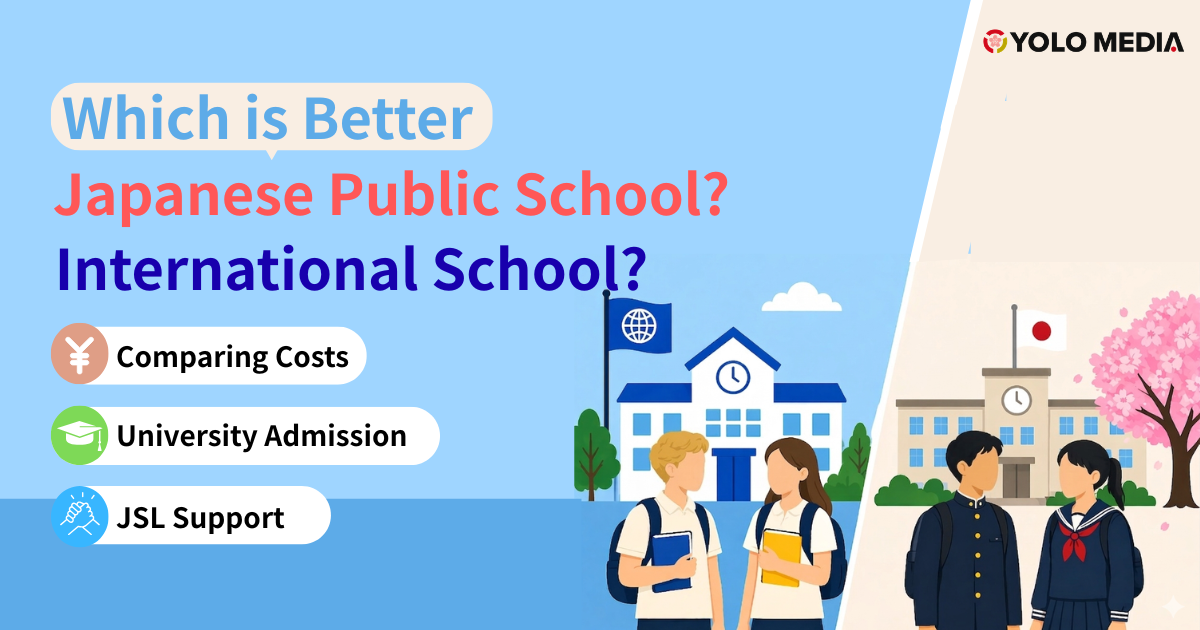
For international families raising children in Japan, choosing the right school is a major decision. A tuition-free public school, or an international school with a globally recognized curriculum? The right answer depends on your planned length of stay, budget, vision for university admission, and your child’s age. If you have preschool-age children, start by reviewing the differences between hoikuen, yochien, and kodomo-en before considering elementary options.
This guide compares three options (public schools, international schools (hereafter “international schools” or “IS”), and bilingual schools) across three axes—cost, university admission qualification, and JSL (Japanese language) support—and organizes the optimal choice across 6 family types including expats, international marriages, and permanent residents.
Disclaimer: This article is for general informational purposes and does not constitute professional advice on education or career paths. Please verify the latest systems, costs, and admission requirements with each school, board of education (kyoiku iinkai), or MEXT.


TL;DR
- International schools (¥1.5M–¥4.5M/year) excel at maintaining the native language and offer inquiry-based learning directly linked to overseas university admissions
- Japanese public schools are nearly free, with overwhelming advantages in early Japanese acquisition and integration into the local community
- Families staying under 3 years often choose international schools; those staying 5+ years or aiming for permanent residency often choose public schools
- A “third option” — bilingual schools at ¥700,000–¥1.5M/year — is growing in popularity
- Public school JSL (Japanese as a Second Language) support varies widely by municipality; consulting your local board of education before enrollment is critical
Comparing the Three Options
| School Type | Estimated Cost | Ease of Enrollment | Impact on Japanese University Admission |
|---|---|---|---|
| Public Elementary/Junior High | Tuition and textbooks free; only school lunch (¥3,000–5,000/month) | School zone determined by address; non-Japanese children can also enroll by application to the municipality | Naturally meets admission requirements |
| International School | ¥1.5M–¥4.5M/year (entrance fees and facility fees additional) | Entrance exam and parent interview required | If not internationally accredited (WASC, CIS, IB, etc.), additional procedures are needed for application qualification |
| Bilingual School | ¥700,000–¥1.5M/year typical | Some require entrance exams or interviews | No issue if accredited as a Japanese formal school |
Children of non-Japanese nationality are exempt from Japan’s compulsory education requirement; not attending public school does not in itself create a legal problem (Reference: MEXT "Procedures for Enrollment of Foreign Children"). The critical factors are the following three practical issues.
Three Practical Issues that Matter Most
Issue 1: Public school JSL support varies widely by municipality
The structure of “JSL teacher allocations” and “Japanese language instruction classrooms” varies by school. Municipalities with large international populations (Yokohama, Osaka, Shinjuku, Minato, etc.) offer robust support, but in some rural areas, support staff visit only 1–2 times per week. Before enrollment, ask the board of education: “Does the school have JSL teacher allocation? How many hours per week of support is available?” According to MEXT’s FY2023 (Reiwa 5) survey, 69,123 non-Japanese children nationwide require Japanese language instruction (Reference: MEXT "Survey on the Acceptance of Students Requiring Japanese Language Instruction").
Issue 2: The Japanese university admission qualification barrier
For an international school graduate to apply to a Japanese university, one of the following is required:
- Graduation from an international school accredited by WASC, CIS, ACSI, or similar (treated as MEXT-designated foreign schools)
- Acquisition of the International Baccalaureate (IB) Diploma
- Passing the Certificate for Students Achieving the Proficiency Level of Upper Secondary School Graduates (Koutou Gakkou Sotsugyou Teido Nintei Shiken)
If you want to keep Japanese universities as an option, verify before enrollment whether the school is “MEXT-designated” or “IB-accredited” (Reference: MEXT "University Admission Qualifications").
Issue 3: Flexibility when transferring schools
Public → International transfers are possible at the age-appropriate grade if seats are available. Conversely, International → Public transfers presume age-appropriate grade placement and may require brief interviews or academic checks; if Japanese is not yet conversational, a combined start with support classes or Japanese language instruction classrooms may be needed. Families considering “we might switch back to public someday” should maintain reading and writing of both the native language and Japanese at home — this becomes a valuable safety net at transfer time.
Why International Schools Are Expensive, the Appeal of Public Schools, and the Middle Ground of Bilingual Schools
International schools are expensive because they are not part of Japan’s officially recognized formal school system (elementary, junior high, and high schools defined under Article 1 of the School Education Act, commonly called Ichijo-ko); they are classified as miscellaneous schools (kakushu gakko). Schools outside the Ichijo-ko system do not receive private school subsidies (government grants for schools), so all operating costs must be covered by tuition (Reference: MEXT "Tuition Support Fund System"). On top of tuition, entrance fees, facility fees, and donations significantly inflate the total cost. For impact on overall household finances, see the Cost of Living in Japan Guide.
Public schools have free tuition and textbooks, and through uniquely Japanese customs like kyushoku-touban (lunch duty rotation) and souji-no-jikan (cleaning time), children naturally integrate into the local community. Even children who initially struggle typically pick up everyday conversation in 3–6 months. For balancing Japanese and the native language at home, see the Bilingual Parenting Guide.
Bilingual schools base their curriculum on Japan’s national learning guidelines while delivering more than half of classes in English. If accredited as a Japanese formal school (Ichijo-ko), they naturally secure Japanese university admission qualification.
Family-Type Decision Guide at a Glance
| Family Type | First Choice | Key Points |
|---|---|---|
| Expats (1–3 years) | International school (preferably IB) | Prioritize maintaining native language and English. Confirm company education subsidies |
| Expats (5+ years) | Bilingual school | Preserve flexibility to transfer to public school later |
| International Marriage (Permanent Residency) | Public school + native language at home | Verify in-zone JSL support. Reinforce native language with weekend study |
| Permanent Resident / Highly Skilled Professional | Public or formal-school-accredited bilingual school | Balance admission qualification with English environment |
| Preschool-age Arrival in Japan | Public school (when in doubt) | Peak language absorption period; community integration develops naturally |
| Arriving age 10+ | International or bilingual school | Public school carries high psychological burden |
Public School Enrollment Process
Three steps: “Resident registration → Enrollment guidance from the board of education → Interview and preparation at the designated school.”
| Step | Content | What to Bring / Confirm |
|---|---|---|
| 1. Municipal Office | Tell the board of education or school affairs division: “I want to enroll my child in public elementary/junior high school” | Residence Card (Zairyu Card) for all family members, certificate of residence (juminhyo), passport, school transcript from your home country, mother-and-child health handbook (boshi techo) |
| 2. Confirm JSL Support | Specifically inquire about “JSL teacher allocation, pull-out instruction, and interpreter volunteer availability” | Also confirm whether there is an international classroom (kokusai kyoshitsu) within the school zone |
| 3. Interview at Designated School | Meet with the principal and prospective homeroom teacher; confirm enrollment supplies | Allergy/religious accommodations for school lunch; documented list of designated supplies (uwabaki indoor shoes, PE uniforms, etc.) |
Public schools follow the “designated school by address” principle. Changing the designated school requires application and may not be approved, so confirm the JSL support of in-zone schools at the property-selection stage before moving for the most reliable approach.
For the annual schedule of school events, see the Japanese School Events Year Guide.
FAQ
Q: What is the major difference between IB-accredited and other international schools?
A: The biggest difference is “qualification to apply to Japanese universities.” IB Diploma holders can apply to most Japanese universities through IB admissions. Graduates from international schools that are neither IB-accredited nor MEXT-designated do not have a recognized Japanese high school graduation qualification, so they additionally need to pass the “Certificate for Students Achieving the Proficiency Level of Upper Secondary School Graduates.” If overseas study is your only path, the impact is minimal; but if you want to keep Japanese universities as an option, always verify whether the school is accredited before enrolling.
Q: Do public schools offer English-maintenance programs for native English-speaking children?
A: Some municipalities operate English immersion classes or English supplementary lessons, but these are rare nationwide. Public school English education is fundamentally premised on “English as a second language for Japanese students.” To maintain native-level English, many international families combine Saturday schools (English supplementary schools), private online schools, and home study.
Q: Can my child enter a public school mid-semester?
A: Yes. The Japanese school year starts in April, but public schools accept transfers mid-year due to family relocations or circumstances. Family support at home is necessary to help catch up on the learning gap from the curriculum’s progress.
Q: My child is at an international elementary school — can they continue to a Japanese public junior high school?
A: If the international school they attended is neither MEXT-designated nor IB-accredited, completion of compulsory education at the time of elementary school graduation may not be recognized, making transfer procedures more complex. Always consult the local board of education in advance for this route.
Q: Are there school fee subsidies available to international families?
A: Public elementary and junior high schools have free tuition, so additional subsidies are typically unnecessary. For families in financial difficulty, the Shugaku-Enjo (school enrollment assistance) program is available; if income criteria are met, non-Japanese households are also eligible. International schools are not generally subsidized by the national government, but for expatriate families, be sure to confirm your company’s overseas-assignee education benefits through HR. It is not unusual for companies to cover ¥1M–¥3M per year of tuition.
Final Takeaways
- ✅ Decide based on three axes — planned length of stay, budget, and educational pathway — with a long-term perspective
- ✅ Move beyond simple “global vs. local” framing; identify the environment that fits your child’s personality through actual school visits
- ✅ A school transfer is realistic if circumstances change. Plan with a 3–5-year review cycle in mind
School choice is shaped by the quality of information you gather. Start by confirming JSL support with your local board of education and visit 2–3 candidate schools. Speaking directly with teachers and JSL coordinators, and experiencing the atmosphere of current students, leads to a decision both your child and family can feel confident about. For other topics on raising children in Japan, the Family category on YOLO MEDIA is updated regularly — use it as a resource.
![Father’s Day Gift Budget in Japan: The Right Gift for Your Partner’s Dad [2026]](https://media.yolo-japan.com/wp-content/uploads/2026/06/fathers-day-japan-2026-en-768x432.webp)