Introduction
The process of finding a daycare spot for your child in Japan has its own dedicated term — “hokatsu” — and it is widely talked about as a project on par with job hunting. The volume of paperwork, the point-based ranking system, and the local rules that vary by municipality all combine to make it hard to know where to start. For international families, residence card and visa-related considerations add another layer.
This article walks through the parts of applying to a licensed hoikuen that international families most often stumble on: the annual hokatsu schedule, the required documents checklist, how the shisuu (point) system works, visa-specific considerations, and backup strategies for waiting lists. If you are still deciding between hoikuen, yochien, and nintei kodomo-en, our Guide to the Three Childcare Options is the right place to start.
Disclaimer: This article is for general informational purposes only and does not constitute professional advice. Always verify the latest information with your local municipality and individual facilities.


TL;DR
- Licensed daycare applications for April enrollment close in October–November of the prior year. Start research as early as April–June
- Admission is not first-come, first-served — it’s based on a *point system (shisuu)* combining base points and adjustment points
- Core required documents are the residence card copy, certificate of employment, and tax certificate. Allow 2–3 weeks to gather everything
- Parents on a “Dependent (Kazoku Taizai)” visa practically need Permission to Engage in Activity Other Than Permitted (max 28 hours/week) before applying
- Backup options for waiting lists include certified daycares (Tokyo’s Ninsho), employer-led daycares, and unlicensed facilities. Time at an unlicensed facility often boosts your points the following year
- Starting during pregnancy gives you an edge, especially in competitive urban districts
1. The Hokatsu Annual Schedule
Licensed hoikuen run their main intake every April, with applications collected in October–November of the prior year. Japanese municipal offices are strict about deadlines — missing by a single day usually means rejection — so working backwards from those dates is essential.
| Timing | What to do |
|---|---|
| April–June (prior year) | Visit the municipal childcare division. Pick up the latest application booklet and point chart |
| July–August (prior year) | List 5–10 candidate facilities and book tours |
| September (prior year) | Start touring (popular facilities fill up by mid-summer) |
| October–November (prior year) | Prepare and submit application documents. Request the employment certificate from your employer with plenty of lead time |
| January–February (current year) | First-round results announced. If accepted, attend health checks and orientations |
| February–March (current year) | Second-round applications (if you missed the first), and applications to unlicensed facilities |
| April (current year) | Enrollment and narashi hoiku (gradual adjustment period of shorter hours for the first 1–2 weeks) |
During the narashi hoiku period, you cannot return to full-time work yet. Negotiate “shorter hours through late April” with your employer in advance to avoid scrambling.
Mid-year enrollment (May onward) is technically possible, but only if a spot opens up — so for your first year, target April enrollment.
Why starting during pregnancy gives you an edge
In competitive districts (areas with high waiting lists), many families begin facility tours during pregnancy. Some go further and prioritize “ease of daycare entry” when picking which neighborhood to live in. Even during pregnancy, dropping by your ward’s childcare division to grab the latest point chart and current capacity numbers gets your search off the ground early. See our Complete Guide to Giving Birth in Japan for parallel preparation steps.
2. Required Documents Checklist
Allow 2–3 weeks to gather everything. Start at least one month before the application deadline.
Documents required from everyone
- Application form (municipality’s standard format)
- Statement of “need for childcare” reason
- Certificate of employment (filled in by employer; for self-employed, a copy of the tax return)
- Residence card copies (both sides, for both parents and the child)
- Municipal tax certificate or tax notice (proves prior year’s income)
- My Number identification document
- Health certificate (if required by the facility)
Notes on the residence card
- Both front and back sides must be copied. The back contains address change history and the activity permission stamp — both are reviewed
- If your card is within six months of expiry, renew before applying
- For Dependent visa holders applying based on part-time employment, the activity permission stamp on the back is mandatory (more on this below)
Getting the certificate of employment
- If the municipality has a designated form, hand it to your employer to fill in
- Issuance typically takes 1–2 weeks — request it at least one month before the application deadline
- If you are planning to leave or change jobs, ask the municipality whether the current employer’s certificate or the new employer’s offer letter is required
- Self-employed and freelance applicants substitute with a tax return copy plus a service contract or business registration
Getting the tax certificate
- Issued at the city office counter or via convenience store kiosks (with a My Number card)
- Issued by the municipality where you were registered as of January 1 of the prior year — recent movers may need to request from a previous address
- Some municipalities require multiple years of certificates
3. Shisuu: The Point System That Decides Admission
Licensed daycares are not first-come, first-served — a major difference from daycare systems in most other countries (where availability is usually decided by who applies first, lotteries, or simply by paying). Japan operates on the principle that families with the greatest need for childcare should get priority, so each family’s situation is converted into a numerical score called “shisuu.” Admission goes to the highest-scoring families until capacity fills.
The score has two components:
- Base score: Determined by parents’ employment status. Both parents working full-time scores the maximum; part-time or shorter hours scores lower
- Adjustment score: Additions and deductions based on family circumstances. Single-parent households and having an older sibling already enrolled add points; some municipalities deduct points if grandparents live nearby
Tie-breaking rules and the precise point values vary by municipality, so moving across city lines changes the rules of the game. “Last month our score was enough for the top choice in Ward A, but in Ward B it wasn’t” is a common story.
Major scoring factors
| Factor | Notes |
|---|---|
| Both parents working full-time (40+ hrs/week) | The standard high-point pattern |
| Single-parent household | Significant boost in most municipalities |
| Older sibling already enrolled | Same-facility priority adds points |
| Already using paid unlicensed daycare for 1+ year | Counted as “hokatsu effort” in many municipalities |
| No co-resident grandparents / caring for elderly | Lack of in-home support adds points |
A point boost specific to international families: documenting the absence of grandparents
For international families, explicitly stating in the application form or attached statement that “relying on grandparents or relatives in our home country is physically impossible” is treated as a relevant adjustment factor by many municipalities. The key is to get this on paper, not just say it verbally at the counter. Use the comment section of the form or attach a separate statement so it’s recorded for the selection committee.
How to read a point chart: the Setagaya (Tokyo) example
In Tokyo’s Setagaya ward, both parents working full-time (40+ hrs/week, 20+ days/month) earn 20 base points each — totaling 40 points as the standard starting line for dual-income families. Adjustment points stack on top: +5 for single-parent households, +3 for six or more months of paid unlicensed daycare history, +5 for households on public assistance, and so on. The high 40s are typical for full-time dual-income families, and from 50 points up, ties are broken by additional factors like sibling enrollment and lower household income.
(Note: Point charts vary by municipality — always pick up the latest version at your local childcare division.)
4. Visa-Specific Application Notes
The application procedure itself is the same across visa statuses, but supporting documents and point implications shift depending on which status you hold. Common cases:
Dependent (Kazoku Taizai) visa + Activity Permission
If a parent on a Dependent visa works part-time without the Permission to Engage in Activity Other Than Permitted stamped on the back of their residence card, the municipality will not recognize the employment claim and the application can be rejected. The permission caps work at 28 hours per week — to exceed that, you’ll need to switch to a different status (such as “Engineer/Specialist in Humanities/International Services”).
(Reference: Immigration Services Agency, "Activities Permission for Dependent Visa Holders")
The practical issue is keeping monthly working hours above the municipal floor. Most municipalities set the “need for childcare” floor at 48–64 hours per month (roughly 12–16 hours per week), so design shifts to fit between the activity permission ceiling (28 hrs/week) and the municipal floor (16 hrs/week).
Student
A “certificate of enrollment” from your university or vocational school plus class hours establishes “need for childcare” without employment. Some municipalities treat schooling as equivalent to full-time work for points; others apply a deduction. Confirm with the childcare division before applying.
Self-employed / freelance
Substitute with a copy of your tax return plus a service contract or business registration. If you are not incorporated and your income fluctuates, this can lower your points — gather evidence of stable, ongoing business (multiple months of receipts, ongoing contracts) to mitigate.
Expat employee + spouse on Dependent visa
The expat’s full-time employment alone usually clears the base score, so a non-working spouse still qualifies. However, in dense urban wards where competition is fierce, “both parents working full-time” scores higher — many spouses obtain activity permission and take 20–28 hour part-time roles to add points.
International marriage with a Japanese spouse working full-time
Treated identically to Japanese applicants — the foreign parent’s visa does not factor into the assessment. A residence card copy is still required, but only the Japanese spouse’s employment is evaluated.
5. Backup Strategies for Waiting Lists
The infamous “taiki jido” (waiting list children) issue describes children who meet eligibility but are stuck waiting due to capacity overflow. As of April 2025, the nationwide count fell to a historic low of 2,254, but parts of central Tokyo and Osaka still see fierce competition.
(Reference: Children and Families Agency, "Daycare Capacity Status Summary (April 2025)")
To hedge against rejection, run the following backup options in parallel:
| Type | Monthly Cost | Notes |
|---|---|---|
| Tokyo Certified Daycare (Ninsho Hoikusho) | ¥50,000–¥80,000 | Accepts from age 0; usually first-come or interview-based |
| Unlicensed Daycare (general) | ¥60,000–¥100,000 | Direct contract. Immediate enrollment if space exists |
| Employer-led Daycare | ¥30,000–¥70,000 | Slots tied to partner employers, with some community slots |
| International Preschool | ¥80,000–¥200,000 | English environment. May qualify for subsidy with “need for childcare” certification |
These are direct-contract facilities — apply individually rather than through the municipal system. A subset of unlicensed facilities meets standardized supervision criteria and is published as such by the municipality, so ask the childcare division for the list.
(Reference: Children and Families Agency, "Unlicensed Childcare Facilities")
Using unlicensed daycare as long-term insurance
Time spent at a paid unlicensed daycare often earns adjustment points the following year when reapplying for a licensed spot. A common strategy: spend year one at an unlicensed facility, build the score, and transition to a licensed daycare in year two. You secure a spot now and improve your odds for next time.
6. Strategy: Combining Licensed and Unlicensed Applications
Three approaches reduce the risk of being shut out:
- Apply to licensed and unlicensed in parallel — secures a spot from April even if your licensed application is rejected
- List up to 10 facility choices — “Stick to my top 3” loses to “list everything within commuting range” in point-based competition. Some municipalities also break ties using preference order
- Tour facilities before applying — learning each facility’s policies and commute logistics in advance prevents post-acceptance regrets
7. What to Check During Facility Tours
A facility’s atmosphere doesn’t come through in brochures. Confirm the following on tour to avoid mismatches after enrollment:
- Commute logistics: bicycle/stroller accessibility, distance from the station, rainy-day routes
- Meal policy: allergy accommodations, religious accommodations (no pork, no beef), vegetarian flexibility
- Multilingual support: translated newsletters, emergency communication channels
- Extended care limits: how late they accept children, whether dinner is provided, fees
- Parent-participation events: how many weekday absences per year (sports day, recitals, parent-teacher meetings)
- Diaper / towel policy: some facilities require carrying used items home, others dispose on-site
For international parents, the reality of multilingual support deserves special attention. Ask whether the facility uses a communication app (Codomon, Lookmee, etc.), whether emergency phone calls can be handled in another language, and whether interpreters are arranged for parent meetings — these answers tell you what your post-enrollment workload will look like.
FAQ
Q: Should I really start hokatsu while I’m still pregnant?
A: In most cases, yes — especially in competitive districts. Many local families begin facility tours mid-pregnancy, and some go further by analyzing district-level “daycare entry probability” before signing a lease. Use pregnancy as parallel time alongside our Giving Birth in Japan Guide to drop by your ward’s childcare division early.
Q: If I move across municipal lines, do my points reset?
A: Mostly yes. Each municipality has its own point chart, so a score that wins your top choice in Ward A may fall short in Ward B. If you’re considering a move, narrow the candidate locations early and ask the childcare divisions in both wards: “If our household applied today, where would we land in the rankings?”
Q: What happens if I quit or change jobs after enrolling?
A: Submit an “employment status change notification” to the municipality — generally you can stay enrolled. After resignation, you usually need to find new employment within 2–3 months; exceeding that may force withdrawal. Your hokatsu score is also recalculated the following year, so plan job changes carefully.
Q: Is it common for siblings to attend different facilities?
A: In high-waiting-list areas, unfortunately yes. Same-facility preference for older siblings adds points, but if the older child’s class is at capacity, siblings end up split. Some families specifically choose municipalities with explicit “sibling co-enrollment priority” rules (Setagaya, Minato in Tokyo) to avoid this.
Q: What is narashi hoiku (gradual adjustment) and how long does it last?
A: A 1–3 week period right after enrollment where the child’s hours are gradually extended. Day one might be 1–2 hours, then expanding through lunch, eventually reaching full hours. Roughly 3 weeks for infants and 1 week for ages 3+. Tell your employer in advance: “I need shorter hours through late April.”
Q: Can I request interpreter support during the application process?
A: Yes. Most municipalities offer “volunteer interpreter dispatch” or “multilingual consultation desks” for international residents, and translation devices like Pocketalk are increasingly common at counter desks. Reservations may be required — call the childcare division 1–2 weeks before your application visit to lock in support.
Q: Is it easier to get into the 0-year-old class or the 1-year-old class?
A: Generally the 0-year-old class is easier. The 0-year-old class opens with full new capacity each year, while the 1-year-old class fills mostly with children promoting from the 0-year-old class — leaving very few new slots. This is why so many families cut parental leave short to enter at age 0 in April. Children born in late autumn or winter who miss the 0-year April intake face a much tougher 1-year-old round, so confirm the facility’s minimum age (most accept from 57 days old) and move early.
Key Takeaways
- ✅ Visit the municipal childcare division in person first: The latest local point chart and capacity figures beat any online summary
- ✅ Get residence card and employment proof ready six months out: Visa expiry, activity permission for Dependent visas, and income certificates — list and gather
- ✅ Move along the hokatsu calendar: Tour in summer, paperwork in fall, results in winter. Working backwards reduces last-minute panic
- ✅ Hedge with unlicensed applications: Secures a spot if the licensed application falls through, and builds adjustment points for next year
- ✅ In point competition, “list everything” wins: Putting down up to 10 choices beats sticking to a short list
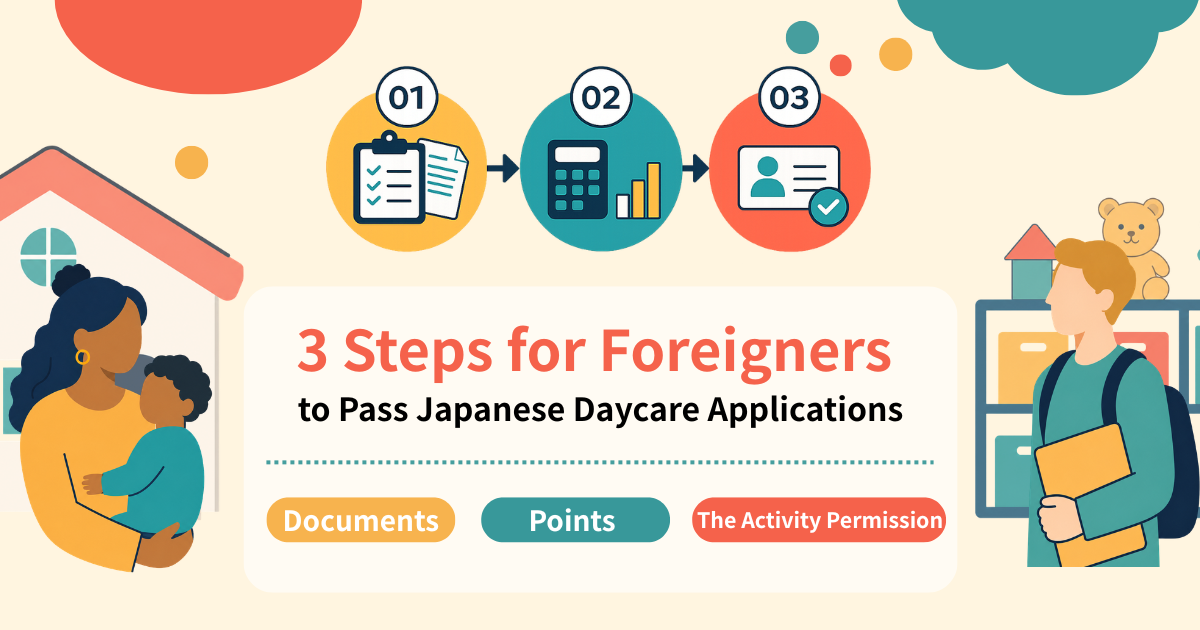
Hokatsu is far from easy, but if you nail down the three pillars — required documents, the point system, and visa status — international families can absolutely navigate the path to a licensed daycare spot. If you want to revisit how hoikuen, yochien, and nintei kodomo-en differ, see our Guide to the Three Childcare Options, and if you are starting from pregnancy, our Complete Guide to Giving Birth in Japan is a useful companion.
![Father’s Day Gift Budget in Japan: The Right Gift for Your Partner’s Dad [2026]](https://media.yolo-japan.com/wp-content/uploads/2026/06/fathers-day-japan-2026-en-768x432.webp)