Last Updated: May 6, 2026
Reading Time: 9 min read
Disclaimer: This article is for general informational purposes only and does not constitute professional advice on childcare or education. Always verify the latest information with your local municipality and individual facilities.
Introduction
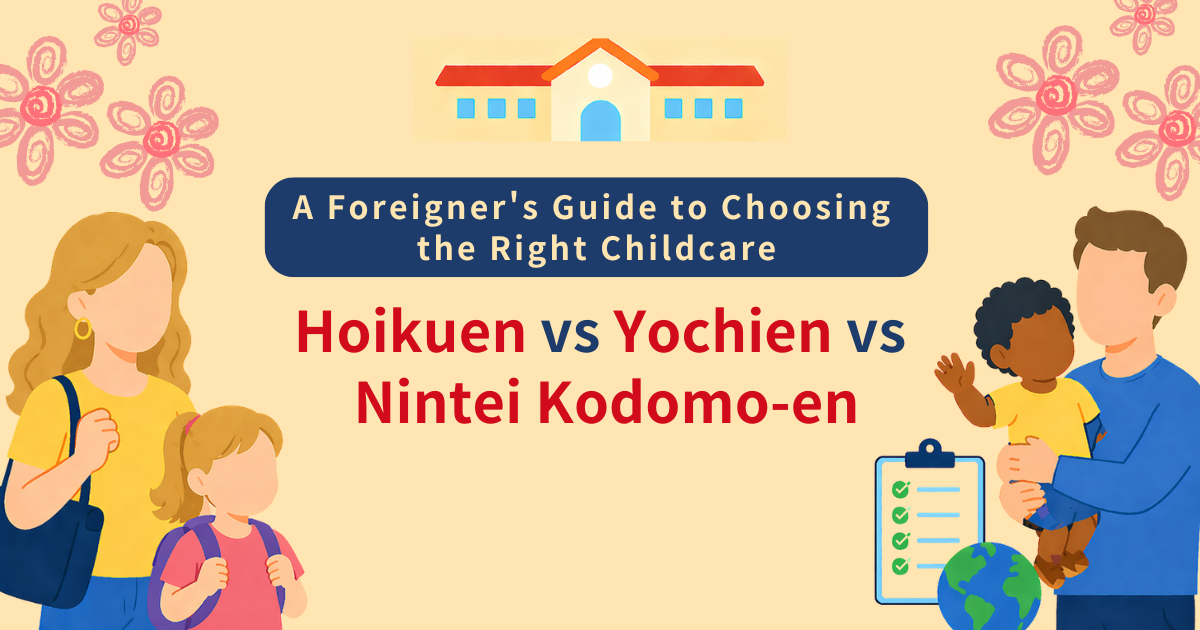
For international families starting family life in Japan, the first big decision is choosing where to entrust your child during the day. Japan offers three distinct frameworks — hoikuen (daycare), yochien (kindergarten), and nintei kodomo-en (certified combined facility) — each governed by a different ministry, with different age ranges and parental employment requirements.
This guide focuses on what makes the three facilities different — their roles, the free childcare subsidy, visa-based eligibility differences, and the reality of English-language support — so you can make an informed choice for your family. If you are still in the prenatal stage, our Complete Guide to Giving Birth in Japan is a useful companion read.

TL;DR
- Hoikuen is a welfare-style daycare under the Children and Families Agency. Ages 0–5, employment required, longer hours
- Yochien is an education-focused kindergarten under the Ministry of Education. Ages 3–5, no employment requirement, shorter hours
- Nintei Kodomo-en is a hybrid of the two. Children stay enrolled even if parents’ work status changes
- The free childcare subsidy waives tuition for ages 3–5 (all households) and 0–2 (tax-exempt households only)
- No facility can refuse admission based on nationality. However, the level of English-language support varies dramatically by facility
- Visa status affects eligibility: parents on a “Dependent” visa generally need Permission to Engage in Activity Other Than Permitted (shikaku-gai katsudou kyoka) before they can apply for hoikuen
1. The Three Childcare Options Explained
Let’s start by mapping out what each facility actually does.
| Aspect | Hoikuen (Daycare) | Yochien (Kindergarten) | Nintei Kodomo-en |
|---|---|---|---|
| Primary Purpose | Care for working families | Early childhood education | Hybrid of care and education |
| Age Range | 0–5 | 3–5 | 0–5 |
| Standard Hours | 7:30–18:30 (up to 11 hrs) | 9:00–14:00 (4 hrs base) | Varies by certification type |
| Parental Employment | Required (proof of work) | Not required | Depends on certification type |
| Jurisdiction | Children and Families Agency | Ministry of Education (MEXT) | Cabinet Office |
| Application Channel | Municipal childcare division | Direct to facility | Type 1 → facility, Types 2/3 → municipality |
Hoikuen (保育所): Daycare for Working Households
A welfare facility operating under the Child Welfare Act. Children are accepted from infancy, and daily routines naturally weave together meals, naps, and the building of basic life habits — making hoikuen the most practical option for dual-income households. The official name is hoikusho, but everyone calls them hoikuen in conversation.
(Reference: Children and Families Agency, "Operations of Childcare Centers")
Yochien (幼稚園): Kindergartens for Early Education
An educational facility under the School Education Act, governed by MEXT. Stay-at-home families can use yochien, and many facilities run distinctive curricula featuring music, art, physical activity, and English. Standard hours run only until early afternoon, but the number of yochien offering “extended care” (azukari hoiku) until evening has grown rapidly to accommodate working families.
(Reference: MEXT, "About Yochien")
Nintei Kodomo-en (認定こども園): The Best of Both Worlds
A unified framework that combines daycare and kindergarten functions. The biggest advantage: your child does not need to switch facilities even if your work situation changes. A family transitioning from full-time work (Type 2 certification) to stay-at-home (Type 1) can keep the child in the same facility. Kodomo-en come in four formats — yo-ho renkei-gata (integrated), yochien-gata (kindergarten-based), hoiku-jo-gata (daycare-based), and chiho sairyo-gata (locally certified) — and the atmosphere varies considerably depending on the original facility type. Ask “What was this facility originally?” during tours to gauge the culture.
(Reference: Cabinet Office, "Nintei Kodomo-en Overview")
Certification Categories (Types 1, 2, 3) Explained
When you use a kodomo-en or hoikuen, the municipality assigns your family a “certification category” based on your situation. Understanding this is foundational for comparing all three facilities.
| Type | Age | Need for Childcare | Eligible Facilities | Subsidy Coverage | Admission Difficulty |
|---|---|---|---|---|---|
| Type 1 | 3–5 | Not required | Yochien, kodomo-en (education slot) | All families free | Relatively easy |
| Type 2 | 3–5 | Required | Hoikuen, kodomo-en (childcare slot) | All families free | Generally accessible outside dense urban cores |
| Type 3 | 0–2 | Required | Hoikuen, kodomo-en (childcare slot) | Tax-exempt households only | Most competitive (especially ages 0 and 1) |
“Need for childcare” refers to circumstances that prevent parents from caring for the child at home — employment, job-hunting, education, childbirth, illness, or caregiving for another family member. For employment specifically, the national floor is 48–64 hours per month, with each municipality setting a specific number within this range. In practice, the threshold is roughly 12–16 hours per week, and most Tokyo wards set 64 hours per month (about 16 hours per week) as the lower limit. Meet this and you qualify for Type 2 or 3; fall below and you are treated as Type 1 (no childcare need).
Parents on a “Dependent” (Kazoku Taizai) visa are limited to 28 hours per week under their Permission to Engage in Activity Other Than Permitted. Since this exceeds the certification floor (16 hrs/week), obtaining the permission and working 16–28 hours per week meets the Type 2/3 requirement. If you are considering a short-shift part-time job, plan your schedule so monthly hours do not slip below the municipal floor.
The practical differences between Type 2 and Type 3 come down to three points. First, subsidy coverage: Type 2 (ages 3–5) is fully free for all families, while Type 3 (ages 0–2) is free only for tax-exempt households — taxable households pay tens of thousands of yen up to roughly ¥80,000 per month based on income. Second, staffing ratios: Type 3 mandates one caregiver per 3 infants and one per 6 toddlers (1–2 yrs), versus Type 2’s roughly one per 15–20 (age 3) and 1 per 25–30 (ages 4–5), giving Type 3 children significantly more individualized care. Third, admission difficulty: Type 3 slots are limited and demand is concentrated, making age 0 and age 1 slots in central Tokyo the toughest in the system — even families with strong scores can miss out.
2. Money: The Free Early Childhood Education Subsidy (Mushouka)
Japan has a reputation for being expensive, but a robust subsidy applies equally to international households. The “Free Early Childhood Education and Care” program, launched in October 2019, covers every child enrolled in qualifying facilities as long as the family has a registered residence in Japan. Combined with the monthly Child Benefit (*Jido Teate*), the financial burden becomes much more manageable.
| Child’s Age | Eligibility | Subsidy |
|---|---|---|
| 3–5 | All families (no income cap) | Tuition free at licensed hoikuen, yochien, kodomo-en |
| 0–2 | Tax-exempt households only | Tuition free at licensed hoikuen |
| Unlicensed (3–5) | “Need for childcare” certification required | Up to ¥37,000/month subsidy |
| Unlicensed (0–2, tax-exempt) | “Need for childcare” certification required | Up to ¥42,000/month subsidy |
Only the “base tuition” is waived. Lunch fees, bus fees, uniform costs, and event fees are still out of pocket. Plan for roughly ¥5,000–¥10,000/month in additional expenses.
Unlicensed facilities and some international preschools also qualify for subsidies if you obtain a “need for childcare” certification from your municipality. The procedure typically goes through the same window as your enrollment application — at city hall, simply say, “Please process the mushouka subsidy along with my application.”
(Reference: Children and Families Agency, "Free Early Childhood Education and Care")
The new Child and Childcare Support Fund (*Kosodate Shien-kin*), starting in fiscal 2026, is collected as a surcharge on health insurance premiums. If permanent residency is on your radar, factor in how this affects your social insurance contribution record.
3. How Visa Status Affects Eligibility
None of the three facilities can refuse admission based on nationality or visa status. However, hoikuen and Type 2/3 kodomo-en require a “need for childcare” certification, and this is where visa status starts to matter.
| Visa Status | Hoikuen / Kodomo-en (Types 2/3) | Notes |
|---|---|---|
| Engineer / Specialist in Humanities / International Services / Business Manager | Eligible (proof of employment only) | Standard process. Dual-income households generally pass scoring |
| Highly Skilled Professional | Eligible | Standard process. Income proof is straightforward |
| Permanent Resident / Spouse of Japanese National | Eligible | Treated identically to Japanese nationals |
| Dependent (Kazoku Taizai) | Eligible (with conditions) | Working parents practically need Permission to Engage in Activity Other Than Permitted (max 28 hrs/week) |
| Student | Eligible | Use “certificate of enrollment” to establish “need for childcare” |
| Specified Skilled Worker | Eligible (only if family accompaniment is allowed) | Family accompaniment is permitted only for “Specified Skilled Worker (ii)” |
If a parent on a Dependent visa works part-time without the activity permission stamped on the back of their residence card, the municipality will not recognize the employment claim and the application can be rejected. To work beyond 28 hours per week, consider switching to a status like “Engineer/Specialist in Humanities/International Services.”
(Reference: Immigration Services Agency, "Activities Permission for Dependent Visa Holders")
Yochien is an “education facility” and does not test for “need for childcare,” so visa status and employment have almost no bearing on eligibility — the same applies to Type 1 kodomo-en. If you want a path that does not depend on your work situation or visa nuances, yochien and Type 1 kodomo-en are the more flexible options.
4. The Reality of English and Multilingual Support
The honest truth: parents struggle with the language barrier far more than children do.
Children Adapt to Japanese Quickly
Licensed hoikuen and standard yochien run in fully Japanese-language environments. Children who cry on day one typically begin saying “sensei” (teacher) or “o-yatsu” (snack) within 3–6 months, and within a year they are singing Japanese folk songs. As long as you maintain the home language at home and let the facility handle Japanese, your child will naturally develop bilingually. Our Bilingual Parenting Guide goes deeper on this.
Parental Communication Varies Greatly by Facility
Newsletter translations, communication notebooks, and parent meetings differ significantly from facility to facility. During tours, check three things:
- Are translated versions of parent communications available? (English newsletters are limited to certain urban facilities)
- Is there a communication app? (Apps like Codomon and Lookmee are spreading, but some facilities still use hand-written notebooks)
- How is multilingual emergency communication handled? (The “fever-call rule” of being summoned when your child hits 37.5°C is universal at hoikuen)
Most municipalities offer “volunteer interpreters for international residents” and “multilingual consultation desks,” and you can request an interpreter at the time of application. Increasingly, ward offices keep translation devices like Pocketalk on hand. Standard licensed facilities run in Japanese by default — if English-language environment is a priority, also consider the international preschools in the next section.
5. International and English-Language Preschools
If you want to maintain the English-language environment built at home, or if you prefer a soft landing into Japanese society, English-immersion preschools are a strong alternative.
These facilities cluster in central Tokyo (Minato, Shibuya), Yokohama, and Osaka’s Kita ward, with English-native or bilingual staff. Monthly tuition runs ¥80,000 to ¥150,000+, but the value of a culturally fluid environment for your child is hard to put a price on.
| Type | Monthly Cost | Notes |
|---|---|---|
| Licensed Hoikuen | ¥0–¥80,000 (income/age based) | Japanese environment. Free for ages 3–5 |
| Tokyo Certified Daycare (Ninsho Hoikusho) | ¥50,000–¥80,000 | Accepts children from age 0; usually first-come or interview-based |
| Unlicensed Daycare (general) | ¥60,000–¥100,000 | Direct contract. Immediate enrollment if space exists |
| International Preschool | ¥80,000–¥200,000 | English environment. May qualify for subsidy with “need for childcare” certification |
A common strategy: enroll in an English preschool for the first year after relocating to Japan, then transition to a Japanese hoikuen or yochien once life stabilizes. If you are also weighing elementary-school options, see our International School vs. Japanese Public School Guide.
6. Which Facility Fits Your Family? A Quick Decision Guide
Once you understand the three facility types, the next step is matching them to your family’s situation.
| Situation | Recommended Options |
|---|---|
| Ages 0–2 | Hoikuen / Kodomo-en (Type 3). Yochien is not available |
| Ages 3–5, both parents full-time | Hoikuen / Kodomo-en (Type 2). Long hours are decisive |
| Ages 3–5, one parent part-time | Hoikuen / Kodomo-en (Type 2) + yochien with extended care |
| Ages 3–5, one stay-at-home parent | Yochien / Kodomo-en (Type 1) |
| Education focus | Yochien / Kodomo-en (Type 1). Distinctive curricula are common |
| English-immersion priority | English preschool / Yochien with English curriculum |
| Work situation may change | Kodomo-en. Switching certification types lets you stay enrolled |
A note on visa status: if you are on a Dependent visa and plan to work, Permission to Engage in Activity Other Than Permitted is practically a prerequisite for hoikuen and Type 2 access. Students can establish “need for childcare” using a certificate of enrollment. Permanent residents and spouses of Japanese nationals are treated identically to Japanese applicants.
FAQ
Q: Can a facility refuse admission because of our nationality?
A: Not legally. That said, smaller private facilities sometimes hesitate over concerns like “we cannot communicate evacuation drills in Japanese during emergencies.” Visiting in person and showing willingness to communicate via translation apps usually softens this hesitation considerably.
Q: Is there a developmental difference between yochien and hoikuen children?
A: Officially the systems split “education” and “care,” but in practice the gap has narrowed sharply. Integrated kodomo-en use the same curriculum across both functions, and hoikuen increasingly fold in literacy and English activities. Developmental differences come more from individual facility programs and home life than from the facility category itself.
Q: What are the four types of kodomo-en (yo-ho renkei-gata, yochien-gata, hoiku-jo-gata, chiho sairyo-gata)?
A: They differ in originating institution. Yo-ho renkei-gata (integrated): designed from the ground up as a kodomo-en. Yochien-gata (kindergarten-based): an existing yochien with childcare added. Hoiku-jo-gata (daycare-based): an existing hoikuen with education added. Chiho sairyo-gata (locally certified): an unlicensed facility that gained kodomo-en certification. The original character of the facility tends to persist, so during tours ask which type it originated as to get a feel for the culture.
Q: What happens if our work situation changes after enrolling in a kodomo-en?
A: You change your certification category (Types 1, 2, or 3) through a paperwork update, and your child stays enrolled. Going from full-time to stay-at-home shifts you from Type 2 to Type 1, and vice versa. This certification flexibility within a single facility is the unique strength of kodomo-en. Hoikuen and yochien do not offer the same flexibility — a change in work status often forces a transfer.
Key Takeaways
- ✅ The three facilities differ in jurisdiction, age range, and employment requirements: Hoikuen is welfare-focused and requires employment, yochien is education-focused, and kodomo-en blend both.
- ✅ The free childcare subsidy applies equally to international households: Tuition for ages 3–5 is free; lunch and other fees are still out of pocket.
- ✅ Visa status changes eligibility: Working parents on Dependent visas practically need activity permission. Yochien and Type 1 kodomo-en don’t ask about employment.
- ✅ English-language support varies dramatically by facility: Standard licensed facilities run in Japanese. International preschools are a viable alternative if English environment is a priority.
- ✅ Kodomo-en is the most flexible choice: Switching between certification types lets you adapt to changes in your work situation without changing facilities.
![Father’s Day Gift Budget in Japan: The Right Gift for Your Partner’s Dad [2026]](https://media.yolo-japan.com/wp-content/uploads/2026/06/fathers-day-japan-2026-en-768x432.webp)