Last Updated: May 4, 2026
Reading Time: 8 min read
Introduction
When you find out you’re pregnant in Japan, three big walls tend to appear at once: the medical system, the language barrier, and the post-birth paperwork at city hall. With family back home harder to lean on than usual, it’s only natural to feel lost about where to start.
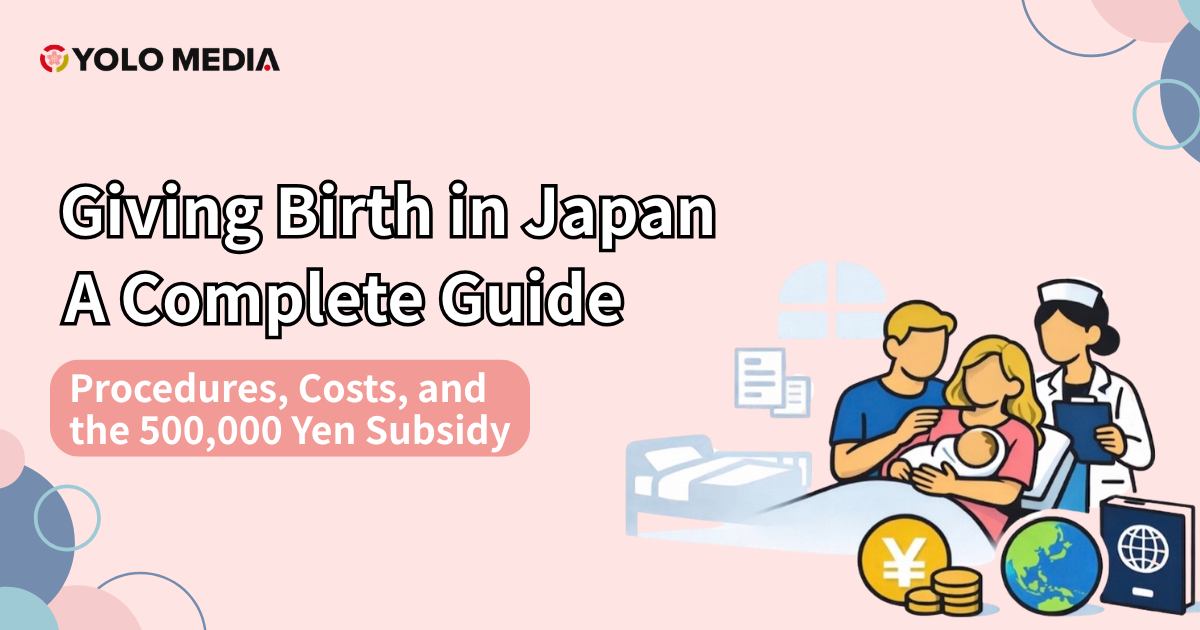
The reassuring news is this: as long as you are enrolled in Japanese health insurance, you receive the same support as Japanese citizens, regardless of nationality. This guide walks you through everything in chronological order — from finding English-speaking hospitals and claiming the Lump-Sum Birth Grant (¥500,000), to navigating city hall and immigration paperwork after birth.


TL;DR
- Pick up your Mother and Child Handbook (Boshi Kenko Techo) at city hall as soon as your pregnancy is confirmed
- Anyone enrolled in health insurance receives the Lump-Sum Birth Grant (¥500,000) regardless of nationality
- Vaginal delivery costs an average of about ¥519,000 nationwide. Use the Direct Payment System to minimize what you pay at discharge
- Submit the Birth Registration within 14 days of birth, and apply for your baby’s residence status within 30 days
- International residents have the right to take maternity leave, childcare leave, and receive related benefits
Disclaimer: This article reflects information as of May 2026. Rules and amounts can change without notice — always verify with official sources or consult a qualified professional.
What You Need to Know First
Pregnancy and childbirth in Japan revolve around two gatekeepers: health insurance and the Mother and Child Handbook. If you’re enrolled in health insurance, you’re automatically eligible as an international resident for the ¥500,000 grant, subsidized prenatal checkups, and maternity leave benefits. If you’re not, you pay 100% out-of-pocket for both checkups and delivery. Getting your insurance sorted before you start trying to conceive is the single biggest cost-saver.
Japan also follows the principle of jus sanguinis (bloodline-based citizenship), not birthright citizenship. A child born in Japan to non-Japanese parents does not automatically become a Japanese citizen. After birth, you’ll need to run two parallel processes: a passport application at your home country’s embassy and a residence status application at Japanese immigration.
(Reference: Ministry of Justice, Nationality Act, Article 2)
You’ll generally choose between three types of birthing facilities.
| Facility Type | Features | Best For |
|---|---|---|
| General Hospital (sogo byoin) | NICU on site, strong emergency response | High-risk or older-age pregnancies |
| OB/GYN Clinic (sanfujinka clinic) | Comfort-oriented, often all private rooms | Lower-risk pregnancies |
| Midwife Center (josan-in) | Midwife-led natural birth | Those wanting a low-intervention birth |
Cost Breakdown
Normal vaginal delivery in Japan is not covered by health insurance, but the Lump-Sum Birth Grant covers most of the bill.
| Item | Cost (Yen) |
|---|---|
| Vaginal Delivery (national average) | Approx. ¥519,000 |
| Vaginal Delivery (Tokyo average) | Approx. ¥648,000 |
| C-Section (after insurance) | Approx. ¥100,000–200,000 |
| Epidural (additional fee) | +¥100,000–200,000 |
(Reference: Ministry of Health, Labour and Welfare, “Status of Birth Costs,” FY2024 results)
The Lump-Sum Birth Grant (¥500,000) and the Direct Payment System
Anyone enrolled in National Health Insurance or company-based social insurance receives ¥500,000 per child, regardless of nationality. With the Direct Payment System (Chokusetsu Shiharai Seido), the insurer pays the ¥500,000 straight to the hospital, so you only pay the difference at discharge (timing of the consent form and key cautions are covered in Step 3).
(Reference: MHLW "About the Lump-Sum Birth Grant", Japan Health Insurance Association "Birth Grant & Maternity Allowance")
On top of the national grant, many municipalities add their own bonuses (Tokyo’s “Baby First” program is roughly ¥100,000 in vouchers) and the national “Birth and Child-Rearing Support Allowance” totals about ¥100,000 in equivalent value. Always check your municipality’s website for what’s available locally.
Pregnancy-to-Postpartum Procedure Timeline
Here’s the full sequence from confirming your pregnancy to picking up your baby’s passport. Many of these steps come with strict deadlines, so understanding “what by when” during pregnancy will save you a huge amount of stress later.
Step 1: Weeks 5–10 of Pregnancy | Submit the Pregnancy Notification and Receive the Mother and Child Handbook
Once your OB/GYN confirms your pregnancy, head to your local city hall to submit the Pregnancy Notification Form (Ninshin Todoke) and receive your Mother and Child Handbook. The handbook comes with 14 vouchers for subsidized prenatal checkups — without them, every checkup is fully out-of-pocket. Most municipalities offer multilingual versions in English, Chinese, Vietnamese, Tagalog and more, so ask the desk: “Do you have an English version?”
The same window typically hands out information about maternity classes and parenting classes, and conducts the first interview for the Birth and Child-Rearing Support Allowance (about ¥50,000 in value). Bring photo ID and your My Number card so you can finish everything in one visit.
Step 2: Weeks 8–12 of Pregnancy | Book Your Delivery Hospital
Popular hospitals fill up early in pregnancy. English-speaking and epidural-capable facilities are especially scarce, so start hospital hunting the moment you have your handbook. The AMDA International Medical Information Center and your municipality’s foreign resident desk can introduce multilingual hospitals.
(Reference: AMDA International Medical Information Center)
Walk-in epidural requests are almost always declined. Hospitals with on-site anesthesiologists cluster in major cities, so if you live outside the metro areas, consider giving birth at a hospital near your parents (satogaeri shussan).
Step 3: Week 20 to Delivery | Direct Payment System, Birth Prep, and Maternity Leave Paperwork
This stretch can feel like an “in-between” period, but what you do here directly affects how heavy your postpartum load is. Run these three tracks in parallel.
- Sign the Direct Payment System consent form: Around week 34, your hospital hands you a form to sign. That signature alone routes the ¥500,000 grant straight to the hospital, leaving you to pay only the difference at discharge.
- Hospital and birth preparation: Submit your birth plan (epidural preferences, partner attendance), pack your hospital bag, and shop for baby supplies. Two Japan-specific items worth stocking up on: postpartum (sanjoku) shorts and overnight pads.
- Maternity leave paperwork: If you’re a company employee, you have the right to start prenatal leave (sanzen kyugyo) six weeks before your due date. Submit the “Maternity Leave Notification” to HR, and start the paperwork for the Maternity Allowance (Shussan Teate-kin, about 67% of your standard daily wage) in parallel.
If the hospital thinks you’re not using the Direct Payment System, they’ll ask you to pay the full ¥500,000+ in cash at discharge. Confirm with the hospital window during the third trimester whether your consent form is signed and on file.
Step 4: Within 14 Days of Birth | Submit the Birth Registration
Once you’re discharged, you have 14 days to submit the Birth Registration (Shussei Todoke) to city hall. Bring the birth certificate issued by the hospital, your Mother and Child Handbook, and the registrant’s residence card.
Miss the 14-day window and you’ll need a special filing through family court — significantly more complicated. Given the recovering mother’s physical state, assign the city hall errands to your partner from the start.
Step 5: At the Same Visit | Apply for the Child Allowance
While you’re at city hall, also apply for the Child Allowance (Jido Teate). From 2026, coverage extends through high school and the income cap has been removed. Payments start “from the month after your application,” so a delay can literally cost you tens of thousands of yen.
(Related: Complete Guide to Child Allowance (Jido Teate) for International Residents 2026)
Step 6: Within 30 Days of Birth | Apply for Residence Status
If your baby will stay in Japan for more than 60 days, you must apply for residence status (zairyu shikaku) at immigration within 30 days of birth. Most parents apply for “Dependent” or “Long-Term Resident” status to match their own visa.
(Reference: Immigration Services Agency "Procedures for Children of Foreign Nationals Born in Japan")
Past 30 days, your baby is technically overstaying — and that can affect the entire family’s residence status. As soon as you have the “Certificate of Acceptance of Birth Registration” from city hall, head straight to immigration.
(Related: Complete Guide to the Dependent Visa)
Step 7: As Soon as Possible After Birth | Register the Birth and Apply for a Passport at Your Embassy
In parallel with the immigration application, report the birth to your home country and obtain the baby’s passport. Required documents and processing times vary heavily by country, so start checking your embassy’s website during pregnancy. Some countries also require apostille certification.
Common Reality Checks for International Families
The number-one stumbling block: not enough copies of the birth certificate. City hall, immigration, and your embassy all require either submission or presentation of the original — but the hospital usually issues just one copy. Before handing it over to anyone, stop at a convenience store and make 3–5 full-color copies.
The other issue is postpartum mental health. The combination of language barriers, lack of family support, and cultural isolation tends to raise the risk for international moms. Don’t try to power through it alone — lean on the multilingual hotlines listed below, and on parent communities you can speak to in your own language (your municipal international exchange association, embassy-organized meetups, mom groups on social media organized by nationality, etc.).
Multilingual Support Hotlines (Free)
| Service | Languages | What They Offer |
|---|---|---|
| AMDA International Medical Information Center | English, Chinese, and many more | Medical consultations, hospital referrals |
| Yorisoi Hotline | 10 languages | 24-hour phone counseling |
| Municipal Health Center | Interpreters can be arranged | Prenatal checkups, postpartum care, newborn home visits |
| International Exchange Association | Varies by municipality | Interpreter dispatch, accompaniment for procedures |
Common Mistakes to Avoid
- Putting off health insurance enrollment — Without it, you lose subsidized checkups and the ¥500,000 grant. If there’s any chance of pregnancy, get enrolled
- Asking for an epidural mid-labor — Walk-in requests almost always fail. Book an epidural-capable hospital early in pregnancy
- Letting your residence period expire while abroad — Track the expiration of your re-entry permit and visa renewal timing carefully
Maternity & Childcare Leave (Your Rights as a Worker)
International workers in Japan are covered by the same Labor Standards Act and Childcare Leave Law as Japanese employees.
- Maternity Leave: 6 weeks before birth, 8 weeks after (a legal right)
- Maternity Allowance: Approx. 67% of your standard daily wage (paid by health insurance)
- Childcare Leave Benefits: Approx. 67% of salary for the first 6 months, 50% thereafter (from employment insurance)
- Postpartum Paternity Leave (Sango Papa Ikukyu): Fathers can take flexible leave within 8 weeks of birth
Japanese law overrides any company-internal rule, so don’t hesitate — talk to HR with confidence.
(Reference: Labor Standards Act Article 65, Health Insurance Act Article 102, Childcare and Family Care Leave Act)
(Related: Hoikuen, Yochien & Nintei Kodomo-en: Childcare Options for International Parents)
FAQ
Q: Can I get the Mother and Child Handbook in English?
A: Many municipalities offer it in English, Chinese, Vietnamese, Tagalog, Portuguese, and more. Just ask at the city hall window: “Do you have an English version?”
Q: How much does a C-section cost?
A: A C-section is treated as an “abnormal delivery” and is covered by health insurance (you pay 30%). Combined with the High-Cost Medical Expense Benefit (Kogaku Ryoyo-hi), the monthly out-of-pocket can typically be kept around ¥100,000. Gestational diabetes and threatened preterm labor are also covered by insurance.
Q: Can I receive the Lump-Sum Birth Grant on a student visa?
A: Yes. As long as you or your spouse is enrolled in health insurance, the grant is available regardless of visa type. National Health Insurance is open to anyone with a residence status of 3 months or more.
Key Takeaways
- The Mother and Child Handbook is your gateway to subsidized care — head to city hall as soon as your pregnancy is confirmed
- Choose a hospital and decide on epidural early — book between weeks 8–10
- Use the Lump-Sum Birth Grant + Direct Payment System to minimize what you pay at discharge
- Honor the deadlines: 14 days for the birth registration, 30 days for immigration. Build a task list with your partner
- Maternity leave, childcare leave, and benefits are your rights as an international worker — don’t hold back at HR
- Don’t forget mental health care — bookmark the multilingual hotlines during pregnancy
![Father’s Day Gift Budget in Japan: The Right Gift for Your Partner’s Dad [2026]](https://media.yolo-japan.com/wp-content/uploads/2026/06/fathers-day-japan-2026-en-768x432.webp)