Last Updated: May 1, 2026
Reading Time: 14 min read
Introduction: Noticed a “Mystery Item” on Your Paystub?
“Is my take-home pay a little lower this month?”
“What is this new ‘Support Fund’ (shienkin) charge on my salary statement?”
In May 2026, many foreign residents working in Japan likely felt this small shock when checking their salary statements (kyuyo meisai). Some may also wonder, “Why do I have to pay for ‘child-rearing’ when I don’t even have children?”
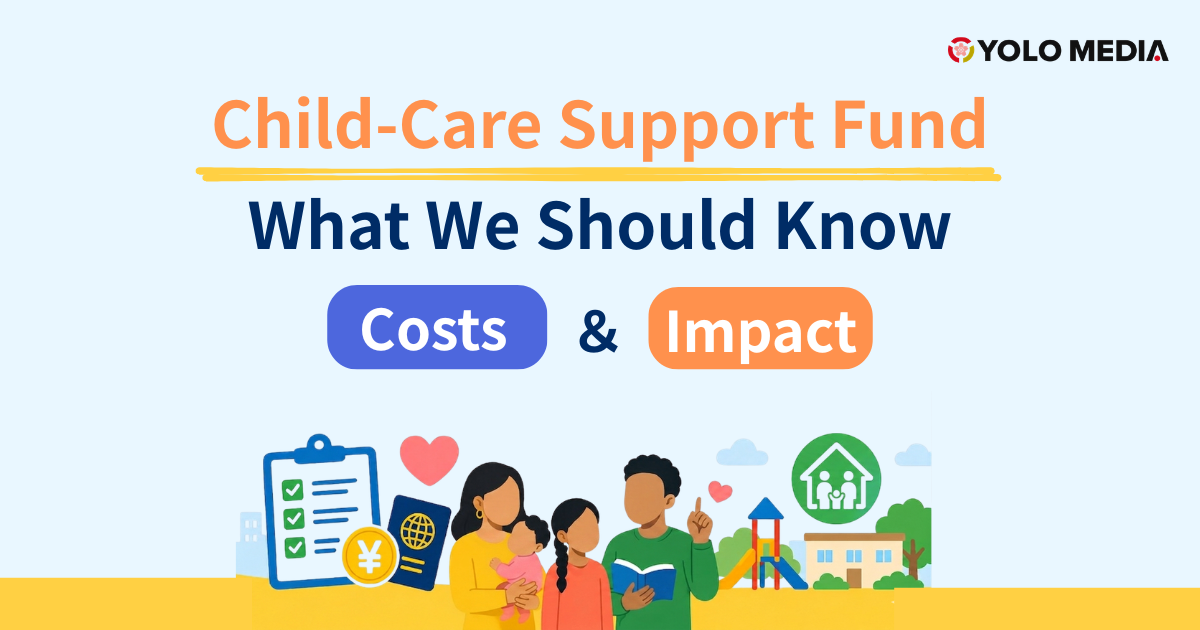
The “Child-Care Support Fund” is a new public contribution that officially began in April 2026. Beyond a few hundred to a few thousand yen of monthly cost, your payment record can affect future visa renewals or Permanent Residency (eiju-ken / PR) applications—making this an issue foreign residents in Japan cannot afford to overlook.
This guide breaks down how the fund works, salary-based contribution simulations, and the points foreign residents need to watch out for.


TL;DR: 5 Key Points to Remember
- Started April 2026: Collection began via salary deductions or direct payments.
- Surcharge on Health Insurance: It is not a new tax, but an automatic addition to your existing health insurance premiums.
- Cost (FY2026): For employees, the effective rate is 0.115%. For a ¥300,000 monthly salary, this starts at about ¥345.
- Direct Link to PR: Late payments are a critical cause for “denial” in Permanent Residency (PR) applications.
- Big Benefits: The fund finances the expansion of Child Benefit (Jido Teate) and the “Kodomo Daredemo Tsuuen Seido” (Daycare for Everyone) system.
What is the Child-Care Support Fund?
The “Child-Care Support Fund” is a new collection system created by the Japanese government to address the country’s accelerating birthrate decline. The core principle is that society as a whole—not just specific groups—shares the cost of supporting the next generation.
(Reference: Children and Families Agency: About the Child-Care Support Fund System)
1. Why is it collected as “Social Insurance” instead of a tax?
The fund was not established as a new “tax.” Instead, it uses the existing Public Medical Insurance (Health Insurance) framework for collection. This design ensures the money is used exclusively for childcare support and that all beneficiaries—working adults across society—contribute fairly, just like with health insurance.
2. Are foreign residents also obligated to pay?
Yes, absolutely. Japan’s social insurance system is determined by whether you live in Japan and are enrolled in insurance, not by your nationality (kokuseki). Since foreign residents receive the same high-quality medical services as Japanese citizens, the same rules apply.
- Employees/Public Servants: Deducted from salary via Kyokai Kenpo or Health Insurance Societies.
- Self-employed/Freelancers: Paid via National Health Insurance (kokumin kenko hoken) payment slips.
- People aged 75+: Paid via the Medical System for the Elderly.
Is “I don’t have kids, so it’s not my problem” a misconception?
Social insurance is a system of mutual aid. Supporting the next generation today helps secure the medical and care workforce that will serve all of us later in life.
Calculation Simulation: How Much Will My Take-Home Pay Decrease?
Let’s look at the numbers based on the latest 2026 rates.
The 2026 Rate is “0.23%”
For the first year of the system (FY2026), the support fund rate has been set at a national average of 0.23%.
If you are a company employee, you do not pay this entire amount yourself. Japanese social insurance follows a rule called “Roushi Seppan” (split between employer and employee), where your employer pays half of the contribution. The actual amount deducted from your take-home pay is therefore 0.115%.
Contribution Table by Monthly Salary (For Employees)
This table calculates the monthly cost based on your “Standard Monthly Remuneration” (hyojun hoshu getsugaku), which is your approximate gross monthly income including overtime.
| Est. Monthly Income | Total Contribution | Your Share (Monthly) |
|---|---|---|
| ¥200,000 | ¥460 | ¥230 |
| ¥250,000 | ¥575 | ¥287 |
| ¥300,000 | ¥690 | ¥345 |
| ¥400,000 | ¥920 | ¥460 |
| ¥500,000 | ¥1,150 | ¥575 |
| ¥600,000 | ¥1,380 | ¥690 |
| ¥1,000,000 | ¥2,300 | ¥1,150 |
Note: The same rate (0.115%) applies to bonus payments in the months they are received.
(Reference: MHLW: Official Materials on Support Fund Rate Calculation)
The initial cost starts at a few hundred yen per month.
Future Outlook: Gradual Increase Until 2028
To minimize the impact on households, the system is being phased in over three years.
- FY2026: Approx. 0.23% (Your share: 0.115%)
- FY2027: Approx. 0.35% (Your share: 0.175% / Estimated)
- FY2028 onwards: Approx. 0.5% (Your share: 0.25% / Estimated)
By FY2028, when the system is fully in effect, the cost will roughly double. For someone earning ¥300,000, the monthly amount will be around ¥750.
Why It Matters Most for Foreign Residents: The Impact on Permanent Residency (PR)
You might think, “It’s only a few hundred yen, why all the fuss?” However, foreign residents face a hurdle that Japanese citizens don’t: the “Status of Residence” (Visa), which is the foundation of life in Japan.
1. PR Applications and the “Insurance Record”
If you are planning to apply for Permanent Residency (eijuken) in the future, this is the most important section to read. The Immigration Services Agency strictly checks whether applicants have paid their “Public Dues” (taxes, pension, and health insurance) on time.
The Support Fund is collected as part of your “Health Insurance Premium” (kenko hoken-ryo). This means that if you fall behind on your health insurance payments (taino), you are automatically flagged as failing to fulfill your Support Fund obligations as well.
2. Why “One Day Late” Becomes a Risk
This is especially critical for freelancers or self-employed individuals who pay their National Health Insurance via payment slips.
PR applications are screened against your last 2 years of payment records
The Immigration Services Agency’s “Guidelines for Permission for Permanent Residence” explicitly require that applicants properly fulfill public obligations (taxes, public pension, public medical insurance contributions, etc.). “Properly” means paying on or before the due date, and applicants must submit documentation of their last 2 years of pension and health insurance payment status. Even a delay of just a few days can be recorded and work against you in screening.
With the introduction of the Support Fund, your health insurance premiums will be slightly higher. Minor mistakes—an insufficient bank balance for auto-deduction, or ignoring a bill because the amount changed—can delay your long-term plans in Japan by years.
(Reference: Immigration Services Agency: Guidelines for Permission for Permanent Residence)
How to Avoid Payment Mistakes
If you are self-employed, set up “Auto-Debit” (Kouza Furikae) immediately!
If you pay with paper slips (nofu-sho), it’s too easy to forget. For visa holders where “one day late” can be a fatal blow, paying manually is too high a risk. Go to your local Ward Office (ku-yakusho / shi-yakusho) and set up automatic bank transfers. This reduces your risk of accidental delinquency to zero.
Watch out for the “Gap Month” when changing jobs
When you quit a job, you are responsible for switching your health insurance “yourself,” even if there is only a gap of two weeks before your next job starts. Sometimes the bill from the city office arrives late, but forgetting to pay just because the bill didn’t arrive is still recorded as a late payment. If you are changing jobs, consult the insurance window at your city hall immediately.
Where Is Your Money Going? Direct Benefits for Foreign Families
The Support Fund is fueling new childcare services. Here are two that are especially valuable for foreign families living in Japan.
1. Daycare for Everyone! “Kodomo Daredemo Tsuuen Seido”
Starting nationwide in FY2026, this system is incredibly valuable for foreign families. Previously, Japanese daycare centers (hoikuen) generally required both parents to be working to enroll a child. Under this new system, you can use childcare services for a certain number of hours regardless of your employment status.
- “I’m stressed from parenting far away from my home country. I just need a few hours to refresh.”
- “I need a place for my child while I’m job hunting or attending Japanese language school (nihongo gakko).”
- “I want my child to get used to the Japanese environment and make Japanese friends.”
(Reference: YOLO Media: Hoikuen vs. Yochien – Differences and How to Choose)
2. Massive Expansion of Child Benefit (Jido Teate)
For families who already have children or are planning to, there are direct “cash” benefits.
- Removal of Income Caps: Previously, high-income earners had their benefits cut. As of 2026, everyone receives the full amount.
- Extended Eligibility: It now covers children until the end of high school (age 18), extended from the previous middle-school cutoff.
- Third Child Bonus: For the third child, the monthly payment increases to a substantial ¥30,000.
(Reference: Guide to Child Benefit: Amounts and Application Process)
FAQ: Common Concerns
Q: I’m single and have no kids. Paying a “Singles Tax” feels unfair.
The term “Singles Tax” (dokushin-zei) is widely used on Japanese social media, but the fund is structurally a part of the health insurance premium—not a tax targeted at single individuals. It’s positioned as a society-wide cost-sharing mechanism for supporting the next generation.
Q: Will this reduce my other taxes (Year-End Adjustment)?
Yes, this is important! Since this fund is part of your health insurance, it is fully eligible for the *“Social Insurance Premium Deduction” (shakai hokenryo kojo). If you correctly fill out your Year-End Adjustment (nemmatsu chosei*) forms, your income tax and residence tax will decrease accordingly. The “real” burden is actually 15–20% lower than the number shown on your paystub.
(Reference: National Tax Agency: Social Insurance Premium Deduction Rules (2026 Edition))
Q: I plan to leave Japan in a few years. Do I get a refund?
Unfortunately, no. This is different from the Pension “Lump-sum Withdrawal Payment” (dattai ichijikin). The Support Fund is consumed each year for medical and childcare services and is non-refundable. Think of it as a “community membership fee” while you live in Japan.
Q: Where can I find it on my paystub?
The notation varies by company.
- It might be bundled into “Health Insurance,” with a note saying “Including ¥XXX for Support Fund.”
- It might be listed as a separate line item called “Support Fund” (shienkin).
If you can’t find it, ask your HR department: “Kodomo kosodate shienkin wa dore desu ka?” (Which one is the child-care support fund?)
Key Takeaways
For a ¥300,000 salary, your share starts at about ¥345/month.
[!TIP]
Delinquency is a massive negative in visa screenings. Never be even “one day” late with payments.
[!TIP]
Take advantage of the Child Benefit and the “Kodomo Daredemo Tsuuen Seido” system.
[!TIP]
Get your deduction during the Year-End Adjustment to lower the actual cost.
For more detailed calculations or services available in your specific area, your local municipality’s help desk can provide personalized guidance.
![Father’s Day Gift Budget in Japan: The Right Gift for Your Partner’s Dad [2026]](https://media.yolo-japan.com/wp-content/uploads/2026/06/fathers-day-japan-2026-en-768x432.webp)