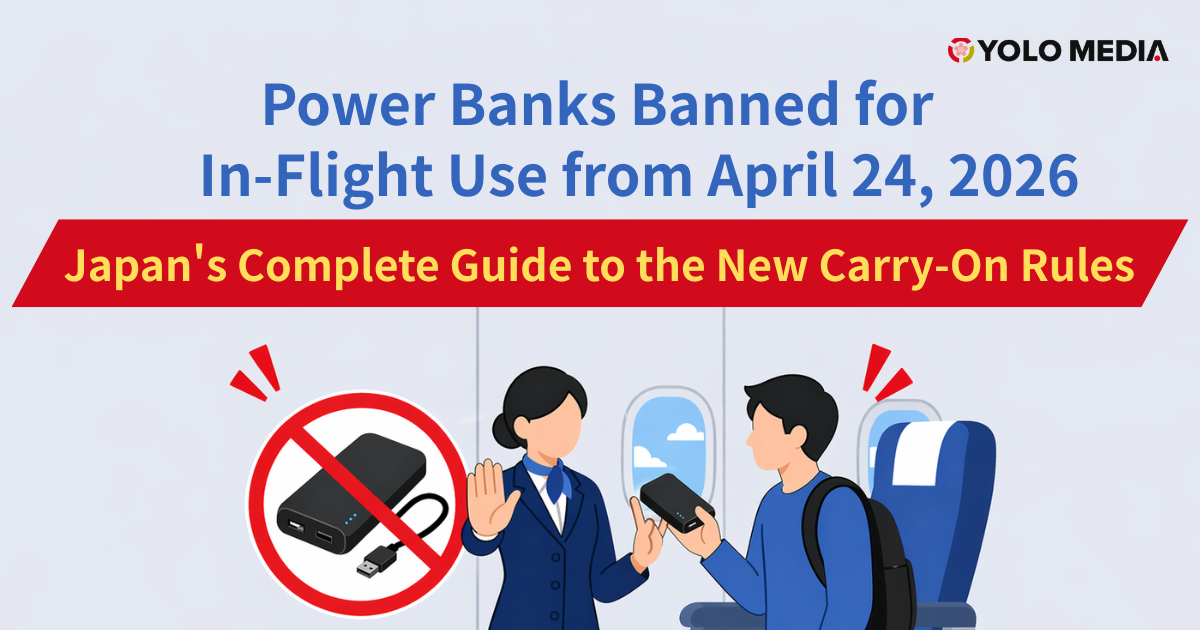
Last Updated: April 24, 2026
Reading Time: ~10 min read
Category: Travel
Introduction: What to Know Before Your Next Flight
Whether you’re flying home for Golden Week, taking a domestic trip in August, or booking that year-end vacation abroad, chances are you’ll be on a plane sooner than you think. A power bank is basically essential for long-haul flights, but starting April 24, 2026, the rules for bringing them onto planes in Japan have changed in a big way.
Japan’s Ministry of Land, Infrastructure, Transport and Tourism (MLIT) introduced the new rules after ICAO (the International Civil Aviation Organization) revised its international standards. The new rules apply to every flight departing from or arriving in Japan (domestic and international) on every airline (JAL, ANA, Peach, and overseas carriers alike). Show up at the airport without knowing them and you could have your power bank confiscated, or worse, face denied boarding or a fine.
If you’re an international resident, two things matter most: checking the capacity label on a battery you bought back home, and knowing what to do when flying with a foreign airline. This guide walks through everything you need to know before departure, following the actual flow at a Japanese airport.
TL;DR
- New rules take effect April 24, 2026: Applies to all flights departing or arriving in Japan, regardless of airline nationality
- Maximum 2 units at 160Wh or less: High-capacity batteries (over 160Wh) are completely banned
- No in-flight charging or discharging: Neither charging the battery itself nor using it to charge your phone is allowed
- Still banned from checked baggage: Must go in your carry-on (this rule has been in place for years)
- Violations: up to 2 years imprisonment or ¥1 million fine: Capacity/quantity violations and in-flight charging are criminal offenses
- Overhead bin storage also banned (since July 8, 2025): Keep batteries in the seat pocket or somewhere visible
Disclaimer: Aviation laws and airline policies may change. Always check the official website of your airline before departure. This article is for informational purposes only and does not constitute legal advice.
Information Sources:
| Source | Topic | URL |
|---|---|---|
| MLIT (Ministry of Land, Infrastructure, Transport and Tourism) | Official announcement of new power bank rules | MLIT |
| JAL (Japan Airlines) | Power bank rule change notice | JAL Official |
| ANA (All Nippon Airways) | Domestic baggage regulations | ANA Official |
| Narita International Airport | Battery carry-on guidelines | Narita Airport |
| JNTO (Japan National Tourism Organization) | English-language guidance | JNTO Official |
Information in this article is current as of April 24, 2026. Rules may change without notice.
New Rules at a Glance: Before vs. After April 24, 2026
| Item | Until April 23, 2026 | From April 24, 2026 |
|---|---|---|
| Capacity limit | 160Wh or less | 160Wh or less (unchanged) |
| Number of units | Unlimited for 100Wh or less, 2 max for 100–160Wh | Max 2 per person regardless of capacity |
| Charging the battery in-flight | Allowed | Banned |
| Using the battery to charge devices in-flight | Allowed | Banned |
| Storing in overhead bins | Banned (since July 2025) | Banned (continues) |
| Checked baggage | Banned | Banned (continues) |
The new rules apply to every flight departing from Japan. If you’re flying home on a foreign carrier like Delta, Korean Air, or China Airlines, the same rules apply. As long as you’re departing from a Japanese airport, you’re subject to these rules.
Why the Change? Rising Battery Fires and ICAO’s Emergency Revision
If the new restrictions feel like they came out of nowhere, there’s a clear reason behind them: lithium-ion battery fires on aircraft have been rising sharply worldwide.
The Spark: Air Busan Flight Fire in January 2025
On January 28, 2025, Air Busan Flight 391 at Gimhae International Airport in South Korea caught fire when a power bank stored in the rear overhead bin ignited. The incident injured 27 passengers. The aircraft was totally destroyed. Miraculously, no one died, but the event exposed a critical flaw: batteries stored in overhead bins can ignite without anyone noticing in time.
Fires Happening in Japan Too
According to NITE (National Institute of Technology and Evaluation), Japan recorded 123 power bank-related incidents in 2024 alone. Domestic flights haven’t been spared either: ANA Flight 994 (Itami to New Chitose) had an in-cabin smoke incident. This isn’t just a problem happening somewhere else.
ICAO Issues Emergency Revision
In response, ICAO revised its international standards on an emergency basis on March 27, 2026, urging rapid action from aviation authorities worldwide. Japan formally announced the new rules on April 14, 2026, and enforcement began just 10 days later on April 24. That kind of speed is unusual for Japanese regulators.
Capacity Check: Converting mAh to Wh for Your Battery
Most batteries sold in Japan display capacity in Wh (watt-hours), but many models from overseas (or older ones) only show mAh (milliamp-hours). A lot of international residents are still using a power bank they brought from back home, so the first step is to convert the capacity and check whether it fits.
Conversion Formula
Wh = mAh × Voltage(V) ÷ 1,000If voltage isn’t listed, use 3.7V (the standard nominal voltage for lithium-ion batteries).
Quick Reference Table (calculated at 3.7V)
| mAh Rating | Converted Wh | Allowed? |
|---|---|---|
| 5,000mAh | ~18.5Wh | ✅ 2 max OK |
| 10,000mAh | ~37Wh | ✅ 2 max OK |
| 20,000mAh | ~74Wh | ✅ 2 max OK |
| 27,000mAh | ~100Wh | ✅ 2 max OK |
| 30,000mAh | ~111Wh | ✅ 2 max OK |
| 40,000mAh | ~148Wh | ✅ 2 max OK |
| 43,243mAh | ~160Wh | ⚠️ Just barely OK |
| 50,000mAh | ~185Wh | ❌ Not allowed |
Standard smartphone power banks (10,000–20,000mAh) almost always fall within the limit. Batteries over 160Wh are typically only found in niche products for professional photographers or long-haul backpackers.
Missing or Illegible Capacity Labels
Security will likely reject any battery where the capacity label can’t be read. If your sticker is peeling or the printed text is fading on an older battery, check it early once travel is on the horizon. If you’re not sure, buying a new one is the safe call.
No In-Flight Charging or Discharging, Period
The biggest day-to-day change in these new rules is the total ban on using power banks in-flight.
What’s Banned
- Charging the power bank itself: You can’t plug the battery into the in-seat outlet or USB port to top it up
- Using the power bank to charge other devices: No using it to charge your phone, tablet, or laptop
In other words, during the flight, your power bank has to sit there “doing nothing” the entire time.
The Alternative: Use In-Flight Outlets
Long flights can make phone battery life a real concern. The good news is that most modern long-haul aircraft have USB ports or AC outlets built into each seat. If you need to charge something in the air, plug your device straight into the seat.
The golden rule is to fully charge your phone and power bank at the airport lounge or terminal before boarding. Plan your power management ahead of time, especially if you have a connecting flight or a long journey after landing.
Checked Baggage: Absolutely Not
This rule isn’t new, but it’s worth repeating: putting a power bank in your checked baggage (suitcase) has been banned for years.
Why the Ban?
If a battery ignites in the cargo hold, the crew can’t see it and a fire can escalate fast. Lithium-ion batteries are especially tough to extinguish once they catch fire, and temperatures can climb close to 1,000°C.
If You Accidentally Check It In
If it’s discovered after check-in, you’ll be paged at the gate and asked to reopen your bag. Worst case, if the discovery comes too late, the battery will be destroyed and you could miss your flight. When packing, make it a habit to move power banks into your carry-on bag first.
Penalties: Up to ¥1 Million Fine
Under Japan’s Civil Aeronautics Act, the following actions carry up to 2 years’ imprisonment or a fine of up to ¥1 million.
Offenses Subject to Criminal Penalties
- Bringing a battery with capacity over 160Wh onboard
- Bringing 3 or more batteries onboard (per person)
- Charging the battery itself in-flight
No Criminal Penalty, But Still Confiscated or Denied Boarding
- Using the battery to charge other devices (no criminal penalty at this time)
- Bringing a battery with no visible capacity label
“I didn’t know” is not a valid defense. For international residents holding a residence card, fines or a criminal record can affect future visa renewals or permanent residency applications. Make sure you know the rules before heading to the airport.
Major Airlines: One Unified Rule
A common concern is whether the rules differ by airline. The answer is no: at this point, every major airline has aligned on the same rules.
| Airline | Status |
|---|---|
| JAL (Japan Airlines) | New rules apply (domestic and international) |
| ANA (All Nippon Airways) | New rules apply (domestic and international) |
| Peach Aviation | New rules apply |
| Jetstar Japan | New rules apply |
| Skymark | New rules apply |
| Solaseed Air / AIRDO | New rules apply |
| Foreign carriers (flights from Japan) | New rules apply |
Foreign airlines follow the Japanese rules whenever the flight departs from a Japanese airport. That applies to Delta, United, Korean Air, China Airlines, Singapore Airlines, Cathay Pacific, and everyone else.
Extra Notes for International Residents: Trips Home and Abroad
Here are the points to watch when flying back to your home country or heading abroad.
Check the Rules at Your Destination Too
Japan’s rules apply on departure, but the destination country’s rules apply when you arrive. For example, domestic flights in mainland China don’t allow any battery without a visible capacity label, and some countries have even stricter requirements. If you have a connecting flight, check the rules for every transit country involved.
Check the Label on Batteries Bought Abroad
- Made in the U.S.: Wh rating usually printed (FAA standard)
- Made in China: Many models only show mAh → conversion needed
- Made in Korea: Wh and mAh often both listed
- Made in Europe: Wh rating usually printed (EU standard)
If the label is only in Chinese or Korean and you can’t read it, the safest approach is to search the model number by product name and confirm the Wh rating on the manufacturer’s official website before flying.
3 Ways to Breeze Through Airport Security
1. Make the Capacity Label Visible
If the sticker is peeling, printing a photo of the capacity label and keeping it in a clear folder is a practical workaround. A screenshot of the manufacturer’s spec page also works.
2. Prevent Terminal Short Circuits
Throwing a bare battery into your bag is risky. Do one of the following:
- Apply insulating tape over the terminals
- Use a dedicated protective pouch or ziplock bag
- Keep it in its original retail box
3. Keep It Accessible in Your Bag
Security may ask you to place the battery in a separate tray. Rather than burying it deep in your suitcase, tuck it into an outer pocket of your carry-on where you can grab it quickly.
Peak travel periods (Golden Week, Obon, New Year) create serious airport congestion. Security lines at Narita, Haneda, and Kansai International can take 1.5–2 times longer than usual. Plan to arrive earlier than you normally would.
Frequently Asked Questions (FAQ)
Q1: Are built-in batteries in laptops and tablets restricted?
A: No. Built-in batteries in laptops, tablets, and similar devices are exempt. These rules target “spare power banks.” That said, it’s still recommended to keep your laptop in carry-on rather than checked baggage.
Q2: What about wireless earbud charging cases?
A: Charging cases like those for AirPods count as built-in batteries and are exempt. Spare loose batteries (including button cells) may be subject to the rules, so be careful with those.
Q3: How do I charge my phone during the flight?
A: Use the in-seat USB port or outlet built into the aircraft. Most international long-haul aircraft (JAL and ANA’s 787s and A350s, for example) have these as standard. LCCs and older aircraft may not, so check ahead.
Q4: For a family of 4, how many batteries can we bring total?
A: 2 per person means a family of 4 can bring up to 8. Young children count as one passenger each. Don’t lump them all with one family member — split them across each person’s carry-on.
Q5: What about spare camera batteries (for DSLRs)?
A: Camera batteries at 100Wh or less have no quantity limit. Between 100–160Wh, the limit is 2. These are counted separately from power banks, so you don’t need to worry about combining them.
Q6: What if a battery is confiscated at the airport on my way home?
A: Confiscated batteries are generally not returned. Rules differ between your departure and arrival countries, so check both directions before you fly.
Q7: Is it true that rules will get even stricter after 2027?
A: IATA (International Air Transport Association) has indicated that its 2027 edition may further restrict batteries over 100Wh. That isn’t confirmed yet, but choosing a battery at 100Wh or less is the safer long-term choice.
Q8: Do foreign airlines departing from Japan (Delta, Korean Air, etc.) follow the same rules?
A: Yes, flights departing from Japan follow Japanese rules regardless of carrier. For your connecting flight or return flight, however, the rules of other countries and airlines may apply.
Key Takeaways
Every flight departing or arriving in Japan, every airline
[!TIP]
Start by checking the capacity of your own battery
[!TIP]
Use the in-seat USB port or outlet instead
[!TIP]
Never in checked baggage
[!TIP]
Follow the rules, especially given possible visa renewal implications
[!TIP]
Prepare in advance to clear security smoothly
Final Thoughts
The new rules exist for safety reasons, but showing up at the airport unaware can ruin the start of your trip. Packing tends to get rushed right before a trip home or an overseas vacation. The night before departure, do a final check on your power bank’s capacity, quantity, and where it’s packed.
With the right prep, you can fly with confidence and enjoy the trip. Safe travels!