Last Updated: March 29, 2026
Reading Time: About 8 min
Category: Culture
Introduction
Have you ever walked around a historical area like Asakusa or Kyoto and wondered, \”Is this a shrine or a temple? And do I clap my hands here or not?\”
Don’t worry. Even many foreigners who have lived in Japan for years (and even some Japanese people!) get these confused. But once you know the basic rules and visual cues, visiting Japan’s power spots becomes incredibly rewarding. Let’s master the etiquette and cultural background of Japan’s sacred sites!

TL;DR
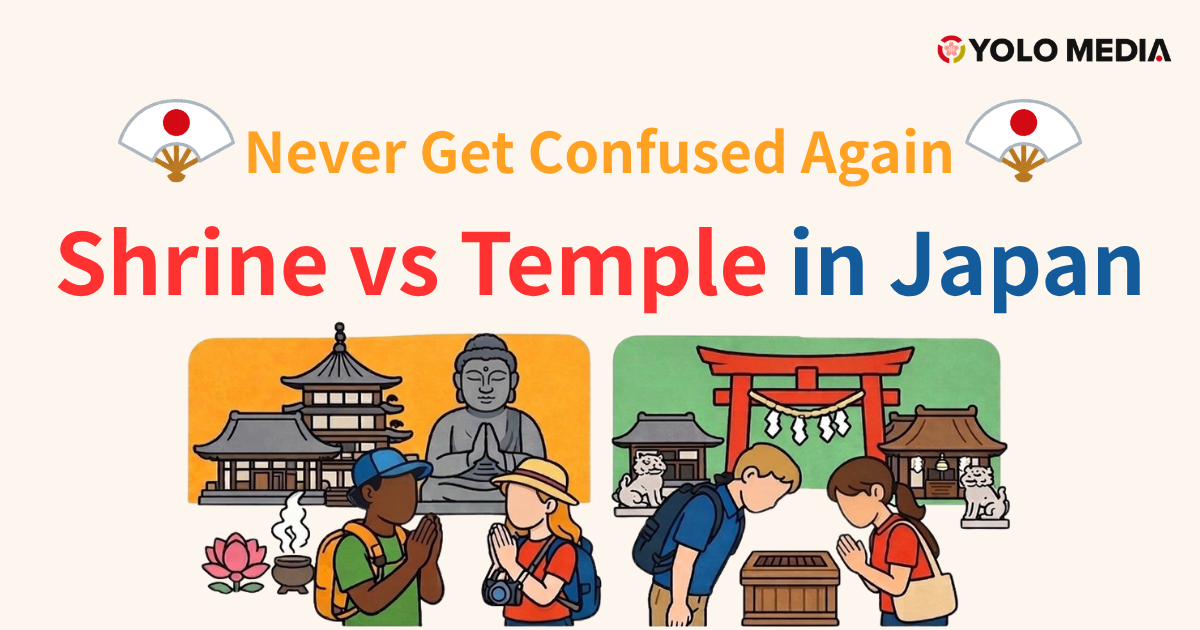
- The Easiest Way to Tell: If you see a Torii (⛩️) gate, it’s a Shinto Shrine. If you see a large gate with a roof (Sanmon) or an incense burner, it’s a Buddhist Temple.
- Prayer Manners: At a shrine, you clap your hands twice (Two Bows, Two Claps, One Bow). At a temple, you do not clap; just place your hands together in silence (Gassho).
- Purification: Always wash your hands and mouth at the Chozuya water basin before praying to show respect.
- Everyone is Welcome: Regardless of your faith or nationality, both shrines and temples welcome visitors who show respect.
Shrines vs. Temples: Comparison at a Glance
Japan has two major religions, Shinto and Buddhism, which have peacefully coexisted for over 1,000 years. Most Japanese people incorporate both into their daily lives.
| Shinto Shrine (Jinja) | Buddhist Temple (Tera) | |
|---|---|---|
| Religion | Shinto (Japan’s indigenous faith) | Buddhism (Imported from India/China) |
| Worshipped | Kami (Gods) & Nature Spirits | Buddha & Bodhisattvas |
| Entrance Marker | Torii Gate (⛩️) | Sanmon / Niomon Gate |
| Prayer Action | Clap hands (2 Bows, 2 Claps, 1 Bow) | Do NOT clap (Gassho – hands together) |
| Incense | None | Large incense burners are standard |
| Name Suffix | -jinja, -jingu, -taisha | -ji, -tera, -in, -do |
Pro Tip: The absolute easiest rule is: If there is a Torii (⛩️), it is a shrine.
Part 1: Exploring Shinto Shrines
Shinto is based on the belief that gods (Kami) inhabit everything in nature—mountains, rivers, trees, and rocks. There are no founders or scriptures; it is a way of living in harmony with nature.
What to Look for in a Shrine
- Torii: The gate that separates the sacred space from the everyday world.
- Sando: The path leading to the main hall. The center of the path is for the gods, so it’s polite to walk slightly to the left or right.
- Komainu: Guardian lion-dog statues that ward off evil spirits.
Proper Shrine Etiquette
1. Purify at the Chozuya
Before praying, you must cleanse your body and mind:
- Pick up the ladle with your right hand and wash your left hand.
- Switch the ladle to your left hand and wash your right hand.
- Move the ladle back to your right hand, pour some water into your left palm, and rinse your mouth (never touch the ladle directly to your mouth).
- Rinse your left hand again.
- Finally, tilt the ladle vertically to let the remaining water wash the handle, and place it back.
2. The \”Two Bows, Two Claps, One Bow\” Ceremony
- Toss a coin (Saisen) quietly into the box.
- If there is a bell, ring it to get the gods’ attention.
- Two Bows: Bow deeply (90 degrees) twice.
- Two Claps: Clap your hands twice at chest level. Keep your hands together and pray silently.
- One Bow: Bow deeply once more to finish.
Part 2: Exploring Buddhist Temples
Buddhism was introduced to Japan in the 6th century and has deeply influenced Japanese philosophy and arts, including practices like Zen meditation.
What to Look for in a Temple
- Sanmon Gate: Large, heavy wooden gates. You might see fierce-looking \”Nio\” statues guarding the entrance.
- Incense Burner (Okoro): A large pot with smoke rising from incense sticks (Senko). It is a tradition to waft the smoke toward yourself (e.g., toward your head if you want to be smarter) for healing and purification.
Proper Temple Etiquette
- If incense is sold, light one and place it in the burner.
- Stand before the Hondo (Main Hall) and toss a coin quietly into the box.
- Gassho: Place your hands together in front of your chest. Do NOT clap.
- Bow deeply once and pray silently.
- Bow lightly one more time to finish.
Accidentally clapping at a temple is a very common mistake for both visitors and locals. If you do it, don’t panic! The deities aren’t angry. Just follow it up with a silent prayer.
Getting a \”Goshuin\” (Travel Soul Art)
If you visit a shrine or temple, you must check out Goshuin.
This is sacred calligraphy and a red stamp provided by the staff in a special notebook called a Goshuin-cho. It’s a beautiful, hand-crafted record of your visit.
- Cost: Usually ¥300 – ¥500.
- Rule: You must use a dedicated Goshuin-cho notebook; do not ask for one in a regular notebook or piece of paper.
FAQ
Q: I am not religious. Is it okay to pray?
A: Absolutely! Shrines and temples welcome everyone. Even if you don’t believe in the specific deity, showing respect to the historical site and the local culture is highly appreciated.
Q: Is there a dress code?
A: There is no strict dress code, but modest clothing is respectful. Avoid extremely revealing outfits. Also, remember to remove your hat and sunglasses before entering the main prayer buildings.
Q: Can I take photos?
A: You can usually take photos of gardens and building exteriors. However, photography is strictly forbidden inside the main halls (especially facing the statues). Look for \”No Photography\” signs.
Key Takeaways
Torii = Shrine. Sanmon = Temple.
[!TIP]
Clap at Shrines. Silence at Temples.
[!TIP]
Use the Chozuya water basin first to show you understand local manners.
[!TIP]
Start a Goshuin collection for a unique, artistic souvenir of your travels.
Now you’re a pro at navigating Japan’s spiritual sites! Next time you travel, use these tips to connect more deeply with the local culture and history.