In Japan, typhoons arrive from summer into autumn. When a typhoon gets close, the rain and wind become very strong, and trains may stop or the power may go out.
In this article, we explain what to do before a typhoon, what to watch out for on the day, when to evacuate, and how to get typhoon information in English, based on official information from the Japan Meteorological Agency (JMA), the Prime Minister’s Office and other public sources.
This article is based on information as of November 2, 2026. For evacuation information and train suspensions, check announcements from your city or ward office and your railway company.
1. Typhoon Preparation in Japan: The Quick Answers
Here are answers to the most common questions.
| Question | Answer |
|---|---|
| When are typhoons most common? | July to October. The most typhoons come close to Japan in August and September (Section 2) |
| What’s dangerous? | Heavy rain (flooded rivers and roads, landslides) and strong wind (flying objects) (Section 2) |
| What should I do the day before? | Bring balcony items inside, lock your windows, and prepare water and food (Section 3) |
| What about the day itself? | Stay indoors. Trains may be stopped in advance (Section 4) |
| When should I evacuate? | Leave dangerous areas by evacuation alert Level 4 (Section 5) |
| How can I get information in English? | JMA’s multilingual pages and the “Safety tips” app (Section 6) |
You’ll find details and sources in each section.
2. When Do Typhoons Hit Japan, and What’s Dangerous?
Typhoon season
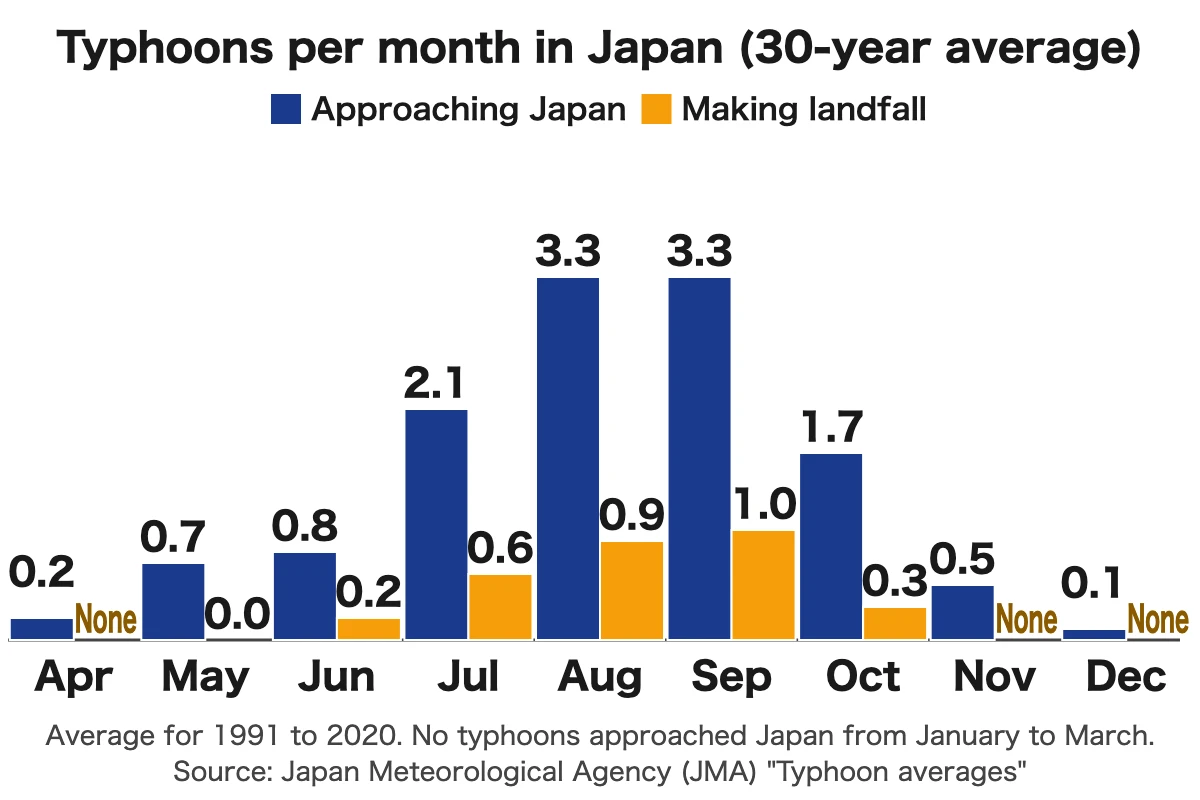
The Prime Minister’s Office says that many typhoons approach or make landfall in Japan from July to October. Here are JMA’s monthly averages (the 30-year average from 1991 to 2020).
| Month | Typhoons approaching Japan | Typhoons making landfall |
|---|---|---|
| Apr | 0.2 | None |
| May | 0.7 | 0.0 |
| Jun | 0.8 | 0.2 |
| Jul | 2.1 | 0.6 |
| Aug | 3.3 | 0.9 |
| Sep | 3.3 | 1.0 |
| Oct | 1.7 | 0.3 |
| Nov | 0.5 | None |
| Dec | 0.1 | None |
| Year | 11.7 | 3.0 |
“None” means it did not happen even once in 30 years.
On average, 11.7 typhoons approach Japan each year. August and September have the most, but typhoons can still come close in October.
What heavy rain can cause
- Flooded roads: When you walk on a flooded road, it’s hard to see the gutters at the edge of the road. The Prime Minister’s Office says people have fallen into gutters on flooded roads, and underpasses (roads that go under railways or other roads) have filled with water
- Overflowing rivers: Water can get into homes near rivers
- Landslides: Near mountains and cliffs, soil and rocks can slide down
What strong wind can cause
Signs and other objects can fly through the air, and trees can fall. JMA calls the area where winds of 25 m/s or more are blowing, or may blow, the “storm area” (boufuuiki).
Words you’ll hear in the news
Typhoon news uses some difficult words. Here they are in plain English, based on JMA’s definitions.
| Word | Reading | Meaning |
|---|---|---|
| 冠水 | kansui | Roads or fields covered with water |
| 浸水 | shinsui | Water getting into homes or other buildings |
| 洪水 | kouzui | A river rising sharply and overflowing |
| 高潮 | takashio | Storm surge: the sea level rising far above normal because of a typhoon or other storm |
| 暴風域 | boufuuiki | Storm area: where winds of 25 m/s or more are blowing, or may blow |
| 予報円 | yohouen | Forecast circle: the area the typhoon’s center has a 70% chance of being in at the forecast time (it does not show the size of the typhoon) |
(Sources: Prime Minister’s Office "What disasters can heavy rain and typhoons cause?" / JMA "Typhoon averages" / JMA "Types of typhoon information" / JMA "Forecast terms: rivers" / JMA "Forecast terms: waves" (Japanese))
3. Before a Typhoon: Your Preparation Checklist
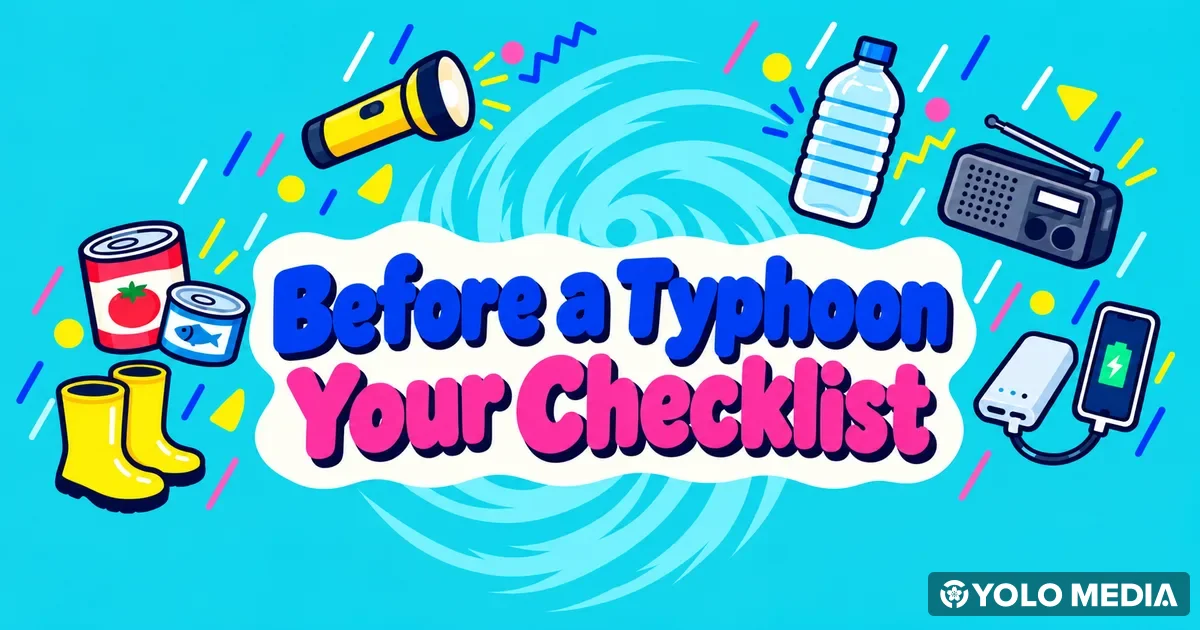
Finish your preparations before the rain and wind get strong. We made this checklist based on guidance from JMA and the Prime Minister’s Office, with some examples added.
Outside (balcony and entrance)
- [ ] Bring in or tie down anything the wind could blow away: plant pots, laundry poles, bicycles and so on
- [ ] Lock your windows and storm shutters (amado): Reinforce them if needed
- [ ] Clean gutters and drains (including the balcony drain): This helps water flow away
Inside
- [ ] Protect your windows: JMA recommends putting shatter-resistant film on window glass (so the glass doesn’t scatter if it breaks) and closing your curtains or blinds
- [ ] Store water: Besides drinking water, fill your bathtub in case the water supply stops
- [ ] Prepare for a power cut: a flashlight, a battery-powered radio, and a charged phone
- [ ] Stock food and water: The Prime Minister’s Office recommends 3 days of drinking water (about 3 liters per person per day) and 3 days of food. For a large disaster, it says a week’s supply is better
- [ ] Check your emergency bag: Keep what you need in a backpack so you can grab it and go
Check the risks where you live
On the “Hazard Map Portal Site” run by the Ministry of Land, Infrastructure, Transport and Tourism (MLIT) and the Geospatial Information Authority of Japan, you can enter an address and see flood, landslide, storm surge and other risks on a map. There is also a page that links to the hazard maps made by each city and town. Check once before a typhoon comes whether your home is in an area that floods easily.
Watch your garbage day
Some cities ask residents not to put out garbage when a typhoon is coming. For example, Yokohama City in Kanagawa Prefecture asks people to put their garbage out on a later collection day when a typhoon is approaching, because flying objects can cause injuries. For the basics of putting out garbage, see our guide to garbage rules in Japan.
 Living in Japan
Garbage Rules in Japan: Sorting, Bulky Items & Appliances
How to sort and put out garbage in Japan: finding local rules, plastics, collection times and bags, batteries and spray …
Read related article
Check your fire insurance
According to the General Insurance Association of Japan, people who rent their home take out fire insurance for household contents only (furniture, appliances and so on). The association also explains that wind damage from typhoons and storms is covered by both basic fire insurance and comprehensive home insurance. Water damage (floods) is covered by comprehensive home insurance but not by basic fire insurance. In both cases, you may have to pay part of the cost yourself. Check your policy to see what’s covered.
(Sources: JMA "Disaster preparation you can do yourself" / Prime Minister’s Office "What you can do before a disaster" / Hazard Map Portal Site / Yokohama City "Garbage collection in bad weather" / General Insurance Association of Japan "Fire insurance" (Japanese))
4. On the Day: Power Cuts, Trains and Work
Stay indoors
When a typhoon is close, stay at home as much as you can. The Prime Minister’s Office says people have fallen into gutters on flooded roads. Stay away from flooded streets, swollen rivers and the coast.
If the power goes out
The Cabinet Office says power cuts can also happen because of natural disasters such as floods. If the power goes out at night, your home will be completely dark, so keep a flashlight within reach.
Trains may stop in advance (planned suspensions)
When a big typhoon is coming, railway companies may decide in advance to stop trains and announce it. This is called a “planned suspension” (keikaku unkyu). MLIT says railway companies prepare a timeline in advance for what information they release and when. The day before a typhoon, check the website or app of the railway company for the lines you use.
Work and part-time jobs
Whether you get the day off during a typhoon depends on your employer. By the day before, ask your company or part-time job whether you’ll have the day off and how to contact them. For how to call or email when you’ll be late or can’t come in, see our phrases for running late in Japanese.
 Japanese Language
Running Late in Japanese: Phrases for Interviews and Work
Japanese phrases for running late to an interview, part-time job, or work: phone scripts, email and LINE examples, phras…
Read related article
If your company closes for its own reasons, it generally has to pay you a business closure allowance (at least 60% of your average wage). The exception is force majeure: a closure caused by something outside the business that the company could not have avoided even with the greatest care. In that case, the company does not have to pay. The Ministry of Health, Labour and Welfare explains this in its guidance on earthquake closures, and says that if the company’s buildings and equipment were not directly damaged, the closure is generally considered to be for the company’s own reasons. Ask your company how it handles typhoons.
(Sources: Prime Minister’s Office "What disasters can heavy rain and typhoons cause?" / Cabinet Office "Power cut measures at home" / MLIT "Railway companies to create timelines for planned suspensions" / Ministry of Health, Labour and Welfare "Handling of business closures due to earthquakes" (Japanese))
5. When Should You Evacuate?
If you’re in a dangerous area, evacuate by alert Level 4 at the latest. The Cabinet Office’s evacuation guidelines say, “Always evacuate by alert Level 4!” JMA also says Level 4 is the level at which people need to leave dangerous areas.
| Alert level | Information from your city or town |
|---|---|
| Level 3 | Evacuation of older people and others (koureisha-tou hinan) |
| Level 4 | Evacuation order (hinan shiji) |
| Level 5 | Emergency safety measures (kinkyuu anzen kakuho) |
Don’t wait for Level 5. Evacuate by Level 4.
The Prime Minister’s Office recommends that households with older people or small children, in particular, evacuate early, for example when a Level 3 “evacuation of older people and others” alert is issued.
Evacuating doesn’t only mean going to a shelter
The Cabinet Office explains that “evacuation” (hinan) means avoiding danger, and people who are already in a safe place don’t need to go to an evacuation site. A safe relative’s or friend’s home can also be where you evacuate to. If the hazard map shows your home is not in an area at risk of flooding, landslides or storm surge, you may not need to go to a shelter. Check the guidance from your city or ward office for details.
Warning names changed in May 2026
JMA started using its new disaster weather information system on May 29, 2026. For example, what used to be called a heavy rain warning is now called a “Level 3 heavy rain warning.” For details, see our news article on the new disaster warnings.
 Living in Japan
Japan’s Disaster Warnings Changed on May 28, 2026. What Is a ‘Danger Warning’? How to Read Alert Levels and When to Evacuate
Japan's disaster prevention weather information was overhauled on May 28, 2026. A new 'Danger Warning' (Level 4), the en…
Read related article
(Sources: Cabinet Office "Guidelines on evacuation information" / Cabinet Office "White Paper on Disaster Management 2020" / Prime Minister’s Office "What disasters can heavy rain and typhoons cause?" / JMA "Alert levels" / JMA "New disaster weather information (from 2026)" (Japanese))
6. Typhoon Information in English and 00000JAPAN Wi-Fi
JMA’s multilingual pages
JMA posts weather (forecasts, heavy rain and so on), earthquake, tsunami and volcano information in many languages. Besides Japanese, you can choose English, Chinese, Korean, Vietnamese, Nepali and others.
The “Safety tips” app
The Japan Tourism Agency’s “Safety tips” app sends alerts for earthquake early warnings, tsunami warnings and other weather warnings in 15 languages.
00000JAPAN: free Wi-Fi in a disaster
In a large disaster, free Wi-Fi may be opened up for everyone. The network name (SSID) is “00000JAPAN”. If you see “00000JAPAN” in your phone’s Wi-Fi list, select it to connect.
- When can I use it?: When a large disaster happens. Since May 2023, it may also be opened when communication stops because of a carrier’s network failure
- Who can use it?: It’s set up so anyone in the affected area can use it
- What to watch out for: The connection is not encrypted. Use it only to check that your family is safe and to get information. Avoid entering personal information such as IDs and passwords, and avoid banking services if you can
(Sources: JMA "Multilingual Information on Disaster Risk Reduction" / JMA multilingual pages / Japan Tourism Agency "Safety tips" (JNTO) / Wireless LAN Business Promotion Council "About the disaster SSID 00000JAPAN" / Wireless LAN Business Promotion Council "To users of 00000JAPAN" (Japanese))
7. FAQ
Q. What should I do the day before a typhoon?
Start with four things: bring balcony items inside, lock your windows, prepare water and food, and charge your phone. See the checklist in Section 3 too.
Q. Should I put tape on my windows?
JMA’s guidance doesn’t mention tape. What JMA recommends is putting shatter-resistant film on window glass and closing your curtains or blinds.
Q. Will my company close on a typhoon day?
It depends on the company. Check with your employer by the day before. If trains have a planned suspension, you may not be able to get to work (Section 4).
Q. Can I stay home, or do I have to go to a shelter?
If the hazard map shows your home is not in an area at risk of flooding, landslides or storm surge, you may not need to go to a shelter. Check the guidance from your city or ward office for details. If you’re in a dangerous area, evacuate by Level 4 (Section 5).
Q. Is 00000JAPAN safe to use?
It’s Wi-Fi made so that anyone in an affected area can use it in a disaster. The connection isn’t encrypted, so avoid entering personal information if you can (Section 6).
(Sources: JMA "Disaster preparation you can do yourself" / Cabinet Office "Guidelines on evacuation information" / Wireless LAN Business Promotion Council "To users of 00000JAPAN" (Japanese))
Summary
- ✅ Typhoons are most common from July to October. The most come close to Japan in August and September
- ✅ By the day before, bring balcony items inside, lock your windows, and prepare water and food
- ✅ On the day, stay indoors. Check for planned train suspensions and messages from your employer
- ✅ If you’re in a dangerous area, evacuate by alert Level 4. Check the hazard map for risks near your home
- ✅ You can get information in English from JMA’s multilingual pages and the “Safety tips” app. In a disaster, 00000JAPAN Wi-Fi may also be available
Once a typhoon arrives, it’s too late to prepare. When you hear typhoon news, use this checklist and get ready early.