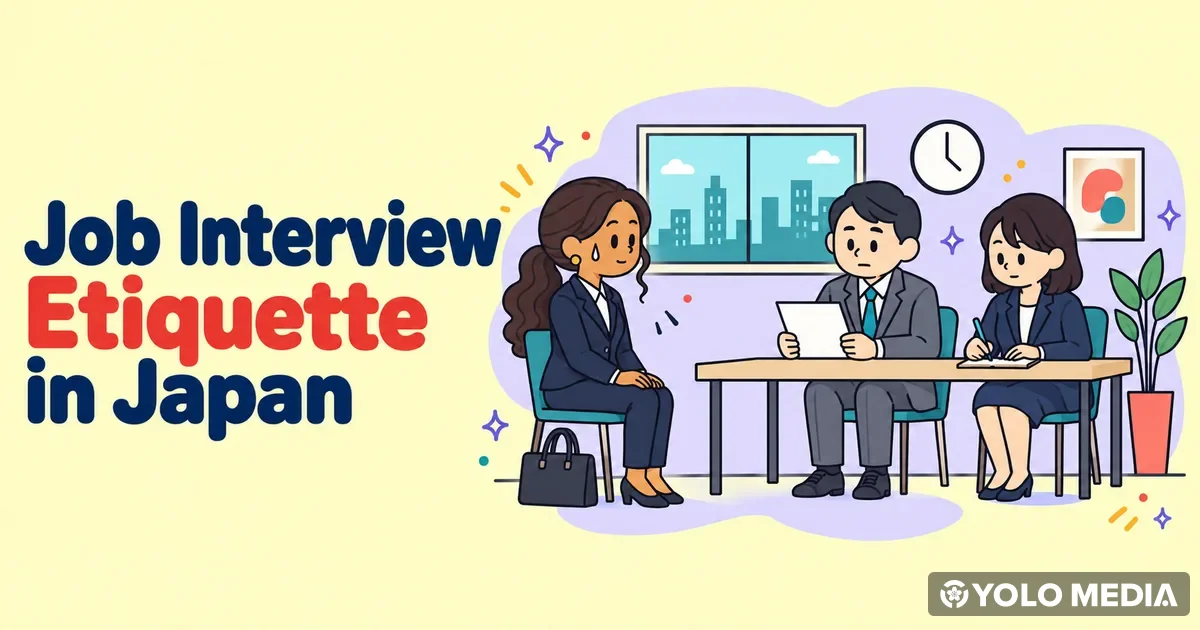
Job interviews at Japanese companies come with customs that may be different from your home country, such as how many times to knock and how to bow. If it’s your first time, you may wonder what you need to watch out for.
In this guide, we cover the flow on the day, entering and leaving the room, bowing, what to wear, online interviews, and common questions, based on official information such as the “Job Hunting Guide for International Students” by JASSO (Japan Student Services Organization). We also explain how to think about questions on your residence status and what to do after you get a job offer.
This article provides general information based on official sources as of October 2026. JASSO’s guide is mainly for international students looking for their first job after graduation. For part-time jobs or mid-career job changes, the number and format of interviews may differ. Interview styles differ by company, so always check the company’s instructions.
1. How Job Interviews Work in Japan
Recruitment at Japanese companies often has three parts: documents (an entry sheet or resume), a written test, and interviews. JASSO’s guide calls the interview “the most important part of the selection process.”
It’s common for one company to hold several interviews (JASSO’s guide says “two or more,” and Study in Japan says “three or more”), so that people in different positions can see your personality and way of thinking. The main types are:
| Type of interview | What it is |
|---|---|
| Group discussion | A group of 4 to 6 applicants discusses a topic given by the company |
| Group interview | Several applicants take the interview together and answer questions in turn |
| Individual interview | Interviewers spend time asking one applicant questions |
| Online or video interview | Taken on a computer or similar. For a video interview, you record your answers and send them |
If you pass the final interview, the company gives you a job offer (naitei), which means the company tells you it will hire you. In new-graduate hiring, before the formal offer, the company may tell you it intends to hire you. This is called an unofficial offer (nainaitei).
(Reference: JASSO "Job Hunting Guide for International Students 2027" (PDF) (Japanese) / Study in Japan "Recruitment tests in Japan" (Japanese))
2. What to Prepare Before the Interview
Interviewers ask questions while looking at the documents you submitted. To avoid giving answers that differ from what you wrote, reread your entry sheet and resume before the interview. For how to write it, see How to Write a Japanese Resume (Rirekisho): Gakuchika, Motivation & Self-PR Guide (2026).
 Work & Career
How to Write a Japanese Resume (Rirekisho): Gakuchika, Motivation & Self-PR Guide (2026)
Learn how to write a Japanese resume (rirekisho) step by step. From basic info and education to motivation, self-PR, and…
Read related article
Things to do before the interview:
- Research the company: check its website for its products and services. You may be asked, “Have you used our products?”
- Keep your self-introduction short: JASSO’s guide recommends preparing a self-introduction you can give in about one minute
- Practice out loud: record yourself on video to check your eye line and how you speak. You can also ask a friend or a career center advisor at your school to play the interviewer
International students can use job consultations and job interview fairs at places such as the government employment service centers for international job seekers (gaikokujin koyo service center) in Tokyo, Osaka, Nagoya, and Fukuoka.
(Reference: JASSO "Job Hunting Guide for International Students 2027" (PDF) (Japanese) / Study in Japan "Working in Japan" (Japanese))
3. What to Wear
If the company gives no dress instructions, choosing neat, formal clothes such as a suit is the safe choice.
JASSO’s guide says clothing is important for showing the company “that you take the interview seriously and have social common sense,” and recommends choosing clothes that suit you and give the company a good impression. There are also suits sold for job hunting.
The table below shows the general approach.
| Company’s instructions | What to wear |
|---|---|
| No instructions | A suit is safe |
| “Dress freely” or “Casual clothes” | Follow the instructions. If you’re unsure, it’s fine to ask the company |
| Online interview | Make sure your upper body on screen looks as neat as in person |
Check that you look clean and neat: hair, nails, shoes, and wrinkles in your clothes. In winter, it’s considered good manners to take off your coat before entering the building and put it on after leaving.
(Reference: JASSO "Job Hunting Guide for International Students 2027" (PDF) (Japanese))
4. The Flow on Interview Day
JASSO’s guide describes the flow of an in-person interview as follows:
- Arrive: never be late. Aim to arrive 15 minutes before the meeting time. Turn off your phone in front of the company entrance
- Reception: think of the interview as starting at reception. Clearly state your school (or current affiliation), your name, and that you’re there for an interview. Thank the person who shows you the way
- Waiting room: wait quietly until it’s your turn. Put your bag on the floor by your feet, not on the table
- Entering: knock 2 or 3 times, and when you hear “Douzo,” say “Shitsurei shimasu” and enter. Bow to the interviewers, say your name beside the chair, and bow again. Sit down only after you’re told “Douzo okake kudasai,” saying “Shitsurei shimasu” as you sit
- During the interview: put your bag by your feet and sit up straight without leaning on the backrest. Look at the interviewers and answer politely, briefly, and clearly
- Leaving: when it’s over, stand up and say “Honjitsu wa arigatou gozaimashita” (thank you for today). At the door, say “Shitsurei shimasu,” bow, and close the door quietly. Turn your phone back on only after leaving the building
How to bow
| Bow | Angle | When to use it |
|---|---|---|
| Keirei | About 30 degrees | Entering and leaving the room, asking for something, thanking someone |
| Eshaku | About 15 degrees | Passing company staff |
If you’re going to be late
If you can’t avoid being late, for example because a train stopped, always call the company before the interview start time. Give your name, interview time, where you are, and when you expect to arrive, and ask what you should do. For Japanese phrases you can use on the phone, see Running Late in Japanese: Phrases for Interviews and Work.
 Japanese Language
Running Late in Japanese: Phrases for Interviews and Work
Japanese phrases for running late to an interview, part-time job, or work: phone scripts, email and LINE examples, phras…
Read related article
(Reference: JASSO "Job Hunting Guide for International Students 2027" (PDF) (Japanese))
5. Online Interviews
Online interviews need different preparation from in-person ones. JASSO’s guide recommends the following:
- Log in at least 5 minutes before the interview starts and get ready
- Place the camera at your eye level, and look at the camera when you speak
- Speak a little louder than usual, and make movements such as nodding a little bigger
- When it’s over, say “Arigatou gozaimashita,” bow, and disconnect only after the interviewer does
If the connection drops or you can’t hear, stay calm and contact the company by chat or phone. It’s reassuring to have a backup device, such as a smartphone, ready in case your computer stops working.
A video interview is a format where you record answers of about 1 to 2 minutes and send them. Prepare your clothes and appearance just as you would for an in-person interview.
(Reference: JASSO "Job Hunting Guide for International Students 2027" (PDF) (Japanese))
6. What You May Be Asked, and Your Japanese
JASSO’s guide lists questions you may be asked in an interview, such as:
- Why did you choose to study in Japan (why do you want to work for a Japanese company)?
- How long do you want to work in Japan?
- What would you do if you weren’t assigned to the department you wanted?
- What do you expect from the company and the job?
- Are you in the selection process with other companies?
For why you want to work for a Japanese company and how long you plan to work in Japan, prepare answers that connect your experience with the work you want to do at that company. For sample answers to each question, see Top 10 Job Interview Questions for International Students in Japan and Why Do You Want to Work in Japan? How to Answer This Interview Question.
 Work & Career
Top 10 Job Interview Questions for International Students in Japan — With Sample Answers & Mistakes to Avoid (2027 Graduates)
Preparing for a job interview in Japan as an international student? Here are the 10 most common questions you'll face, w…
Read related article
 Work & Career
“Why Do You Want to Work in Japan?” — How to Answer This Interview Question With Confidence (With Examples)
The question 'Why do you want to work in Japan?' comes up in almost every interview for international students. Learn th…
Read related article
Your Japanese is also being assessed
According to JASSO’s guide, companies pay special attention to international students’ Japanese ability, and in interviews they check your “ability to understand explanations (listening)” and “ability to express yourself (speaking).” Having a Japanese-Language Proficiency Test (JLPT) or BJT Business Japanese Proficiency Test score makes it easier to show your level.
If you don’t understand a question, don’t pretend you do. Ask again by saying “Moushiwake gozaimasen, mou ichido onegai dekimasu ka” (I’m sorry, could you say that again?). Understanding the question properly and answering politely is what matters.
(Reference: JASSO "Job Hunting Guide for International Students 2027" (PDF) (Japanese))
7. Will They Ask About Your Visa? Which Questions Shouldn’t Be Asked?
Your residence status and what work you can do may be checked during the hiring process. On the other hand, questions unrelated to your abilities are, in principle, not supposed to be asked in an interview.
| Question topic | Will it be asked? |
|---|---|
| Type of residence status, period of stay, what work you can do | May be asked or checked on your residence card (companies check when hiring) |
| Japanese ability, work experience, what you studied | Often asked |
| Family register domicile or place of birth, family members’ jobs or income | In principle, shouldn’t be asked |
| Religion, political party you support, people you respect | In principle, shouldn’t be asked |
Checking your residence status is legitimate
In its leaflet for employers, the Immigration Services Agency tells companies to check the residence card when hiring, including the “work restrictions” field on the front. So during the hiring process, you may be asked about your residence status and period of stay, or asked to show your residence card. Be ready to state your current residence status and period of stay correctly.
Questions unrelated to your abilities
The Ministry of Health, Labour and Welfare’s “Basics of fair recruitment and selection” says that asking about matters unrelated to an applicant’s aptitude and ability, such as the following, may lead to discrimination in hiring:
- Family register domicile and place of birth
- Family (jobs, health, education, income, and so on)
- Housing, living environment, and home environment
- Religion, political party you support, outlook on life, people you respect, and beliefs
If you’re asked such questions and feel uncomfortable, it’s fine to politely say you’d rather not answer. You might also talk to your school’s career center or a similar office.
(Reference: Immigration Services Agency "Leaflet for employers" (PDF) / Immigration Services Agency "Leaflet on proper employment" (PDF) / Ministry of Health, Labour and Welfare "Basics of fair recruitment and selection" (Japanese))
8. Asking Your Own Questions
At the end of the interview, you may be asked, “Do you have any questions?” In Japanese, this is called gyaku shitsumon (reverse questions). Prepare one or two questions about the work after joining, not things you could learn from the company website.
- “Is there anything I should study before joining?”
- “What kind of team would I work with in the department?”
- “What kind of work do employees who aren’t Japanese nationals do here?”
If you want to confirm things needed for joining, such as how the residence status procedures will go, it’s a good idea to ask at the end of the interview or after you receive an offer.
9. After the Interview
Thank-you emails
JASSO’s guide lists “thanking the company for an interview” as one situation for using email during job hunting. Write a subject line that makes the purpose clear, and briefly thank them for their time. For how to write the email, see Japanese Business Email & Phone Guide 2026: Work Templates.
 Japanese Language
Japanese Business Email & Phone Guide 2026: Work Templates
Copy-paste Japanese business email templates and phone scripts for working in Japan: addressing, set phrases, requests, …
Read related article
After a job offer, handle your residence status
For international students to work at a Japanese company, they need to change their residence status from “Student” to one that allows work. You apply through the Immigration Services Agency’s “Application for Change of Status of Residence.” JASSO’s guide says that to join a company on April 1, you need to apply for the change of residence status by the end of January.
If you’re changing jobs, check whether you can work on your current residence status and whether you need to submit a notification. For job changes on a gijinkoku visa, see Changing Jobs on a Gijinkoku Visa: Notifications, the 90-Day Rule, and the N2 Requirement.
 Visa & Legal
Changing Jobs on a Gijinkoku Visa: Notifications, the 90-Day Rule, and the N2 Requirement
A complete guide to changing jobs on Japan's gijinkoku (Engineer/Specialist in Humanities/International Services) visa: …
Read related article
For part-time job hunting as a student, also see Student Part-Time Jobs in Japan With Little or No Japanese.
 Work & Career
Student Part-Time Jobs in Japan With Little or No Japanese
Can't speak Japanese yet? Here are 5 student part-time jobs in Japan you can start with little or no Japanese, plus work…
Read related article
(Reference: JASSO "Job Hunting Guide for International Students 2027" (PDF) / Immigration Services Agency "Application for Change of Status of Residence" (Japanese))
FAQ
Q: How early should I arrive for an interview?
A: JASSO’s guide recommends arriving 15 minutes before the meeting time. If you’re going to be late, call the company before the interview starts.
Q: How many times should I knock?
A: JASSO’s guide says 2 or 3 times. When you hear “Douzo,” say “Shitsurei shimasu” and enter.
Q: What should I wear if it says “dress freely”?
A: Follow the company’s instructions. If you’re unsure what to wear, it’s fine to ask the company. If there are no instructions, a suit is safe.
Q: I was asked to show my residence card in the interview. Is that okay?
A: Companies check whether you can work by looking at your residence card when hiring, and the Immigration Services Agency tells companies to check the residence card when hiring. So you may be asked to show your residence card during the hiring process.
Q: Do I have to answer if I’m asked about my family’s jobs or my religion?
A: The Ministry of Health, Labour and Welfare says asking about things unrelated to an applicant’s ability, such as family register domicile, family, or religion, may lead to discrimination in hiring. If you’d rather not answer, it’s fine to say so politely. If you’re having trouble, try talking to your school’s career center or a similar office.
Q: What should I do if the connection drops in an online interview?
A: Stay calm and contact the company by chat or phone. Having a backup device such as a smartphone ready is reassuring.
Key Takeaways
- ✅ It’s common for one company to hold several interviews. Know what you wrote in your entry sheet and resume
- ✅ If there are no dress instructions, neat clothes such as a suit are safe. If it says “dress freely,” follow the instructions and ask if you’re unsure
- ✅ Arrive 15 minutes early and knock 2 or 3 times. Bow about 30 degrees when entering and leaving
- ✅ For online interviews, log in 5 minutes early and look at the camera
- ✅ Prepare answers to why you want to work for a Japanese company and how long you plan to work here. Your ability to understand and answer in Japanese is also assessed
- ✅ Your residence status or residence card may be checked when you’re hired. Questions about family register domicile, family, or religion shouldn’t be asked, in principle
- ✅ After a job offer, start the residence status change procedure early
Interview manners are a way to show respect to the people you meet. Prepare well, stay calm, and tell them about yourself.