Last Updated: March 29, 2026
Reading Time: About 9 min
Category: Culture
Introduction
You invite your Japanese coworker to lunch, and they smile politely, saying, \”Ah, that might be a bit difficult today…\” You assume they are just busy and try again the next day, and the next. Eventually, you sense a strange tension.
Wait, did they actually mean \”I don’t want to go\”?
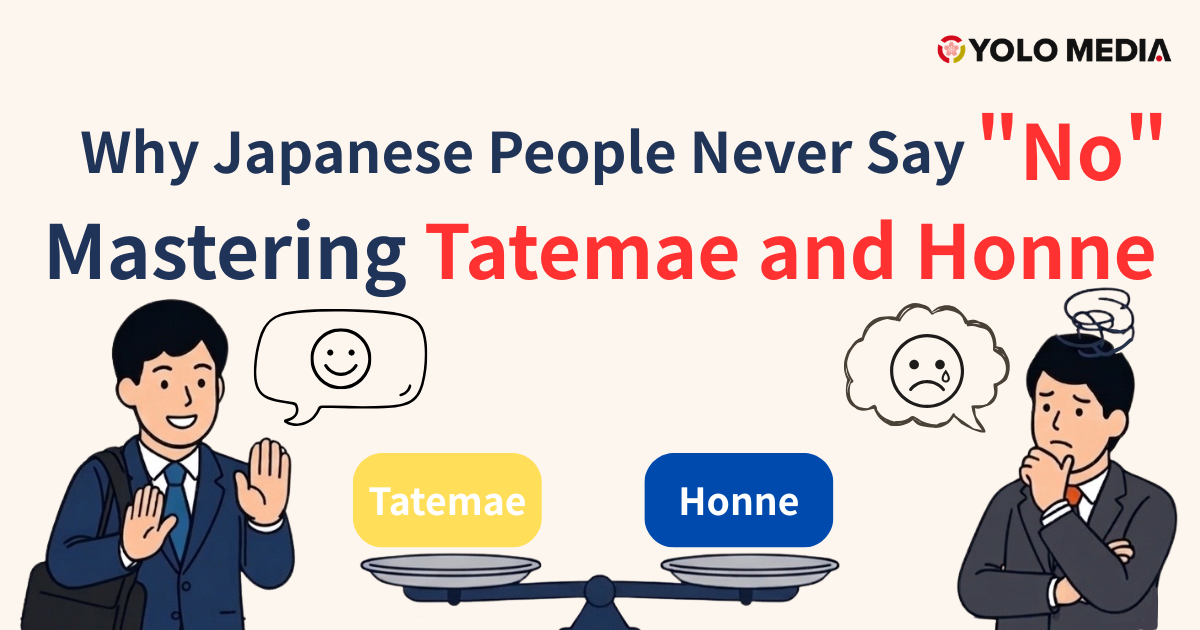
Welcome to the complex and fascinating world of Tatemae and Honne. Understanding these two concepts is the single most important key to unlocking Japanese communication. Once you master how they work, the mystery of \”What were they actually thinking?\” will finally start to clear up.

TL;DR
- Tatemae (建前) = Public face and words used to maintain social harmony (Wa).
- Honne (本音) = Your true feelings, private thoughts, and honest opinions.
- The \”No\” Rule: Japanese people rarely say \”No\” directly. \”It’s a bit difficult…\” often means \”Absolutely not.\”
- Reading the Air (Kuuki wo Yomu): Sensing the unspoken atmosphere and adapting your behavior accordingly.
- Goal: Using these concepts is not about \”lying\”—it’s a social skill to keep relationships smooth and respectful.
What are Tatemae and Honne?
Honne (本音) — The \”True Sound\”
Honne literally means \”true sound.\” It represents a person’s honest desires, private opinions, and raw feelings. It is the version of yourself you show only to your closest family and oldest friends.
Tatemae (建前) — The \”Built Front\”
Tatemae literally means \”built in front.\” It is the public facade, the \”polite version\” of your thoughts that you present to maintain social harmony (Wa). It ensures that no one is embarrassed, no feelings are hurt, and the group stays cohesive.
Why is this gap so important?
Japan is a high-context society where group harmony is valued above individual directness.
- *Maintaining Harmony (Wa)*: A direct \”No\” is seen as a social attack. Roundabout refusals are a way to protect the other person’s feelings.
- Reading Context: What isnt said is often more important than what is said.
- Saving Face: Both the speaker and the listener work together to avoid awkward or confrontational moments.
Real-Life Translation Dictionary
Let’s look at common \”Japanese-to-True-Feeling\” translations you’ll encounter in daily life.
In the Workplace
| What is Said (Tatemae) | What it Means (Honne) |
|---|---|
| \”That’s an interesting idea.\” | \”It’s not going to work, but I’m being polite.\” |
| \”It’s a bit difficult…\” (Chotto muzukashii) | \”No. Impossible. Forget it.\” |
| \”We’ll give it serious consideration.\” | \”We aren’t going to do it.\” |
| \”I’ll try my best.\” | \”I’m not confident/dont want to, but I have to say this.\” |
| \”I need to check with my boss.\” | \”I’m using my boss as an excuse to decline.\” |
In Social Settings
| What is Said (Tatemae) | What it Means (Honne) |
|---|---|
| \”I’ll come if I can!\” | \”I’m probably not coming, but I dont want to say no.\” |
| \”You dont need to bring anything!\” | \”Bringing a small gift (Omiyage) is expected.\” |
| \”Your Japanese is so good!\” | \”I appreciate you speaking Japanese (even if you’re a beginner).\” |
| \”Let’s grab a coffee sometime!\” | \”Goodbye\” (It’s a polite ending, not always a real plan). |
Real Experience: \”I once asked a Japanese friend if they liked my new shirt. They said, ‘Its very unique!’ I felt proud until I realized later that ‘unique’ is often a polite way to say ‘thats a bit much for me!’\”
Mastering the Art of \”Reading the Air\” (Kuuki wo Yomu)
One essential skill in Japan is sensing the unspoken atmosphere, called Kuuki wo Yomu (空気を読む), literally \”reading the air.\”
People who fail to do this are called KY (Kuuki Yomenai). Being labeled KY is a serious social critique in Japan, implying you are loud, disruptive, or socially unaware.
Tips for Reading the Unspoken
- Watch the \”Saa…\” sound: When a Japanese person inhales air through their teeth and says \”Saa…\”, its a huge red flag that they are uncomfortable or about to decline.
- The \”Tilt\”: If someone tilts their head while thinking, they are likely skeptical of your idea.
- The Eye Contact: Avoidance of eye contact during a request usually means \”Please stop asking.\”
Consensous Building: Nemawashi (根回し)
In Japanese business, major decisions arent made during meetings. They are finalized before the meeting starts through a process called Nemawashi.
Literally meaning \”digging around the roots\” (like preparing a tree for transplanting), Nemawashi involves talking to all key stakeholders individually and getting their \”Honne\” and approval behind the scenes. The actual meeting is just a formal ceremony to announce the decision everyone already agreed on.
How to Handle Tatemae as a Foreigner
You dont have to become a master of disguise, but following these three tips will save you a lot of stress:
- Accept \”Vague\” as \”No\”: If the answer isnt a clear \”Yes\” or a definite \”Okay!\”, just treat it as a polite \”No.\” Stop pushing for a clear answer; it only makes things more awkward.
- Dont force a direct \”Yes/No\”: Asking \”So, is it yes or no?\” in public puts a Japanese person on the spot. Instead, offer them a \”way out\” by saying, \”Its totally fine if its difficult for you to join.\”
- Wait for the Izakaya: True feelings (Honne) often come out after work over a few drinks. The \”Nomunication\” (Drinking + Communication) culture is where the walls come down.
FAQ
Q: Isnt Tatemae just lying?
A: In the Japanese context, no. Its considered a social lubricant. Like saying \”Fine\” when someone asks how you are, even if you are tired. In Japan, this courtesy is just applied to almost every social interaction to prevent friction.
Q: How do I know if someone is actually my friend?
A: When someone starts sharing their \”Honne\” with you—complaining about work, sharing personal worries, or being more direct—its a sign they trust you and consider you a close friend.
Q: Should I use Tatemae too?
A: Yes, especially in professional or formal settings. Using soft phrases like \”Ill try my best\” or \”It might be difficult\” instead of a flat \”I cant\” will make your life in Japan much smoother.
Key Takeaways
- ✅ Tatemae protects the \”Wa\” (Harmony). Use it to keep relationships smooth.
- ✅ \”Chotto…\” is a superpower word. Use it when you need to decline something politely.
Avoid being the person who ignores the mood of the room.
[!TIP]
If you want something done at work, talk to people individually before the big meeting.
[!TIP]
Honne is earned. Dont worry if people seem formal at first; its their way of showing respect.
By understanding these two layers of communication, you arent just learning a language—youre learning how to live in harmony with the people around you.