Last Updated: April 7, 2026
Reading Time: 12 min read
Introduction
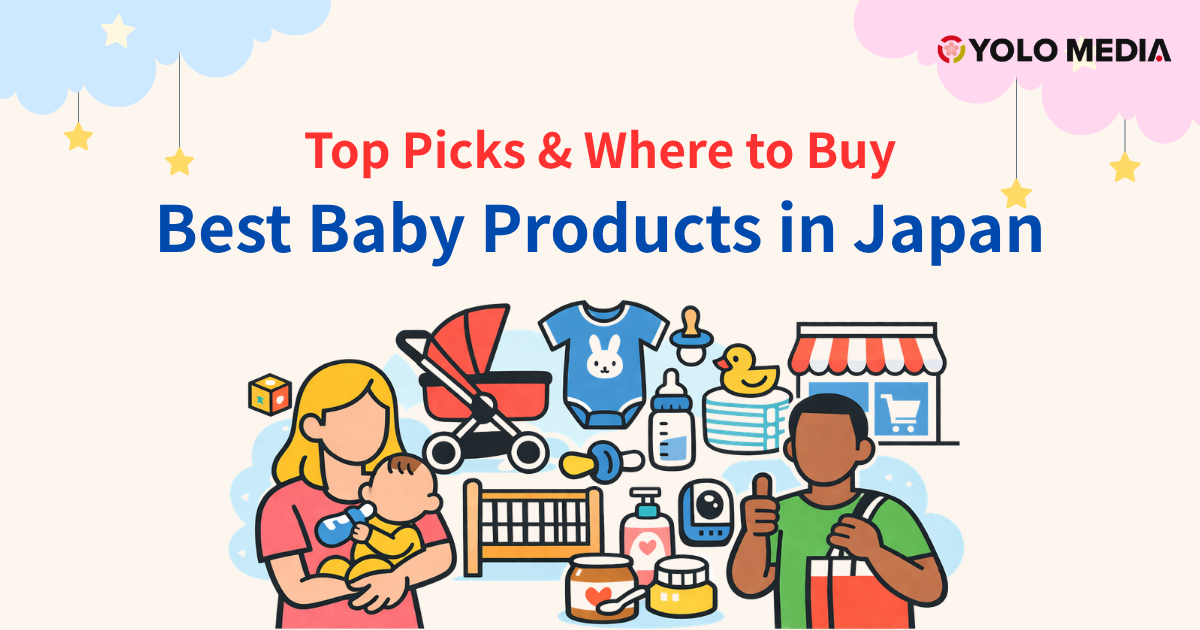
Welcoming a new baby in an unfamiliar country is exciting, but it also comes with a lot of anxiety. “Where should I buy baby products in Japan?” “Can I get that item I used back home here in Japan?” Many international parents find themselves staring at a maternity preparation list, wondering these exact things.
But don’t worry! Japanese baby products are internationally recognized for their high quality and thoughtful design. From diapers and skincare to revolutionary feeding products, Japan is brimming with safe and convenient items.
Based on the real-life experiences of expat parents living in Japan, this article provides a comprehensive guide covering the 2026 edition of truly ‘must-have’ items, how to smartly choose between popular shops, and even the surprising baby culture unique to Japan. Once you read this, your baby preparations in Japan will be perfect!
TL;DR
- Diapers and formula? Buy them in Japan: Merries, Pampers, and Meiji formula are world-class quality. No need to bring them from your home country.
- Use different shops for different needs: Akachan Honpo for selection, Nishimatsuya for budget, Uniqlo for baby undergarments.
- Watch out for sizing: Japanese baby clothes run small. For fast-growing babies, buy one size up or bring clothes from home.
- Take advantage of Japan’s ‘miracle items’: Electric nasal aspirators (Mercipot), cube-type formula, and belly bands dramatically make parenting easier.
- Choose compact designs: For Japan’s compact homes and train commutes, lightweight and slim strollers are the way to go.
Where to Buy Baby Products in Japan: Finding the Right Shops
First, let’s look at the big picture of where you should buy your baby items. In Japan, there are broadly three categories: “specialty stores with great selection,” “budget-friendly shops,” and “quality undergarment stores.”
How to Use Each Shop
To help you understand the Japanese baby shop landscape, here is a comparison of the major stores.
| Shop Name | Price Range | Selection | Best Used For |
|---|---|---|---|
| Akachan Honpo | Mid–High | ★★★★★ | Big-ticket items like strollers, gifts, one-stop initial birth preparation. Staff are very knowledgeable. |
| Nishimatsuya | Budget | ★★★☆☆ | Consumables, bulk-buying clothes for daycare. Best for cost-conscious shopping. |
| Uniqlo | Mid | ★☆☆☆☆ | The go-to for baby undergarments. Incredibly durable through washes, with thoughtful details like color-coded buttons. |
| Amazon / Rakuten | Discounted | ★★★★★ | Subscription deliveries for diapers and formula, heavy items delivered to your door. |
1. Akachan Honpo
The “you can’t go wrong starting here” baby specialty store and one of the largest in Japan.
Register on their app and enter your due date to receive a free sample bag (Pre-mama bag) and generous coupons.
2. Nishimatsuya
A powerful ally for your household budget. Babies soil their clothes instantly and outgrow them in months, so stocking up cheaply here is the smart move.
3. Uniqlo (Uniqlo Baby)
Among international residents in Japan, Uniqlo is so trusted that many say, “I wouldn’t even consider another brand for baby innerwear.” Their “Cotton Mesh Inner” series is an absolute must-have for Japan’s hot and humid summers.
For “big-ticket items you only use for a few months” like baby beds or newborn car seats, consider checking flea market apps like Mercari instead of buying new. You can often find items in pristine condition for less than half the retail price.
Recommended Baby Products in Japan by Category
Choosing items with “compactness” and “multi-functionality” in mind to fit the Japanese living environment is the key to avoiding mistakes.
1. Clothing & Diapers
The quality of Japanese *disposable diapers (kami-omutsu)* is the real deal.
- Merries: Highly praised for breathability and preventing diaper rash.
- Pampers Japan: An international brand, but the Japanese version is specially manufactured to be thinner with higher absorbency.
Japanese baby clothes run smaller (slimmer fit) compared to overseas sizes. Even if the listed size appears to match, a slightly chubby baby may feel cramped. When in doubt, buy one size larger.
2. Bath & Skincare
- Inflatable Baby Baths: Richell’s “Fukafuka Baby Bath” is a massive hit. You can deflate and fold it up after use, making it perfect for Japanese apartments with narrow bathrooms.
- *Pigeon Peach Leaf Lotion (Momo no Ha Lotion)*: A traditional Japanese solution for heat rash. Additive-free and gentle on skin, it is ideal for preventing skin irritation during the hot and humid season.
3. Feeding & Baby Food
Japanese feeding products are packed with thoughtful features that dramatically reduce parental stress.
- Meiji Hohoemi Raku Raku Cube Formula: Solid block-shaped formula cubes. No need to measure powder with a spoon; just pop them into the bottle. A revolutionary item for late-night feedings and outings. ¥1,800–¥2,000
(Reference: Meiji Hohoemi RakuRaku Cube)
- Pigeon “Bonyu Jikkan” Baby Bottles: The benchmark bottle adopted by an overwhelmingly high percentage of maternity hospitals in Japan. Thoroughly researched to minimize bottle refusal in babies. ¥2,000–¥3,000
(Reference: Pigeon Official Bonyu Jikkan Product Info)
- Wakodo Weaning Food Pouches: Walk into a drugstore, and you’ll find an entire wall of Japanese dashi (soup stock) based baby food. The type that comes with a disposable spoon is a must-have for outings, as you can pop the lid off anywhere to feed your baby and toss the container when done.
(Reference: Wakodo Baby Food Official Site)
4. Outing & Strollers
If you are using urban trains or buses, “lightness” is key.
- Lightweight Japanese Strollers: Japanese brands like Combi and Aprica focus on lightweight models under 5kg. They fold with one hand and have a slim width to pass through narrow station ticket gates.
- *Baby Carriers (dakko-himo)*: Ergobaby is a staple in Japan too, but recently fabric carriers like the Korean brand Konny have become a massive trend for being “light and not bulky.” Many parents own two: a sturdy one like Ergo and an ultra-lightweight fabric one.
Surprising Baby Culture: Unique Japanese Goods That Expat Parents Marvel At
If you walk through a Japanese baby product aisle, you will discover unique, convenient, and original items rarely seen in other countries.
Belly Bands (Haramaki)
When I first left the hospital in Japan, I was slightly bewildered when the midwife firmly reminded me, “Make sure to put a haramaki on them so their belly doesn’t get cold.” The belly band—a tube-like knitted cloth worn around the stomach—is the ultimate item born from Japanese grandmothers’ wisdom.
In Japan, it is strongly believed that “chilling the stomach causes colds,” so it’s normal to put a thin cotton haramaki on babies even in the summer. Convenient items like “pants with a built-in haramaki” are sold in massive quantities at stores like Nishimatsuya, and once you use them, you might not be able to let go of the convenience.
Electric Nose Aspirators (Mercipot)
When your baby catches a cold, gets a stuffed nose, and cries through the night without sleeping… it’s a truly heart-wrenching time for parents. For times like these, the electric nasal aspirator, represented by products like “Mercipot,” is widely used in Japanese households. While manual bulb syringes might be common overseas, during the period when kids catch colds almost every month at daycare (hoikuen), this machine that can quickly clear out the nasal cavity at home is heavily relied upon by many families. At around ¥10,000, it is not cheap, but it acts as a reassuring ally for the whole family to get a good night’s sleep, causing many to say, “I wish I bought this sooner!”
(Reference: Seastar Mercipot Official Site)
Non-contact Thermometers
The “non-contact thermometer,” which reads a baby’s temperature from their forehead in just one second, is an indispensable item for parenting in Japan. Products from reliable brands like OMRON and Pigeon are extremely popular. This is because Japan has a strong culture of making strict decisions based on temperature readings—such as “canceling a bath if there’s a fever” or “daycares refusing entry if the temperature hits 37.5°C (99.5°F).” During the chaotic morning rush to prepare for daycare, this item—which can instantly check the temperature without having to hold a screaming baby still—becomes an absolute necessity for parents in Japan.
(Reference: OMRON Healthcare Official Site)
What to Bring from Home: Must-Have Items
Japanese baby products are fantastic, but you can’t find everything domestically. Here are items you should secure when visiting your home country or by importing them online.
- Larger-Sized Clothes: As mentioned earlier, Japanese clothing has a slim fit. If you think, “My child might be on the larger side,” utilize online shops of Western apparel brands (like H&M or GAP) or bring a bunch from your home country.
- Specific Ethnic Skincare: Strong moisturizers intended for babies with darker skin tones, or dedicated hair care products for very curly hair textures, are nearly impossible to find in Japanese drugstores.
- Fever Reducers (Syrup instead of suppositories): At Japanese pediatricians, it is very common to be prescribed a “suppository (zayaku)” when a baby gets a fever. While you can ask them to change it by saying “I prefer powders or syrups,” having a stock of familiar syrup medicine from your home country (like Tylenol) will provide great mental peace during a sudden midnight fever.
Common Mistakes to Avoid
Here are two common “mistakes” that international parents starting to raise a child in Japan often fall into.
- Buying Newborn-Sized Diapers in Bulk
Japanese paper diapers are sometimes made slightly smaller than overseas ones. This is because Japanese babies are often born averaging around 3,000g. “I bought 3 packs of newborn diapers for my birth prep, but they outgrew them in 2 weeks and I couldn’t use them all” is a very common failure among expat moms. Start by preparing just 1 pack; if you need more, it is much wiser to buy them as needed at a nearby drugstore or online shop.
- Assuming You Can Breastfeed Anywhere
Unlike some parts of the West, the open culture of breastfeeding proudly on a café sofa or a park bench is not yet established in Japan. It is considered good manners to conceal it using “nursing wear” or a “nursing cape.”
But don’t be disappointed! Japanese shopping malls and train stations are fully equipped with free private nursing spaces called *nursing rooms (juryoshitsu) everywhere. They are so well-stocked they resemble five-star hotels, complete with hot water dispensers and hand-washing stations. Make it a habit to locate a juryoshitsu* via Google Maps when you go out.
FAQ
Q: Are there English-speaking staff at baby product stores in Japan?
A: Depending on the area (like central Tokyo) and the size of the store, there may be some staff who speak a little English, but customer service is generally Japanese-only. However, even if you can’t read the Japanese packaging, you can understand most uses by utilizing the camera function on Google Translate.
Q: Are Japanese baby products expensive?
A: When you consider the quality, everyday consumables like diapers and formula are quite affordable, even by global standards.
Q: Is it safe to buy secondhand baby products?
A: Japan’s secondhand market (like Mercari) is known for items being in exceptionally good condition. If you select “nearly unused” listings, you can get expensive items like strollers at a great price.
Key Takeaways
Uniqlo for innerwear, Nishimatsuya for consumables, Akachan Honpo for big-ticket items.
[!TIP]
Raku Raku Cube formula and the electric nasal aspirator will dramatically make parenting easier.
[!TIP]
Lightweight and slim is the way to go for Japan’s living environment.
[!TIP]
Embrace convenient Japanese items like belly bands and dashi-based baby food.
![Father’s Day Gift Budget in Japan: The Right Gift for Your Partner’s Dad [2026]](https://media.yolo-japan.com/wp-content/uploads/2026/06/fathers-day-japan-2026-en-768x432.webp)